Please answer the question neatly and clearly.
Be as detailed as possible. Show examples if necessary.
Dumb everything down.
Include visuals as well*

Homework Answers
Hey, in case of any doubt feel free to drop me a comment.
Add Answer to:
Please answer the question neatly and clearly.
Be as detailed as possible. Show examples if
necessary. ...
Five kg of water is contained in a piston–cylinder assembly, initially at 5 bar and 200°C....
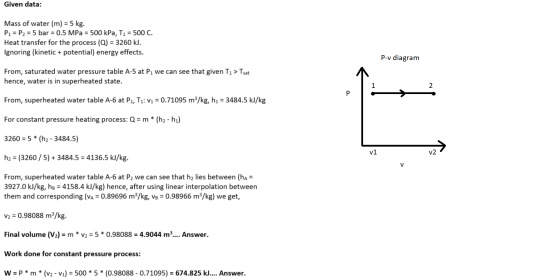
Five kg of water is contained in a piston–cylinder assembly, initially at 5 bar and 200°C. The water is slowly heated at constant pressure to a final state. The heat transfer for the process is 3260 kJ and kinetic and potential energy effects are negligible. Determine the final volume, in m3, and the work for the process, in kJ.
Please answer the question neatly and clearly. Be as detailed as possible. Show examples if necessary. ...
 Please answer the question neatly and clearly.
Be as detailed as possible. Show examples if
necessary.
Dumb everything down.
Include visuals as well*
When designing an automated assembly process, which of the following is NOT a guideline that should be followed? Use modularity in the part design O Minimize threaded fasteners Use low quality parts for the most economic process possible Do not select this answer.
Please answer the question neatly and clearly.
Be as detailed as possible. Show examples if
necessary.
Dumb everything down.
Include visuals as well*
When designing an automated assembly process, which of the following is NOT a guideline that should be followed? Use modularity in the part design O Minimize threaded fasteners Use low quality parts for the most economic process possible Do not select this answer.
Five kg of water is contained in a piston–cylinder assembly, initially at 5 bar and 360°C....
Five kg of water is contained in a piston–cylinder assembly, initially at 5 bar and 360°C. The water is slowly heated at constant pressure to a final state. The heat transfer for the process is 2960 kJ and kinetic and potential energy effects are negligible. Determine the final volume, in m3, and the work for the process, in kJ.
Please answer the question neatly and clearly. Be as detailed as possible. Show examples if necessary. ...
 Please answer the question neatly and clearly.
Be as detailed as possible. Show examples if
necessary.
Dumb everything down.
Include visuals as well*
Which of the following fasteners is used to fasten collars, gears, and pulleys to shafts? O Setscrew Screw thread insert O Rivet O Bolt Which of the following is NOT a failure method of bolts? Stripping external threads O Stripping internal threads O Excessive tensile stresses on cross-sectional area O All of the above are failure methods...
Please answer the question neatly and clearly.
Be as detailed as possible. Show examples if
necessary.
Dumb everything down.
Include visuals as well*
Which of the following fasteners is used to fasten collars, gears, and pulleys to shafts? O Setscrew Screw thread insert O Rivet O Bolt Which of the following is NOT a failure method of bolts? Stripping external threads O Stripping internal threads O Excessive tensile stresses on cross-sectional area O All of the above are failure methods...
Please answer the question neatly and clearly. Be as detailed as possible. Show examples if necessary. ...
 Please answer the question neatly and clearly.
Be as detailed as possible. Show examples if
necessary.
Dumb everything down.
Include visuals as well*
Which of the following is NOT a method of applying flux? O pouring granular flux onto the joint melting stick electrode flux coating during the operation o deliver flux to the joint via a tube O All of the above are methods of applying flux Which is NOT a benefit of using flux in welding? O Provides...
Please answer the question neatly and clearly.
Be as detailed as possible. Show examples if
necessary.
Dumb everything down.
Include visuals as well*
Which of the following is NOT a method of applying flux? O pouring granular flux onto the joint melting stick electrode flux coating during the operation o deliver flux to the joint via a tube O All of the above are methods of applying flux Which is NOT a benefit of using flux in welding? O Provides...
Problem 3.050 SI Five kg of water is contained in a piston-cylinder assembly, initially at 5...
 Problem 3.050 SI Five kg of water is contained in a piston-cylinder assembly, initially at 5 bar and 500°C. The water is slowly heated at constant pressure to a final state. The heat transfer for the process is 2960 kJ and kinetic and potential energy effects are negligible. Determine the final volume, in m3, and the work for the process, in k. Step X Your answer is incorrect. Try again. Determine the final volume, in m3 v, = 1320.328 m3...
Answer: W/m=20.94kJ/kg Q/m=1705 kJ/kg Applying the Energy Balance Referring to Fig. P3.71, water contained in a...
 Answer: W/m=20.94kJ/kg
Q/m=1705 kJ/kg
Applying the Energy Balance Referring to Fig. P3.71, water contained in a piston-cylinder assembly, initially at 1.5 bar and a quality of 20%, is heated at constant pressure until the piston hits the stops. Heating then continues until the water is saturated vapor. Show the processes of the water in series on a sketch of the 7-vdiagram. For the overall process of the water, evaluate the work and heat transfer, each in kJ/kg. Kinetic and potential...
Answer: W/m=20.94kJ/kg
Q/m=1705 kJ/kg
Applying the Energy Balance Referring to Fig. P3.71, water contained in a piston-cylinder assembly, initially at 1.5 bar and a quality of 20%, is heated at constant pressure until the piston hits the stops. Heating then continues until the water is saturated vapor. Show the processes of the water in series on a sketch of the 7-vdiagram. For the overall process of the water, evaluate the work and heat transfer, each in kJ/kg. Kinetic and potential...
Question 1 A piston-cylinder assembly contains 3.2 kg of water at 211.9oC and 3 bar. The...
Question 1 A piston-cylinder assembly contains 3.2 kg of water at 211.9oC and 3 bar. The water is compressed to a saturated vapor state where the pressure is 51.5 bar. During compression, there is a heat transfer of energy from the water to its surroundings having a magnitude of 230 kJ. Neglecting changes in kinetic energy and potential energy, determine the work, in kJ, for the process of the water. Question 2 Water, initially saturated vapor at 10.2 bar, fills...
Referring to the figure shown below, water contained in a piston–cylinder assembly, initially at 1.5 bar...
Referring to the figure shown below, water contained in a piston–cylinder assembly, initially at 1.5 bar and a quality of 60%, is heated at constant pressure until the piston hits the stops. Heating then continues until the water is saturated vapor. The initial height, L1, is 0.05 m and the change in height, L2, is 0.03 m. For the overall process of the water, evaluate the work and heat transfer, each in kJ/kg. Kinetic and potential effects are negligible.
finding work and heat transfer given a piston-cylinder assembly
 As shown in Fig. P2.56, a gas contained within a piston–cylinder assembly, initially at a volume of 0.1 m3, undergoesa constant-pressure expansion at 2 bar to a final volume of0.12 m3, while being slowly heated through the base. Thechange in internal energy of the gas is 0.25 kJ. The pistonand cylinder walls are fabricated from heat-resistant material,and the piston moves smoothly in the cylinder. The localatmospheric pressure is 1 bar.(a) For the gas as the system, evaluate work and heat...
 Please answer the question neatly and clearly.
Be as detailed as possible. Show examples if
necessary.
Dumb everything down.
Include visuals as well*
When designing an automated assembly process, which of the following is NOT a guideline that should be followed? Use modularity in the part design O Minimize threaded fasteners Use low quality parts for the most economic process possible Do not select this answer.
Please answer the question neatly and clearly.
Be as detailed as possible. Show examples if
necessary.
Dumb everything down.
Include visuals as well*
When designing an automated assembly process, which of the following is NOT a guideline that should be followed? Use modularity in the part design O Minimize threaded fasteners Use low quality parts for the most economic process possible Do not select this answer.
 Please answer the question neatly and clearly.
Be as detailed as possible. Show examples if
necessary.
Dumb everything down.
Include visuals as well*
Which of the following fasteners is used to fasten collars, gears, and pulleys to shafts? O Setscrew Screw thread insert O Rivet O Bolt Which of the following is NOT a failure method of bolts? Stripping external threads O Stripping internal threads O Excessive tensile stresses on cross-sectional area O All of the above are failure methods...
Please answer the question neatly and clearly.
Be as detailed as possible. Show examples if
necessary.
Dumb everything down.
Include visuals as well*
Which of the following fasteners is used to fasten collars, gears, and pulleys to shafts? O Setscrew Screw thread insert O Rivet O Bolt Which of the following is NOT a failure method of bolts? Stripping external threads O Stripping internal threads O Excessive tensile stresses on cross-sectional area O All of the above are failure methods...
 Please answer the question neatly and clearly.
Be as detailed as possible. Show examples if
necessary.
Dumb everything down.
Include visuals as well*
Which of the following is NOT a method of applying flux? O pouring granular flux onto the joint melting stick electrode flux coating during the operation o deliver flux to the joint via a tube O All of the above are methods of applying flux Which is NOT a benefit of using flux in welding? O Provides...
Please answer the question neatly and clearly.
Be as detailed as possible. Show examples if
necessary.
Dumb everything down.
Include visuals as well*
Which of the following is NOT a method of applying flux? O pouring granular flux onto the joint melting stick electrode flux coating during the operation o deliver flux to the joint via a tube O All of the above are methods of applying flux Which is NOT a benefit of using flux in welding? O Provides...
 Problem 3.050 SI Five kg of water is contained in a piston-cylinder assembly, initially at 5 bar and 500°C. The water is slowly heated at constant pressure to a final state. The heat transfer for the process is 2960 kJ and kinetic and potential energy effects are negligible. Determine the final volume, in m3, and the work for the process, in k. Step X Your answer is incorrect. Try again. Determine the final volume, in m3 v, = 1320.328 m3...
 Answer: W/m=20.94kJ/kg
Q/m=1705 kJ/kg
Applying the Energy Balance Referring to Fig. P3.71, water contained in a piston-cylinder assembly, initially at 1.5 bar and a quality of 20%, is heated at constant pressure until the piston hits the stops. Heating then continues until the water is saturated vapor. Show the processes of the water in series on a sketch of the 7-vdiagram. For the overall process of the water, evaluate the work and heat transfer, each in kJ/kg. Kinetic and potential...
Answer: W/m=20.94kJ/kg
Q/m=1705 kJ/kg
Applying the Energy Balance Referring to Fig. P3.71, water contained in a piston-cylinder assembly, initially at 1.5 bar and a quality of 20%, is heated at constant pressure until the piston hits the stops. Heating then continues until the water is saturated vapor. Show the processes of the water in series on a sketch of the 7-vdiagram. For the overall process of the water, evaluate the work and heat transfer, each in kJ/kg. Kinetic and potential...
Most questions answered within 3 hours.
-
Where is the error in this code sequence?
String s1 = "Hello";
String s2 = "ello";...
asked 10 months ago -
Financial data for Joel de Paris, Inc., for last year
follow:
Joel de Paris, Inc.
Balance...
asked 10 months ago -
Consider this reaction:
Al2(SO4)3 (aq)+ BaCl3
(aq) Al2Cl6 (aq)- +
3BaSO4(s) . What is the...
asked 10 months ago -
Suppose that Savneet is considering increasing her
recent random sample from 20 car rentals to 40...
asked 10 months ago -
Trucks arrive at an unloading terminal at an average rate of 120
per hour.
Trucks arrive...
asked 10 months ago -
Why are methanol and ethanol completely soluble in water while
octanol is not very little soluble....
asked 10 months ago -
A facilities manager at a university reads in a research report
that the mean amount of...
asked 10 months ago -
When the CuSO4 is rehydrated by adding water to the anhydrous
compound, is this an endothermic...
asked 10 months ago -
A ray of sunlight is passing from diamond into crown glass; the
angle of incidence is...
asked 10 months ago -
A block of mass 0.249 kg is placed on top of a light, vertical
spring of...
asked 10 months ago -
how do the kidneys compensate in the presences of acidosis
a) trigger hyperventilate
b) reserve acid...
asked 10 months ago -
Question 501 pts
The rental rate of capital to the firm increases. Which of the
following...
asked 10 months ago