Consider the following undirected weighted graph where you want to find a path from A to...
 Consider the following undirected weighted graph where
you want to find a path from A to G.
              A
            /   \
           B --- C
            \   /  \
              G --- H
Weights (costs) of the edges are
W(AB) = 1; W(AC) = 3; W(BC) = 1; W(BG) = 9; W(CG) = 5; W(CH) = 2;
W(GH) = 1,
and the heuristic estimates (h(n)) to the goal node, G, are
h(A) = 5, h(B) = 4, h(C) = 1, h(G) = 0, h(H) = 1.

Simulate A* search. At each step, show the path to the node that is being
expanded, the length of that path, the total estimated cost (actual + heuristic)
and the expanded list of nodes (all nodes visited so far in the order in which
they were visited). Provide the answer in the following table.

Path to node expanded   Length of Path   Total Estimated Cost   Expanded list

         A                    0                  5                   (A)

....... finish the table as suggested.

Is the given h(n) function an admissible heuristic? Explain.
Homework Answers
for admissible heuristic,
h(n) is admissible for all n i.e.
h(n)<=h*(n)
h*(n) is the actual cost.here the actual cost is 7.while h(n) is i.e h(A) is 5
hence 5<7.hence it is admissible.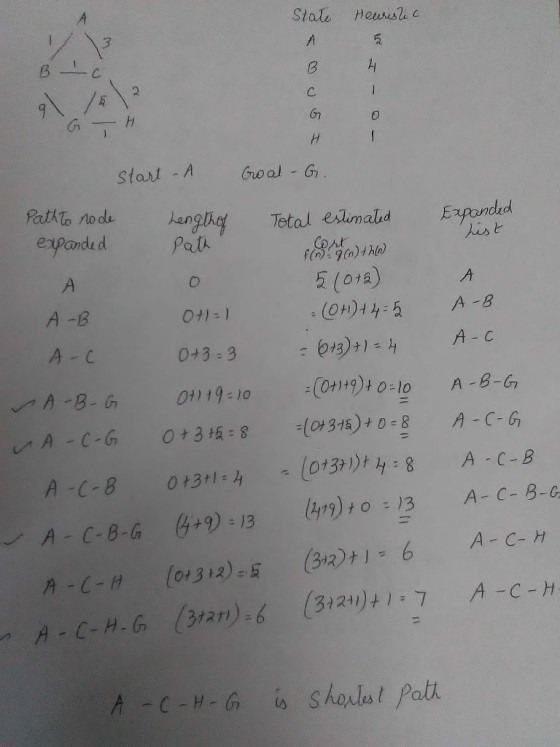
Add Answer to:
Consider the following undirected weighted graph where
you want to find a path from A to...
We now consider undirected graphs. Recall that such a graph is • connected iff for all...
We now consider undirected graphs. Recall that such a graph is • connected iff for all pairs of nodes u, w, there is a path of edges between u and w; • acyclic iff for all pairs of nodes u, w, whenever there is an edge between u and w then there is no path Given an acyclic undirected graph G with n nodes (where n ≥ 1) and a edges, your task is to prove that a ≤ n...
Dijkstra's algorithm QUESTION 2 Consider the following weighted undirected graph: 10 We would like to find...
 Dijkstra's algorithm
QUESTION 2 Consider the following weighted undirected graph: 10 We would like to find the shortest path from the node A to each other node. 1) What is the order in which nodes will be processed, using Dijkstra's algorithm? 2) What is the final found shortest path from A to each node? A.d = 0 B.d = C.d = D.d = E.d = F.d = G.d = H.d = I.d = 2.
Dijkstra's algorithm
QUESTION 2 Consider the following weighted undirected graph: 10 We would like to find the shortest path from the node A to each other node. 1) What is the order in which nodes will be processed, using Dijkstra's algorithm? 2) What is the final found shortest path from A to each node? A.d = 0 B.d = C.d = D.d = E.d = F.d = G.d = H.d = I.d = 2.
Instructions Write a program in Java that implements the A* algorithm to find a path from...
Instructions Write a program in Java that implements the A* algorithm to find a path from any two given nodes. Problem Overview & Algorithm Description In a fully-observable environment where there are both pathable and blocked nodes, an agent must find a good path from their starting node to the goal node. The agent must use the A* algorithm to determine its path. For this program, you must use the Manhattan method for calculating the heuristic. Remember: your heuristic function...
Consider the width search algorithm from a start node s. The diameter of an undirected, contiguous...
Consider the width search algorithm from a start node s. The diameter of an undirected, contiguous Graph G = (V, E) is defined as the maximum over all node pairs v, w ∈ V of the length of the shortest path from v to w. We assume that each edge has the length of 1. Specify an extension of the width search algorithm in pseudo code that has the diameter of an undirected graph G = (V, E). First explain...
Q1: Here we consider finding the length of the shortest path between all pairs of nodes...
Q1: Here we consider finding the length of the shortest path between all pairs of nodes in an undirected, weighted graph G. For simplicity, assume that the n nodes are labeled 1; 2; : : : ; n, that the weight wij of any edge e = (i; j) is positive and that there is an edge between every pair of nodes. In this question, the goal is to solve this via dynamic programming. Note that the algorithm you will...
Input a simple undirected weighted graph G with non-negative edge weights (represented by w), and a...
 Input a simple undirected weighted graph G with non-negative edge weights (represented by w), and a source node v of G. Output: TDB. D: a vector indexed by the vertices of G. Q: priority queue containing the vertices of G using D[] as key D[v]=0; for (all vertex ut-v) [D[u]-infinity:) while not Q. empty() 11 Q is not empty fu - Q.removein(); // retrieve a vertex of Q with min D value for (all vertex : adjacent to u such...
Have the explaination please. 4 Graph Application: Network Connectivity (Adapted from Problem 9, Chapter 3 of...
 Have the explaination please.
4 Graph Application: Network Connectivity (Adapted from Problem 9, Chapter 3 of K&T) Think of a communications network as a connected, undi rected graph, where messages from one node s to another node t are sent along paths from s to t. Nodes can sometimes fail. If a node v fails then no messages can be sent along edges incident on v. A network is particularly vulnerable if failure of a single node v can cause...
Have the explaination please.
4 Graph Application: Network Connectivity (Adapted from Problem 9, Chapter 3 of K&T) Think of a communications network as a connected, undi rected graph, where messages from one node s to another node t are sent along paths from s to t. Nodes can sometimes fail. If a node v fails then no messages can be sent along edges incident on v. A network is particularly vulnerable if failure of a single node v can cause...
PROMPT: Consider a graph G. A connected component is a maximal subset of nodes that induces a connected sub graph. It’s maximal in the sense that you cannot add a node with the resulting induced sub g...
 PROMPT:
Consider a graph G. A connected component is a maximal subset of
nodes that induces a connected sub graph. It’s maximal in the sense
that you cannot add a node with the resulting induced sub graph
remaining connected.The following function
numComponents returns the number of connected
components in an undirected graph.
QUESTION:
What is the time complexity for this function? The time
complexity should be a function of the number of nodes |V| and the
number of edges |E|....
PROMPT:
Consider a graph G. A connected component is a maximal subset of
nodes that induces a connected sub graph. It’s maximal in the sense
that you cannot add a node with the resulting induced sub graph
remaining connected.The following function
numComponents returns the number of connected
components in an undirected graph.
QUESTION:
What is the time complexity for this function? The time
complexity should be a function of the number of nodes |V| and the
number of edges |E|....
Shortest Path (DAG) Students, In this coding assignment, you will be asked to write Java code...
Shortest Path (DAG) Students, In this coding assignment, you will be asked to write Java code to read a text file (input.txt) of a graph represented as an adjacency list. Example: A, 7, B, 9, C B, 1, C C, 8, E, 2, F D, 1, E, 3, G E, 3, G F, 3, D, -3, H H, 6, G K, 3, H, -1, F The graph represented by the adjacency list above looks like this: The graph is a...
1) Consider the directed graph below. “S” is the start state and “G1,G2,G3” are 3 goal...
1) Consider the directed graph below. “S” is the start state and “G1,G2,G3” are 3 goal states. In traversing the graph one can move only in the direction indicated by the arrows. The numbers on the edges indicate the step-cost for traversing that edge. The numbers in the nodes represent the estimated cost to the nearest goal state. In the following you will be asked to search this graph using various search strategies. When you work out your answer, please...
 Dijkstra's algorithm
QUESTION 2 Consider the following weighted undirected graph: 10 We would like to find the shortest path from the node A to each other node. 1) What is the order in which nodes will be processed, using Dijkstra's algorithm? 2) What is the final found shortest path from A to each node? A.d = 0 B.d = C.d = D.d = E.d = F.d = G.d = H.d = I.d = 2.
Dijkstra's algorithm
QUESTION 2 Consider the following weighted undirected graph: 10 We would like to find the shortest path from the node A to each other node. 1) What is the order in which nodes will be processed, using Dijkstra's algorithm? 2) What is the final found shortest path from A to each node? A.d = 0 B.d = C.d = D.d = E.d = F.d = G.d = H.d = I.d = 2.
 Input a simple undirected weighted graph G with non-negative edge weights (represented by w), and a source node v of G. Output: TDB. D: a vector indexed by the vertices of G. Q: priority queue containing the vertices of G using D[] as key D[v]=0; for (all vertex ut-v) [D[u]-infinity:) while not Q. empty() 11 Q is not empty fu - Q.removein(); // retrieve a vertex of Q with min D value for (all vertex : adjacent to u such...
 Have the explaination please.
4 Graph Application: Network Connectivity (Adapted from Problem 9, Chapter 3 of K&T) Think of a communications network as a connected, undi rected graph, where messages from one node s to another node t are sent along paths from s to t. Nodes can sometimes fail. If a node v fails then no messages can be sent along edges incident on v. A network is particularly vulnerable if failure of a single node v can cause...
Have the explaination please.
4 Graph Application: Network Connectivity (Adapted from Problem 9, Chapter 3 of K&T) Think of a communications network as a connected, undi rected graph, where messages from one node s to another node t are sent along paths from s to t. Nodes can sometimes fail. If a node v fails then no messages can be sent along edges incident on v. A network is particularly vulnerable if failure of a single node v can cause...
 PROMPT:
Consider a graph G. A connected component is a maximal subset of
nodes that induces a connected sub graph. It’s maximal in the sense
that you cannot add a node with the resulting induced sub graph
remaining connected.The following function
numComponents returns the number of connected
components in an undirected graph.
QUESTION:
What is the time complexity for this function? The time
complexity should be a function of the number of nodes |V| and the
number of edges |E|....
PROMPT:
Consider a graph G. A connected component is a maximal subset of
nodes that induces a connected sub graph. It’s maximal in the sense
that you cannot add a node with the resulting induced sub graph
remaining connected.The following function
numComponents returns the number of connected
components in an undirected graph.
QUESTION:
What is the time complexity for this function? The time
complexity should be a function of the number of nodes |V| and the
number of edges |E|....
Most questions answered within 3 hours.
-
Where is the error in this code sequence?
String s1 = "Hello";
String s2 = "ello";...
asked 10 months ago -
Financial data for Joel de Paris, Inc., for last year
follow:
Joel de Paris, Inc.
Balance...
asked 10 months ago -
Consider this reaction:
Al2(SO4)3 (aq)+ BaCl3
(aq) Al2Cl6 (aq)- +
3BaSO4(s) . What is the...
asked 10 months ago -
Suppose that Savneet is considering increasing her
recent random sample from 20 car rentals to 40...
asked 10 months ago -
Trucks arrive at an unloading terminal at an average rate of 120
per hour.
Trucks arrive...
asked 10 months ago -
Why are methanol and ethanol completely soluble in water while
octanol is not very little soluble....
asked 10 months ago -
A facilities manager at a university reads in a research report
that the mean amount of...
asked 10 months ago -
When the CuSO4 is rehydrated by adding water to the anhydrous
compound, is this an endothermic...
asked 10 months ago -
A ray of sunlight is passing from diamond into crown glass; the
angle of incidence is...
asked 10 months ago -
A block of mass 0.249 kg is placed on top of a light, vertical
spring of...
asked 10 months ago -
how do the kidneys compensate in the presences of acidosis
a) trigger hyperventilate
b) reserve acid...
asked 10 months ago -
Question 501 pts
The rental rate of capital to the firm increases. Which of the
following...
asked 10 months ago