
Homework Answers

Add Answer to:
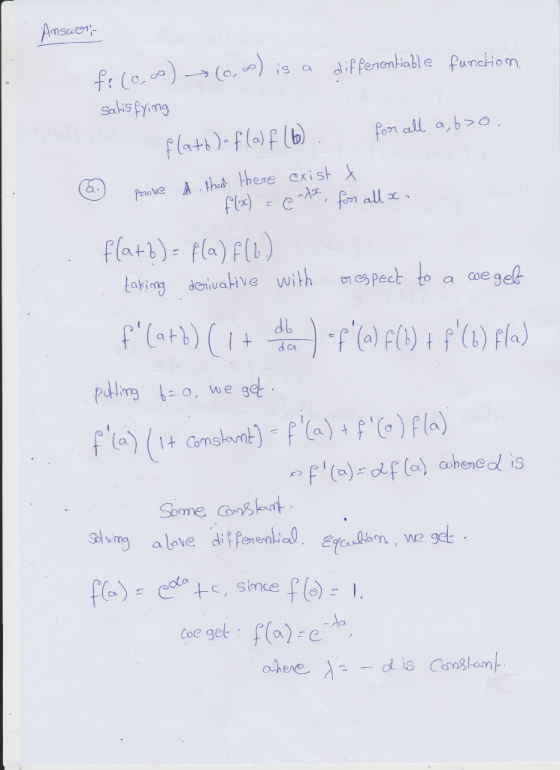
4 Suppose f : (0,0) → (0,x), is a differentiable function satisfying f(a +b)-f(a)fb), for all...
3. (a) Suppose f : (a, b) + R is differentiable, and there exists M E...
 3. (a) Suppose f : (a, b) + R is differentiable, and there exists M E R such that If'(x) < M for all x € (a, b). Prove that f is uniformly continuous on (a, b). (b) Let f : [0, 1] → [0, 1] be a continuous function. Prove that there exists a point pe [0, 1] with f(p) = p.
2. Let f: R R be a continuous function. Suppose that f is differentiable on R\{0} and that there exists an L e R such that lim,of,(z) = L. Prove that f is differentiable at 1-0 with f,(0) = L. (Hint:...
 2. Let f: R R be a continuous function. Suppose that f is differentiable on R\{0} and that there exists an L e R such that lim,of,(z) = L. Prove that f is differentiable at 1-0 with f,(0) = L. (Hint: Use the definition of derivative and then use mean value theorem)
2. Let f: R R be a continuous function. Suppose that f is differentiable on R\{0} and that there exists an L e R such that lim,of,(z) =...
2. Let f: R R be a continuous function. Suppose that f is differentiable on R\{0} and that there exists an L e R such that lim,of,(z) = L. Prove that f is differentiable at 1-0 with f,(0) = L. (Hint: Use the definition of derivative and then use mean value theorem)
2. Let f: R R be a continuous function. Suppose that f is differentiable on R\{0} and that there exists an L e R such that lim,of,(z) =...
For each n E N, define a function fn A - R. Suppose that each function fn is uniformly continuous. Moreover, suppose there is a function f : A R such that for all є 0, there exists a N, and for all x...
 For each n E N, define a function fn A - R. Suppose that each function fn is uniformly continuous. Moreover, suppose there is a function f : A R such that for all є 0, there exists a N, and for all x E A, we have lÍs(x)-f(x)|く for all n > N. Then f is uniformly continuous. Note: We could say that the "sequence of functions" f "converges to the function" f. These are not defined terms for...
Q3 (Prove that P∞ k=1 1/kr < ∞ if r > 1) . Let f : (0,∞) → R be a twice differentiable function with f ''(x) ≥ 0 for all x ∈ (0,∞). (a) Show that f '(k) ≤ f(k + 1) − f(k) ≤ f '(...
 Q3 (Prove that P∞ k=1 1/kr < ∞ if r > 1) . Let
f : (0,∞) → R be a twice differentiable function with f ''(x) ≥ 0
for all x ∈ (0,∞).
(a) Show that f '(k) ≤ f(k + 1) − f(k) ≤ f '(k + 1) for all k ∈
N.
(b) Use (a), show that Xn−1 k=1 f '(k) ≤ f(n) − f(1) ≤ Xn k=2 f
'(k).
(c) Let r > 1. By finding...
Q3 (Prove that P∞ k=1 1/kr < ∞ if r > 1) . Let
f : (0,∞) → R be a twice differentiable function with f ''(x) ≥ 0
for all x ∈ (0,∞).
(a) Show that f '(k) ≤ f(k + 1) − f(k) ≤ f '(k + 1) for all k ∈
N.
(b) Use (a), show that Xn−1 k=1 f '(k) ≤ f(n) − f(1) ≤ Xn k=2 f
'(k).
(c) Let r > 1. By finding...
Suppose f is a continuous and differentiable function on [0,1] and f(0)= f(1). Let a E...
 Suppose f is a continuous and differentiable function on [0,1] and f(0)= f(1). Let a E (0, 1). Suppose Vr,y(0,1) IF f'(x) 0 and f'(y) ±0 THEN f'(x) af'(y) Show that there is exactly f(ax) and f'(x) 0 such that f(x) one Hint: Suppose f(x) is a continuous function on [0, 1] and f(0) x € (0, 1) such that f(x) = f(ax) f(1). Let a e (0,1), there exists an
Suppose f is a continuous and differentiable function on...
Suppose f is a continuous and differentiable function on [0,1] and f(0)= f(1). Let a E (0, 1). Suppose Vr,y(0,1) IF f'(x) 0 and f'(y) ±0 THEN f'(x) af'(y) Show that there is exactly f(ax) and f'(x) 0 such that f(x) one Hint: Suppose f(x) is a continuous function on [0, 1] and f(0) x € (0, 1) such that f(x) = f(ax) f(1). Let a e (0,1), there exists an
Suppose f is a continuous and differentiable function on...
differentiable function and there exists 0 <A < 1 (6) Suppose that f : R" -> R" is a such that |f'...
 differentiable function and there exists 0 <A < 1 (6) Suppose that f : R" -> R" is a such that |f'(x)|< A, for all x E R". Prove that the function F(x)= x - f(x) maps R" one-to-one and onto R". (Suggestion: Use the Contraction Mapping Principle Why not use the Inverse Function Theorem?)
differentiable function and there exists 0
differentiable function and there exists 0 <A < 1 (6) Suppose that f : R" -> R" is a such that |f'(x)|< A, for all x E R". Prove that the function F(x)= x - f(x) maps R" one-to-one and onto R". (Suggestion: Use the Contraction Mapping Principle Why not use the Inverse Function Theorem?)
differentiable function and there exists 0
4. (a) Suppose that limz-c f(x) = L > 0. Prove that there exists a 8...
 4. (a) Suppose that limz-c f(x) = L > 0. Prove that there exists a 8 >0 such that if 0 < 12 – c < 8, then f(x) > 0. (b) Use Part (a) and the Heine-Borel Theorem to prove that if is continuous on (a, b) and f(x) > 0 for all x € (a, b), then there exists an e > 0 such that f(x) > € for all x € [a, b].
(0, 1) given by f (x) - sin (). Is f Let f b e the...
 (0, 1) given by f (x) - sin (). Is f Let f b e the function t on the domain uniformly continuous? Explain. (You may take it as given that sin is a continuous function) Suppose that f [0, oo) -R is a continuous function, and suppose also that lim, ->oo f (x)- 0. Prove that f is uniformly continuous Just to be clear: to say that lim,->o f (x) - 0 means that
6.59. Let f be a continuous function on [a, b]. Suppose that there exists a positive...
 6.59. Let f be a continuous function on [a, b]. Suppose that there exists a positive constant K such that If(x) <K for all x in [a, b]. Prove that f(x) = 0 for all x in [a, b]. *ſ isoidi,
Suppose that f is bounded on a, b and that for any cE (a, b), f...
 Suppose that f is bounded on a, b and that for any cE (a, b), f is integrable on [c, b (a) Prove that for every e> 0, there exists CE (a, b) so that f(x)(c-a) < € for all x [a,b]. (b) For any > 0, find a partition P of [a, b so that U,P)-J f(r)dz < j and s f(r)dz L(f, P) < Hint: Do this by choosing c carefully and extending a partition of [c, b...
 3. (a) Suppose f : (a, b) + R is differentiable, and there exists M E R such that If'(x) < M for all x € (a, b). Prove that f is uniformly continuous on (a, b). (b) Let f : [0, 1] → [0, 1] be a continuous function. Prove that there exists a point pe [0, 1] with f(p) = p.
 2. Let f: R R be a continuous function. Suppose that f is differentiable on R\{0} and that there exists an L e R such that lim,of,(z) = L. Prove that f is differentiable at 1-0 with f,(0) = L. (Hint: Use the definition of derivative and then use mean value theorem)
2. Let f: R R be a continuous function. Suppose that f is differentiable on R\{0} and that there exists an L e R such that lim,of,(z) =...
2. Let f: R R be a continuous function. Suppose that f is differentiable on R\{0} and that there exists an L e R such that lim,of,(z) = L. Prove that f is differentiable at 1-0 with f,(0) = L. (Hint: Use the definition of derivative and then use mean value theorem)
2. Let f: R R be a continuous function. Suppose that f is differentiable on R\{0} and that there exists an L e R such that lim,of,(z) =...
 For each n E N, define a function fn A - R. Suppose that each function fn is uniformly continuous. Moreover, suppose there is a function f : A R such that for all є 0, there exists a N, and for all x E A, we have lÍs(x)-f(x)|く for all n > N. Then f is uniformly continuous. Note: We could say that the "sequence of functions" f "converges to the function" f. These are not defined terms for...
 Q3 (Prove that P∞ k=1 1/kr < ∞ if r > 1) . Let
f : (0,∞) → R be a twice differentiable function with f ''(x) ≥ 0
for all x ∈ (0,∞).
(a) Show that f '(k) ≤ f(k + 1) − f(k) ≤ f '(k + 1) for all k ∈
N.
(b) Use (a), show that Xn−1 k=1 f '(k) ≤ f(n) − f(1) ≤ Xn k=2 f
'(k).
(c) Let r > 1. By finding...
Q3 (Prove that P∞ k=1 1/kr < ∞ if r > 1) . Let
f : (0,∞) → R be a twice differentiable function with f ''(x) ≥ 0
for all x ∈ (0,∞).
(a) Show that f '(k) ≤ f(k + 1) − f(k) ≤ f '(k + 1) for all k ∈
N.
(b) Use (a), show that Xn−1 k=1 f '(k) ≤ f(n) − f(1) ≤ Xn k=2 f
'(k).
(c) Let r > 1. By finding...
 Suppose f is a continuous and differentiable function on [0,1] and f(0)= f(1). Let a E (0, 1). Suppose Vr,y(0,1) IF f'(x) 0 and f'(y) ±0 THEN f'(x) af'(y) Show that there is exactly f(ax) and f'(x) 0 such that f(x) one Hint: Suppose f(x) is a continuous function on [0, 1] and f(0) x € (0, 1) such that f(x) = f(ax) f(1). Let a e (0,1), there exists an
Suppose f is a continuous and differentiable function on...
Suppose f is a continuous and differentiable function on [0,1] and f(0)= f(1). Let a E (0, 1). Suppose Vr,y(0,1) IF f'(x) 0 and f'(y) ±0 THEN f'(x) af'(y) Show that there is exactly f(ax) and f'(x) 0 such that f(x) one Hint: Suppose f(x) is a continuous function on [0, 1] and f(0) x € (0, 1) such that f(x) = f(ax) f(1). Let a e (0,1), there exists an
Suppose f is a continuous and differentiable function on...
 differentiable function and there exists 0 <A < 1 (6) Suppose that f : R" -> R" is a such that |f'(x)|< A, for all x E R". Prove that the function F(x)= x - f(x) maps R" one-to-one and onto R". (Suggestion: Use the Contraction Mapping Principle Why not use the Inverse Function Theorem?)
differentiable function and there exists 0
differentiable function and there exists 0 <A < 1 (6) Suppose that f : R" -> R" is a such that |f'(x)|< A, for all x E R". Prove that the function F(x)= x - f(x) maps R" one-to-one and onto R". (Suggestion: Use the Contraction Mapping Principle Why not use the Inverse Function Theorem?)
differentiable function and there exists 0
 4. (a) Suppose that limz-c f(x) = L > 0. Prove that there exists a 8 >0 such that if 0 < 12 – c < 8, then f(x) > 0. (b) Use Part (a) and the Heine-Borel Theorem to prove that if is continuous on (a, b) and f(x) > 0 for all x € (a, b), then there exists an e > 0 such that f(x) > € for all x € [a, b].
 (0, 1) given by f (x) - sin (). Is f Let f b e the function t on the domain uniformly continuous? Explain. (You may take it as given that sin is a continuous function) Suppose that f [0, oo) -R is a continuous function, and suppose also that lim, ->oo f (x)- 0. Prove that f is uniformly continuous Just to be clear: to say that lim,->o f (x) - 0 means that
 6.59. Let f be a continuous function on [a, b]. Suppose that there exists a positive constant K such that If(x) <K for all x in [a, b]. Prove that f(x) = 0 for all x in [a, b]. *ſ isoidi,
 Suppose that f is bounded on a, b and that for any cE (a, b), f is integrable on [c, b (a) Prove that for every e> 0, there exists CE (a, b) so that f(x)(c-a) < € for all x [a,b]. (b) For any > 0, find a partition P of [a, b so that U,P)-J f(r)dz < j and s f(r)dz L(f, P) < Hint: Do this by choosing c carefully and extending a partition of [c, b...
Most questions answered within 3 hours.
-
Where is the error in this code sequence?
String s1 = "Hello";
String s2 = "ello";...
asked 10 months ago -
Financial data for Joel de Paris, Inc., for last year
follow:
Joel de Paris, Inc.
Balance...
asked 10 months ago -
Consider this reaction:
Al2(SO4)3 (aq)+ BaCl3
(aq) Al2Cl6 (aq)- +
3BaSO4(s) . What is the...
asked 10 months ago -
Suppose that Savneet is considering increasing her
recent random sample from 20 car rentals to 40...
asked 10 months ago -
Trucks arrive at an unloading terminal at an average rate of 120
per hour.
Trucks arrive...
asked 10 months ago -
Why are methanol and ethanol completely soluble in water while
octanol is not very little soluble....
asked 10 months ago -
A facilities manager at a university reads in a research report
that the mean amount of...
asked 10 months ago -
When the CuSO4 is rehydrated by adding water to the anhydrous
compound, is this an endothermic...
asked 10 months ago -
A ray of sunlight is passing from diamond into crown glass; the
angle of incidence is...
asked 10 months ago -
A block of mass 0.249 kg is placed on top of a light, vertical
spring of...
asked 10 months ago -
how do the kidneys compensate in the presences of acidosis
a) trigger hyperventilate
b) reserve acid...
asked 10 months ago -
Question 501 pts
The rental rate of capital to the firm increases. Which of the
following...
asked 10 months ago