
Homework Answers
Question 7
Two discrete random variables Z1 and Z2
are independent if and only if  , for all possible pairs (z1, z2).
Here,
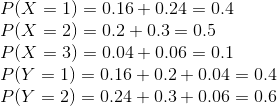
Now,

Hence, X and Y are mutually independent.
Question 8
Let b be the least square estimator of  .
.
Then, 
Hence, a 68% confidence indeval for
will be given by 
Here, b = 100.23 / 220.11 = 0.455 (approximately)
Since we do not know the value  , we will have to use its estimate to get the value of d. But we
should use the cut-off based on t23 distribution, as
, we will have to use its estimate to get the value of d. But we
should use the cut-off based on t23 distribution, as
 distribution. But as an approximation, one can use the normal
cutoff also.
distribution. But as an approximation, one can use the normal
cutoff also.
Hence, d = 0.994 * sqrt(4.19 / 220.11) = 0.137 (approximately)
Thus, the 68% confidence interval is given by (0.455 - 0.137, 0.455 + 0.137)
Add Answer to:
Please explain both questions. Show work.
7. Suppose X and Y are the random variables with...
1) Let X and Y be random variables. Show that Cov( X + Y, X-Y) Var(X)--Var(Y)...
 1) Let X and Y be random variables. Show that Cov( X + Y, X-Y) Var(X)--Var(Y) without appealing to the general formulas for the covariance of the linear combinations of sets of random variables; use the basic identity Cov(Z1,22)-E[Z1Z2]- E[Z1 E[Z2, valid for any two random variables, and the properties of the expected value 2) Let X be the normal random variable with zero mean and standard deviation Let ?(t) be the distribution function of the standard normal random variable....
2. Let X and Y are independent random variables with the same mass function f(-1) f(1)...
 2. Let X and Y are independent random variables with the same mass function f(-1) f(1) = 1/2. Let Z = XY. Show that X, Y, Z are pairwise independent but they are not independent. (Here、X,, . .. , xn are said to be pairwise independent if every pair Xi, X, with i f j are independent.)
4. Recall that the covariance of random variables X, and Y is defined by Cov(X,Y) =...
 4. Recall that the covariance of random variables X, and Y is defined by Cov(X,Y) = E(X - Ex)(Y - EY) (a) (2pt) TRUE or FALSE (circle one). E(XY) 0 implies Cov(X, Y) = 0. (b) (4 pt) a, b, c, d are constants. Mark each correct statement ( ) Cov(aX, cY) = ac Cov(X, Y) ( ) Cor(aX + b, cY + d) = ac Cov(X, Y) + bc Cov(X, Y) + da Cov(X, Y) + bd ( )...
Suppose that X and Y are independent standard normal random variables. Show that U = }(X+Y)...
 Suppose that X and Y are independent standard normal random variables. Show that U = }(X+Y) and V = 5(X-Y) are also independent standard normal random variables.
2. Suppose X and Y are independent continuous random variables. Show that P(Y < X) =...
 2. Suppose X and Y are independent continuous random variables. Show that P(Y < X) = | Fy(x) · fx (x) dx -oo where Fy is the CDF of Y and fx is the PDF of X [hint: P[Y E A] = S.P(Y E A|X = x) · fx(x) dx]. Rewrite the above equation as an expectation of a function of X, i.e. P(Y < X) = Ex[•]. Use the above relation to compute P[Y < X] if X~Exp (2)...
7. Suppose that Xi,..., Xk are independent random variables, and X, ~ Exp(B) for i =...
 7. Suppose that Xi,..., Xk are independent random variables, and X, ~ Exp(B) for i = 1, . . . , k. Let Y = min(X1 , . . . , Xk). Show that Y ~ Exp(Σ-1 β).
5. Let X1,X2, . , Xn be a random sample from a distribution with finite variance. Show that (i) COV(Xi-X, X )-0 f ) ρ (Xi-XX,-X)--n-1, 1 # J, 1,,-1, , n. OV&.for any two random variables X and Y)...
 5. Let X1,X2, . , Xn be a random sample from a distribution with finite variance. Show that (i) COV(Xi-X, X )-0 f ) ρ (Xi-XX,-X)--n-1, 1 # J, 1,,-1, , n. OV&.for any two random variables X and Y) or each 1, and (11 CoV(X,Y) var(x)var(y) (Recall that p vararo
5. Let X1,X2, . , Xn be a random sample from a distribution with finite variance. Show that (i) COV(Xi-X, X )-0 f ) ρ (Xi-XX,-X)--n-1, 1 # J,...
5. Let X1,X2, . , Xn be a random sample from a distribution with finite variance. Show that (i) COV(Xi-X, X )-0 f ) ρ (Xi-XX,-X)--n-1, 1 # J, 1,,-1, , n. OV&.for any two random variables X and Y) or each 1, and (11 CoV(X,Y) var(x)var(y) (Recall that p vararo
5. Let X1,X2, . , Xn be a random sample from a distribution with finite variance. Show that (i) COV(Xi-X, X )-0 f ) ρ (Xi-XX,-X)--n-1, 1 # J,...
2. The covariance of two random variables is Oxy = (x-7)(y-7) Show that the covariance is...
 2. The covariance of two random variables is Oxy = (x-7)(y-7) Show that the covariance is zero if the random variables are independent.
please show steps, thank you (Sec. 5.2, 00) Suppose X and Y are independent random variables...
please show steps, thank you (Sec. 5.2, 00) Suppose X and Y are independent random variables with E[X] = 6, E[Y ] = −3, Var[X] = 9, and Var[Y ] = 25. Find: (a) E[2Y − X] (b) Var[2Y − X] (c) Cov[X, Y ] (d) ρ[X, Y ] (e) Cov[5X + Y, Y ] (f) Cov[X, 2Y − X]
Show steps, thanks ·Additional Problem 13. For random variables X and Y it is given that...
 Show steps, thanks
·Additional Problem 13. For random variables X and Y it is given that Ox = 2, ơY = 5, and pxy 3 (a) Find Cov(Xx,y) (b) Var(4X-2Y7 Answers: (a) -. (b) 002 10652 li 3 . Additional Problem 14. Suppose Xi and X2 are independent random variables that have exponential distribution with β 4. (a) Find the covariance and correlation between 5Xi + 3X, and 7Xi-2X. (b) Find Var-5X2-2
Show steps, thanks
·Additional Problem 13. For random variables X and Y it is given that Ox = 2, ơY = 5, and pxy 3 (a) Find Cov(Xx,y) (b) Var(4X-2Y7 Answers: (a) -. (b) 002 10652 li 3 . Additional Problem 14. Suppose Xi and X2 are independent random variables that have exponential distribution with β 4. (a) Find the covariance and correlation between 5Xi + 3X, and 7Xi-2X. (b) Find Var-5X2-2
 1) Let X and Y be random variables. Show that Cov( X + Y, X-Y) Var(X)--Var(Y) without appealing to the general formulas for the covariance of the linear combinations of sets of random variables; use the basic identity Cov(Z1,22)-E[Z1Z2]- E[Z1 E[Z2, valid for any two random variables, and the properties of the expected value 2) Let X be the normal random variable with zero mean and standard deviation Let ?(t) be the distribution function of the standard normal random variable....
 2. Let X and Y are independent random variables with the same mass function f(-1) f(1) = 1/2. Let Z = XY. Show that X, Y, Z are pairwise independent but they are not independent. (Here、X,, . .. , xn are said to be pairwise independent if every pair Xi, X, with i f j are independent.)
 4. Recall that the covariance of random variables X, and Y is defined by Cov(X,Y) = E(X - Ex)(Y - EY) (a) (2pt) TRUE or FALSE (circle one). E(XY) 0 implies Cov(X, Y) = 0. (b) (4 pt) a, b, c, d are constants. Mark each correct statement ( ) Cov(aX, cY) = ac Cov(X, Y) ( ) Cor(aX + b, cY + d) = ac Cov(X, Y) + bc Cov(X, Y) + da Cov(X, Y) + bd ( )...
 Suppose that X and Y are independent standard normal random variables. Show that U = }(X+Y) and V = 5(X-Y) are also independent standard normal random variables.
 2. Suppose X and Y are independent continuous random variables. Show that P(Y < X) = | Fy(x) · fx (x) dx -oo where Fy is the CDF of Y and fx is the PDF of X [hint: P[Y E A] = S.P(Y E A|X = x) · fx(x) dx]. Rewrite the above equation as an expectation of a function of X, i.e. P(Y < X) = Ex[•]. Use the above relation to compute P[Y < X] if X~Exp (2)...
 7. Suppose that Xi,..., Xk are independent random variables, and X, ~ Exp(B) for i = 1, . . . , k. Let Y = min(X1 , . . . , Xk). Show that Y ~ Exp(Σ-1 β).
 5. Let X1,X2, . , Xn be a random sample from a distribution with finite variance. Show that (i) COV(Xi-X, X )-0 f ) ρ (Xi-XX,-X)--n-1, 1 # J, 1,,-1, , n. OV&.for any two random variables X and Y) or each 1, and (11 CoV(X,Y) var(x)var(y) (Recall that p vararo
5. Let X1,X2, . , Xn be a random sample from a distribution with finite variance. Show that (i) COV(Xi-X, X )-0 f ) ρ (Xi-XX,-X)--n-1, 1 # J,...
5. Let X1,X2, . , Xn be a random sample from a distribution with finite variance. Show that (i) COV(Xi-X, X )-0 f ) ρ (Xi-XX,-X)--n-1, 1 # J, 1,,-1, , n. OV&.for any two random variables X and Y) or each 1, and (11 CoV(X,Y) var(x)var(y) (Recall that p vararo
5. Let X1,X2, . , Xn be a random sample from a distribution with finite variance. Show that (i) COV(Xi-X, X )-0 f ) ρ (Xi-XX,-X)--n-1, 1 # J,...
 2. The covariance of two random variables is Oxy = (x-7)(y-7) Show that the covariance is zero if the random variables are independent.
 Show steps, thanks
·Additional Problem 13. For random variables X and Y it is given that Ox = 2, ơY = 5, and pxy 3 (a) Find Cov(Xx,y) (b) Var(4X-2Y7 Answers: (a) -. (b) 002 10652 li 3 . Additional Problem 14. Suppose Xi and X2 are independent random variables that have exponential distribution with β 4. (a) Find the covariance and correlation between 5Xi + 3X, and 7Xi-2X. (b) Find Var-5X2-2
Show steps, thanks
·Additional Problem 13. For random variables X and Y it is given that Ox = 2, ơY = 5, and pxy 3 (a) Find Cov(Xx,y) (b) Var(4X-2Y7 Answers: (a) -. (b) 002 10652 li 3 . Additional Problem 14. Suppose Xi and X2 are independent random variables that have exponential distribution with β 4. (a) Find the covariance and correlation between 5Xi + 3X, and 7Xi-2X. (b) Find Var-5X2-2
Most questions answered within 3 hours.
-
Where is the error in this code sequence?
String s1 = "Hello";
String s2 = "ello";...
asked 10 months ago -
Financial data for Joel de Paris, Inc., for last year
follow:
Joel de Paris, Inc.
Balance...
asked 10 months ago -
Consider this reaction:
Al2(SO4)3 (aq)+ BaCl3
(aq) Al2Cl6 (aq)- +
3BaSO4(s) . What is the...
asked 10 months ago -
Suppose that Savneet is considering increasing her
recent random sample from 20 car rentals to 40...
asked 10 months ago -
Trucks arrive at an unloading terminal at an average rate of 120
per hour.
Trucks arrive...
asked 10 months ago -
Why are methanol and ethanol completely soluble in water while
octanol is not very little soluble....
asked 10 months ago -
A facilities manager at a university reads in a research report
that the mean amount of...
asked 10 months ago -
When the CuSO4 is rehydrated by adding water to the anhydrous
compound, is this an endothermic...
asked 10 months ago -
A ray of sunlight is passing from diamond into crown glass; the
angle of incidence is...
asked 10 months ago -
A block of mass 0.249 kg is placed on top of a light, vertical
spring of...
asked 10 months ago -
how do the kidneys compensate in the presences of acidosis
a) trigger hyperventilate
b) reserve acid...
asked 10 months ago -
Question 501 pts
The rental rate of capital to the firm increases. Which of the
following...
asked 10 months ago