
Homework Answers
(A) - 3.20 J is correct option
Explanation :
Electric potential energy = electric potential x charge
Since electric potential at D = 2 volt (shown in figure)
And charge = - 1.6 (in the units of 10^(-19) C)
Therefore
Electric potential energy = - 1.6 x 2 J (x 10^(-19))
= - 3.20 J (x 10^(-19))
Add Answer to:
QUESTION 1 Consider the following plot of electric field lines (solid) and equipotential lines (dashed). What...
The equipotential surfaces in the field map below (shown as dashed lines) have potential differences between...
 The equipotential surfaces in
the field map below (shown as dashed lines) have potential
differences between a point at infinity and themselves of 1V, 5V,
and 10V. (a)[4 pt(s) ]Label the surfaces with the correct voltage.
Justify your choices using the properties of electric potential and
its relation to work. (b)[3 pt(s) ]Is the work to move a +q charge
from points A to B positive, negative, or about zero? Justify using
the properties of work and electric potential. (c)[3...
The equipotential surfaces in
the field map below (shown as dashed lines) have potential
differences between a point at infinity and themselves of 1V, 5V,
and 10V. (a)[4 pt(s) ]Label the surfaces with the correct voltage.
Justify your choices using the properties of electric potential and
its relation to work. (b)[3 pt(s) ]Is the work to move a +q charge
from points A to B positive, negative, or about zero? Justify using
the properties of work and electric potential. (c)[3...
A uniform electric field is shown below. Draw equipotential surfaces. In which direction does the voltage...
 A uniform electric field is
shown below. Draw equipotential surfaces. In which direction does
the voltage decrease? If an electron is placed in the electric
field at rest, draw the direction of the force. The electron moves
from higher potential point to lower potential point or the other
way around? If the potential difference between two locations of
the electron is 5V, what is the change in potential energy of the
electron. What is its speed at the end of...
A uniform electric field is
shown below. Draw equipotential surfaces. In which direction does
the voltage decrease? If an electron is placed in the electric
field at rest, draw the direction of the force. The electron moves
from higher potential point to lower potential point or the other
way around? If the potential difference between two locations of
the electron is 5V, what is the change in potential energy of the
electron. What is its speed at the end of...
PART 2: Electric Potential 1. (2) TF Equipotential surfaces are perpendicular to electric field lines. 2....
 PART 2: Electric Potential 1. (2) TF Equipotential surfaces are perpendicular to electric field lines. 2. (2) T F Electric field lines point towards lower electric potential. 3. (2) T F The electron-volt is a unit of electric potential. 4. (2) T F When two charges of opposite signs get closer together their electric potential energy increases.
The dashed lines in the diagram represent cross sections of equipotential surfaces drawn in 1 Vincrements....
 The dashed lines in the diagram represent cross sections of
equipotential surfaces drawn in 1 Vincrements. (Figure 1)
Part A
What is the work WAB done by the electric force to move
a 1 Ccharge from A to B?
Part B
What is the work WAD done by the electric force to move
a 1 Ccharge from A to D?
Part C
The magnitude of the electric field at point C is
*greater than the magnitude of the electric field...
The dashed lines in the diagram represent cross sections of
equipotential surfaces drawn in 1 Vincrements. (Figure 1)
Part A
What is the work WAB done by the electric force to move
a 1 Ccharge from A to B?
Part B
What is the work WAD done by the electric force to move
a 1 Ccharge from A to D?
Part C
The magnitude of the electric field at point C is
*greater than the magnitude of the electric field...
The dashed lines in the diagram represent cross-sections of equipotential surfaces drawn in 1-V increments.
 The dashed lines in the diagram represent cross-sections of equipotential surfaces drawn in 1-V increments.What is the work WAB done
by the electric force to move a 1-C charge
from A to B?What is the work WAD done
by the electric force to move a 1-C charge
from A to D?The magnitude of the electric field at point C
isa) greater than the magnitude of the electric field at point B.b) less than the magnitude of the electric field at point B.c) equal...
The dashed lines in the diagram represent cross-sections of equipotential surfaces drawn in 1-V increments.What is the work WAB done
by the electric force to move a 1-C charge
from A to B?What is the work WAD done
by the electric force to move a 1-C charge
from A to D?The magnitude of the electric field at point C
isa) greater than the magnitude of the electric field at point B.b) less than the magnitude of the electric field at point B.c) equal...
uestions for electric field experiment i) Info and draw on in it three more equipotential lines:...
 uestions for electric field experiment i) Info and draw on in it three more equipotential lines: one at the one slightly to the right of center and another slightly o 1. Use Fig. 5.6 center of the dipole, to the left of center sli Figure 5.6: The dashed lines are field lines for a dipole configuration. At each point it shows the direction that a positive probe-charge would follow if left alone there. The concentric lines around the poles are...
(c) How are the Electric Field lines related to the equipotential lines? How do they cross...
 (c) How are the Electric Field lines related to the equipotential lines? How do they cross each other? What does Eq. 11.2 indicate? Use a sketch to illustrate the relation of the Electric Field lines to the equipotential lines. (d) The Electric Field gives the direction in which a positive test charge would move from a given point in space. Explain why different lines of force can never cross each other.
I need some explanation for this question. What are the equipotential lines? Draw electric field lines...
I need some explanation for this question. What are the equipotential lines? Draw electric field lines and equipotential lines around a positive and around a negative charge, if both opposite charges are located close to each other? When you shuffle your feet across the carpet and then reach your hand to a nearby doorknob, you may create a spark between your hand and the door knob. Explain the Physics behind it in terms of electric potential difference
4. The following picture depicts several labeled equipotential lines (dashed, corresponding to constant potential). Calculate the...
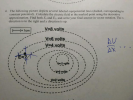 4. The following picture depicts several labeled equipotential lines (dashed, corresponding to constant potential). Calculate the electric field at the marked point using the derivative approximation. Find both Ex and Ey, and write your final answer in vector notation. The x direction is to the right and y direction is up.
Equipotentials answer the following questions about equipotential lines. 4 points total. 1. Explain what equipotential lines...
 Equipotentials answer the following questions about equipotential lines. 4 points total. 1. Explain what equipotential lines are. In particular, explain how they relate to electric field lines (geo- metrically) and how they relate to potential energy. 2 points. 2. Below are lines of equipotential for a charge distribution. Draw the electric field lines associated with the equipotentials. Draw a guess for the shape of the charge distribution. Explain in words the important points that you were trying to show through...
 The equipotential surfaces in
the field map below (shown as dashed lines) have potential
differences between a point at infinity and themselves of 1V, 5V,
and 10V. (a)[4 pt(s) ]Label the surfaces with the correct voltage.
Justify your choices using the properties of electric potential and
its relation to work. (b)[3 pt(s) ]Is the work to move a +q charge
from points A to B positive, negative, or about zero? Justify using
the properties of work and electric potential. (c)[3...
The equipotential surfaces in
the field map below (shown as dashed lines) have potential
differences between a point at infinity and themselves of 1V, 5V,
and 10V. (a)[4 pt(s) ]Label the surfaces with the correct voltage.
Justify your choices using the properties of electric potential and
its relation to work. (b)[3 pt(s) ]Is the work to move a +q charge
from points A to B positive, negative, or about zero? Justify using
the properties of work and electric potential. (c)[3...
 A uniform electric field is
shown below. Draw equipotential surfaces. In which direction does
the voltage decrease? If an electron is placed in the electric
field at rest, draw the direction of the force. The electron moves
from higher potential point to lower potential point or the other
way around? If the potential difference between two locations of
the electron is 5V, what is the change in potential energy of the
electron. What is its speed at the end of...
A uniform electric field is
shown below. Draw equipotential surfaces. In which direction does
the voltage decrease? If an electron is placed in the electric
field at rest, draw the direction of the force. The electron moves
from higher potential point to lower potential point or the other
way around? If the potential difference between two locations of
the electron is 5V, what is the change in potential energy of the
electron. What is its speed at the end of...
 PART 2: Electric Potential 1. (2) TF Equipotential surfaces are perpendicular to electric field lines. 2. (2) T F Electric field lines point towards lower electric potential. 3. (2) T F The electron-volt is a unit of electric potential. 4. (2) T F When two charges of opposite signs get closer together their electric potential energy increases.
 The dashed lines in the diagram represent cross sections of
equipotential surfaces drawn in 1 Vincrements. (Figure 1)
Part A
What is the work WAB done by the electric force to move
a 1 Ccharge from A to B?
Part B
What is the work WAD done by the electric force to move
a 1 Ccharge from A to D?
Part C
The magnitude of the electric field at point C is
*greater than the magnitude of the electric field...
The dashed lines in the diagram represent cross sections of
equipotential surfaces drawn in 1 Vincrements. (Figure 1)
Part A
What is the work WAB done by the electric force to move
a 1 Ccharge from A to B?
Part B
What is the work WAD done by the electric force to move
a 1 Ccharge from A to D?
Part C
The magnitude of the electric field at point C is
*greater than the magnitude of the electric field...
 The dashed lines in the diagram represent cross-sections of equipotential surfaces drawn in 1-V increments.What is the work WAB done
by the electric force to move a 1-C charge
from A to B?What is the work WAD done
by the electric force to move a 1-C charge
from A to D?The magnitude of the electric field at point C
isa) greater than the magnitude of the electric field at point B.b) less than the magnitude of the electric field at point B.c) equal...
The dashed lines in the diagram represent cross-sections of equipotential surfaces drawn in 1-V increments.What is the work WAB done
by the electric force to move a 1-C charge
from A to B?What is the work WAD done
by the electric force to move a 1-C charge
from A to D?The magnitude of the electric field at point C
isa) greater than the magnitude of the electric field at point B.b) less than the magnitude of the electric field at point B.c) equal...
 uestions for electric field experiment i) Info and draw on in it three more equipotential lines: one at the one slightly to the right of center and another slightly o 1. Use Fig. 5.6 center of the dipole, to the left of center sli Figure 5.6: The dashed lines are field lines for a dipole configuration. At each point it shows the direction that a positive probe-charge would follow if left alone there. The concentric lines around the poles are...
 (c) How are the Electric Field lines related to the equipotential lines? How do they cross each other? What does Eq. 11.2 indicate? Use a sketch to illustrate the relation of the Electric Field lines to the equipotential lines. (d) The Electric Field gives the direction in which a positive test charge would move from a given point in space. Explain why different lines of force can never cross each other.
 4. The following picture depicts several labeled equipotential lines (dashed, corresponding to constant potential). Calculate the electric field at the marked point using the derivative approximation. Find both Ex and Ey, and write your final answer in vector notation. The x direction is to the right and y direction is up.
 Equipotentials answer the following questions about equipotential lines. 4 points total. 1. Explain what equipotential lines are. In particular, explain how they relate to electric field lines (geo- metrically) and how they relate to potential energy. 2 points. 2. Below are lines of equipotential for a charge distribution. Draw the electric field lines associated with the equipotentials. Draw a guess for the shape of the charge distribution. Explain in words the important points that you were trying to show through...
Most questions answered within 3 hours.
-
Where is the error in this code sequence?
String s1 = "Hello";
String s2 = "ello";...
asked 10 months ago -
Financial data for Joel de Paris, Inc., for last year
follow:
Joel de Paris, Inc.
Balance...
asked 10 months ago -
Consider this reaction:
Al2(SO4)3 (aq)+ BaCl3
(aq) Al2Cl6 (aq)- +
3BaSO4(s) . What is the...
asked 10 months ago -
Suppose that Savneet is considering increasing her
recent random sample from 20 car rentals to 40...
asked 10 months ago -
Trucks arrive at an unloading terminal at an average rate of 120
per hour.
Trucks arrive...
asked 10 months ago -
Why are methanol and ethanol completely soluble in water while
octanol is not very little soluble....
asked 10 months ago -
A facilities manager at a university reads in a research report
that the mean amount of...
asked 10 months ago -
When the CuSO4 is rehydrated by adding water to the anhydrous
compound, is this an endothermic...
asked 10 months ago -
A ray of sunlight is passing from diamond into crown glass; the
angle of incidence is...
asked 10 months ago -
A block of mass 0.249 kg is placed on top of a light, vertical
spring of...
asked 10 months ago -
how do the kidneys compensate in the presences of acidosis
a) trigger hyperventilate
b) reserve acid...
asked 10 months ago -
Question 501 pts
The rental rate of capital to the firm increases. Which of the
following...
asked 10 months ago