Is it easier to add a new data pair using divided-difference methods or the Lagrange polynomial...
Is it easier to add a new data pair using
divided-difference methods or the Lagrange polynomial in order to
obtain a higher-degree polynomial?
Homework Answers
Request Answer!
We need at least 10 more requests to produce the answer.
0 / 10 have requested this problem solution
The more requests, the faster the answer.
Add Answer to:
Is it easier to add a new data pair using
divided-difference methods or the Lagrange polynomial...
Under which mathematical principle is created the Newton Interpolating polynomial a Lagrange polynomial b Divided Difference...
Under which mathematical principle is created the Newton Interpolating polynomial a Lagrange polynomial b Divided Difference technique c Limit definition d Subtracted difference technique
er Lagrange ,Divided difference and Hermitewatnejed, Jnp 1.5, and x2-2, andf (x)ssin(x) * Given the point sx.-1, a) Find its Lagrange interpolation P on these points b) Write its newton's divi...
 er Lagrange ,Divided difference and Hermitewatnejed, Jnp 1.5, and x2-2, andf (x)ssin(x) * Given the point sx.-1, a) Find its Lagrange interpolation P on these points b) Write its newton's divided difference P, polynomial c)Write Hermite Hs by Using part a outcomes d) Write Hermite Hi by Using part b outcomes Rules: Lagrange form of Hermite polynomial of degre at most 2n-+1 Here, L., (r) denotes the Lagrange coefficient polynomial of degree n. If ec la.bl, then the error formula...
a) Find False Position function for this data. b) Find the third-order interpolation function with Lagrange...
 a) Find False Position function for this data.
b) Find the third-order interpolation function with Lagrange
method
c) Find the third-order interpolation function with Newton's
Divided Difference Method.
d)Find the natural spline interpolation function for the same
data
e)Draw the given points in a row using the False Position
function, the third order polynomial obtained by Lagrange and
Newton's Divided Difference Method, and the natural spline
interpolation function using MATLAB.
4-0 2
a) Find False Position function for this data.
b) Find the third-order interpolation function with Lagrange
method
c) Find the third-order interpolation function with Newton's
Divided Difference Method.
d)Find the natural spline interpolation function for the same
data
e)Draw the given points in a row using the False Position
function, the third order polynomial obtained by Lagrange and
Newton's Divided Difference Method, and the natural spline
interpolation function using MATLAB.
4-0 2
Let (xi , f(xi)), i = 0, . . . , 3, be data points, where xi = i + 2, for i = 0, . . . , 3. Given the divided difference...
 Let (xi , f(xi)), i = 0, . . . , 3, be data points, where xi = i
+ 2, for i = 0, . . . , 3. Given the divided differences f[x0] = 1,
f[x0, x1] = 2, f[x0, x1, x2] = −7, f[x0, x1, x2, x3] = 9, add the
data point (0, 3), find a Newton form for the Lagrange polynomial
interpolating all 5 data points.
3. (25 pts) Let (r,, f()), 0,3, be data...
Let (xi , f(xi)), i = 0, . . . , 3, be data points, where xi = i
+ 2, for i = 0, . . . , 3. Given the divided differences f[x0] = 1,
f[x0, x1] = 2, f[x0, x1, x2] = −7, f[x0, x1, x2, x3] = 9, add the
data point (0, 3), find a Newton form for the Lagrange polynomial
interpolating all 5 data points.
3. (25 pts) Let (r,, f()), 0,3, be data...
Hide email Problem 5 (10 points): For the data below, perform Newton Divided Difference interpola...
 Please solve problem 7 not 5. however you need data from problem 5
to slove problem 7
Hide email Problem 5 (10 points): For the data below, perform Newton Divided Difference interpolation of fC7.5 C) using first through third order interpolating polynomial:s for f viscosity of water 1000 in metric (MKS) units. Choose thexi interpolation points to provide the most accurate interpolation (points should most closely surround x = 7.5 C). 040 y i 1.781 | İ .568 | 1...
Please solve problem 7 not 5. however you need data from problem 5
to slove problem 7
Hide email Problem 5 (10 points): For the data below, perform Newton Divided Difference interpolation of fC7.5 C) using first through third order interpolating polynomial:s for f viscosity of water 1000 in metric (MKS) units. Choose thexi interpolation points to provide the most accurate interpolation (points should most closely surround x = 7.5 C). 040 y i 1.781 | İ .568 | 1...
The second lab continues with the Polynomial class from the first lab by adding new methods...
The second lab continues with the Polynomial class from the first lab by adding new methods for polynomial arithmetic to its source code. (There is no inheritance or polymorphism taking place yet in this lab.) Since the class Polynomial is designed to be immutable, none of the following methods should modify the objects this or other in any way, but return the result of that arithmetic operation as a brand new Polynomial object created inside that method. public Polynomial add(Polynomial...
Compute, using divided differences, the value of the piecewise cubic Her- mite interpolating polynomial at x = 11=10 giv...
 Compute, using divided differences, the value of the piecewise
cubic Her-
mite interpolating polynomial at x = 11=10 given nodes at xi = i,
for i = 1; : : : ; 10,
and values and derivatives at the nodes from the function f(x) =
1=x.
Remember iterative formula for divided differences:
2. (25 pts) Compute, using divided differences, the value of the piecewise cubic Her mite interpolating polynomial at x-11/10 given nodes at ai-i, for i-1, , 10. and...
Compute, using divided differences, the value of the piecewise
cubic Her-
mite interpolating polynomial at x = 11=10 given nodes at xi = i,
for i = 1; : : : ; 10,
and values and derivatives at the nodes from the function f(x) =
1=x.
Remember iterative formula for divided differences:
2. (25 pts) Compute, using divided differences, the value of the piecewise cubic Her mite interpolating polynomial at x-11/10 given nodes at ai-i, for i-1, , 10. and...
1)Select five-data pair (x, y) randomly yourself (not from any books, any documents etc. Form yourself!)...
1)Select five-data pair (x, y) randomly yourself (not from any books, any documents etc. Form yourself!) and - Fit a curve with a linear equation. - Fit a curve with non-linear equation by writing the equation in a linear form. - Fit a curve with fourth-order polynomial directly. - Find fourth-order polynomial by Lagrange interpolating polynomial method. - Find fourth-order polynomial by Newton's interpolating polynomial method. Numerical methods.
Using the Excel, fit a second-order polynomial to the data in Table Q2. Using the MATLAB. findfX)...
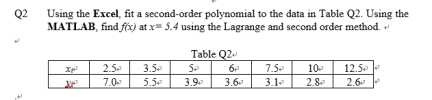 Using the Excel, fit a second-order polynomial to the data in Table Q2. Using the MATLAB. findfX) at x= 5.4 using the Lagrange and second order method. + Q2 Table Q2 2.5-| 3.5-| 5+' | 6' | 7.5-1 1001 12.5-1+' Vie | 70+ | 5.5- ו3.9 '| 3.6e | 3.1-וכ2.8 -וכ2.6 -וכ+'
Using the Excel, fit a second-order polynomial to the data in Table Q2. Using the MATLAB. findfX) at x= 5.4 using the Lagrange and second order method. +...
Using the Excel, fit a second-order polynomial to the data in Table Q2. Using the MATLAB. findfX) at x= 5.4 using the Lagrange and second order method. + Q2 Table Q2 2.5-| 3.5-| 5+' | 6' | 7.5-1 1001 12.5-1+' Vie | 70+ | 5.5- ו3.9 '| 3.6e | 3.1-וכ2.8 -וכ2.6 -וכ+'
Using the Excel, fit a second-order polynomial to the data in Table Q2. Using the MATLAB. findfX) at x= 5.4 using the Lagrange and second order method. +...
Problem 2. Given the data points (xi. yi), with xi 2 02 4 yil 5 1 1.25 find the following interpo...
 Problem 2. Given the data points (xi. yi), with xi 2 02 4 yil 5 1 1.25 find the following interpolating polynomials, and use MATLAB to graph both the interpolating polynomials and the data points: a) The piecewise linear Lagrange interpolating polynomialx) b) The piecewise quadratic Lagrange interpolating polynomial q(x) c) Newton's divided difference interpolation pa(x) of degree s 4
Problem 2. Given the data points (xi. yi), with xi 2 02 4 yil 5 1 1.25 find the following...
Problem 2. Given the data points (xi. yi), with xi 2 02 4 yil 5 1 1.25 find the following interpolating polynomials, and use MATLAB to graph both the interpolating polynomials and the data points: a) The piecewise linear Lagrange interpolating polynomialx) b) The piecewise quadratic Lagrange interpolating polynomial q(x) c) Newton's divided difference interpolation pa(x) of degree s 4
Problem 2. Given the data points (xi. yi), with xi 2 02 4 yil 5 1 1.25 find the following...
 er Lagrange ,Divided difference and Hermitewatnejed, Jnp 1.5, and x2-2, andf (x)ssin(x) * Given the point sx.-1, a) Find its Lagrange interpolation P on these points b) Write its newton's divided difference P, polynomial c)Write Hermite Hs by Using part a outcomes d) Write Hermite Hi by Using part b outcomes Rules: Lagrange form of Hermite polynomial of degre at most 2n-+1 Here, L., (r) denotes the Lagrange coefficient polynomial of degree n. If ec la.bl, then the error formula...
 a) Find False Position function for this data.
b) Find the third-order interpolation function with Lagrange
method
c) Find the third-order interpolation function with Newton's
Divided Difference Method.
d)Find the natural spline interpolation function for the same
data
e)Draw the given points in a row using the False Position
function, the third order polynomial obtained by Lagrange and
Newton's Divided Difference Method, and the natural spline
interpolation function using MATLAB.
4-0 2
a) Find False Position function for this data.
b) Find the third-order interpolation function with Lagrange
method
c) Find the third-order interpolation function with Newton's
Divided Difference Method.
d)Find the natural spline interpolation function for the same
data
e)Draw the given points in a row using the False Position
function, the third order polynomial obtained by Lagrange and
Newton's Divided Difference Method, and the natural spline
interpolation function using MATLAB.
4-0 2
 Let (xi , f(xi)), i = 0, . . . , 3, be data points, where xi = i
+ 2, for i = 0, . . . , 3. Given the divided differences f[x0] = 1,
f[x0, x1] = 2, f[x0, x1, x2] = −7, f[x0, x1, x2, x3] = 9, add the
data point (0, 3), find a Newton form for the Lagrange polynomial
interpolating all 5 data points.
3. (25 pts) Let (r,, f()), 0,3, be data...
Let (xi , f(xi)), i = 0, . . . , 3, be data points, where xi = i
+ 2, for i = 0, . . . , 3. Given the divided differences f[x0] = 1,
f[x0, x1] = 2, f[x0, x1, x2] = −7, f[x0, x1, x2, x3] = 9, add the
data point (0, 3), find a Newton form for the Lagrange polynomial
interpolating all 5 data points.
3. (25 pts) Let (r,, f()), 0,3, be data...
 Please solve problem 7 not 5. however you need data from problem 5
to slove problem 7
Hide email Problem 5 (10 points): For the data below, perform Newton Divided Difference interpolation of fC7.5 C) using first through third order interpolating polynomial:s for f viscosity of water 1000 in metric (MKS) units. Choose thexi interpolation points to provide the most accurate interpolation (points should most closely surround x = 7.5 C). 040 y i 1.781 | İ .568 | 1...
Please solve problem 7 not 5. however you need data from problem 5
to slove problem 7
Hide email Problem 5 (10 points): For the data below, perform Newton Divided Difference interpolation of fC7.5 C) using first through third order interpolating polynomial:s for f viscosity of water 1000 in metric (MKS) units. Choose thexi interpolation points to provide the most accurate interpolation (points should most closely surround x = 7.5 C). 040 y i 1.781 | İ .568 | 1...
 Compute, using divided differences, the value of the piecewise
cubic Her-
mite interpolating polynomial at x = 11=10 given nodes at xi = i,
for i = 1; : : : ; 10,
and values and derivatives at the nodes from the function f(x) =
1=x.
Remember iterative formula for divided differences:
2. (25 pts) Compute, using divided differences, the value of the piecewise cubic Her mite interpolating polynomial at x-11/10 given nodes at ai-i, for i-1, , 10. and...
Compute, using divided differences, the value of the piecewise
cubic Her-
mite interpolating polynomial at x = 11=10 given nodes at xi = i,
for i = 1; : : : ; 10,
and values and derivatives at the nodes from the function f(x) =
1=x.
Remember iterative formula for divided differences:
2. (25 pts) Compute, using divided differences, the value of the piecewise cubic Her mite interpolating polynomial at x-11/10 given nodes at ai-i, for i-1, , 10. and...
 Using the Excel, fit a second-order polynomial to the data in Table Q2. Using the MATLAB. findfX) at x= 5.4 using the Lagrange and second order method. + Q2 Table Q2 2.5-| 3.5-| 5+' | 6' | 7.5-1 1001 12.5-1+' Vie | 70+ | 5.5- ו3.9 '| 3.6e | 3.1-וכ2.8 -וכ2.6 -וכ+'
Using the Excel, fit a second-order polynomial to the data in Table Q2. Using the MATLAB. findfX) at x= 5.4 using the Lagrange and second order method. +...
Using the Excel, fit a second-order polynomial to the data in Table Q2. Using the MATLAB. findfX) at x= 5.4 using the Lagrange and second order method. + Q2 Table Q2 2.5-| 3.5-| 5+' | 6' | 7.5-1 1001 12.5-1+' Vie | 70+ | 5.5- ו3.9 '| 3.6e | 3.1-וכ2.8 -וכ2.6 -וכ+'
Using the Excel, fit a second-order polynomial to the data in Table Q2. Using the MATLAB. findfX) at x= 5.4 using the Lagrange and second order method. +...
 Problem 2. Given the data points (xi. yi), with xi 2 02 4 yil 5 1 1.25 find the following interpolating polynomials, and use MATLAB to graph both the interpolating polynomials and the data points: a) The piecewise linear Lagrange interpolating polynomialx) b) The piecewise quadratic Lagrange interpolating polynomial q(x) c) Newton's divided difference interpolation pa(x) of degree s 4
Problem 2. Given the data points (xi. yi), with xi 2 02 4 yil 5 1 1.25 find the following...
Problem 2. Given the data points (xi. yi), with xi 2 02 4 yil 5 1 1.25 find the following interpolating polynomials, and use MATLAB to graph both the interpolating polynomials and the data points: a) The piecewise linear Lagrange interpolating polynomialx) b) The piecewise quadratic Lagrange interpolating polynomial q(x) c) Newton's divided difference interpolation pa(x) of degree s 4
Problem 2. Given the data points (xi. yi), with xi 2 02 4 yil 5 1 1.25 find the following...
Most questions answered within 3 hours.
-
Where is the error in this code sequence?
String s1 = "Hello";
String s2 = "ello";...
asked 10 months ago -
Financial data for Joel de Paris, Inc., for last year
follow:
Joel de Paris, Inc.
Balance...
asked 10 months ago -
Consider this reaction:
Al2(SO4)3 (aq)+ BaCl3
(aq) Al2Cl6 (aq)- +
3BaSO4(s) . What is the...
asked 10 months ago -
Suppose that Savneet is considering increasing her
recent random sample from 20 car rentals to 40...
asked 10 months ago -
Trucks arrive at an unloading terminal at an average rate of 120
per hour.
Trucks arrive...
asked 10 months ago -
Why are methanol and ethanol completely soluble in water while
octanol is not very little soluble....
asked 10 months ago -
A facilities manager at a university reads in a research report
that the mean amount of...
asked 10 months ago -
When the CuSO4 is rehydrated by adding water to the anhydrous
compound, is this an endothermic...
asked 10 months ago -
A ray of sunlight is passing from diamond into crown glass; the
angle of incidence is...
asked 10 months ago -
A block of mass 0.249 kg is placed on top of a light, vertical
spring of...
asked 10 months ago -
how do the kidneys compensate in the presences of acidosis
a) trigger hyperventilate
b) reserve acid...
asked 10 months ago -
Question 501 pts
The rental rate of capital to the firm increases. Which of the
following...
asked 10 months ago