
Homework Answers

Add Answer to:
Use the data below from an electron impact mass spectrum of a pure compound to deduce...
Use the data below from an electron impact mass spectrum of a pure compound to deduce...
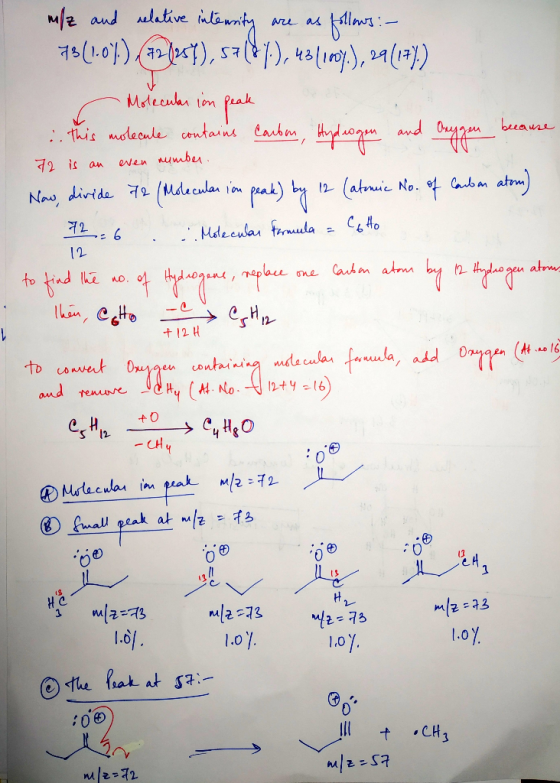
Use the data below from an electron impact mass spectrum of a pure compound to deduce its structure. Draw your structure in the drawing window. Data selected from the NIST WebBook, https://webbook.nist.gov/chemistry/ m/z Relative intensity 96 94 94 100 15 47
Use the data below from an electron impact mass spectrum of a pure compound to deduce...
Use the data below from an electron impact mass spectrum of a pure compound to deduce its structure. Draw your structure. PART 1: m/z relative intensity 52 31 50 100 15 2 PART 2: m/z Relative intensity 17 1.6 16 100 15 89 14 20 13 11
Mass Spectrometry: can someone explain how the heck I do this problem? It's French to me....
 Mass Spectrometry: can someone explain how the heck I do this
problem? It's French to me.
Use the data below from an electron impact mass spectrum of a pure compound to deduce its structure. Draw your structure in the drawing window. Data selected from the NIST Web Book. You do not have to consider stereochemistry. You do not have to explicitly draw H atoms. In cases where there is more than one answer, just draw one.
Mass Spectrometry: can someone explain how the heck I do this
problem? It's French to me.
Use the data below from an electron impact mass spectrum of a pure compound to deduce its structure. Draw your structure in the drawing window. Data selected from the NIST Web Book. You do not have to consider stereochemistry. You do not have to explicitly draw H atoms. In cases where there is more than one answer, just draw one.
The 'H-NMR spectrum of an unknown compound with molecular formula C5H10 is shown below. Deduce a...
 The 'H-NMR spectrum of an unknown compound with molecular formula C5H10 is shown below. Deduce a structural formula for this compound. 81.070 CH00 81.07 82.42) 8241 (0) 10 3 7 9 6 5 0 ppm Chemical Shin (5) 2005 Brooks Cole Thomson You do not have to consider stereochemistry. • You do not have to explicitly draw H atoms. . Do not include lone pairs in your answer. They will not be considered in the grading. • In cases where...
i am not sure how to answer the bottom question... Examine the IR spectrum below and...
 i am not sure how to answer the bottom question...
Examine the IR spectrum below and identity as molecule (1-chlorohentanel and consider all expe ational modes even in the fingerprint (you do regions of the expected vibrations) entify as many peaks as you can. Draw the structure of the er all expected peaks, labeling them with functional groups serprint (you do not need to label individual peaks, only Heptane, 1-chloro- INFRARED SPECTRUM 800 Iloco Co chloride) c-c. Relative Transmittance Alkane...
i am not sure how to answer the bottom question...
Examine the IR spectrum below and identity as molecule (1-chlorohentanel and consider all expe ational modes even in the fingerprint (you do regions of the expected vibrations) entify as many peaks as you can. Draw the structure of the er all expected peaks, labeling them with functional groups serprint (you do not need to label individual peaks, only Heptane, 1-chloro- INFRARED SPECTRUM 800 Iloco Co chloride) c-c. Relative Transmittance Alkane...
References The mass spectrum of octanoic acid, CH3(CH2)COOH, exhibits a series of peaks differing by 14...
 References The mass spectrum of octanoic acid, CH3(CH2)COOH, exhibits a series of peaks differing by 14 amu at m/ 29, 43, 57, 71, 85, and 99 1 pt Draw the structure of the fragment resulting in the m/z 57 peak 1 pt 1 pt .You do not have to consider stereochemistry You do not have to explicitly draw H atoms. In cases where there is more than one answer, just draw one. .Do not use the square brackets tool in...
The ^1H- and ^13C-NMR data for an unknown compound with molecular formula C_4H_4O_5 are shown below....
 The ^1H- and ^13C-NMR data for an unknown compound with molecular formula C_4H_4O_5 are shown below. Deduce a structural formula for this compound. ^1NMR: 4.46 (s, 2H), 11.0 (s, 2H). ^13C-NMR: 191.8,171.5,162.8, 37.2. You do not have to consider stereochemistry. You do not have to explicitly draw H atoms. In cases where there is more than one answer, just draw one.
Draw the structure of the compound you would expect from E2 reaction of the molecule below...
 Draw the structure of the compound you would expect from E2 reaction of the molecule below with NaOH. NH G C ball & stick + labels • Consider E/Z stereochemistry of alkenes. • You do not have to explicitly draw H atoms. • In cases where there is a choice, draw the most substituted alkene product. Draw the structure of the alkyl bromide from which the alkyl acetate shown below was made by Sn2 reaction. CH ball & stick +...
A compound, CyH,202, has an IR spectrum showing a peak at 1710 cm. Its 'H NMR...
 A compound, CyH,202, has an IR spectrum showing a peak at 1710 cm. Its 'H NMR spectrum has peaks at delta 1.3 (3 H, triplet), 4.3 (2 H, quartet), 6.5 (1 H, doublet), 7.4-7.6 (5 H, multiplet), and 7.7 (1 H, doublet). Draw its structure in the window below. • You do not have to consider stereochemistry. • You do not have to explicitly draw H atoms. . Do not include lone pairs in your answer. They will not be...
2. Match the electron impact (El) mass spectrum with the correct structure from the choices below....
 2. Match the electron impact (El) mass spectrum with the correct structure from the choices below. ectra of the following molecules (write the correct letter in the upper left-hand corner of the spectra). Draw the structure of the indicated fragments (*) A OH *(43) *(71) * (43) 100- MS-NU-O1 Relative Intensity Relative Intensity 10 20 30 40 50 70 80 90 100 10 30 40 60 70 50 /z 60 /z m m
 Mass Spectrometry: can someone explain how the heck I do this
problem? It's French to me.
Use the data below from an electron impact mass spectrum of a pure compound to deduce its structure. Draw your structure in the drawing window. Data selected from the NIST Web Book. You do not have to consider stereochemistry. You do not have to explicitly draw H atoms. In cases where there is more than one answer, just draw one.
Mass Spectrometry: can someone explain how the heck I do this
problem? It's French to me.
Use the data below from an electron impact mass spectrum of a pure compound to deduce its structure. Draw your structure in the drawing window. Data selected from the NIST Web Book. You do not have to consider stereochemistry. You do not have to explicitly draw H atoms. In cases where there is more than one answer, just draw one.
 The 'H-NMR spectrum of an unknown compound with molecular formula C5H10 is shown below. Deduce a structural formula for this compound. 81.070 CH00 81.07 82.42) 8241 (0) 10 3 7 9 6 5 0 ppm Chemical Shin (5) 2005 Brooks Cole Thomson You do not have to consider stereochemistry. • You do not have to explicitly draw H atoms. . Do not include lone pairs in your answer. They will not be considered in the grading. • In cases where...
 i am not sure how to answer the bottom question...
Examine the IR spectrum below and identity as molecule (1-chlorohentanel and consider all expe ational modes even in the fingerprint (you do regions of the expected vibrations) entify as many peaks as you can. Draw the structure of the er all expected peaks, labeling them with functional groups serprint (you do not need to label individual peaks, only Heptane, 1-chloro- INFRARED SPECTRUM 800 Iloco Co chloride) c-c. Relative Transmittance Alkane...
i am not sure how to answer the bottom question...
Examine the IR spectrum below and identity as molecule (1-chlorohentanel and consider all expe ational modes even in the fingerprint (you do regions of the expected vibrations) entify as many peaks as you can. Draw the structure of the er all expected peaks, labeling them with functional groups serprint (you do not need to label individual peaks, only Heptane, 1-chloro- INFRARED SPECTRUM 800 Iloco Co chloride) c-c. Relative Transmittance Alkane...
 References The mass spectrum of octanoic acid, CH3(CH2)COOH, exhibits a series of peaks differing by 14 amu at m/ 29, 43, 57, 71, 85, and 99 1 pt Draw the structure of the fragment resulting in the m/z 57 peak 1 pt 1 pt .You do not have to consider stereochemistry You do not have to explicitly draw H atoms. In cases where there is more than one answer, just draw one. .Do not use the square brackets tool in...
 The ^1H- and ^13C-NMR data for an unknown compound with molecular formula C_4H_4O_5 are shown below. Deduce a structural formula for this compound. ^1NMR: 4.46 (s, 2H), 11.0 (s, 2H). ^13C-NMR: 191.8,171.5,162.8, 37.2. You do not have to consider stereochemistry. You do not have to explicitly draw H atoms. In cases where there is more than one answer, just draw one.
 Draw the structure of the compound you would expect from E2 reaction of the molecule below with NaOH. NH G C ball & stick + labels • Consider E/Z stereochemistry of alkenes. • You do not have to explicitly draw H atoms. • In cases where there is a choice, draw the most substituted alkene product. Draw the structure of the alkyl bromide from which the alkyl acetate shown below was made by Sn2 reaction. CH ball & stick +...
 A compound, CyH,202, has an IR spectrum showing a peak at 1710 cm. Its 'H NMR spectrum has peaks at delta 1.3 (3 H, triplet), 4.3 (2 H, quartet), 6.5 (1 H, doublet), 7.4-7.6 (5 H, multiplet), and 7.7 (1 H, doublet). Draw its structure in the window below. • You do not have to consider stereochemistry. • You do not have to explicitly draw H atoms. . Do not include lone pairs in your answer. They will not be...
 2. Match the electron impact (El) mass spectrum with the correct structure from the choices below. ectra of the following molecules (write the correct letter in the upper left-hand corner of the spectra). Draw the structure of the indicated fragments (*) A OH *(43) *(71) * (43) 100- MS-NU-O1 Relative Intensity Relative Intensity 10 20 30 40 50 70 80 90 100 10 30 40 60 70 50 /z 60 /z m m
Most questions answered within 3 hours.
-
Where is the error in this code sequence?
String s1 = "Hello";
String s2 = "ello";...
asked 10 months ago -
Financial data for Joel de Paris, Inc., for last year
follow:
Joel de Paris, Inc.
Balance...
asked 10 months ago -
Consider this reaction:
Al2(SO4)3 (aq)+ BaCl3
(aq) Al2Cl6 (aq)- +
3BaSO4(s) . What is the...
asked 10 months ago -
Suppose that Savneet is considering increasing her
recent random sample from 20 car rentals to 40...
asked 10 months ago -
Trucks arrive at an unloading terminal at an average rate of 120
per hour.
Trucks arrive...
asked 10 months ago -
Why are methanol and ethanol completely soluble in water while
octanol is not very little soluble....
asked 10 months ago -
A facilities manager at a university reads in a research report
that the mean amount of...
asked 10 months ago -
When the CuSO4 is rehydrated by adding water to the anhydrous
compound, is this an endothermic...
asked 10 months ago -
A ray of sunlight is passing from diamond into crown glass; the
angle of incidence is...
asked 10 months ago -
A block of mass 0.249 kg is placed on top of a light, vertical
spring of...
asked 10 months ago -
how do the kidneys compensate in the presences of acidosis
a) trigger hyperventilate
b) reserve acid...
asked 10 months ago -
Question 501 pts
The rental rate of capital to the firm increases. Which of the
following...
asked 10 months ago