
What is causing the variation shown in each graph. Only use the options:
genotype
genotype + environment
genotype x environment
Question 12 options:
Save
Homework Answers
For graph a there is not interaction between genotype and environment as both line are running parallel to each other . Variation in graph a is only due to
Genotype
For graph b and c interaction between genotype and enviroment and variation in graph is due to :
genotype x environment
Add Answer to:
What is causing the variation shown in each graph. Only use the
options:
genotype
genotype +...
(a) What is the genotype of individual I-1? (b) What is the genotype of individual I-2?...
 (a) What is the genotype of individual I-1?
(b) What is the genotype of individual I-2?
(c) What is the genotype of individual IV-3?
(d) What is the genotype of individual IV-6?
PART B
If individuals IV-3 and IV-6 were to have children:
(e) What is the probability that these children will express
this X-linked dominant trait? %
(f) If they only have sons, what is the probability that these
sons will express this X-linked dominant trait?
%
(g) If...
(a) What is the genotype of individual I-1?
(b) What is the genotype of individual I-2?
(c) What is the genotype of individual IV-3?
(d) What is the genotype of individual IV-6?
PART B
If individuals IV-3 and IV-6 were to have children:
(e) What is the probability that these children will express
this X-linked dominant trait? %
(f) If they only have sons, what is the probability that these
sons will express this X-linked dominant trait?
%
(g) If...
Please use ONLY the variation of parameters method if possible. Thank you! 1. Solve the following...
 Please use ONLY the variation of parameters method if
possible. Thank you!
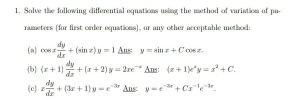
1. Solve the following differential equations using the method of variation of pa- rameters (for first order equations), or any other acceptable method: cos x + (sin x) y = 1 Ans: y = sin c +C cosx. (b) (x+1) 7 + (x + 2) y = 2xe-* Ans: (x+1)e’y = 22 + C. 2 + (3x + 1) y = e-32 Ans: y = e-3x + Cx-1e-3r.
Please use ONLY the variation of parameters method if
possible. Thank you!
1. Solve the following differential equations using the method of variation of pa- rameters (for first order equations), or any other acceptable method: cos x + (sin x) y = 1 Ans: y = sin c +C cosx. (b) (x+1) 7 + (x + 2) y = 2xe-* Ans: (x+1)e’y = 22 + C. 2 + (3x + 1) y = e-32 Ans: y = e-3x + Cx-1e-3r.
Please show how to solve. Correct answer shown. Use variation of parameters to find a general...
 Please show how to solve. Correct answer shown.
Use variation of parameters to find a general solution to the differential equation given that the functions y, and y2 are linearly independent solutions to the corresponding homogeneous equation for t>0. - 2t + ty +(2t - 1)x - 2y =ềe -2t, Y1 = 2t - 1, y2 = e - A general solution is y(t) = X X That's incorrect. 1 Correct answer: C1(2t - 1) + c2 e - 2t...
Please show how to solve. Correct answer shown.
Use variation of parameters to find a general solution to the differential equation given that the functions y, and y2 are linearly independent solutions to the corresponding homogeneous equation for t>0. - 2t + ty +(2t - 1)x - 2y =ềe -2t, Y1 = 2t - 1, y2 = e - A general solution is y(t) = X X That's incorrect. 1 Correct answer: C1(2t - 1) + c2 e - 2t...
Please graph well Transform each graph as specified below. (a) The graph of y=f(x) is shown....
 Please graph well
Transform each graph as specified below. (a) The graph of y=f(x) is shown. Graph y=f(x). (b) The graph of y=g(x) is shown. Graph y=2g(x). Part (a) Part (b)
Please graph well
Transform each graph as specified below. (a) The graph of y=f(x) is shown. Graph y=f(x). (b) The graph of y=g(x) is shown. Graph y=2g(x). Part (a) Part (b)
step by step please. (b) The graph shows the variation with nucleon number A of the...
 step by step please.
(b) The graph shows the variation with nucleon number A of the binding energy per nucleon. binding energy per nucleon /MeV 0 20 40 60 80 100 120 140 160 180 200 220 240 nucleon number A Plutonium (3Pu undergoes nuclear fission according to the reaction given below Calculate the number x of neutrons produced. Use the graph to estimate the ene rgy released in this reac 12/ tion
step by step please.
(b) The graph shows the variation with nucleon number A of the binding energy per nucleon. binding energy per nucleon /MeV 0 20 40 60 80 100 120 140 160 180 200 220 240 nucleon number A Plutonium (3Pu undergoes nuclear fission according to the reaction given below Calculate the number x of neutrons produced. Use the graph to estimate the ene rgy released in this reac 12/ tion
A - H The graph of the function is shown. Find (or estimate) each of the...
 A - H
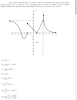
The graph of the function is shown. Find (or estimate) each of the items below. If the symbol oo oro applies, use it. If a limit does not exists and neither of these symbols applies, indicate the limit does not exists (DNE). If there is no answer, write "none." + + + + + + + (a) f(1) = (b) lim (3 - f(t)= (e) lim («f(x)]= (d) /'(2)= (e) lim ()= (1) f(x)dx = (8) Liv(n)...
A - H
The graph of the function is shown. Find (or estimate) each of the items below. If the symbol oo oro applies, use it. If a limit does not exists and neither of these symbols applies, indicate the limit does not exists (DNE). If there is no answer, write "none." + + + + + + + (a) f(1) = (b) lim (3 - f(t)= (e) lim («f(x)]= (d) /'(2)= (e) lim ()= (1) f(x)dx = (8) Liv(n)...
4. Consider the graph of the function f shown below. Use this graph to sketch the...
 4. Consider the graph of the function f shown below. Use this graph to sketch the graphs of the following functions. To print an enlarged copy of the graph, go to the website www.mathgraphs.com (a) f(x) (c) 2f(x) 4 (d) fx) (f) f(x) (e) -f() (g) f(x) 2 4 -2 -4
ranslate each graph as specified below. is shown. Translate it to get the graph of y...
 ranslate each graph as specified below. is shown. Translate it to get the graph of y fx+3). is shown. Translate it to get the graph of y g (x)-5. a) The graph of y=f(x) b) The graph of y=g (x) Part (b) Part (a) ? 4-17, 3) /010) Explanation Check 0 2010 McGrw-Hill EduICation All F earch a X
QUESTION 6 8 points Save Answer A bacterial strain with the genotype pro galt lysstrain was...
 QUESTION 6 8 points Save Answer A bacterial strain with the genotype pro galt lysstrain was used as the donor to transform another strain with the genotype pro gal lys'. The genotypes of the transformed cells were as follows: Number of cells Genotype pro gals pro galthy progally pro galthy pro gals jo gally frogatys What is the order of the genes? Please explain your reasoning. Which two genes are closest to each other? How do you know? QUESTION 5...
Question ) a) For the composite area shown, determine the position of the centroid, (x,y) options:...
Question ) a) For the composite area shown, determine the position of the centroid, (x,y) options: a) none of these are correct. b) (0,0) c) (4.8, 2.6) m d) (9, 4.5) m e) (2.6, 4.8) m b) For the triangular shape shown, locate the horizontal position of the centroid, x. Question 17 options: a) b/2 b) h/2 c) 2h/3 d) h/3 e) b/3 c) For the triangular shape shown, locate the vertical position of the centroid, y. options: a) b/3...
 (a) What is the genotype of individual I-1?
(b) What is the genotype of individual I-2?
(c) What is the genotype of individual IV-3?
(d) What is the genotype of individual IV-6?
PART B
If individuals IV-3 and IV-6 were to have children:
(e) What is the probability that these children will express
this X-linked dominant trait? %
(f) If they only have sons, what is the probability that these
sons will express this X-linked dominant trait?
%
(g) If...
(a) What is the genotype of individual I-1?
(b) What is the genotype of individual I-2?
(c) What is the genotype of individual IV-3?
(d) What is the genotype of individual IV-6?
PART B
If individuals IV-3 and IV-6 were to have children:
(e) What is the probability that these children will express
this X-linked dominant trait? %
(f) If they only have sons, what is the probability that these
sons will express this X-linked dominant trait?
%
(g) If...
 Please use ONLY the variation of parameters method if
possible. Thank you!
1. Solve the following differential equations using the method of variation of pa- rameters (for first order equations), or any other acceptable method: cos x + (sin x) y = 1 Ans: y = sin c +C cosx. (b) (x+1) 7 + (x + 2) y = 2xe-* Ans: (x+1)e’y = 22 + C. 2 + (3x + 1) y = e-32 Ans: y = e-3x + Cx-1e-3r.
Please use ONLY the variation of parameters method if
possible. Thank you!
1. Solve the following differential equations using the method of variation of pa- rameters (for first order equations), or any other acceptable method: cos x + (sin x) y = 1 Ans: y = sin c +C cosx. (b) (x+1) 7 + (x + 2) y = 2xe-* Ans: (x+1)e’y = 22 + C. 2 + (3x + 1) y = e-32 Ans: y = e-3x + Cx-1e-3r.
 Please show how to solve. Correct answer shown.
Use variation of parameters to find a general solution to the differential equation given that the functions y, and y2 are linearly independent solutions to the corresponding homogeneous equation for t>0. - 2t + ty +(2t - 1)x - 2y =ềe -2t, Y1 = 2t - 1, y2 = e - A general solution is y(t) = X X That's incorrect. 1 Correct answer: C1(2t - 1) + c2 e - 2t...
Please show how to solve. Correct answer shown.
Use variation of parameters to find a general solution to the differential equation given that the functions y, and y2 are linearly independent solutions to the corresponding homogeneous equation for t>0. - 2t + ty +(2t - 1)x - 2y =ềe -2t, Y1 = 2t - 1, y2 = e - A general solution is y(t) = X X That's incorrect. 1 Correct answer: C1(2t - 1) + c2 e - 2t...
 Please graph well
Transform each graph as specified below. (a) The graph of y=f(x) is shown. Graph y=f(x). (b) The graph of y=g(x) is shown. Graph y=2g(x). Part (a) Part (b)
Please graph well
Transform each graph as specified below. (a) The graph of y=f(x) is shown. Graph y=f(x). (b) The graph of y=g(x) is shown. Graph y=2g(x). Part (a) Part (b)
 step by step please.
(b) The graph shows the variation with nucleon number A of the binding energy per nucleon. binding energy per nucleon /MeV 0 20 40 60 80 100 120 140 160 180 200 220 240 nucleon number A Plutonium (3Pu undergoes nuclear fission according to the reaction given below Calculate the number x of neutrons produced. Use the graph to estimate the ene rgy released in this reac 12/ tion
step by step please.
(b) The graph shows the variation with nucleon number A of the binding energy per nucleon. binding energy per nucleon /MeV 0 20 40 60 80 100 120 140 160 180 200 220 240 nucleon number A Plutonium (3Pu undergoes nuclear fission according to the reaction given below Calculate the number x of neutrons produced. Use the graph to estimate the ene rgy released in this reac 12/ tion
 A - H
The graph of the function is shown. Find (or estimate) each of the items below. If the symbol oo oro applies, use it. If a limit does not exists and neither of these symbols applies, indicate the limit does not exists (DNE). If there is no answer, write "none." + + + + + + + (a) f(1) = (b) lim (3 - f(t)= (e) lim («f(x)]= (d) /'(2)= (e) lim ()= (1) f(x)dx = (8) Liv(n)...
A - H
The graph of the function is shown. Find (or estimate) each of the items below. If the symbol oo oro applies, use it. If a limit does not exists and neither of these symbols applies, indicate the limit does not exists (DNE). If there is no answer, write "none." + + + + + + + (a) f(1) = (b) lim (3 - f(t)= (e) lim («f(x)]= (d) /'(2)= (e) lim ()= (1) f(x)dx = (8) Liv(n)...
 4. Consider the graph of the function f shown below. Use this graph to sketch the graphs of the following functions. To print an enlarged copy of the graph, go to the website www.mathgraphs.com (a) f(x) (c) 2f(x) 4 (d) fx) (f) f(x) (e) -f() (g) f(x) 2 4 -2 -4
 ranslate each graph as specified below. is shown. Translate it to get the graph of y fx+3). is shown. Translate it to get the graph of y g (x)-5. a) The graph of y=f(x) b) The graph of y=g (x) Part (b) Part (a) ? 4-17, 3) /010) Explanation Check 0 2010 McGrw-Hill EduICation All F earch a X
 QUESTION 6 8 points Save Answer A bacterial strain with the genotype pro galt lysstrain was used as the donor to transform another strain with the genotype pro gal lys'. The genotypes of the transformed cells were as follows: Number of cells Genotype pro gals pro galthy progally pro galthy pro gals jo gally frogatys What is the order of the genes? Please explain your reasoning. Which two genes are closest to each other? How do you know? QUESTION 5...
Most questions answered within 3 hours.
-
Where is the error in this code sequence?
String s1 = "Hello";
String s2 = "ello";...
asked 10 months ago -
Financial data for Joel de Paris, Inc., for last year
follow:
Joel de Paris, Inc.
Balance...
asked 10 months ago -
Consider this reaction:
Al2(SO4)3 (aq)+ BaCl3
(aq) Al2Cl6 (aq)- +
3BaSO4(s) . What is the...
asked 10 months ago -
Suppose that Savneet is considering increasing her
recent random sample from 20 car rentals to 40...
asked 10 months ago -
Trucks arrive at an unloading terminal at an average rate of 120
per hour.
Trucks arrive...
asked 10 months ago -
Why are methanol and ethanol completely soluble in water while
octanol is not very little soluble....
asked 10 months ago -
A facilities manager at a university reads in a research report
that the mean amount of...
asked 10 months ago -
When the CuSO4 is rehydrated by adding water to the anhydrous
compound, is this an endothermic...
asked 10 months ago -
A ray of sunlight is passing from diamond into crown glass; the
angle of incidence is...
asked 10 months ago -
A block of mass 0.249 kg is placed on top of a light, vertical
spring of...
asked 10 months ago -
how do the kidneys compensate in the presences of acidosis
a) trigger hyperventilate
b) reserve acid...
asked 10 months ago -
Question 501 pts
The rental rate of capital to the firm increases. Which of the
following...
asked 10 months ago