
Homework Answers
Add Answer to:
Please prove it
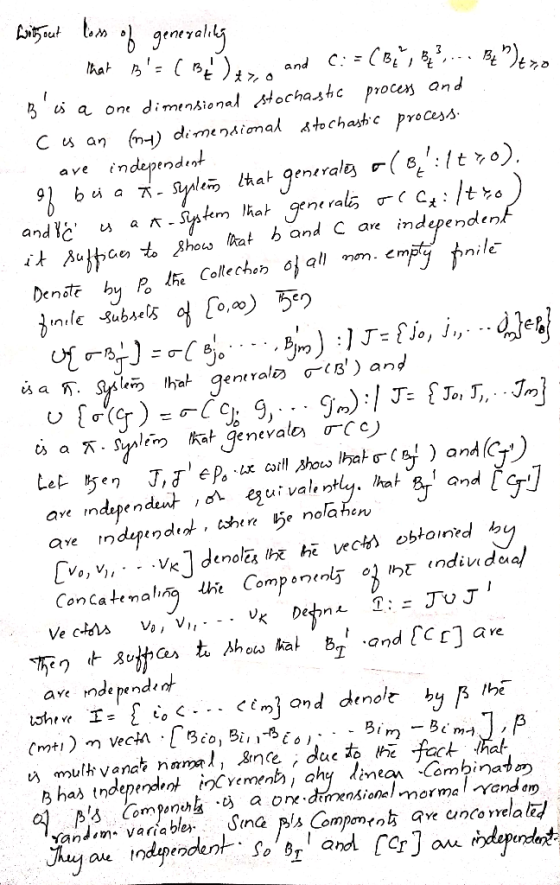
If B4 =(B{"),...,B")) is n-dimensional Brownian motion, then the 1-dimensional processes {B }t>0,...
Help please! Let Be be Brownian motion and fix to > 0. Prove that By: =...
 Help please!
Let Be be Brownian motion and fix to > 0. Prove that By: = Bto+t - Blo; t o is a Brownian motion.
Help please!
Let Be be Brownian motion and fix to > 0. Prove that By: = Bto+t - Blo; t o is a Brownian motion.
Let the Brownian motion (b(t)) start at X0 (constant) B(0)=X0, => B(t) ~ N(X0,t) why?
Let the Brownian motion (b(t)) start at X0 (constant) B(0)=X0, => B(t) ~ N(X0,t) why?
8.20. Prove that, with probability 1, for Brownian motion with drift pH XO 8.20. Prove that, with probability 1, for Brownian motion with drift pH XO
 8.20. Prove that, with probability 1, for Brownian motion with drift pH XO
8.20. Prove that, with probability 1, for Brownian motion with drift pH XO
8.20. Prove that, with probability 1, for Brownian motion with drift pH XO
8.20. Prove that, with probability 1, for Brownian motion with drift p XO 8.20. Prove that, with probability 1, for Brownian motion with drift p XO
 8.20. Prove that, with probability 1, for Brownian motion with drift p XO
8.20. Prove that, with probability 1, for Brownian motion with drift p XO
8.20. Prove that, with probability 1, for Brownian motion with drift p XO
t2s points). Let B(t) be Brownian motion and let zu) with drift u0. For any B()+ ut be Brownian motion t 0, let T be the first time Z(t) hits a. a) Show that T, is a random time for Z(t) and for...
 t2s points). Let B(t) be Brownian motion and let zu) with drift u0. For any B()+ ut be Brownian motion t 0, let T be the first time Z(t) hits a. a) Show that T, is a random time for Z(t) and for B(t). b) Show P(T, 0o)1. c) Use martingale methods to compute E [e-m] for any θ > 0 r>
t2s points). Let B(t) be Brownian motion and let zu) with drift u0. For any B()+ ut be...
t2s points). Let B(t) be Brownian motion and let zu) with drift u0. For any B()+ ut be Brownian motion t 0, let T be the first time Z(t) hits a. a) Show that T, is a random time for Z(t) and for B(t). b) Show P(T, 0o)1. c) Use martingale methods to compute E [e-m] for any θ > 0 r>
t2s points). Let B(t) be Brownian motion and let zu) with drift u0. For any B()+ ut be...
I need help to understand the increment of Brownian motion. Especially for second equation, why E[B(t+u)-B(t)^2]...
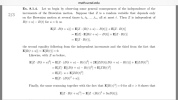 I need help to understand the increment of Brownian motion.
Especially for second equation, why E[B(t+u)-B(t)^2] = u?
Please explain the details as much as possible. Thank
you
math.ucsd.edu Ex. 8.1.4. Let us begin by observing some general consequences of the independence of the 2/3 213 crements of the Brownian motion. Suppose that Z is a random variable that depends only on the Brownian motion at several times t1, t,.,tn, all at most t. Then Z is independent of B(t...
I need help to understand the increment of Brownian motion.
Especially for second equation, why E[B(t+u)-B(t)^2] = u?
Please explain the details as much as possible. Thank
you
math.ucsd.edu Ex. 8.1.4. Let us begin by observing some general consequences of the independence of the 2/3 213 crements of the Brownian motion. Suppose that Z is a random variable that depends only on the Brownian motion at several times t1, t,.,tn, all at most t. Then Z is independent of B(t...
{ W, : t > 0} be a Brownian motion. Find E(W, (W2t --We), where 0 < t < 1: Let W Select one: t (1 -t) 0 { W, : t > 0} be a Brownian motion. Find E(W, (W2t --We), where 0
 { W, : t > 0} be a Brownian motion. Find E(W, (W2t --We), where 0 < t < 1: Let W Select one: t (1 -t) 0
{ W, : t > 0} be a Brownian motion. Find E(W, (W2t --We), where 0
{ W, : t > 0} be a Brownian motion. Find E(W, (W2t --We), where 0 < t < 1: Let W Select one: t (1 -t) 0
{ W, : t > 0} be a Brownian motion. Find E(W, (W2t --We), where 0
How to prove a Brownian Motion Process {X(t),t>=o} that its X(t) is normally distributed with mean...
How to prove a Brownian Motion Process {X(t),t>=o} that its X(t) is normally distributed with mean 0 and variance σ2t using Central Limit Theorem?
Let {X(t), 1 2 0} denote a Brownian motion 8.1. Let Y(t) = tx(1/t). (a) What is the distributio...
 let {X(t), 1 2 0} denote a Brownian motion 8.1. Let Y(t) = tx(1/t). (a) What is the distribution of Y(t)? (b) Compute Cov(Y(s), Y()) (c) Argue that {Y(t), t 2 0] is also Brownian motion (d) Let Using (c) present an argument that
let {X(t), 1 2 0} denote a Brownian motion
8.1. Let Y(t) = tx(1/t). (a) What is the distribution of Y(t)? (b) Compute Cov(Y(s), Y()) (c) Argue that {Y(t), t 2 0] is also Brownian motion...
let {X(t), 1 2 0} denote a Brownian motion 8.1. Let Y(t) = tx(1/t). (a) What is the distribution of Y(t)? (b) Compute Cov(Y(s), Y()) (c) Argue that {Y(t), t 2 0] is also Brownian motion (d) Let Using (c) present an argument that
let {X(t), 1 2 0} denote a Brownian motion
8.1. Let Y(t) = tx(1/t). (a) What is the distribution of Y(t)? (b) Compute Cov(Y(s), Y()) (c) Argue that {Y(t), t 2 0] is also Brownian motion...
Let W - {Wi,0< t < ) represent a standard Brownian motion Show that the process...
 Let W - {Wi,0< t < ) represent a standard Brownian motion Show that the process Z(s)-(zt-W f.0 < t-1) is a standard Brownian motion, where s > 0 is fixed
 Help please!
Let Be be Brownian motion and fix to > 0. Prove that By: = Bto+t - Blo; t o is a Brownian motion.
Help please!
Let Be be Brownian motion and fix to > 0. Prove that By: = Bto+t - Blo; t o is a Brownian motion.
 8.20. Prove that, with probability 1, for Brownian motion with drift pH XO
8.20. Prove that, with probability 1, for Brownian motion with drift pH XO
8.20. Prove that, with probability 1, for Brownian motion with drift pH XO
 8.20. Prove that, with probability 1, for Brownian motion with drift p XO
8.20. Prove that, with probability 1, for Brownian motion with drift p XO
8.20. Prove that, with probability 1, for Brownian motion with drift p XO
 t2s points). Let B(t) be Brownian motion and let zu) with drift u0. For any B()+ ut be Brownian motion t 0, let T be the first time Z(t) hits a. a) Show that T, is a random time for Z(t) and for B(t). b) Show P(T, 0o)1. c) Use martingale methods to compute E [e-m] for any θ > 0 r>
t2s points). Let B(t) be Brownian motion and let zu) with drift u0. For any B()+ ut be...
t2s points). Let B(t) be Brownian motion and let zu) with drift u0. For any B()+ ut be Brownian motion t 0, let T be the first time Z(t) hits a. a) Show that T, is a random time for Z(t) and for B(t). b) Show P(T, 0o)1. c) Use martingale methods to compute E [e-m] for any θ > 0 r>
t2s points). Let B(t) be Brownian motion and let zu) with drift u0. For any B()+ ut be...
 I need help to understand the increment of Brownian motion.
Especially for second equation, why E[B(t+u)-B(t)^2] = u?
Please explain the details as much as possible. Thank
you
math.ucsd.edu Ex. 8.1.4. Let us begin by observing some general consequences of the independence of the 2/3 213 crements of the Brownian motion. Suppose that Z is a random variable that depends only on the Brownian motion at several times t1, t,.,tn, all at most t. Then Z is independent of B(t...
I need help to understand the increment of Brownian motion.
Especially for second equation, why E[B(t+u)-B(t)^2] = u?
Please explain the details as much as possible. Thank
you
math.ucsd.edu Ex. 8.1.4. Let us begin by observing some general consequences of the independence of the 2/3 213 crements of the Brownian motion. Suppose that Z is a random variable that depends only on the Brownian motion at several times t1, t,.,tn, all at most t. Then Z is independent of B(t...
 { W, : t > 0} be a Brownian motion. Find E(W, (W2t --We), where 0 < t < 1: Let W Select one: t (1 -t) 0
{ W, : t > 0} be a Brownian motion. Find E(W, (W2t --We), where 0
{ W, : t > 0} be a Brownian motion. Find E(W, (W2t --We), where 0 < t < 1: Let W Select one: t (1 -t) 0
{ W, : t > 0} be a Brownian motion. Find E(W, (W2t --We), where 0
 let {X(t), 1 2 0} denote a Brownian motion 8.1. Let Y(t) = tx(1/t). (a) What is the distribution of Y(t)? (b) Compute Cov(Y(s), Y()) (c) Argue that {Y(t), t 2 0] is also Brownian motion (d) Let Using (c) present an argument that
let {X(t), 1 2 0} denote a Brownian motion
8.1. Let Y(t) = tx(1/t). (a) What is the distribution of Y(t)? (b) Compute Cov(Y(s), Y()) (c) Argue that {Y(t), t 2 0] is also Brownian motion...
let {X(t), 1 2 0} denote a Brownian motion 8.1. Let Y(t) = tx(1/t). (a) What is the distribution of Y(t)? (b) Compute Cov(Y(s), Y()) (c) Argue that {Y(t), t 2 0] is also Brownian motion (d) Let Using (c) present an argument that
let {X(t), 1 2 0} denote a Brownian motion
8.1. Let Y(t) = tx(1/t). (a) What is the distribution of Y(t)? (b) Compute Cov(Y(s), Y()) (c) Argue that {Y(t), t 2 0] is also Brownian motion...
 Let W - {Wi,0< t < ) represent a standard Brownian motion Show that the process Z(s)-(zt-W f.0 < t-1) is a standard Brownian motion, where s > 0 is fixed
Most questions answered within 3 hours.
-
Where is the error in this code sequence?
String s1 = "Hello";
String s2 = "ello";...
asked 10 months ago -
Financial data for Joel de Paris, Inc., for last year
follow:
Joel de Paris, Inc.
Balance...
asked 10 months ago -
Consider this reaction:
Al2(SO4)3 (aq)+ BaCl3
(aq) Al2Cl6 (aq)- +
3BaSO4(s) . What is the...
asked 10 months ago -
Suppose that Savneet is considering increasing her
recent random sample from 20 car rentals to 40...
asked 10 months ago -
Trucks arrive at an unloading terminal at an average rate of 120
per hour.
Trucks arrive...
asked 10 months ago -
Why are methanol and ethanol completely soluble in water while
octanol is not very little soluble....
asked 10 months ago -
A facilities manager at a university reads in a research report
that the mean amount of...
asked 10 months ago -
When the CuSO4 is rehydrated by adding water to the anhydrous
compound, is this an endothermic...
asked 10 months ago -
A ray of sunlight is passing from diamond into crown glass; the
angle of incidence is...
asked 10 months ago -
A block of mass 0.249 kg is placed on top of a light, vertical
spring of...
asked 10 months ago -
how do the kidneys compensate in the presences of acidosis
a) trigger hyperventilate
b) reserve acid...
asked 10 months ago -
Question 501 pts
The rental rate of capital to the firm increases. Which of the
following...
asked 10 months ago