
Homework Answers
Add Answer to:
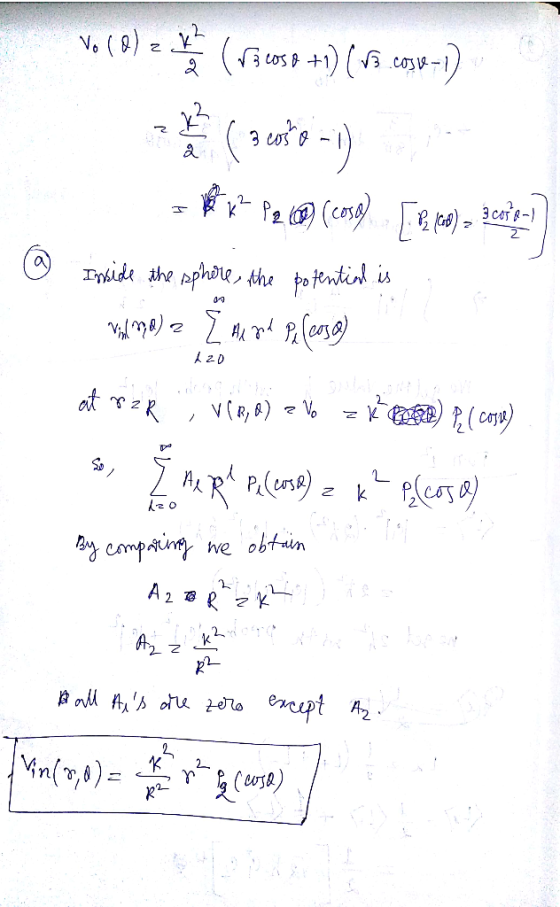
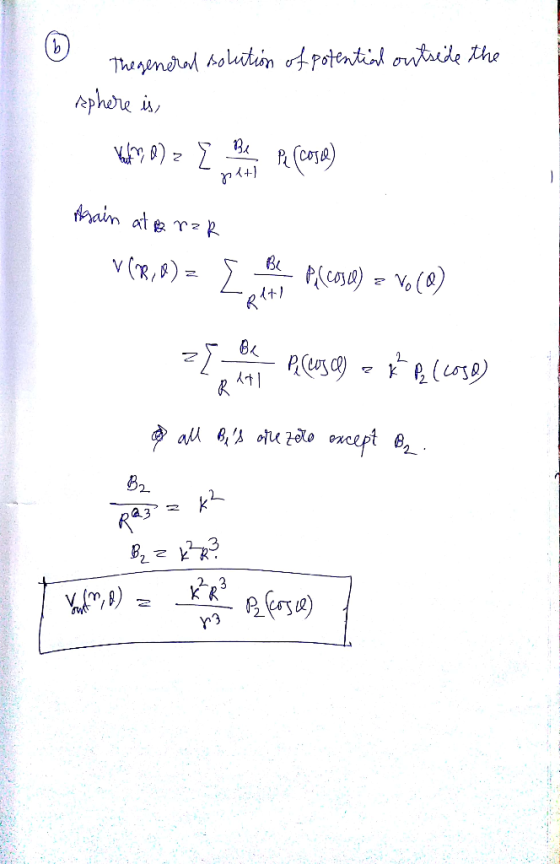
Suppose that the potential Volt) is specified on the surface of a sphere. Voce= k (Brose...
(16 pts total) The potential at the surface of a sphere of radius R is given...
 (16 pts total) The potential at the surface of a sphere of radius R is given by Vo k(35cos 0-30cos +5cos+3) where k is a constant. Assume there is no charge inside or outside the sphere. 2. a. (5 pts) Write Vo in terms of Legendre polynomials b. (6 pts) Determine the boundary conditions and find the potential inside and outside the sphere. (5 pts) Find the surface charge density σ(θ) at the surface of the sphere. C.
The potential at the surface of a sphere is given by V = kcos(theta) where k...
The potential at the surface of a sphere is given by V = kcos(theta) where k is a constant. A) find the potential inside and outside the sphere (no charge present inside or outside the sphere) B) Determine the charge density sigma on the surface of the sphere.
6. The electric potential at the surface of a sphere of radius R is constant, i.e.,...
 6. The electric potential at the surface of a sphere of radius R is constant, i.e., V(R,0) = k, where k + 0. Very far away from the sphere (r >> R) the electric potential is V(r,0) = kr cos(0). Find the electric potential outside the sphere, remember to check that your answer matches the boundary conditions (1 point).
5. A hollow sphere of radius R has a potential on the surface of V(θ, d)...
 5. A hollow sphere of radius R has a potential on the surface of V(θ, d) Vo cos θ. There is no a) Find the potential everywhere inside and outside the sphere. b) Find the electric field everywhere inside the sphere. (You will find it easier to convert the potential to Cartesian coordinates and then find the field.) c) Find the charge density σ(0) on the surface of the sphere using Gauss' law. charge inside or outside the sphere.
1. The potential at the surface of a sphere is kept at potential V(R.0)-Vo sin20. The...
 1. The potential at the surface of a sphere is kept at potential V(R.0)-Vo sin20. The potential at infinity is zero. (a) Find V(r, 0) inside the sphere. (b) Find V(r,0) outside the sphere. (c) Find σ(θ), the charge density on the sphere. (d) Find the total charge of the sphere. (e) The problern would be a lot harder if the potential were specified to be V(R,θ)-Võsin θ Why? Explain how you would do part (a) without going through the...
2. Potentials and a Conducting Surface The electric potential outside of a solid spherical conductor of...
 2. Potentials and a Conducting Surface The electric potential outside of a solid spherical conductor of radius R is found to be V(r, 9) = -E, cose (--) where E, is a constant and r and 0 are the spherical radial and polar angle coordinates, respectively. This electric potential is due to the charges on the conductor and charges outside of the conductor 1. Find an expression for the electric field inside the spherical conductor. 2. Find an expression for...
2. (30 POINTS) A spherical shell of radius R holds a potential on its surface of:...
 2. (30 POINTS) A spherical shell of radius R holds a potential on its surface of: V(R, 0) = V.(1 + 2cose - cos20) (a.) Find the potential inside and outside the sphere. (b.) Find the surface charge density on the sphere. (c.) Find the dipole moment and the dipole term of the electric field, Epip.
Charge is spread uniformly over the surface of a sphere of radius R. The potential at...
Charge is spread uniformly over the surface of a sphere of radius R. The potential at the sphere's center is V. Find an expression for the net charge Q on the sphere. Express your answer in terms of the variables R, V, and the Coulomb's constant k.
This problem involves solving for the electric potential inside the surface of one quarter of a sphere of radius ro. A 90 800 ers ariszed a cviu The potental Inside The surfaces of this quadra-sphere...
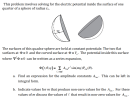 This problem involves solving for the electric potential inside the surface of one quarter of a sphere of radius ro. A 90 800 ers ariszed a cviu The potental Inside The surfaces of this quadra-sphere are held at constant potentials: The two flat surfaces at Φ-0 and the curved surface at φ-V," The potential inside this surface where V-Φ-0 can be written as a series expansion, , msl a. Find an expression for the amplitude constants A(m This can be...
A sphere has a total charge Q uniformly distributed over its volume. The field inside the...
A sphere has a total charge Q uniformly distributed over its volume. The field inside the sphere at a radius r is given by Er= k (Q/R^3) r (a) What is the electric field at a radius r from the center of the sphere, where r > R (i.e outside of the sphere)? (b) Write down an expression for the electric potential at a radius r for r > R (i.e. outside of the sphere). (c) What is the electric...
 (16 pts total) The potential at the surface of a sphere of radius R is given by Vo k(35cos 0-30cos +5cos+3) where k is a constant. Assume there is no charge inside or outside the sphere. 2. a. (5 pts) Write Vo in terms of Legendre polynomials b. (6 pts) Determine the boundary conditions and find the potential inside and outside the sphere. (5 pts) Find the surface charge density σ(θ) at the surface of the sphere. C.
 6. The electric potential at the surface of a sphere of radius R is constant, i.e., V(R,0) = k, where k + 0. Very far away from the sphere (r >> R) the electric potential is V(r,0) = kr cos(0). Find the electric potential outside the sphere, remember to check that your answer matches the boundary conditions (1 point).
 5. A hollow sphere of radius R has a potential on the surface of V(θ, d) Vo cos θ. There is no a) Find the potential everywhere inside and outside the sphere. b) Find the electric field everywhere inside the sphere. (You will find it easier to convert the potential to Cartesian coordinates and then find the field.) c) Find the charge density σ(0) on the surface of the sphere using Gauss' law. charge inside or outside the sphere.
 1. The potential at the surface of a sphere is kept at potential V(R.0)-Vo sin20. The potential at infinity is zero. (a) Find V(r, 0) inside the sphere. (b) Find V(r,0) outside the sphere. (c) Find σ(θ), the charge density on the sphere. (d) Find the total charge of the sphere. (e) The problern would be a lot harder if the potential were specified to be V(R,θ)-Võsin θ Why? Explain how you would do part (a) without going through the...
 2. Potentials and a Conducting Surface The electric potential outside of a solid spherical conductor of radius R is found to be V(r, 9) = -E, cose (--) where E, is a constant and r and 0 are the spherical radial and polar angle coordinates, respectively. This electric potential is due to the charges on the conductor and charges outside of the conductor 1. Find an expression for the electric field inside the spherical conductor. 2. Find an expression for...
 2. (30 POINTS) A spherical shell of radius R holds a potential on its surface of: V(R, 0) = V.(1 + 2cose - cos20) (a.) Find the potential inside and outside the sphere. (b.) Find the surface charge density on the sphere. (c.) Find the dipole moment and the dipole term of the electric field, Epip.
 This problem involves solving for the electric potential inside the surface of one quarter of a sphere of radius ro. A 90 800 ers ariszed a cviu The potental Inside The surfaces of this quadra-sphere are held at constant potentials: The two flat surfaces at Φ-0 and the curved surface at φ-V," The potential inside this surface where V-Φ-0 can be written as a series expansion, , msl a. Find an expression for the amplitude constants A(m This can be...
Most questions answered within 3 hours.
-
Where is the error in this code sequence?
String s1 = "Hello";
String s2 = "ello";...
asked 10 months ago -
Financial data for Joel de Paris, Inc., for last year
follow:
Joel de Paris, Inc.
Balance...
asked 10 months ago -
Consider this reaction:
Al2(SO4)3 (aq)+ BaCl3
(aq) Al2Cl6 (aq)- +
3BaSO4(s) . What is the...
asked 10 months ago -
Suppose that Savneet is considering increasing her
recent random sample from 20 car rentals to 40...
asked 10 months ago -
Trucks arrive at an unloading terminal at an average rate of 120
per hour.
Trucks arrive...
asked 10 months ago -
Why are methanol and ethanol completely soluble in water while
octanol is not very little soluble....
asked 10 months ago -
A facilities manager at a university reads in a research report
that the mean amount of...
asked 10 months ago -
When the CuSO4 is rehydrated by adding water to the anhydrous
compound, is this an endothermic...
asked 10 months ago -
A ray of sunlight is passing from diamond into crown glass; the
angle of incidence is...
asked 10 months ago -
A block of mass 0.249 kg is placed on top of a light, vertical
spring of...
asked 10 months ago -
how do the kidneys compensate in the presences of acidosis
a) trigger hyperventilate
b) reserve acid...
asked 10 months ago -
Question 501 pts
The rental rate of capital to the firm increases. Which of the
following...
asked 10 months ago