Homework Answers
Rod in vertical position:
Gravitational potential energy, Ui=MgL/2
As it is in equilibrium and not moving kinetic energy, Ki=0
Total mechanical energy, Ei=Ui+Ki = MgL/2 -----------(1)
Rod in horizontal position:
As the rod falls and just reaches the horizontal position, its centre of mass is in the ground. Therefore gravitational potential energy, Uf = 0
As it is in equilibrium and not moving kinetic energy, Kf=(1/2)Iω2
where I is the moment of inertia about the axis of rotation which is the point of contact with the ground.
Total mechanical energy, Ef = Uf+Kf =(1/2)Iω2------------(2)
As gravitational force is conservative in natutre, the total mechanical enrgy remains constant.
Therefore, Ef = Ei
Equating (2) and (1), we get, (1/2)I*ω2=MgL/2
As we need angular velocity about the point of conatct, we determine moment of inertia also about the same point.
So, moment of inertia I=ML2 /3
Using this we get, (1/2)*(ML2/3)*ω2 = MgL2
Or, (L2/3)*ω2 = gL
Which gives, (L/3)ω2 = gL
Or, ω2=3g / L
The angular speed, ω = √(3g/L)
ω = √(3*9.8 / 2.0m) = 3.83 rad/s
Add Answer to:
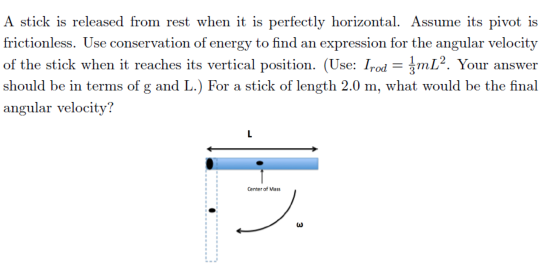
A stick is released from rest when it is perfectly horizontal.
Assume its pivot is
frictionless....
A think stick 1.5m long is pivoted about one end. The stick is held in a...
A think stick 1.5m long is pivoted about one end. The stick is held in a horizontal position and released from rest. Neglecting friction, use conservation of energy to determine the stick's angular velocity when it is vertical. (Hint: When determining the change in gravitational potential energy of the stick, you must consider the change in position of the stick's centre of mass)
11. A thin straight board is held horizontal and then released from rest. It has a...
 11. A thin straight board is held horizontal and then released from rest. It has a mass M and a length L, and it can pivot at one end as shown above. Ignore all effects due to friction At the instant it is released from rest in the horizontal position: (a) What is the board's angular acceleration? (b) What is the tangential acceleration of the board's center of mass? (c) What is the tangential acceleration of the board's free end?...
A long, uniform rod of mass m and length L is connected to a frictionless pivot....
 A long, uniform rod of mass m and length L is connected to a frictionless pivot. It's held in place horizontally and allowed to swing down under the influence of gravity. 3. Sketch the: net torque on the rod as a function of time, and as a function of angular position (for the interval of horizontal to vertical ). (the fatび ) Derive an expression for the angular velocity at the bottom of the rod's swing. a. b.
The thin uniform rod in the figure has length 7.0 m and can pivot about a...
The thin uniform rod in the figure has length 7.0 m and can pivot about a horizontal, frictionless pin through one end. It is released from rest at angle θ = 40° above the horizontal. Use the principle of conservation of energy to determine the angular speed of the rod as it passes through the horizontal position. Assume free-fall acceleration to be equal to 9.83 m/s2.
4(12 points) A uniform rod of length L and mass M is attached at one end...
 4(12 points) A uniform rod of length L and mass M is attached at one end to a frictionless pivot and is free to rotate about the pivot in the vertical plane as in Figure. The rod is released from rest in the horizontal position. (a)What are the initial angular acceleration of the rod and the initial translational acceleration of its right end (as shown in Fig.a)? (b)What is its angular speed when the rod reaches its lowest position (as...
A uniform rod of mass M and length L is released from its horizontal position. The...
 A uniform rod of mass M and length L is released from its horizontal position. The rod pivots about a fixed frictionless axis at' onc end and rotates countcrclockwise duc to gravity. It collides and sticks to another rod with same length and mass which is ver- tically at rest. (For a rod with mass M and length L, the moment of inertia about an axis through its one end is given by1-ML) L,M L, M Initial Final (a)(5 pts.)...
A stick of length 1.5 m and mass 9.0 kg is free to rotate about a...
 A stick of length 1.5 m and mass 9.0 kg is free to rotate about
a horizontal axis through the center. Small bodies of masses 8.0
and 2.0 kg are attached to its two ends (see the following figure).
The stick is released from the horizontal position. What is the
angular velocity of the stick (in rad/s) when it swings through the
vertical? (Enter the magnitude.)
A stick of length 1.5 m and mass 9.0 kg is free to rotate about
a horizontal axis through the center. Small bodies of masses 8.0
and 2.0 kg are attached to its two ends (see the following figure).
The stick is released from the horizontal position. What is the
angular velocity of the stick (in rad/s) when it swings through the
vertical? (Enter the magnitude.)
A slender 9 lb rod can rotate in a vertical plane about a pivot at B. A spring of constant k-30 lb/ft and of unstretched length 6 in. is attached to the rod as shown. The rod is released from rest in...
 A slender 9 lb rod can rotate in a vertical plane about a pivot at B. A spring of constant k-30 lb/ft and of unstretched length 6 in. is attached to the rod as shown. The rod is released from rest in the position shown. 1) Determine its angular velocity after the rod has rotated through 45.(1 point) 2) Determine the reaction force at pivot point B after the rod rotated through 45. (1 point) 24 in 5 in. 4...
Sample Problem 6. The 30 kg slender rod is released from rest when θ-00 (when rod OA is in the horizontal position). The spring is unstretched at θ-00. A constant clockwise moment of 10 N-m is applie...
 Sample Problem 6. The 30 kg slender rod is released from rest when θ-00 (when rod OA is in the horizontal position). The spring is unstretched at θ-00. A constant clockwise moment of 10 N-m is applied to the rod. A force, P, of 20 N is applied and is always perpendicular to the rod. Determine the angular velocity of the rod when θ- 750. (Use the work-energy or conservation of energy method). 2 m 10 N-mm k80 N/m 1.5...
The 0.2-16 bar is released from rest in the position shown. Find the angular velocity of...
 The 0.2-16 bar is released from rest in the position shown. Find the angular velocity of the bar when it reaches a position 30° below horizontal. The spring has a stiffness of 4.5 lb/ft and an undeformed length of 2 in. (50) -5.00 in -3.00 in OWARD B C
 11. A thin straight board is held horizontal and then released from rest. It has a mass M and a length L, and it can pivot at one end as shown above. Ignore all effects due to friction At the instant it is released from rest in the horizontal position: (a) What is the board's angular acceleration? (b) What is the tangential acceleration of the board's center of mass? (c) What is the tangential acceleration of the board's free end?...
 A long, uniform rod of mass m and length L is connected to a frictionless pivot. It's held in place horizontally and allowed to swing down under the influence of gravity. 3. Sketch the: net torque on the rod as a function of time, and as a function of angular position (for the interval of horizontal to vertical ). (the fatび ) Derive an expression for the angular velocity at the bottom of the rod's swing. a. b.
 4(12 points) A uniform rod of length L and mass M is attached at one end to a frictionless pivot and is free to rotate about the pivot in the vertical plane as in Figure. The rod is released from rest in the horizontal position. (a)What are the initial angular acceleration of the rod and the initial translational acceleration of its right end (as shown in Fig.a)? (b)What is its angular speed when the rod reaches its lowest position (as...
 A uniform rod of mass M and length L is released from its horizontal position. The rod pivots about a fixed frictionless axis at' onc end and rotates countcrclockwise duc to gravity. It collides and sticks to another rod with same length and mass which is ver- tically at rest. (For a rod with mass M and length L, the moment of inertia about an axis through its one end is given by1-ML) L,M L, M Initial Final (a)(5 pts.)...
 A stick of length 1.5 m and mass 9.0 kg is free to rotate about
a horizontal axis through the center. Small bodies of masses 8.0
and 2.0 kg are attached to its two ends (see the following figure).
The stick is released from the horizontal position. What is the
angular velocity of the stick (in rad/s) when it swings through the
vertical? (Enter the magnitude.)
A stick of length 1.5 m and mass 9.0 kg is free to rotate about
a horizontal axis through the center. Small bodies of masses 8.0
and 2.0 kg are attached to its two ends (see the following figure).
The stick is released from the horizontal position. What is the
angular velocity of the stick (in rad/s) when it swings through the
vertical? (Enter the magnitude.)
 A slender 9 lb rod can rotate in a vertical plane about a pivot at B. A spring of constant k-30 lb/ft and of unstretched length 6 in. is attached to the rod as shown. The rod is released from rest in the position shown. 1) Determine its angular velocity after the rod has rotated through 45.(1 point) 2) Determine the reaction force at pivot point B after the rod rotated through 45. (1 point) 24 in 5 in. 4...
 Sample Problem 6. The 30 kg slender rod is released from rest when θ-00 (when rod OA is in the horizontal position). The spring is unstretched at θ-00. A constant clockwise moment of 10 N-m is applied to the rod. A force, P, of 20 N is applied and is always perpendicular to the rod. Determine the angular velocity of the rod when θ- 750. (Use the work-energy or conservation of energy method). 2 m 10 N-mm k80 N/m 1.5...
 The 0.2-16 bar is released from rest in the position shown. Find the angular velocity of the bar when it reaches a position 30° below horizontal. The spring has a stiffness of 4.5 lb/ft and an undeformed length of 2 in. (50) -5.00 in -3.00 in OWARD B C
Most questions answered within 3 hours.
-
Where is the error in this code sequence?
String s1 = "Hello";
String s2 = "ello";...
asked 10 months ago -
Financial data for Joel de Paris, Inc., for last year
follow:
Joel de Paris, Inc.
Balance...
asked 10 months ago -
Consider this reaction:
Al2(SO4)3 (aq)+ BaCl3
(aq) Al2Cl6 (aq)- +
3BaSO4(s) . What is the...
asked 10 months ago -
Suppose that Savneet is considering increasing her
recent random sample from 20 car rentals to 40...
asked 10 months ago -
Trucks arrive at an unloading terminal at an average rate of 120
per hour.
Trucks arrive...
asked 10 months ago -
Why are methanol and ethanol completely soluble in water while
octanol is not very little soluble....
asked 10 months ago -
A facilities manager at a university reads in a research report
that the mean amount of...
asked 10 months ago -
When the CuSO4 is rehydrated by adding water to the anhydrous
compound, is this an endothermic...
asked 10 months ago -
A ray of sunlight is passing from diamond into crown glass; the
angle of incidence is...
asked 10 months ago -
A block of mass 0.249 kg is placed on top of a light, vertical
spring of...
asked 10 months ago -
how do the kidneys compensate in the presences of acidosis
a) trigger hyperventilate
b) reserve acid...
asked 10 months ago -
Question 501 pts
The rental rate of capital to the firm increases. Which of the
following...
asked 10 months ago