The following table contains information regarding jobs that are to be scheduled through one machine. Assume...
The following table contains information regarding jobs that are to be scheduled through one machine. Assume jobs are listed in order of arrival (i.e., A, then B, then C, etc.).
| JOB |
PROCESSING TIME (DAYS) |
DUE DATE |
||
| A | 7 | 20 | ||
| B | 15 | 21 | ||
| C | 1 | 16 | ||
| D | 12 | 17 | ||
| E | 11 | 15 | ||
| F | 4 | 6 | ||
| G | 5 | 12 | ||
Round your answers to 1 decimal place.
a. What is the first-come, first-served (FCFS) schedule?
b. What is the shortest operating time (SOT) schedule?
c. What is the slack time remaining (STR) schedule?
Homework Answers


Add Answer to:
The following table contains information regarding jobs that are
to be scheduled through one machine. Assume...
The following table contains information regarding jobs that are to be scheduled through one machine: OPERATIONS...
The following table contains information regarding jobs that are to be scheduled through one machine: OPERATIONS TIME JOB PROCESSING TIME(DAYS) DUE DATE A 4 10 B 12 20 C 2 30 D 11 18 E 10 10 What is the shortest operating time (SOT) schedule? (2 points) What is the slack time remaining (STR) schedule? (4 points) For the schedule A-B-C-D-E, compute average lateness? (4 points)
The following table contains information concerning four jobs that are awaiting processing at a work center....
The following table contains information concerning four jobs that are awaiting processing at a work center. Job Job Time (Days) Due Date (Days) A 14 20 B 10 16 C 7 15 D 6 17 a. Sequence the jobs using (1) First come, first served, (2) Shortest processing time, (3) Earliest due date, and (4) Critical ratio. Assume the list is by order of arrival. Sequence for First come, first served (Click to select) A-B-C-D D-C-B-A C-B-D-A A-C-D-B Sequence for Shortest processing time (Click...
1. The table shows the jobs to be scheduled and estimated process times for the jobs....
1. The table shows the jobs to be scheduled and estimated process times for the jobs. The promised delivery times are shown in the table. Job process time delivery due time slack time A 4 75 B 16 90 C 2 30 D 27 90 E 5 90 F 38 75 G 26 120 Determine the average process completion time and average delay using (i) the shortest processing time first and (ii) the minimum slack time first dispatch rules.
4. [10 points] Today is Nov 15. The following jobs need to be scheduled on the...
 4. [10 points] Today is Nov 15. The following jobs need to be scheduled on the same machine. Job Processing Time (Davs) Due Date Nov 30 Dec 22 Nov 18 Dec 3 Nov 29 12 a. Schedule the jobs according to i. Shortest processing time ii. Earliest due date. iii. Longest processing time. b. For the SPT& EED schedules from part a, calculate the average completion time.
Here is a table of processes and their associated arrival and running times: Show the scheduling...
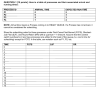 Here is a table of processes and their associated arrival and running times: Show the scheduling order for these processes under First-Come-First-Served (FCFS), Shortest-Job First (SJF), and Round-Robin (RR) with a quantum = 1 time unit. Assume that the context switch overhead is 0 and new processes are added to the head of the queue (i.e. next in line for scheduling) except for FCFS. In the table, use notation such as P1, P2, etc.
Which of the following is TRUE when comparing the shortest processing time (SPT) versus first-come-first-served (FCFS)...
Which of the following is TRUE when comparing the shortest processing time (SPT) versus first-come-first-served (FCFS) for job sequencing? Jobs spend less time in the system with SPT than with FCFS. The system has more capacity with SPT than with FCFS. Jobs spend more time in the system with SPT than with FCFS. The system has less capacity with SPT than with FCFS.
Question 20, Math problem 20. The Mowry Machine Shop still has five jobs to be pro-...
 Question 20, Math problem
20. The Mowry Machine Shop still has five jobs to be pro- cessed as of 8 A.M. today (day 23) at its bottleneck opera- tion. The day when the order arrived, processing time, and promised due dates are given in the following table. The jobs are listed in the order of arrival. Time Since Order Arrived (days ago) Processing Time (days) Due Date (days from now) Job А 11 10 22 10 8 В 13 8...
Question 20, Math problem
20. The Mowry Machine Shop still has five jobs to be pro- cessed as of 8 A.M. today (day 23) at its bottleneck opera- tion. The day when the order arrived, processing time, and promised due dates are given in the following table. The jobs are listed in the order of arrival. Time Since Order Arrived (days ago) Processing Time (days) Due Date (days from now) Job А 11 10 22 10 8 В 13 8...
ABC Enterprises has five jobs that must be scheduled for production at a work center. Below...
ABC Enterprises has five jobs that must be scheduled for production at a work center. Below are the processing times and due dates for each job. Job Processing Time (in days) Due Date (days from today) 1 7 14 2 5 21 3 3 10 4 2 7 5 6 9 Schedule the jobs by sequencing them using the Earliest Due Date (EDD) priority rule. What is the average flow time? Show your Work and round your...
Problem #1 Five jobs are to be processed through a single machine. The processing times and...
Problem #1 Five jobs are to be processed through a single machine. The processing times and due dates are given here. Assume all released dates are zero. Job 1 2 3 4 5 Processing time 3 6 5 4 2 Due date 4 8 12 21 15 In each of the following cases determine the sequence in which she should perform and compute Mean Flow Time, Average Tardiness and the number of tardy jobs. A) Shortest Processing Time B) Early...
Answer ALL Questions 1. For the processes listed in Table 1, draw a chart illustrating their...
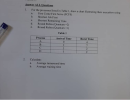 Answer ALL Questions 1. For the processes listed in Table 1, draw a chart illustrating their execution using: a. First Come First Serve (FCFS) b. Shortest Job First Shortest Remaining Time d. Round Robin (Quantum =2) e. Round Robin (Quantum =1) Table 1 Process Arrival Time Burst Time Calculate: a. Average turnaround time b. Average waiting time
 4. [10 points] Today is Nov 15. The following jobs need to be scheduled on the same machine. Job Processing Time (Davs) Due Date Nov 30 Dec 22 Nov 18 Dec 3 Nov 29 12 a. Schedule the jobs according to i. Shortest processing time ii. Earliest due date. iii. Longest processing time. b. For the SPT& EED schedules from part a, calculate the average completion time.
 Here is a table of processes and their associated arrival and running times: Show the scheduling order for these processes under First-Come-First-Served (FCFS), Shortest-Job First (SJF), and Round-Robin (RR) with a quantum = 1 time unit. Assume that the context switch overhead is 0 and new processes are added to the head of the queue (i.e. next in line for scheduling) except for FCFS. In the table, use notation such as P1, P2, etc.
 Question 20, Math problem
20. The Mowry Machine Shop still has five jobs to be pro- cessed as of 8 A.M. today (day 23) at its bottleneck opera- tion. The day when the order arrived, processing time, and promised due dates are given in the following table. The jobs are listed in the order of arrival. Time Since Order Arrived (days ago) Processing Time (days) Due Date (days from now) Job А 11 10 22 10 8 В 13 8...
Question 20, Math problem
20. The Mowry Machine Shop still has five jobs to be pro- cessed as of 8 A.M. today (day 23) at its bottleneck opera- tion. The day when the order arrived, processing time, and promised due dates are given in the following table. The jobs are listed in the order of arrival. Time Since Order Arrived (days ago) Processing Time (days) Due Date (days from now) Job А 11 10 22 10 8 В 13 8...
 Answer ALL Questions 1. For the processes listed in Table 1, draw a chart illustrating their execution using: a. First Come First Serve (FCFS) b. Shortest Job First Shortest Remaining Time d. Round Robin (Quantum =2) e. Round Robin (Quantum =1) Table 1 Process Arrival Time Burst Time Calculate: a. Average turnaround time b. Average waiting time
Most questions answered within 3 hours.
-
Where is the error in this code sequence?
String s1 = "Hello";
String s2 = "ello";...
asked 10 months ago -
Financial data for Joel de Paris, Inc., for last year
follow:
Joel de Paris, Inc.
Balance...
asked 10 months ago -
Consider this reaction:
Al2(SO4)3 (aq)+ BaCl3
(aq) Al2Cl6 (aq)- +
3BaSO4(s) . What is the...
asked 10 months ago -
Suppose that Savneet is considering increasing her
recent random sample from 20 car rentals to 40...
asked 10 months ago -
Trucks arrive at an unloading terminal at an average rate of 120
per hour.
Trucks arrive...
asked 10 months ago -
Why are methanol and ethanol completely soluble in water while
octanol is not very little soluble....
asked 10 months ago -
A facilities manager at a university reads in a research report
that the mean amount of...
asked 10 months ago -
When the CuSO4 is rehydrated by adding water to the anhydrous
compound, is this an endothermic...
asked 10 months ago -
A ray of sunlight is passing from diamond into crown glass; the
angle of incidence is...
asked 10 months ago -
A block of mass 0.249 kg is placed on top of a light, vertical
spring of...
asked 10 months ago -
how do the kidneys compensate in the presences of acidosis
a) trigger hyperventilate
b) reserve acid...
asked 10 months ago -
Question 501 pts
The rental rate of capital to the firm increases. Which of the
following...
asked 10 months ago