
Homework Answers

Add Answer to:
Show that, inside a straight current-carrying conductor of radius R If A is set equal to...
Consider a straight non-magnetic conductor with circular cross-section and a radius a carrying a current I...
Consider a straight non-magnetic conductor with circular cross-section and a radius a carrying a current I in the vertical direction. Using Ampere’s law find the magnetic field inside and outside the conductor.
An infinitely long, straight conductor with a circular cross-section of radius b carries a steady current I. (a) Determine the magnetic flux density (B) both inside and outside the conductor. (b) Det...
 An infinitely long, straight conductor with a circular cross-section of radius b carries a steady current I. (a) Determine the magnetic flux density (B) both inside and outside the conductor. (b) Determine the vector magnetic potential (A) both inside and outside the conductor from the relationship B V x A
An infinitely long, straight conductor with a circular cross-section of radius b carries a steady current I. (a) Determine the magnetic flux density (B) both inside and outside the conductor....
An infinitely long, straight conductor with a circular cross-section of radius b carries a steady current I. (a) Determine the magnetic flux density (B) both inside and outside the conductor. (b) Determine the vector magnetic potential (A) both inside and outside the conductor from the relationship B V x A
An infinitely long, straight conductor with a circular cross-section of radius b carries a steady current I. (a) Determine the magnetic flux density (B) both inside and outside the conductor....
IP A single current-carrying circular loop of radius R is placed next to a long, straight...
IP A single current-carrying circular loop of radius R is placed next to a long, straight wire, as shown in the figure(Figure 1) . The current in the wire points to the right and is of magnitude I. A. In which direction must current flow in the loop to produce zero magnetic field at its center? Explain. B. Calculate the magnitude of the current in part A. Express your answer in terms of some or all of the variables R,...
A single current-carrying circular loop of radius R is placed next to a long, straight wire,...
 A single current-carrying circular loop of radius
R is placed next to a long, straight wire, as
shown in the
figure. The current I in the wire flows to the
right and the a current I flows counter-clockwise
on the loop. What is the net magnetic field produce at the center
of the loop?
I R/2
A single current-carrying circular loop of radius
R is placed next to a long, straight wire, as
shown in the
figure. The current I in the wire flows to the
right and the a current I flows counter-clockwise
on the loop. What is the net magnetic field produce at the center
of the loop?
I R/2
The electric potential inside a charged spherical conductor of radius R is given by V =...
The electric potential inside a charged spherical conductor of radius R is given by V = keQ/R, and the potential outside is given by V = keQ/r. Using Er = -dV/dr, derive the electric field inside and outside this charge distribution. (Use the following as necessary: ke, Q, r and R.) (a) inside E = ? (b) outside E = ?
9. A very long straight wire carrying a current I has a loop of radius R...
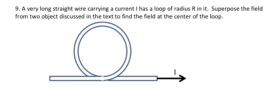 9. A very long straight wire carrying a current I has a loop of radius R in it. Superpose the field from two object discussed in the text to find the field at the center of the loop.
b inside a current carrying wire A steady current I flows through a wire of radius...
 b inside a current carrying wire
A steady current I flows through a wire of radius a. The current density in a wire varies with ras ) = kr2, where k is a constant and r is the distance from the axis of the wire. Find expressions for the magnitudes of the magnetic field inside and outside the wire as a function of r. (Hint: Find the current through an Ampèrian loop of radius r using thru /j. dA. Use...
b inside a current carrying wire
A steady current I flows through a wire of radius a. The current density in a wire varies with ras ) = kr2, where k is a constant and r is the distance from the axis of the wire. Find expressions for the magnitudes of the magnetic field inside and outside the wire as a function of r. (Hint: Find the current through an Ampèrian loop of radius r using thru /j. dA. Use...
The electric potential inside a charged spherical conductor of radius R is given by V = keQ/R, and the potential outsid...
The electric potential inside a charged spherical conductor of radius R is given by V = keQ/R, and the potential outside is given by V = keQ/r. Using Er = -dV/dr, derive the electric field inside and outside this charge distribution. (Use any variable or symbol stated above as necessary.)
A long, cylindrical conductor of radius R = 9.3 m carries a current I. The current...
A long, cylindrical conductor of radius R = 9.3 m carries a current I. The current density J, however, is not uniform over the cross-section of the conductor but is a function of the radius according to J = 15r2. Determine the magnetic field at a distance of R/2 from the center. Express your answer in microTesla.
A cylindrical conductor of radius R = 2.60 cm carries a current of I = 2.00...
A cylindrical conductor of radius R = 2.60 cm carries a current of I = 2.00 A along its length. This current is uniformly distributed throughout the cross section of the conductor. (a) Calculate the magnitude of the magnetic field midway along the radius of the wire (that is, at r = R/2). ________µT (b) Find the distance beyond the surface of the conductor at which the magnitude of the magnetic field has the same value as the magnitude of...
 An infinitely long, straight conductor with a circular cross-section of radius b carries a steady current I. (a) Determine the magnetic flux density (B) both inside and outside the conductor. (b) Determine the vector magnetic potential (A) both inside and outside the conductor from the relationship B V x A
An infinitely long, straight conductor with a circular cross-section of radius b carries a steady current I. (a) Determine the magnetic flux density (B) both inside and outside the conductor....
An infinitely long, straight conductor with a circular cross-section of radius b carries a steady current I. (a) Determine the magnetic flux density (B) both inside and outside the conductor. (b) Determine the vector magnetic potential (A) both inside and outside the conductor from the relationship B V x A
An infinitely long, straight conductor with a circular cross-section of radius b carries a steady current I. (a) Determine the magnetic flux density (B) both inside and outside the conductor....
 A single current-carrying circular loop of radius
R is placed next to a long, straight wire, as
shown in the
figure. The current I in the wire flows to the
right and the a current I flows counter-clockwise
on the loop. What is the net magnetic field produce at the center
of the loop?
I R/2
A single current-carrying circular loop of radius
R is placed next to a long, straight wire, as
shown in the
figure. The current I in the wire flows to the
right and the a current I flows counter-clockwise
on the loop. What is the net magnetic field produce at the center
of the loop?
I R/2
 9. A very long straight wire carrying a current I has a loop of radius R in it. Superpose the field from two object discussed in the text to find the field at the center of the loop.
 b inside a current carrying wire
A steady current I flows through a wire of radius a. The current density in a wire varies with ras ) = kr2, where k is a constant and r is the distance from the axis of the wire. Find expressions for the magnitudes of the magnetic field inside and outside the wire as a function of r. (Hint: Find the current through an Ampèrian loop of radius r using thru /j. dA. Use...
b inside a current carrying wire
A steady current I flows through a wire of radius a. The current density in a wire varies with ras ) = kr2, where k is a constant and r is the distance from the axis of the wire. Find expressions for the magnitudes of the magnetic field inside and outside the wire as a function of r. (Hint: Find the current through an Ampèrian loop of radius r using thru /j. dA. Use...
Most questions answered within 3 hours.
-
Where is the error in this code sequence?
String s1 = "Hello";
String s2 = "ello";...
asked 10 months ago -
Financial data for Joel de Paris, Inc., for last year
follow:
Joel de Paris, Inc.
Balance...
asked 10 months ago -
Consider this reaction:
Al2(SO4)3 (aq)+ BaCl3
(aq) Al2Cl6 (aq)- +
3BaSO4(s) . What is the...
asked 10 months ago -
Suppose that Savneet is considering increasing her
recent random sample from 20 car rentals to 40...
asked 10 months ago -
Trucks arrive at an unloading terminal at an average rate of 120
per hour.
Trucks arrive...
asked 10 months ago -
Why are methanol and ethanol completely soluble in water while
octanol is not very little soluble....
asked 10 months ago -
A facilities manager at a university reads in a research report
that the mean amount of...
asked 10 months ago -
When the CuSO4 is rehydrated by adding water to the anhydrous
compound, is this an endothermic...
asked 10 months ago -
A ray of sunlight is passing from diamond into crown glass; the
angle of incidence is...
asked 10 months ago -
A block of mass 0.249 kg is placed on top of a light, vertical
spring of...
asked 10 months ago -
how do the kidneys compensate in the presences of acidosis
a) trigger hyperventilate
b) reserve acid...
asked 10 months ago -
Question 501 pts
The rental rate of capital to the firm increases. Which of the
following...
asked 10 months ago