
Homework Answers
please upvote ? if you like my answer ?
Add Answer to:
Interpret and model using appropriate Mathem 5) Suppose a particle of mass m in a gravitational...
4. A particle of mass m is constrained to slide without friction on the surface of...
 4. A particle of mass m is constrained to slide without friction on the surface of a smooth circular bowl of mass M with inner radius R as shown in the figure. The bottom of the bowl lies on a horizontal table and is free to slide without friction along the table. All motion is constrained to the plane of the page. Assume uniform gravitati acceleration. =T-V- State the Lagrangian for this system. Derive the differential equations of motion for...
# Problem 1 # Suppose a point-mass particle with mass, 'm', moving in a gravitational potential,...
 # Problem 1 # Suppose a point-mass particle with mass, 'm', moving in a gravitational potential, 'U(r)', where 'r' is the distance from the center of the potential. A positional vector and momentum vector of a particle are vec r' and "vec p', respectively. (\vec means vector symbol.) Q1) An angular momentum vector vec J' is defined as vec J = \vec r x \vec p. Show that \vec J is conserved in such a gravitational potential U(r) which depends...
BY Problem - 11P29 A block of mass m is held at rest on a horizontal...
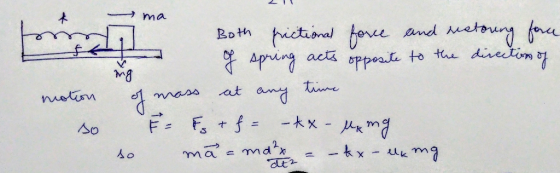
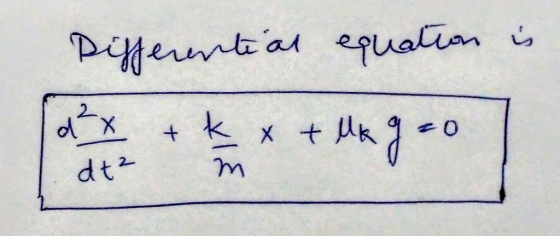
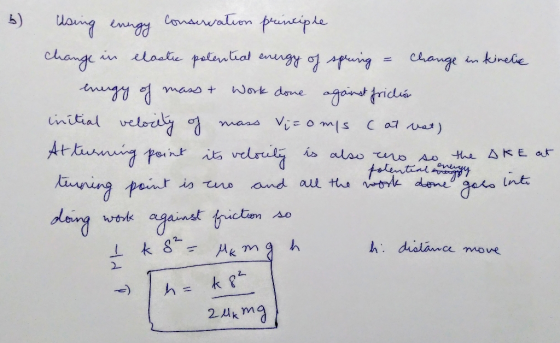
 BY Problem - 11P29 A block of mass m is held at rest on a horizontal surface with which it has coefficient of kinetic friction pk. The block is in contact with a spring of force constant k which is compressed by Ax, as shown at right. The block is released and allowed to slide to the left. (a) What is the speed v of the block at the moment when the spring is no longer com- pressed? (b) The...
A particle of mass m slides without slipping down and inclined plane of mass M. The...
A particle of mass m slides without slipping down and inclined plane of mass M. The plane(a triangle) in turn can slide along the horizontal surface without friction. Find the Lagrangian in terms of (x, s, dx/dt, ds/dt), where s is the distance the particle has traveled down the incline, and solve the corresponding Euler-Lagrangian equations. Let x(t) be the location of the block, relative to the fixed origin, and x(0) = dx/dt(0) = 0, as well as s(0) =...
Consider two masses, both with mass M, attached to a spring with spring constant k. They...
 Consider two masses, both with mass M, attached to a spring with
spring constant k. They slide along angled rails, and the angle
between the rails is theta. There is no friction: the masses slide
freely along the rails. Assume that the masses move together so
that the spring remains parallel to its equilibrium position. The
masses are initially moving upwards such that the spring is being
stretched past its equilibrium length. Describe what happens next,
by using Newton's second...
Consider two masses, both with mass M, attached to a spring with
spring constant k. They slide along angled rails, and the angle
between the rails is theta. There is no friction: the masses slide
freely along the rails. Assume that the masses move together so
that the spring remains parallel to its equilibrium position. The
masses are initially moving upwards such that the spring is being
stretched past its equilibrium length. Describe what happens next,
by using Newton's second...
A m= 2.00 kg block is pushed against a spring with negligible mass and force constant k= 300. N/m
 A m= 2.00 kg block is pushed against a spring with negligible mass and force constant k= 300. N/m, compressing it d= 0.250 m. When the block is released, it moves along a frictionless, horizontal surface and then up an incline with slope 37.0° and a coefficient of kinetic friction of 0.320. A)What is the speed of the block as it slides along the horizontal surface after having left the spring?B) How far does the object travel up the incline before...
5. A particle of mass m slides without friction and starting from rest down a block...
 5. A particle of mass m slides without friction and starting from rest down a block of mass M in which the surface is shaped into a quadrant of a circle of radius R. The block also slides without friction on a table top. Choose two suitable generalized coordinates a) Using the Lagrange-multiplier formalism, find the equations of motion of the mass and the block and the reaction force of the block on the mass (ie. the constraint force b)...
4. A particle of mass m 2 kg moves under the potential energy function U(x.y.z)- (kx...
 4. A particle of mass m 2 kg moves under the potential energy function U(x.y.z)- (kx + 2 k2y2 +3 k3z3) where k 1N. a. Suppose the particle has speed vo3 m/s when it passes through the origin. What will its speed be if and when it passes through the point (1,1.1)? b. Suppose the particle's speed vo at the origin is not known and that the point (1,1,1) is a turning point of the motion (a point where v0)....
1. Newton’s Laws and damped simple harmonic motion A particle of mass m = 5 moves...
1. Newton’s Laws and damped simple harmonic motion A particle of mass m = 5 moves in a straight line on a horizontal surface. It is subject to the following forces: an attractive force in the direction of the fixed origin O with magnitude 40 times the instantaneous distance from O a damping force due to friction which is 20 times the instantaneous speed the force due to gravity the normal force. The particle starts from rest at a distance...
Question 6.3 6.3 Consider a double mass-spring system with two masses of M and m on...
 Question 6.3
6.3 Consider a double mass-spring system with two masses of M and m on a frictionless surface, as shown in Figure 6.30. Mass m is connected to M by a spring of constant k and rest length lo. Mass M is connected to a fixed wall by a spring of constant k and rest length lo and a damper with constant b. Find the equations of motion of each mass. (HINT: See Tutorial 2.1.) risto M wa ww...
Question 6.3
6.3 Consider a double mass-spring system with two masses of M and m on a frictionless surface, as shown in Figure 6.30. Mass m is connected to M by a spring of constant k and rest length lo. Mass M is connected to a fixed wall by a spring of constant k and rest length lo and a damper with constant b. Find the equations of motion of each mass. (HINT: See Tutorial 2.1.) risto M wa ww...
 4. A particle of mass m is constrained to slide without friction on the surface of a smooth circular bowl of mass M with inner radius R as shown in the figure. The bottom of the bowl lies on a horizontal table and is free to slide without friction along the table. All motion is constrained to the plane of the page. Assume uniform gravitati acceleration. =T-V- State the Lagrangian for this system. Derive the differential equations of motion for...
 # Problem 1 # Suppose a point-mass particle with mass, 'm', moving in a gravitational potential, 'U(r)', where 'r' is the distance from the center of the potential. A positional vector and momentum vector of a particle are vec r' and "vec p', respectively. (\vec means vector symbol.) Q1) An angular momentum vector vec J' is defined as vec J = \vec r x \vec p. Show that \vec J is conserved in such a gravitational potential U(r) which depends...
 BY Problem - 11P29 A block of mass m is held at rest on a horizontal surface with which it has coefficient of kinetic friction pk. The block is in contact with a spring of force constant k which is compressed by Ax, as shown at right. The block is released and allowed to slide to the left. (a) What is the speed v of the block at the moment when the spring is no longer com- pressed? (b) The...
 Consider two masses, both with mass M, attached to a spring with
spring constant k. They slide along angled rails, and the angle
between the rails is theta. There is no friction: the masses slide
freely along the rails. Assume that the masses move together so
that the spring remains parallel to its equilibrium position. The
masses are initially moving upwards such that the spring is being
stretched past its equilibrium length. Describe what happens next,
by using Newton's second...
Consider two masses, both with mass M, attached to a spring with
spring constant k. They slide along angled rails, and the angle
between the rails is theta. There is no friction: the masses slide
freely along the rails. Assume that the masses move together so
that the spring remains parallel to its equilibrium position. The
masses are initially moving upwards such that the spring is being
stretched past its equilibrium length. Describe what happens next,
by using Newton's second...
 5. A particle of mass m slides without friction and starting from rest down a block of mass M in which the surface is shaped into a quadrant of a circle of radius R. The block also slides without friction on a table top. Choose two suitable generalized coordinates a) Using the Lagrange-multiplier formalism, find the equations of motion of the mass and the block and the reaction force of the block on the mass (ie. the constraint force b)...
 4. A particle of mass m 2 kg moves under the potential energy function U(x.y.z)- (kx + 2 k2y2 +3 k3z3) where k 1N. a. Suppose the particle has speed vo3 m/s when it passes through the origin. What will its speed be if and when it passes through the point (1,1.1)? b. Suppose the particle's speed vo at the origin is not known and that the point (1,1,1) is a turning point of the motion (a point where v0)....
 Question 6.3
6.3 Consider a double mass-spring system with two masses of M and m on a frictionless surface, as shown in Figure 6.30. Mass m is connected to M by a spring of constant k and rest length lo. Mass M is connected to a fixed wall by a spring of constant k and rest length lo and a damper with constant b. Find the equations of motion of each mass. (HINT: See Tutorial 2.1.) risto M wa ww...
Question 6.3
6.3 Consider a double mass-spring system with two masses of M and m on a frictionless surface, as shown in Figure 6.30. Mass m is connected to M by a spring of constant k and rest length lo. Mass M is connected to a fixed wall by a spring of constant k and rest length lo and a damper with constant b. Find the equations of motion of each mass. (HINT: See Tutorial 2.1.) risto M wa ww...
Most questions answered within 3 hours.
-
Where is the error in this code sequence?
String s1 = "Hello";
String s2 = "ello";...
asked 10 months ago -
Financial data for Joel de Paris, Inc., for last year
follow:
Joel de Paris, Inc.
Balance...
asked 10 months ago -
Consider this reaction:
Al2(SO4)3 (aq)+ BaCl3
(aq) Al2Cl6 (aq)- +
3BaSO4(s) . What is the...
asked 10 months ago -
Suppose that Savneet is considering increasing her
recent random sample from 20 car rentals to 40...
asked 10 months ago -
Trucks arrive at an unloading terminal at an average rate of 120
per hour.
Trucks arrive...
asked 10 months ago -
Why are methanol and ethanol completely soluble in water while
octanol is not very little soluble....
asked 10 months ago -
A facilities manager at a university reads in a research report
that the mean amount of...
asked 10 months ago -
When the CuSO4 is rehydrated by adding water to the anhydrous
compound, is this an endothermic...
asked 10 months ago -
A ray of sunlight is passing from diamond into crown glass; the
angle of incidence is...
asked 10 months ago -
A block of mass 0.249 kg is placed on top of a light, vertical
spring of...
asked 10 months ago -
how do the kidneys compensate in the presences of acidosis
a) trigger hyperventilate
b) reserve acid...
asked 10 months ago -
Question 501 pts
The rental rate of capital to the firm increases. Which of the
following...
asked 10 months ago