
Homework Answers

Add Answer to:
The following graph was obtained by slowly adding mass to a freely hanging spring. From this...
A block of mass 0.125 kg is hanging on a spring. Nora gently pulls the mass...
 A block of mass 0.125 kg is hanging on a spring. Nora gently pulls the mass down a distance of 3.6 cm and then lets go. The mass bobs up and down in simple harmonic motion (i.e. it oscillates) with a period of 0.47 s. (a) What is the value of the spring constant? N/m Nora stops the mass from oscillating. She gently pulls the mass down again, this time to a distance of 4.6 cm, and lets the mass...
show all work! with formulas! 2. (25 pts) A 5 pound mass is hanging from a...
 show all work! with formulas!
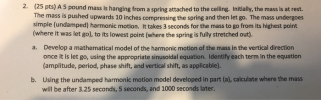
2. (25 pts) A 5 pound mass is hanging from a spring attached to the ceiling. Initially, the mass is at rest. The mass is pushed upwards 10 inches compressing the spring and then let go. The mass undergoes simple (undamped) harmonic motion. It takes 3 seconds for the mass to go from its highest point (where it was let go), to its lowest point (where the spring is fully stretched out). a. Develop a...
show all work! with formulas!
2. (25 pts) A 5 pound mass is hanging from a spring attached to the ceiling. Initially, the mass is at rest. The mass is pushed upwards 10 inches compressing the spring and then let go. The mass undergoes simple (undamped) harmonic motion. It takes 3 seconds for the mass to go from its highest point (where it was let go), to its lowest point (where the spring is fully stretched out). a. Develop a...
A 7.8kg mass hanging from a spring scale is slowly lowered onto a vertical spring, as...
 A 7.8kg mass hanging from a
spring scale is slowly lowered onto a vertical spring, as shown in
the figure.
What does the spring scale read just before the mass touches the
lower spring?(N)
The scale reads 22N when the lower spring has been compressed by
2.6cm . What is the value of the spring constant for the lower
spring? (N/m)
At what compression length will the scale read zero? (cm)
A 7.8kg mass hanging from a
spring scale is slowly lowered onto a vertical spring, as shown in
the figure.
What does the spring scale read just before the mass touches the
lower spring?(N)
The scale reads 22N when the lower spring has been compressed by
2.6cm . What is the value of the spring constant for the lower
spring? (N/m)
At what compression length will the scale read zero? (cm)
from an Atwood's machine experiment using a hanging mass to 2 The table below shows the...
 from an Atwood's machine experiment using a hanging mass to 2 The table below shows the data accrlerane a art The dfierence of the two masses was kept constant, while the total mass was Total mass M Inverse total mass 1/M (kg) 0500 0.600 0700 0 800 1.01 0.83 0.71 0.62 A Complete the third column in the table. (2 Points) B. Plot Acceleration vs. 1/M in increasing order of 1/M, on graph paper.(8 points) C Draw the best-fit straight...
7. A spring with a 100 g mass hanging from it is set into simple harmonic...
 7. A spring with a 100 g mass hanging from it is set into simple harmonic motion. If the stiffness coefficient of the spring (k) is 16 N/m, then what is the period (T) and frequency (f) of this mass?
When a mass of .350kg is attached to a vertical spring and lowered slowly, the spring...
When a mass of .350kg is attached to a vertical spring and lowered slowly, the spring stretches 51.0cm. The mass is now displaced from its equilibrium position and undergoes a simple harmonic motion. What is the period of oscillation? Please follow the template below. List and laws or principles that apply and give a defintion. Draw a diagram. Show the formula you used and how you manipulated it, Show the steps you did. Thank you for your time.
(1 point) The graph shows the displacement from equilibrium of a mass-spring system as a function...
 (1 point) The graph shows the displacement from equilibrium of a mass-spring system as a function of time after the vertically hanging system was set in motion at time t0. Assume that the units of time are seconds, and the units of displacement are centimeters. The first t-intercept is (0.75, 0) and the first minimum has coordinates (1.25,-1) (a) What is the period T of the periodic motion? seconds (b) What is the frequency f in Hertz? What is the...
A mass hanging from one end of a spring whose other end is fixed to the...
A mass hanging from one end of a spring whose other end is fixed to the roof, undergoes simple harmonic motion x(t)=2.4sin(0.6t)x(t)=2.4sin(0.6t). Now if the mass is pulled down from its equilibrium position by a distance 2 times its previous amplitude and released at time t=0t=0, its displacement as a function of time is A.2.4cos(1.2t)2.4cos(1.2t) B. 2.4sin(1.2t)2.4sin(1.2t) C. 4.8sin(1.2t)4.8sin(1.2t) D. 4.8cos(0.6t)4.8cos(0.6t) E. 4.8cos(1.2t)4.8cos(1.2t) F. 4.8sin(0.6t)
(1 point) The graph shows the displacement from equilibrium of a mass-spring system as a function...
 (1 point) The graph shows the displacement from equilibrium of a mass-spring system as a function of time after the vertically hanging system was set in motion at time t= 0. Assume that the units of time are seconds, and the units of displacement are centimeters. The first t-intercept is (0.75, 0) and the first maximum has coordinates (1.25, 4). (a) What is the period T = of the periodic motion? seconds (b) What is the frequency f in Hertz?...
A spring is stretched by adding on different masses and the following Force Position graph is...
 A spring is stretched by adding on different masses and the following Force Position graph is obtained a What kind of energy is stored in the spring when it is stretched by meters? b. Write down the expression in terms of spring constant k and position x. c. Calculate the spring constant k using the graph above. d. Calculate the work done in moving the spring from position '1 meter' to '2 meter'.
 A block of mass 0.125 kg is hanging on a spring. Nora gently pulls the mass down a distance of 3.6 cm and then lets go. The mass bobs up and down in simple harmonic motion (i.e. it oscillates) with a period of 0.47 s. (a) What is the value of the spring constant? N/m Nora stops the mass from oscillating. She gently pulls the mass down again, this time to a distance of 4.6 cm, and lets the mass...
 show all work! with formulas!
2. (25 pts) A 5 pound mass is hanging from a spring attached to the ceiling. Initially, the mass is at rest. The mass is pushed upwards 10 inches compressing the spring and then let go. The mass undergoes simple (undamped) harmonic motion. It takes 3 seconds for the mass to go from its highest point (where it was let go), to its lowest point (where the spring is fully stretched out). a. Develop a...
show all work! with formulas!
2. (25 pts) A 5 pound mass is hanging from a spring attached to the ceiling. Initially, the mass is at rest. The mass is pushed upwards 10 inches compressing the spring and then let go. The mass undergoes simple (undamped) harmonic motion. It takes 3 seconds for the mass to go from its highest point (where it was let go), to its lowest point (where the spring is fully stretched out). a. Develop a...
 A 7.8kg mass hanging from a
spring scale is slowly lowered onto a vertical spring, as shown in
the figure.
What does the spring scale read just before the mass touches the
lower spring?(N)
The scale reads 22N when the lower spring has been compressed by
2.6cm . What is the value of the spring constant for the lower
spring? (N/m)
At what compression length will the scale read zero? (cm)
A 7.8kg mass hanging from a
spring scale is slowly lowered onto a vertical spring, as shown in
the figure.
What does the spring scale read just before the mass touches the
lower spring?(N)
The scale reads 22N when the lower spring has been compressed by
2.6cm . What is the value of the spring constant for the lower
spring? (N/m)
At what compression length will the scale read zero? (cm)
 from an Atwood's machine experiment using a hanging mass to 2 The table below shows the data accrlerane a art The dfierence of the two masses was kept constant, while the total mass was Total mass M Inverse total mass 1/M (kg) 0500 0.600 0700 0 800 1.01 0.83 0.71 0.62 A Complete the third column in the table. (2 Points) B. Plot Acceleration vs. 1/M in increasing order of 1/M, on graph paper.(8 points) C Draw the best-fit straight...
 7. A spring with a 100 g mass hanging from it is set into simple harmonic motion. If the stiffness coefficient of the spring (k) is 16 N/m, then what is the period (T) and frequency (f) of this mass?
 (1 point) The graph shows the displacement from equilibrium of a mass-spring system as a function of time after the vertically hanging system was set in motion at time t0. Assume that the units of time are seconds, and the units of displacement are centimeters. The first t-intercept is (0.75, 0) and the first minimum has coordinates (1.25,-1) (a) What is the period T of the periodic motion? seconds (b) What is the frequency f in Hertz? What is the...
 (1 point) The graph shows the displacement from equilibrium of a mass-spring system as a function of time after the vertically hanging system was set in motion at time t= 0. Assume that the units of time are seconds, and the units of displacement are centimeters. The first t-intercept is (0.75, 0) and the first maximum has coordinates (1.25, 4). (a) What is the period T = of the periodic motion? seconds (b) What is the frequency f in Hertz?...
 A spring is stretched by adding on different masses and the following Force Position graph is obtained a What kind of energy is stored in the spring when it is stretched by meters? b. Write down the expression in terms of spring constant k and position x. c. Calculate the spring constant k using the graph above. d. Calculate the work done in moving the spring from position '1 meter' to '2 meter'.
Most questions answered within 3 hours.
-
Where is the error in this code sequence?
String s1 = "Hello";
String s2 = "ello";...
asked 10 months ago -
Financial data for Joel de Paris, Inc., for last year
follow:
Joel de Paris, Inc.
Balance...
asked 10 months ago -
Consider this reaction:
Al2(SO4)3 (aq)+ BaCl3
(aq) Al2Cl6 (aq)- +
3BaSO4(s) . What is the...
asked 10 months ago -
Suppose that Savneet is considering increasing her
recent random sample from 20 car rentals to 40...
asked 10 months ago -
Trucks arrive at an unloading terminal at an average rate of 120
per hour.
Trucks arrive...
asked 10 months ago -
Why are methanol and ethanol completely soluble in water while
octanol is not very little soluble....
asked 10 months ago -
A facilities manager at a university reads in a research report
that the mean amount of...
asked 10 months ago -
When the CuSO4 is rehydrated by adding water to the anhydrous
compound, is this an endothermic...
asked 10 months ago -
A ray of sunlight is passing from diamond into crown glass; the
angle of incidence is...
asked 10 months ago -
A block of mass 0.249 kg is placed on top of a light, vertical
spring of...
asked 10 months ago -
how do the kidneys compensate in the presences of acidosis
a) trigger hyperventilate
b) reserve acid...
asked 10 months ago -
Question 501 pts
The rental rate of capital to the firm increases. Which of the
following...
asked 10 months ago