
Homework Answers
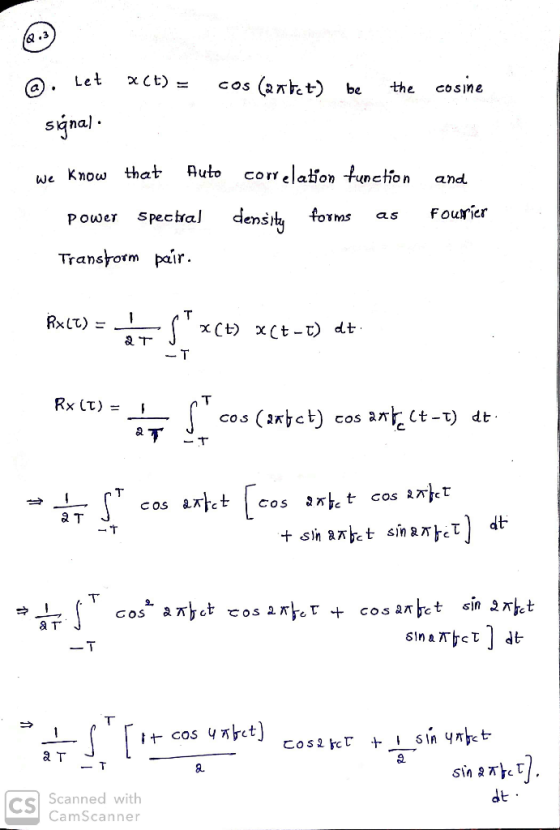
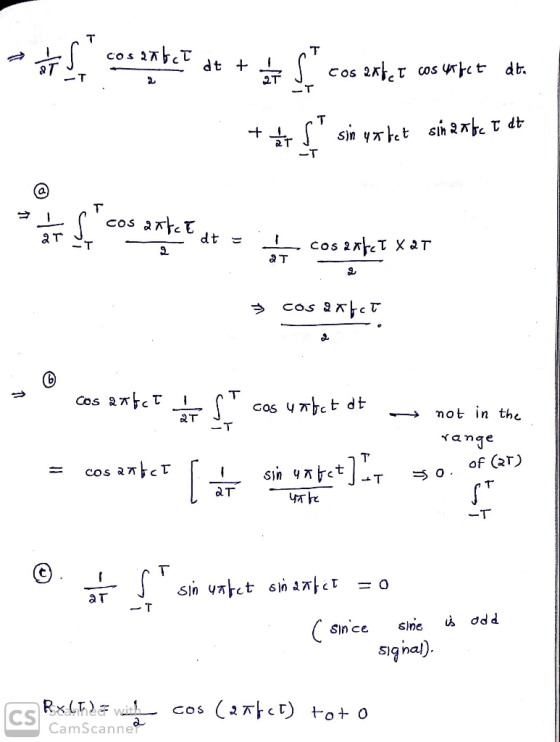
![Rxlt) = ţ cos (axbet) pso and Auto correlation forms as fourier transtorm pair Fit - Fourier Transform pso = FM [ Rx CT »] =](http://img.homeworklib.com/questions/22551f30-aa5e-11eb-bf5b-d1892c8995c2.png?x-oss-process=image/resize,w_560)
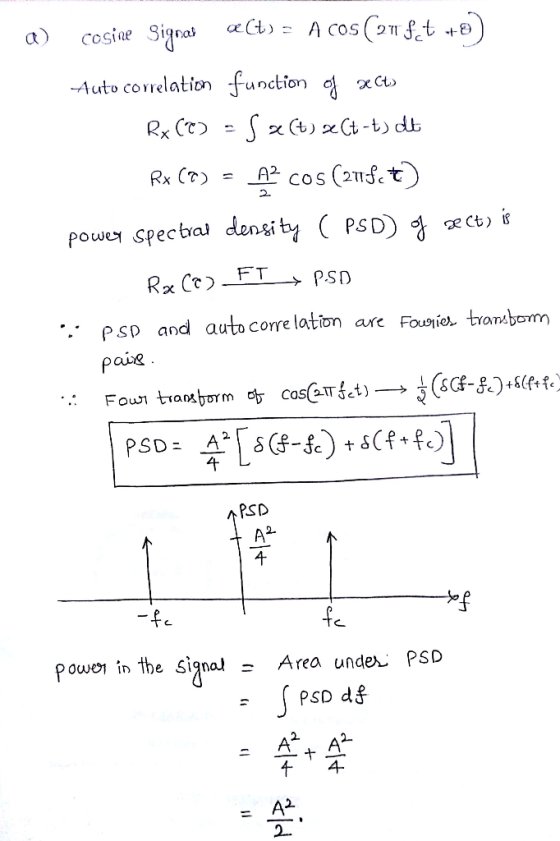
![t $606 [-6mt) + cos [ 2 Cox++ *1946rt). © S 106(61) = 603 or ). a s 2T . cosſo (** +7]p) +6*c] = 0 . of St (not in range 25 x](http://img.homeworklib.com/questions/2385ed60-aa5e-11eb-8374-1b56213c5e68.png?x-oss-process=image/resize,w_560)
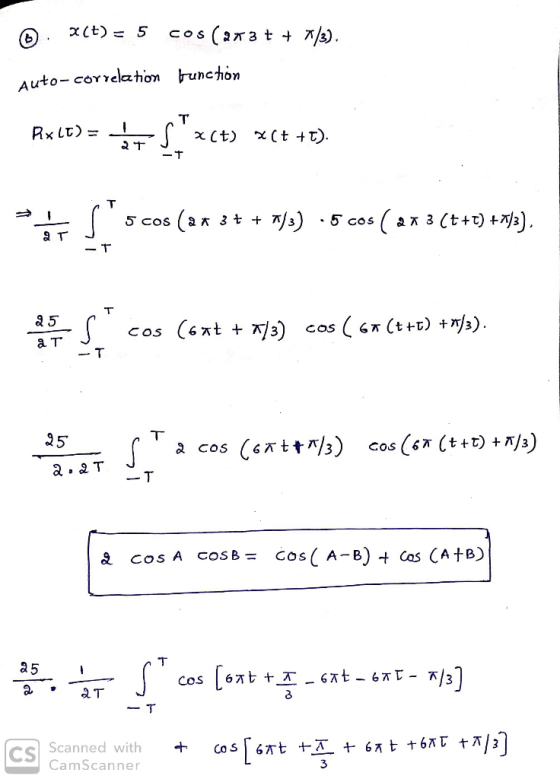
![To b) x(t) = 500$ ( 27 (3)[+]) Auto corelation of xct) RxGt) = Sx(+) x(+-6) dt - SocosCoucou thu ) scos(2m02764-) vyjdt 5. co](http://img.homeworklib.com/questions/58471a60-aa61-11eb-b851-8b871d918dc2.png?x-oss-process=image/resize,w_560)
Add Answer to:
Digital communications
Question 3: a) Find the power spectral density for the cosine signal and also...
2. (30 points) Let X(t) be a wide-sense stationary (WSS) random signal with power spectral density...
 2. (30 points) Let X(t) be a wide-sense stationary (WSS) random signal with power spectral density S(f) = 1011(f/200), and let y(t) be a random process defined by Y(t) = 10 cos(2000nt + 1) where is a uniformly distributed random variable in the interval [ 027]. Assume that X(t) and Y(t) are independent. (a) Derive the mean and autocorrelation function of Y(t). Is Y(t) a WSS process? Why? (b) Define a random signal Z(t) = X(t)Y(t). Determine and sketch the...
Q.2 ICO2]10 Marks] The signal g(t) forms the input to the LPF circuit shown in the figure, where R l,and y(Dis the output. If the power spectral density (PSD) of the signal ge) is (a) The autoc...
 Q.2 ICO2]10 Marks] The signal g(t) forms the input to the LPF circuit shown in the figure, where R l,and y(Dis the output. If the power spectral density (PSD) of the signal ge) is (a) The autocorrelation of g(t) (b) The 3-dB bandwidth of the LPF (c) The power of g(t) and y(t) (d) Based on your answers above, will it be better if the signal has more or less bandwith? (e) If a white noise of PSD No/2 is...
I. The autocorrelation function of a random signal is R(r) !-ⓞrect rect a. Find the power...
 I. The autocorrelation function of a random signal is R(r) !-ⓞrect rect a. Find the power spectral density of the signal. b. Plot the amplitude of the power spectral density with Matlab (Let Ts -2) c. Find the null-to-null bandpass bandwidth, and the 0-to-null baseband bandwidth (in terms of Ts).
Channel with noise power spectral density Sn (f) 1. No/2 a. Compute the signal to noise ratio (Eb...
 channel with noise power spectral density Sn (f) 1. No/2 a. Compute the signal to noise ratio (Eb/No b. Obtain the optimum matched filter impulse response. c. Assuming equally likely transmission, devise the optimum decision device. d. lextral Compute the probability of error in terms ofy Eb/No- S2(0) S1(t) T t T/27/2 7
channel with noise power spectral density Sn (f) 1. No/2 a. Compute the signal to noise ratio (Eb/No b. Obtain the optimum matched filter impulse response. c....
channel with noise power spectral density Sn (f) 1. No/2 a. Compute the signal to noise ratio (Eb/No b. Obtain the optimum matched filter impulse response. c. Assuming equally likely transmission, devise the optimum decision device. d. lextral Compute the probability of error in terms ofy Eb/No- S2(0) S1(t) T t T/27/2 7
channel with noise power spectral density Sn (f) 1. No/2 a. Compute the signal to noise ratio (Eb/No b. Obtain the optimum matched filter impulse response. c....
1.x(t) =Aexp((-t^2)/T^2) (T>0) (a) Energy Spectral Density (b)Autocorrelation Function y(t)=x(t)cos(2m/t) (1) Energy spectral Density 1.x(t) =Aexp((-t^2)/T^2) (T>0) (a) Energy Spectral...
 1.x(t) =Aexp((-t^2)/T^2) (T>0) (a) Energy Spectral Density (b)Autocorrelation Function y(t)=x(t)cos(2m/t) (1) Energy spectral Density
1.x(t) =Aexp((-t^2)/T^2) (T>0) (a) Energy Spectral Density (b)Autocorrelation Function y(t)=x(t)cos(2m/t) (1) Energy spectral Density
1.x(t) =Aexp((-t^2)/T^2) (T>0) (a) Energy Spectral Density (b)Autocorrelation Function y(t)=x(t)cos(2m/t) (1) Energy spectral Density
Power Spectral Density of Signal A signal s(t) can be expressed as the following equation: L-1...
 Power Spectral Density of Signal
A signal s(t) can be expressed as the following equation: L-1 where L is a positive integer. {An}n=0 are independent and identically distributed (i.i.d.) discrete random variables. The probability mass function (PMF) of An is An() 0 otherwise, where A is a positive constant in volt. To is a uniformly distributed random variable with probability density function (PDF) defined by 0. otherwise. L-1 To and {An}n=d are independent. The signal p(t) is a pulse and...
Power Spectral Density of Signal
A signal s(t) can be expressed as the following equation: L-1 where L is a positive integer. {An}n=0 are independent and identically distributed (i.i.d.) discrete random variables. The probability mass function (PMF) of An is An() 0 otherwise, where A is a positive constant in volt. To is a uniformly distributed random variable with probability density function (PDF) defined by 0. otherwise. L-1 To and {An}n=d are independent. The signal p(t) is a pulse and...
Problem 4 Let X(t), a continuous-time white noise process with zero mean and power spectral density equal to 2, be the...
 Problem 4 Let X(t), a continuous-time white noise process with zero mean and power spectral density equal to 2, be the input to an LTI system with impulse response h(t)- 0 otherwise of Y (t). Sketch the autocorrelation function of Y(t)
Problem 4 Let X(t), a continuous-time white noise process with zero mean and power spectral density equal to 2, be the input to an LTI system with impulse response h(t)- 0 otherwise of Y (t). Sketch the autocorrelation function...
Problem 4 Let X(t), a continuous-time white noise process with zero mean and power spectral density equal to 2, be the input to an LTI system with impulse response h(t)- 0 otherwise of Y (t). Sketch the autocorrelation function of Y(t)
Problem 4 Let X(t), a continuous-time white noise process with zero mean and power spectral density equal to 2, be the input to an LTI system with impulse response h(t)- 0 otherwise of Y (t). Sketch the autocorrelation function...
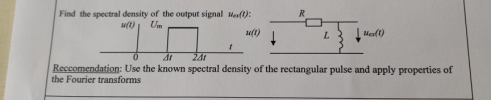
Find the spectral density of the output signal ex(): Um u(0) uex(t) Reccomendation: Use the known spectral densi...
 Find the spectral density of the output signal ex(): Um u(0) uex(t) Reccomendation: Use the known spectral density of the rectangular pulse and apply properties of the Fourier transforms
Find the spectral density of the output signal ex(): Um u(0) uex(t) Reccomendation: Use the known spectral density of the rectangular pulse and apply properties of the Fourier transforms
Find the spectral density of the output signal ex(): Um u(0) uex(t) Reccomendation: Use the known spectral density of the rectangular pulse and apply properties of the Fourier transforms
Can somebody help me with my matlab code? I am plotting the POWER SPECTRAL DENSITY OF...
Can somebody help me with my matlab code? I am plotting the POWER SPECTRAL DENSITY OF Manchester, Polar, UNIPOLAR, and BIPOLAR. It wont run. The error I am getting is "incorrect dimensions for matrix multiplication. Check that the number of columns in the first matrix matches the number of rows in the second matrix. To perform element wise multiplication, use '.*'. " clc; clear all; %Declaration of variables bandwidth = 1; total_bandwidth = 1/bandwidth; f = 0:.05*bandwidth:2*total_bandwidth; x=f*total_bandwidth; %Manchester Power...
Find the spectral density of the output signal uex(): u(t) uex(0) 0 At 24t Reccomendation: Use the known spectral de...
 Find the spectral density of the output signal uex(): u(t) uex(0) 0 At 24t Reccomendation: Use the known spectral density of the rectangular pulse and apply properties of the Fourier transforms
Find the spectral density of the output signal uex(): u(t) uex(0) 0 At 24t Reccomendation: Use the known spectral density of the rectangular pulse and apply properties of the Fourier transforms
Find the spectral density of the output signal uex(): u(t) uex(0) 0 At 24t Reccomendation: Use the known spectral density of the rectangular pulse and apply properties of the Fourier transforms
 2. (30 points) Let X(t) be a wide-sense stationary (WSS) random signal with power spectral density S(f) = 1011(f/200), and let y(t) be a random process defined by Y(t) = 10 cos(2000nt + 1) where is a uniformly distributed random variable in the interval [ 027]. Assume that X(t) and Y(t) are independent. (a) Derive the mean and autocorrelation function of Y(t). Is Y(t) a WSS process? Why? (b) Define a random signal Z(t) = X(t)Y(t). Determine and sketch the...
 Q.2 ICO2]10 Marks] The signal g(t) forms the input to the LPF circuit shown in the figure, where R l,and y(Dis the output. If the power spectral density (PSD) of the signal ge) is (a) The autocorrelation of g(t) (b) The 3-dB bandwidth of the LPF (c) The power of g(t) and y(t) (d) Based on your answers above, will it be better if the signal has more or less bandwith? (e) If a white noise of PSD No/2 is...
 I. The autocorrelation function of a random signal is R(r) !-ⓞrect rect a. Find the power spectral density of the signal. b. Plot the amplitude of the power spectral density with Matlab (Let Ts -2) c. Find the null-to-null bandpass bandwidth, and the 0-to-null baseband bandwidth (in terms of Ts).
 channel with noise power spectral density Sn (f) 1. No/2 a. Compute the signal to noise ratio (Eb/No b. Obtain the optimum matched filter impulse response. c. Assuming equally likely transmission, devise the optimum decision device. d. lextral Compute the probability of error in terms ofy Eb/No- S2(0) S1(t) T t T/27/2 7
channel with noise power spectral density Sn (f) 1. No/2 a. Compute the signal to noise ratio (Eb/No b. Obtain the optimum matched filter impulse response. c....
channel with noise power spectral density Sn (f) 1. No/2 a. Compute the signal to noise ratio (Eb/No b. Obtain the optimum matched filter impulse response. c. Assuming equally likely transmission, devise the optimum decision device. d. lextral Compute the probability of error in terms ofy Eb/No- S2(0) S1(t) T t T/27/2 7
channel with noise power spectral density Sn (f) 1. No/2 a. Compute the signal to noise ratio (Eb/No b. Obtain the optimum matched filter impulse response. c....
 1.x(t) =Aexp((-t^2)/T^2) (T>0) (a) Energy Spectral Density (b)Autocorrelation Function y(t)=x(t)cos(2m/t) (1) Energy spectral Density
1.x(t) =Aexp((-t^2)/T^2) (T>0) (a) Energy Spectral Density (b)Autocorrelation Function y(t)=x(t)cos(2m/t) (1) Energy spectral Density
1.x(t) =Aexp((-t^2)/T^2) (T>0) (a) Energy Spectral Density (b)Autocorrelation Function y(t)=x(t)cos(2m/t) (1) Energy spectral Density
 Power Spectral Density of Signal
A signal s(t) can be expressed as the following equation: L-1 where L is a positive integer. {An}n=0 are independent and identically distributed (i.i.d.) discrete random variables. The probability mass function (PMF) of An is An() 0 otherwise, where A is a positive constant in volt. To is a uniformly distributed random variable with probability density function (PDF) defined by 0. otherwise. L-1 To and {An}n=d are independent. The signal p(t) is a pulse and...
Power Spectral Density of Signal
A signal s(t) can be expressed as the following equation: L-1 where L is a positive integer. {An}n=0 are independent and identically distributed (i.i.d.) discrete random variables. The probability mass function (PMF) of An is An() 0 otherwise, where A is a positive constant in volt. To is a uniformly distributed random variable with probability density function (PDF) defined by 0. otherwise. L-1 To and {An}n=d are independent. The signal p(t) is a pulse and...
 Problem 4 Let X(t), a continuous-time white noise process with zero mean and power spectral density equal to 2, be the input to an LTI system with impulse response h(t)- 0 otherwise of Y (t). Sketch the autocorrelation function of Y(t)
Problem 4 Let X(t), a continuous-time white noise process with zero mean and power spectral density equal to 2, be the input to an LTI system with impulse response h(t)- 0 otherwise of Y (t). Sketch the autocorrelation function...
Problem 4 Let X(t), a continuous-time white noise process with zero mean and power spectral density equal to 2, be the input to an LTI system with impulse response h(t)- 0 otherwise of Y (t). Sketch the autocorrelation function of Y(t)
Problem 4 Let X(t), a continuous-time white noise process with zero mean and power spectral density equal to 2, be the input to an LTI system with impulse response h(t)- 0 otherwise of Y (t). Sketch the autocorrelation function...
 Find the spectral density of the output signal ex(): Um u(0) uex(t) Reccomendation: Use the known spectral density of the rectangular pulse and apply properties of the Fourier transforms
Find the spectral density of the output signal ex(): Um u(0) uex(t) Reccomendation: Use the known spectral density of the rectangular pulse and apply properties of the Fourier transforms
Find the spectral density of the output signal ex(): Um u(0) uex(t) Reccomendation: Use the known spectral density of the rectangular pulse and apply properties of the Fourier transforms
 Find the spectral density of the output signal uex(): u(t) uex(0) 0 At 24t Reccomendation: Use the known spectral density of the rectangular pulse and apply properties of the Fourier transforms
Find the spectral density of the output signal uex(): u(t) uex(0) 0 At 24t Reccomendation: Use the known spectral density of the rectangular pulse and apply properties of the Fourier transforms
Find the spectral density of the output signal uex(): u(t) uex(0) 0 At 24t Reccomendation: Use the known spectral density of the rectangular pulse and apply properties of the Fourier transforms
Most questions answered within 3 hours.
-
Where is the error in this code sequence?
String s1 = "Hello";
String s2 = "ello";...
asked 10 months ago -
Financial data for Joel de Paris, Inc., for last year
follow:
Joel de Paris, Inc.
Balance...
asked 10 months ago -
Consider this reaction:
Al2(SO4)3 (aq)+ BaCl3
(aq) Al2Cl6 (aq)- +
3BaSO4(s) . What is the...
asked 10 months ago -
Suppose that Savneet is considering increasing her
recent random sample from 20 car rentals to 40...
asked 10 months ago -
Trucks arrive at an unloading terminal at an average rate of 120
per hour.
Trucks arrive...
asked 10 months ago -
Why are methanol and ethanol completely soluble in water while
octanol is not very little soluble....
asked 10 months ago -
A facilities manager at a university reads in a research report
that the mean amount of...
asked 10 months ago -
When the CuSO4 is rehydrated by adding water to the anhydrous
compound, is this an endothermic...
asked 10 months ago -
A ray of sunlight is passing from diamond into crown glass; the
angle of incidence is...
asked 10 months ago -
A block of mass 0.249 kg is placed on top of a light, vertical
spring of...
asked 10 months ago -
how do the kidneys compensate in the presences of acidosis
a) trigger hyperventilate
b) reserve acid...
asked 10 months ago -
Question 501 pts
The rental rate of capital to the firm increases. Which of the
following...
asked 10 months ago