
Homework Answers
Add Answer to:
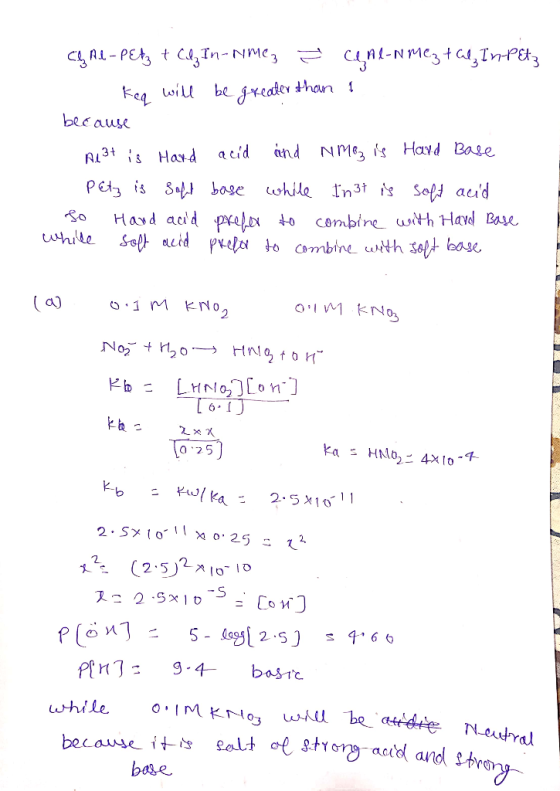
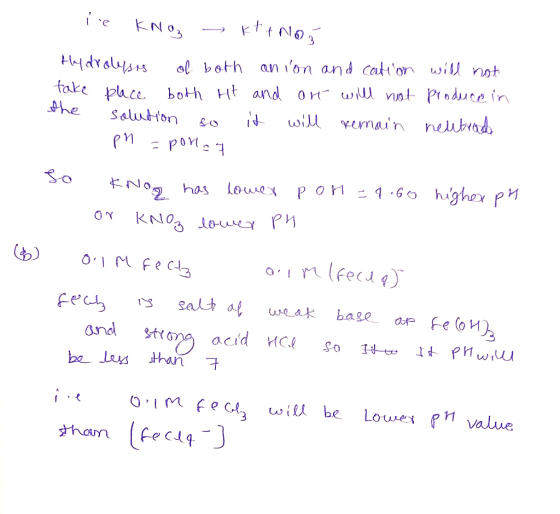
Using the 'hard'/'soft' classification of acids and bases, determine whether Keq > 1 or keq <...
Question 2 of 10 > Attempt 1 Balance the following redox reaction in acidic solution using...
 Question 2 of 10 > Attempt 1 Balance the following redox reaction in acidic solution using whole number coefficients. NO3(aq) +1,(s) — 103(aq) + NO2(g) In the balanced equation, what is the coefficient for NOZ? 5 2 10 Incorrect
Acids, Bases, and Buffers CHEM& 121 Lab Partner Data Part A Red pH Red Cabbage Test Tube Blue Lit...
 Acid, bases and buffers
Acids, Bases, and Buffers CHEM& 121 Lab Partner Data Part A Red pH Red Cabbage Test Tube Blue Litmus (color) Solution Juice (color)values (colbr) no reaction 2.890 Magenta 11.37dark green Red blue no reaction 2.700 Magenta lemon juice soft drink drain cleaner no reaction detergent baking soda no reaction red red no raction 3.530 Purple blue 12.56 no reactionno reaction 8.700 dark green 9.350 teal/green Part B Total Number of rops of HCl(aq) Added DI Water...
Acid, bases and buffers
Acids, Bases, and Buffers CHEM& 121 Lab Partner Data Part A Red pH Red Cabbage Test Tube Blue Litmus (color) Solution Juice (color)values (colbr) no reaction 2.890 Magenta 11.37dark green Red blue no reaction 2.700 Magenta lemon juice soft drink drain cleaner no reaction detergent baking soda no reaction red red no raction 3.530 Purple blue 12.56 no reactionno reaction 8.700 dark green 9.350 teal/green Part B Total Number of rops of HCl(aq) Added DI Water...
Mixing Strong Acids and Bases (< 1 of 13 > Constants Periodic Table Imagine that you...
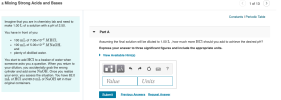 Mixing Strong Acids and Bases (< 1 of 13 > Constants Periodic Table Imagine that you are in chemistry lab and need to make 1.00 L of a solution with a pH of 2.50. You have in front of you Part A • 100 mL of 7.00x10⁻² MHCI, · 100 mL of 5.00x10⁻² M NaOH, and • plenty of distilled water. Assuming the final solution will be diluted to 1.00 L , how much more HCl should you add to...
2. (13 pts) Determine the rate constant and reaction orders for the following reaction using the...
 2. (13 pts) Determine the rate constant and reaction orders for the following reaction using the data provided: 2 NO (g) + 02 (g) > 2 NO2 (g) Rate (M/s 0.028 0.057 0.114 0.227 Experiment NO 0.020 0.020 0.020 0.040 0.010 0.010 0.020 0.040 0.020 0.020 3 4 a.) For the rate law, determine all reaction orders Rate -k [NO]m[O2]' Reaction order m (CIRCLE ONE) 1½ Reaction order n (CIRCLE ONE) 1½
Titration: Acids and Bases 2. How can you determine which acid is diprotic? 3. using the...
 Titration: Acids and Bases
2. How can you determine which acid is diprotic?
3. using the answers to questions one and two, which acid is
diprotic?
4. Which base has more hydroxide ions per molecule?
Acid Volume Base Base Initial Volume (mL) Base Final Volume (mL) Volume of Base Used (mL) Acid: Base Ratio Acid 1 20 mL Base 1 50 mL 34.5 15.5 4:3 Acid 2 20 mL Base 1 Acid 1 20 mL Base 2 Acid 2 20...
Titration: Acids and Bases
2. How can you determine which acid is diprotic?
3. using the answers to questions one and two, which acid is
diprotic?
4. Which base has more hydroxide ions per molecule?
Acid Volume Base Base Initial Volume (mL) Base Final Volume (mL) Volume of Base Used (mL) Acid: Base Ratio Acid 1 20 mL Base 1 50 mL 34.5 15.5 4:3 Acid 2 20 mL Base 1 Acid 1 20 mL Base 2 Acid 2 20...
1. Which of the followi ch of the following reactions is not readily explained by the Arrhenius concept of acids a...
 1. Which of the followi ch of the following reactions is not readily explained by the Arrhenius concept of acids and bases? a. A. HCl(aq) + NaOH(aq) - NaCl(aq) + H20() b. H30(aq) + OH-(aq) + 2H20(1) c. HCI(g) + NH3(g) - NH4Cl(s) d. HC2H302(aq) + H2O(l) H30*(aq) + C2H302-(ag) e. H30 (aq) + OH-(aq) + 2H2O(aq) 2. Classify each of the following species as Brønsted acid or base or both: a) H20, b) OH", c) H30, d) NH3, e)...
Titration Curves of Pre-lab questions. rves of Strong and Weak Acids and Bases. e 1. Explain...
 Titration Curves of Pre-lab questions. rves of Strong and Weak Acids and Bases. e 1. Explain the difference between a stre xplain the difference between a strong acid and a weak acid. **Calculate the pH of an HC Solution in which the H.01 -1.75 x 10°M. Calculate the pH of a NAOH solution in which the (OH) 3.7 x 10" M. Labc 4. Calculate the [H.O') when pH = 7.42 5. Calculate the [H3O+] when pOH = 5.43 6. Calculate...
CHEM 106 Chemical Equilibrium, Acids and Bases 1. Which expression correctly describes the equilibrium constant for...
 CHEM 106 Chemical Equilibrium, Acids and Bases 1. Which expression correctly describes the equilibrium constant for the following reaction? 4NH,(g)+ SO,(g) 4NO(g)+ 6H2O) K. LNO"CHO B) K-(4INOj+ 6HO1) (4NH,]+ S10))CAT6 ) K-(INOl,0])INH,O,l) D K-(INOjHO)/(IINH iol) E) K-(NHJTO) /INO)THO ANS: D 2. Determine the equilibrium constant for the system N;Oa 2NO; at 25 C. The concentrations are shown here: [N;O ]-2.32 x 10 A) 0.608 B) 1.65 C) 1.17 x 10 D) 0.369 E) 8.57 x 10 M, [NO 2]-1.41 x...
Post Lab Activity Acids, Bases, pH, and Buffers 1. Calculate the pH of a 0.08 M NaOH solution. 2. Hydrochloric acid...
 Post Lab Activity Acids, Bases, pH, and Buffers 1. Calculate the pH of a 0.08 M NaOH solution. 2. Hydrochloric acid is a strong acid and dissociate almost 100% in aqueous solution. If two drops (0.1 mL) of 1.0 MHCI are added to pure water to make 1.0 L solution. What is the pH of this solution? 3. M. What will be the A dilute solution of hydrochloric acid (HCI) has a concentration of 0.1 pH of this solution? 4....
the table for problem 5 is attached S. Consider the weak acids in Table 13.2. Which...
 the table for problem 5 is attached
S. Consider the weak acids in Table 13.2. Which acid-base pair would be best for a buffer at a pH of: a) 3.5 b) 7.3 c) 10.0 To make a buffer with pH 3.0 from HCHO2 and CHO2: a) what must the [HCHO2]/[CHO2] ratio be? 6. ep b) how many moles of HCHO2 must be added to a liter of 0.139 M NaCHO2 to give this pH? c) how many grams of NaCHO2...
the table for problem 5 is attached
S. Consider the weak acids in Table 13.2. Which acid-base pair would be best for a buffer at a pH of: a) 3.5 b) 7.3 c) 10.0 To make a buffer with pH 3.0 from HCHO2 and CHO2: a) what must the [HCHO2]/[CHO2] ratio be? 6. ep b) how many moles of HCHO2 must be added to a liter of 0.139 M NaCHO2 to give this pH? c) how many grams of NaCHO2...
 Question 2 of 10 > Attempt 1 Balance the following redox reaction in acidic solution using whole number coefficients. NO3(aq) +1,(s) — 103(aq) + NO2(g) In the balanced equation, what is the coefficient for NOZ? 5 2 10 Incorrect
 Acid, bases and buffers
Acids, Bases, and Buffers CHEM& 121 Lab Partner Data Part A Red pH Red Cabbage Test Tube Blue Litmus (color) Solution Juice (color)values (colbr) no reaction 2.890 Magenta 11.37dark green Red blue no reaction 2.700 Magenta lemon juice soft drink drain cleaner no reaction detergent baking soda no reaction red red no raction 3.530 Purple blue 12.56 no reactionno reaction 8.700 dark green 9.350 teal/green Part B Total Number of rops of HCl(aq) Added DI Water...
Acid, bases and buffers
Acids, Bases, and Buffers CHEM& 121 Lab Partner Data Part A Red pH Red Cabbage Test Tube Blue Litmus (color) Solution Juice (color)values (colbr) no reaction 2.890 Magenta 11.37dark green Red blue no reaction 2.700 Magenta lemon juice soft drink drain cleaner no reaction detergent baking soda no reaction red red no raction 3.530 Purple blue 12.56 no reactionno reaction 8.700 dark green 9.350 teal/green Part B Total Number of rops of HCl(aq) Added DI Water...
 Mixing Strong Acids and Bases (< 1 of 13 > Constants Periodic Table Imagine that you are in chemistry lab and need to make 1.00 L of a solution with a pH of 2.50. You have in front of you Part A • 100 mL of 7.00x10⁻² MHCI, · 100 mL of 5.00x10⁻² M NaOH, and • plenty of distilled water. Assuming the final solution will be diluted to 1.00 L , how much more HCl should you add to...
 2. (13 pts) Determine the rate constant and reaction orders for the following reaction using the data provided: 2 NO (g) + 02 (g) > 2 NO2 (g) Rate (M/s 0.028 0.057 0.114 0.227 Experiment NO 0.020 0.020 0.020 0.040 0.010 0.010 0.020 0.040 0.020 0.020 3 4 a.) For the rate law, determine all reaction orders Rate -k [NO]m[O2]' Reaction order m (CIRCLE ONE) 1½ Reaction order n (CIRCLE ONE) 1½
 Titration: Acids and Bases
2. How can you determine which acid is diprotic?
3. using the answers to questions one and two, which acid is
diprotic?
4. Which base has more hydroxide ions per molecule?
Acid Volume Base Base Initial Volume (mL) Base Final Volume (mL) Volume of Base Used (mL) Acid: Base Ratio Acid 1 20 mL Base 1 50 mL 34.5 15.5 4:3 Acid 2 20 mL Base 1 Acid 1 20 mL Base 2 Acid 2 20...
Titration: Acids and Bases
2. How can you determine which acid is diprotic?
3. using the answers to questions one and two, which acid is
diprotic?
4. Which base has more hydroxide ions per molecule?
Acid Volume Base Base Initial Volume (mL) Base Final Volume (mL) Volume of Base Used (mL) Acid: Base Ratio Acid 1 20 mL Base 1 50 mL 34.5 15.5 4:3 Acid 2 20 mL Base 1 Acid 1 20 mL Base 2 Acid 2 20...
 1. Which of the followi ch of the following reactions is not readily explained by the Arrhenius concept of acids and bases? a. A. HCl(aq) + NaOH(aq) - NaCl(aq) + H20() b. H30(aq) + OH-(aq) + 2H20(1) c. HCI(g) + NH3(g) - NH4Cl(s) d. HC2H302(aq) + H2O(l) H30*(aq) + C2H302-(ag) e. H30 (aq) + OH-(aq) + 2H2O(aq) 2. Classify each of the following species as Brønsted acid or base or both: a) H20, b) OH", c) H30, d) NH3, e)...
 Titration Curves of Pre-lab questions. rves of Strong and Weak Acids and Bases. e 1. Explain the difference between a stre xplain the difference between a strong acid and a weak acid. **Calculate the pH of an HC Solution in which the H.01 -1.75 x 10°M. Calculate the pH of a NAOH solution in which the (OH) 3.7 x 10" M. Labc 4. Calculate the [H.O') when pH = 7.42 5. Calculate the [H3O+] when pOH = 5.43 6. Calculate...
 CHEM 106 Chemical Equilibrium, Acids and Bases 1. Which expression correctly describes the equilibrium constant for the following reaction? 4NH,(g)+ SO,(g) 4NO(g)+ 6H2O) K. LNO"CHO B) K-(4INOj+ 6HO1) (4NH,]+ S10))CAT6 ) K-(INOl,0])INH,O,l) D K-(INOjHO)/(IINH iol) E) K-(NHJTO) /INO)THO ANS: D 2. Determine the equilibrium constant for the system N;Oa 2NO; at 25 C. The concentrations are shown here: [N;O ]-2.32 x 10 A) 0.608 B) 1.65 C) 1.17 x 10 D) 0.369 E) 8.57 x 10 M, [NO 2]-1.41 x...
 Post Lab Activity Acids, Bases, pH, and Buffers 1. Calculate the pH of a 0.08 M NaOH solution. 2. Hydrochloric acid is a strong acid and dissociate almost 100% in aqueous solution. If two drops (0.1 mL) of 1.0 MHCI are added to pure water to make 1.0 L solution. What is the pH of this solution? 3. M. What will be the A dilute solution of hydrochloric acid (HCI) has a concentration of 0.1 pH of this solution? 4....
 the table for problem 5 is attached
S. Consider the weak acids in Table 13.2. Which acid-base pair would be best for a buffer at a pH of: a) 3.5 b) 7.3 c) 10.0 To make a buffer with pH 3.0 from HCHO2 and CHO2: a) what must the [HCHO2]/[CHO2] ratio be? 6. ep b) how many moles of HCHO2 must be added to a liter of 0.139 M NaCHO2 to give this pH? c) how many grams of NaCHO2...
the table for problem 5 is attached
S. Consider the weak acids in Table 13.2. Which acid-base pair would be best for a buffer at a pH of: a) 3.5 b) 7.3 c) 10.0 To make a buffer with pH 3.0 from HCHO2 and CHO2: a) what must the [HCHO2]/[CHO2] ratio be? 6. ep b) how many moles of HCHO2 must be added to a liter of 0.139 M NaCHO2 to give this pH? c) how many grams of NaCHO2...
Most questions answered within 3 hours.
-
Where is the error in this code sequence?
String s1 = "Hello";
String s2 = "ello";...
asked 10 months ago -
Financial data for Joel de Paris, Inc., for last year
follow:
Joel de Paris, Inc.
Balance...
asked 10 months ago -
Consider this reaction:
Al2(SO4)3 (aq)+ BaCl3
(aq) Al2Cl6 (aq)- +
3BaSO4(s) . What is the...
asked 10 months ago -
Suppose that Savneet is considering increasing her
recent random sample from 20 car rentals to 40...
asked 10 months ago -
Trucks arrive at an unloading terminal at an average rate of 120
per hour.
Trucks arrive...
asked 10 months ago -
Why are methanol and ethanol completely soluble in water while
octanol is not very little soluble....
asked 10 months ago -
A facilities manager at a university reads in a research report
that the mean amount of...
asked 10 months ago -
When the CuSO4 is rehydrated by adding water to the anhydrous
compound, is this an endothermic...
asked 10 months ago -
A ray of sunlight is passing from diamond into crown glass; the
angle of incidence is...
asked 10 months ago -
A block of mass 0.249 kg is placed on top of a light, vertical
spring of...
asked 10 months ago -
how do the kidneys compensate in the presences of acidosis
a) trigger hyperventilate
b) reserve acid...
asked 10 months ago -
Question 501 pts
The rental rate of capital to the firm increases. Which of the
following...
asked 10 months ago