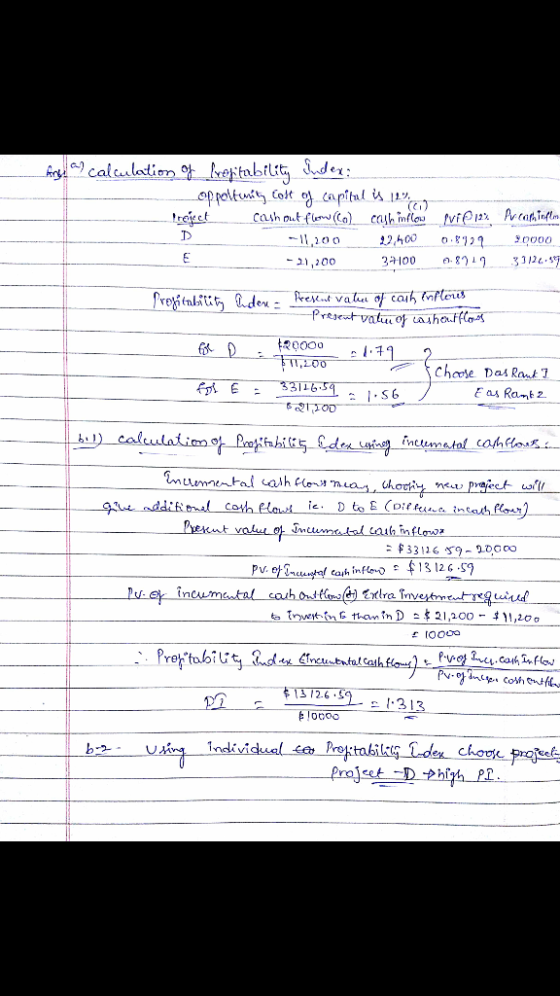
Consider the following projects: Cash Flows ($) Project C0 C1 D –11,200 22,400 E –21,200 37,100...
Consider the following projects:
| Cash Flows ($) | ||
| Project | C0 | C1 |
| D | –11,200 | 22,400 |
| E | –21,200 | 37,100 |
Assume that the projects are mutually exclusive and that the opportunity cost of capital is 12%.
a. Calculate the profitability index for each project. (Do not round intermediate calculations. Round your answers to 2 decimal places.)
| Project | Profitability Index |
| D | |
| E | |
b-1. Calculate the profitability-index using the incremental cash flows. (Do not round intermediate calculations. Round your answer to 2 decimal places.)
Profitability-index
b-2. Which project should you choose?
| Project D | |
| Project E |
Homework Answers
Add Answer to:
Consider the following projects:
Cash Flows ($)
Project
C0
C1
D
–11,200
22,400
E
–21,200
37,100...
Consider the following projects: Cash Flows (S) -10,600 -20,600 C1 21,200 36,050 Assume that the projects...
 Consider the following projects: Cash Flows (S) -10,600 -20,600 C1 21,200 36,050 Assume that the projects are mutually exclusive and that the opportunity cost of capital is 11%. a. Calculate the profitability index for each project. (Do not round intermediate calculations. Round your answers to 2 decimal places.) Project Profitability Index b-1. Calculate the profitability-index using the incremental cash flows. (Do not round intermediate calculations. Round your answer to 2 decimal places.) Profitabillty-Index b-2. Which project should you choose? Project...
Books .l LTE 11:05 AM @ 43%O Consider the following projects: Cash Flows (S) Project CO...
 Books .l LTE 11:05 AM @ 43%O Consider the following projects: Cash Flows (S) Project CO CID-10,500 21,000 E-20,500 35,875 Assume that the projects are mutually exclusive and that the opportunity cost of capital is 10%. a. Calculate the profitability index for each project. (Do not round intermediate calculations. Round your answers to 2 decimal places.) Project Profitability Index DE b-1. Calculate the profitability-index using the incremental cash flows. (Do not round intermediate calculations. Round your answer to 2 decimal...
Consider two mutually exclusive projects A and B: Cash Flows (dollars) Project C0 C1 C2 NPV...
Consider two mutually exclusive projects A and B: Cash Flows (dollars) Project C0 C1 C2 NPV at 11% A −36,500 26,200 26,200 +$8,368 B −56,500 39,500 39,500 +11,145 a. Calculate IRRs for A and B. (Do not round intermediate calculations. Enter your answers as a percent rounded to 2 decimal places.) b. Which project does the IRR rule suggest is best? Project A Project B c. Which project is really best?
Consider the following projects Cash Flows () Co -11,700 -21,700 roject 23,400 37,975 Assume that the...
 Consider the following projects Cash Flows () Co -11,700 -21,700 roject 23,400 37,975 Assume that the projects are mutually exclusive and that the opportunity cost of capital is 12%. a. Calculate the profitability index for each project. (Do not round intermediate calculations. Round your answers to 2 decimal places.) Project Profitability Index 90 b-1. Calculate the profitabilty-index using the incremental cash flows. (Do not round intermediate calculations. Round your answer to 2 decimal places.) Profitability-index b-2. Which project should you...
3. 10.00 points Consider the following projects: Cash Flows (S) -10,500 -20,500 21,000 35,875 Assume that...
 3. 10.00 points Consider the following projects: Cash Flows (S) -10,500 -20,500 21,000 35,875 Assume that the projects are mutually exclusive and that the opportunity cost of capital is 10%. a. Calculate the protitability index for each project. (Do not round intermediate calculations. Round your answers to 2 decimal places.) Project Profitability Index b-1. Calculate the protitablity-index using the incremental cash flows. (Do not round intermediate calculations. Round your answer to 2 decimal places.) Prontability-Index b-2. Which project should you...
Here are the cash flows for two mutually exclusive projects: Project C0 C1 C2 C3 A...
Here are the cash flows for two mutually exclusive projects: Project C0 C1 C2 C3 A −$ 21,800 +$ 9,592 +$ 9,592 +$ 9,592 B − 21,800 0 0 + 29,430 What is the IRR of each project? (Round your answers to 2 decimal places.)
Here are the cash flows for two mutually exclusive projects: Project C0 C1 C2 C3 A...
Here are the cash flows for two mutually exclusive projects: Project C0 C1 C2 C3 A −$ 21,800 +$ 9,592 +$ 9,592 +$ 9,592 B − 21,800 0 0 + 29,430 What is the IRR of each project? (Round your answers to 2 decimal places.)
1. You have the chance to participate in a project that produces the following cash flows:...
1. You have the chance to participate in a project that produces the following cash flows: Cash Flows ($) C0 C1 C2 4,600 4,400 –10,800 a. The internal rate of return is 12.69%. If the opportunity cost of capital is 12%, what is the NPV of the project? (A negative answer should be indicated by a minus sign. Do not round intermediate calculations. Round your answer to 2 decimal places.) NPV $ __________. 2. Consider the following projects: Cash Flows...
Here are the cash flows for two mutually exclusive projects: Project Co -$ 21,200 - 21,200...
 Here are the cash flows for two mutually exclusive projects: Project Co -$ 21,200 - 21,200 1 +$ 8,400 C2 +$8,400 0 B +$ 8,400 + 26,600 a. Given the following interest rates (0%, 2%, 4%, 6%, 8%, 10%, 12%, 14%, 16%, 18%, 20%), above what interest rates would you prefer project A to B? Interest rates above % | b. What is the IRR of each project? (Round your answers to 2 decimal places.) IRR Project A % Project...
Consider the following two mutually exclusive projects: Year Cash Flow (A) Cash Flow (B) 0 –$356,...
Consider the following two mutually exclusive projects: Year Cash Flow (A) Cash Flow (B) 0 –$356,000 –$40,000 1 31,000 23,000 2 42,000 15,200 3 50,000 14,100 4 445,000 11,200 The required return on these investments is 13 percent. Required: (a) What is the payback period for each project? (Do not round intermediate calculations. Round your answers to 2 decimal places (e.g., 32.16).) Payback period Project A years Project B years (b) What is the NPV for each project? (Do not...
 Consider the following projects: Cash Flows (S) -10,600 -20,600 C1 21,200 36,050 Assume that the projects are mutually exclusive and that the opportunity cost of capital is 11%. a. Calculate the profitability index for each project. (Do not round intermediate calculations. Round your answers to 2 decimal places.) Project Profitability Index b-1. Calculate the profitability-index using the incremental cash flows. (Do not round intermediate calculations. Round your answer to 2 decimal places.) Profitabillty-Index b-2. Which project should you choose? Project...
 Books .l LTE 11:05 AM @ 43%O Consider the following projects: Cash Flows (S) Project CO CID-10,500 21,000 E-20,500 35,875 Assume that the projects are mutually exclusive and that the opportunity cost of capital is 10%. a. Calculate the profitability index for each project. (Do not round intermediate calculations. Round your answers to 2 decimal places.) Project Profitability Index DE b-1. Calculate the profitability-index using the incremental cash flows. (Do not round intermediate calculations. Round your answer to 2 decimal...
 Consider the following projects Cash Flows () Co -11,700 -21,700 roject 23,400 37,975 Assume that the projects are mutually exclusive and that the opportunity cost of capital is 12%. a. Calculate the profitability index for each project. (Do not round intermediate calculations. Round your answers to 2 decimal places.) Project Profitability Index 90 b-1. Calculate the profitabilty-index using the incremental cash flows. (Do not round intermediate calculations. Round your answer to 2 decimal places.) Profitability-index b-2. Which project should you...
 3. 10.00 points Consider the following projects: Cash Flows (S) -10,500 -20,500 21,000 35,875 Assume that the projects are mutually exclusive and that the opportunity cost of capital is 10%. a. Calculate the protitability index for each project. (Do not round intermediate calculations. Round your answers to 2 decimal places.) Project Profitability Index b-1. Calculate the protitablity-index using the incremental cash flows. (Do not round intermediate calculations. Round your answer to 2 decimal places.) Prontability-Index b-2. Which project should you...
 Here are the cash flows for two mutually exclusive projects: Project Co -$ 21,200 - 21,200 1 +$ 8,400 C2 +$8,400 0 B +$ 8,400 + 26,600 a. Given the following interest rates (0%, 2%, 4%, 6%, 8%, 10%, 12%, 14%, 16%, 18%, 20%), above what interest rates would you prefer project A to B? Interest rates above % | b. What is the IRR of each project? (Round your answers to 2 decimal places.) IRR Project A % Project...
Most questions answered within 3 hours.
-
Where is the error in this code sequence?
String s1 = "Hello";
String s2 = "ello";...
asked 10 months ago -
Financial data for Joel de Paris, Inc., for last year
follow:
Joel de Paris, Inc.
Balance...
asked 10 months ago -
Consider this reaction:
Al2(SO4)3 (aq)+ BaCl3
(aq) Al2Cl6 (aq)- +
3BaSO4(s) . What is the...
asked 10 months ago -
Suppose that Savneet is considering increasing her
recent random sample from 20 car rentals to 40...
asked 10 months ago -
Trucks arrive at an unloading terminal at an average rate of 120
per hour.
Trucks arrive...
asked 10 months ago -
Why are methanol and ethanol completely soluble in water while
octanol is not very little soluble....
asked 10 months ago -
A facilities manager at a university reads in a research report
that the mean amount of...
asked 10 months ago -
When the CuSO4 is rehydrated by adding water to the anhydrous
compound, is this an endothermic...
asked 10 months ago -
A ray of sunlight is passing from diamond into crown glass; the
angle of incidence is...
asked 10 months ago -
A block of mass 0.249 kg is placed on top of a light, vertical
spring of...
asked 10 months ago -
how do the kidneys compensate in the presences of acidosis
a) trigger hyperventilate
b) reserve acid...
asked 10 months ago -
Question 501 pts
The rental rate of capital to the firm increases. Which of the
following...
asked 10 months ago