

Homework Answers

Add Answer to:
A plastic disk initially rotates freely and without friction on an icy surface, as shown in...
A disk with moment of inertia 9.15 × 10⁻³ kg∙m^2 initially rotates about its center at...
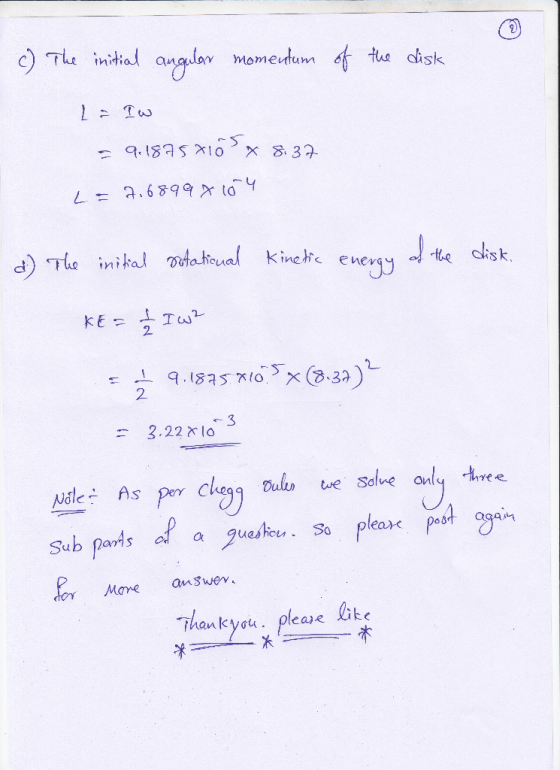
A disk with moment of inertia 9.15 × 10⁻³ kg∙m^2 initially rotates about its center at angular velocity 5.32 rad/s. A non-rotating ring with moment of inertia 4.86 × 10⁻³ kg∙m^2 right above the disk’s center is suddenly dropped onto the disk. Finally, the two objects rotate at the same angular velocity ?? about the same axis. There is no external torque acting on the system during the collision. Please compute the system’s quantities below. 1. Initial angular momentum ??...
(3) A disk with moment of inertia 9.15 × 10⁻³ kg∙m 2 initially rotates about its...
(3) A disk with moment of inertia 9.15 × 10⁻³ kg∙m 2 initially rotates about its center at angular velocity 5.32 rad/s. A non-rotating ring with moment of inertia 4.86 × 10⁻³ kg∙m 2 right above the disk’s center is suddenly dropped onto the disk. Finally, the two objects rotate at the same angular velocity ?? about the same axis. There is no external torque acting on the system during the collision. Please compute the system’s quantities below. 1. Initial...
Consider a turntable to be a circular disk of moment of inertia 0.142 kg⋅m2 rotating at...
Consider a turntable to be a circular disk of moment of inertia 0.142 kg⋅m2 rotating at a constant angular velocity 4.80 rad/s2 around an axis through the center and perpendicular to the plane of the disk (the disk's "primary axis of symmetry"). The axis of the disk is vertical and the disk is supported by frictionless bearings. The motor of the turntable is off, so there is no external torque being applied to the axis. Another disk (a record) is...
of mass m and radius R is freely rotating at angular velocityw,spinning clockwise The moment of...
 of mass m and radius R is freely rotating at angular velocityw,spinning clockwise The moment of inertia of a disk is ImR2.) While it is rotating, someone when seen from above. ( ps a thin ring of mass m and also of radius R on top of it. When the ring lands, it is initially ot otating, but friction quickly causes it to rotate along with the disk, but the rotation of the disk slows down. a) What principle of...
A student on a piano stool rotates freely with an angular speed of 2.95 rev/s ....
A student on a piano stool rotates freely with an angular speed of 2.95 rev/s . The student holds a 1.35 kg mass in each outstretched arm, 0.759 m from the axis of rotation. The combined moment of inertia of the student and the stool, ignoring the two masses, is 5.13 kg⋅m2 , a value that remains constant. Calculate the initial kinetic energy of the system. Calculate the final kinetic energy of the system.
Calculate the angular momentum for a rotating disk, sphere, and rod. (a) A uniform disk of...
 Calculate the angular momentum for a rotating disk, sphere, and rod. (a) A uniform disk of mass 16 kg, thickness 0.5 m, and radius 0.9 m is located at the origin, oriented with its axis along the y axis. It rotates clockwise around its axis when viewed from above (that is, you stand at a point on the +y axis and look toward the origin at the disk). The disk makes one complete rotation every 0.7 s. What is the...
A student on a piano stool rotates freely with an angular speed of 3.05 rev/s ....
A student on a piano stool rotates freely with an angular speed of 3.05 rev/s . The student holds a 1.35 kg mass in each outstretched arm, 0.789 m from the axis of rotation. The combined moment of inertia of the student and the stool, ignoring the two masses, is 5.43 kg⋅m2 , a value that remains constant. a) As the student pulls his arms inward, his angular speed increases to 3.73 rev/s . How far are the masses from...
student on a piano stool rotates freely with an angular speed of 2.85 rev/s . The...
student on a piano stool rotates freely with an angular speed of 2.85 rev/s . The student holds a 1.25 kg mass in each outstretched arm, 0.739 m from the axis of rotation. The combined moment of inertia of the student and the stool, ignoring the two masses, is 5.53 kg⋅m2 , a value that remains constant. As the student pulls his arms inward, his angular speed increases to 3.41 rev/s . How far are the masses from the axis...
A student on a piano stool rotates freely with an angular speed of 3.07 rev/s. The...
A student on a piano stool rotates freely with an angular speed of 3.07 rev/s. The student holds a 1.27-kg mass in each outstretched arm, 0.766 m from the axis of rotation. The combined moment of inertia of the student and the stool, ignoring the two masses, is 5.50 kg*m2, a value that remains constant. As the student pulls his arms inward, his angular speed increases to 3.40 rev/s. How far are the masses from the axis of rotation at...
 of mass m and radius R is freely rotating at angular velocityw,spinning clockwise The moment of inertia of a disk is ImR2.) While it is rotating, someone when seen from above. ( ps a thin ring of mass m and also of radius R on top of it. When the ring lands, it is initially ot otating, but friction quickly causes it to rotate along with the disk, but the rotation of the disk slows down. a) What principle of...
 Calculate the angular momentum for a rotating disk, sphere, and rod. (a) A uniform disk of mass 16 kg, thickness 0.5 m, and radius 0.9 m is located at the origin, oriented with its axis along the y axis. It rotates clockwise around its axis when viewed from above (that is, you stand at a point on the +y axis and look toward the origin at the disk). The disk makes one complete rotation every 0.7 s. What is the...
Most questions answered within 3 hours.
-
Where is the error in this code sequence?
String s1 = "Hello";
String s2 = "ello";...
asked 10 months ago -
Financial data for Joel de Paris, Inc., for last year
follow:
Joel de Paris, Inc.
Balance...
asked 10 months ago -
Consider this reaction:
Al2(SO4)3 (aq)+ BaCl3
(aq) Al2Cl6 (aq)- +
3BaSO4(s) . What is the...
asked 10 months ago -
Suppose that Savneet is considering increasing her
recent random sample from 20 car rentals to 40...
asked 10 months ago -
Trucks arrive at an unloading terminal at an average rate of 120
per hour.
Trucks arrive...
asked 10 months ago -
Why are methanol and ethanol completely soluble in water while
octanol is not very little soluble....
asked 10 months ago -
A facilities manager at a university reads in a research report
that the mean amount of...
asked 10 months ago -
When the CuSO4 is rehydrated by adding water to the anhydrous
compound, is this an endothermic...
asked 10 months ago -
A ray of sunlight is passing from diamond into crown glass; the
angle of incidence is...
asked 10 months ago -
A block of mass 0.249 kg is placed on top of a light, vertical
spring of...
asked 10 months ago -
how do the kidneys compensate in the presences of acidosis
a) trigger hyperventilate
b) reserve acid...
asked 10 months ago -
Question 501 pts
The rental rate of capital to the firm increases. Which of the
following...
asked 10 months ago