
Homework Answers
Types of reactions:
Combination: For this type of reaction there is only 1 product formed from 2 or more reactant
Decomposition:For this type of reaction there is only 1 reactant and decomposes into 2 or more products
single displacement: In this type, 1 reactant displaces other reactant from its compound
double displacement:In this type, both reactant displaces each other
combustion reaction: compound reacts with O2 to give CO2 and H2O
1)
Answer: Decomposition reaction
Because 1 reactant decomposes into 2 products
2)
Answer: Decomposition reaction
Because 1 reactant decomposes into 2 products
3)
Answer: single displacement
Because K+ is exchanged from I to Cl
Add Answer to:
Classify each chemical reaction: Reaction Type Ca(CIO),(s) — CaCI(s) + 302 (8) choose one 2KNO3(-) —...
Classify each chemical reaction: Reaction Type Cl_(s) + 2K1(aq) → 2KCl(aq) + 1,(s) choose one H,soz(aq)...
 Classify each chemical reaction: Reaction Type Cl_(s) + 2K1(aq) → 2KCl(aq) + 1,(s) choose one H,soz(aq) → H20(1) + S02 (8) choose one AgNO3(aq) + NaCl(aq) → NaNO3(aq) + AgCl(s) choose one x 6 ?
Classify each chemical reaction: Reaction Type Mg(s) + FeCl, (aq) → MgCl, (aq) + Fe(s) choose...
 Classify each chemical reaction: Reaction Type Mg(s) + FeCl, (aq) → MgCl, (aq) + Fe(s) choose one 2H0,() — 24,0(1) + 02 (8) choose one 4K (s) + 02(8) — 26,0(s) choose one x 6 ?
Classify each chemical reaction: Reaction Type Na CO2 (s) → Na20(s) + CO2(8) choose one AgNO3(aq) + NaCl(aq) → NaNO3(aq...
 Classify each chemical reaction: Reaction Type Na CO2 (s) → Na20(s) + CO2(8) choose one AgNO3(aq) + NaCl(aq) → NaNO3(aq) + AgCl(s) choose one 2 Mg(s) + 02 (8) ► 2Mgo(s) choose one x 6 ?
Classify each chemical reaction: Reaction Type FeCl2(aq) + Bas (aq) → BaCl2(aq) + FeS (s) choose one C12(g) + 2KI (aq)...
 Classify each chemical reaction: Reaction Type FeCl2(aq) + Bas (aq) → BaCl2(aq) + FeS (s) choose one C12(g) + 2KI (aq) → 2KCl(aq) + 1,(s) choose one Mg(s) + F2(g) → MgF2(s) choose one o ?
Classify each reaction type 4Co(s) + 3O2(g) → 2Co2O3(s) [ Choose ] ...
Classify each reaction type 4Co(s) + 3O2(g) → 2Co2O3(s) [ Choose ] decomposition combination double replacement single replacement neutralization 2LiClO3(s) →2LiCl(s)+ 3O2(g) [ Choose ] decomposition combination double replacement single replacement neutralization Cu(s)+2AgC2H3O2(aq) →Cu(C2H3O2)2(aq)+2Ag(s) [ Choose ] ...
Classify each chemical reaction: reaction HCl(aq) + NaOH(aq) NaCl(aq) + H20(1) 2Nacio, (s) → 2NaCl(s) +...
 Classify each chemical reaction: reaction HCl(aq) + NaOH(aq) NaCl(aq) + H20(1) 2Nacio, (s) → 2NaCl(s) + 30 (8) type of reaction (check all that apply) combination precipitation single replacement combustion double replacement acid-base decomposition combination precipitation single replacement combustion double replacement acid-base decomposition combination precipitation single replacement combustion double replacement acid-base decomposition combination precipitation single replacement combustion double replacement acid-base decomposition CH,CH, CH, (s) + 502 (8) – 300,(8) + 4H2O(8) NaCl(aq) + AgNO, (aq) - NaNO3(aq) + AgCl(s)
The type could be a combination, decomposition, single substitution, metathesis, or none of the above. Thanks in advance...
 The type could be a combination, decomposition, single
substitution, metathesis, or none of the above. Thanks in
advance!
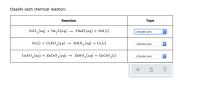
Classify each chemical reaction: Туре Reaction FeCl2(aq) Na2s (a q) 2Na Cl (a q) + FeS (s) choose one Fe(s) CuSO4 (aq) FeSO4 (aq)Cu (s) choose one CuSO4(aq)ZnCrO,(aq) ZnSO4(aq) CuCrO4(s) choose one
The type could be a combination, decomposition, single
substitution, metathesis, or none of the above. Thanks in
advance!
Classify each chemical reaction: Туре Reaction FeCl2(aq) Na2s (a q) 2Na Cl (a q) + FeS (s) choose one Fe(s) CuSO4 (aq) FeSO4 (aq)Cu (s) choose one CuSO4(aq)ZnCrO,(aq) ZnSO4(aq) CuCrO4(s) choose one
1. For the reaction 3 CIO - (aq) → CIO, - (aq) + 2Cl(aq) doubling the...
 1. For the reaction 3 CIO - (aq) → CIO, - (aq) + 2Cl(aq) doubling the concentration of CIOquadruples the initial rate of formation of CIO:: What is the rate expression for the reaction? is first order in CsH5N_CI 2. The reaction CoHsN2Cl(aq) + H2O(l) → CH5OH(aq) + N2 (g) + HCl(aq) and zero order in H2O. What is the rate expression? 3. For the reaction 2 NO(g) + Cl2(g) → 2 NOCI (g) If the concentration of NO is...
Choose Question 2 1. Balance the following chemical equations and 2. Classify the type of reaction...
 Choose Question 2 1. Balance the following chemical equations and 2. Classify the type of reaction (acid-base neutralization, combination, decomposition, double-replacement, single replacement. a. Ll(s) + N2(8) LIN(s) b. (NH4)2Cr2O;(s) + N2(g) + Cr2O3(s) + H2O(g) C. SIO2 (s) + C(s) + Si(s) + COG) d. Al(SO4)3 + Na PO, AIPO, + Na, SO e. HF + Ba(OH)2 - BaF+H2O Upload Choose a Fe Question 3 Write the molecular couation, complete ionicouation nettonic equation and endly the samestor roton 1....
Classify each chemical reaction: reaction 4K (s) + O2(g) → 26,0(s) 2CH,CH, (g) + 70, (g) → 400, (g) + 6H120(g) type of...
 Classify each chemical reaction:
reaction 4K (s) + O2(g) → 26,0(s) 2CH,CH, (g) + 70, (g) → 400, (g) + 6H120(g) type of reaction (check all that apply) combination precipitation single replacement combusti double replacement acid-base decomposition combination precipitation single replacement combustic double replacement acid-base decomposition combination precipitat single replacement combustion double replacement acid-base decomposition combination precipitation single replacement combustion double replacement acid-base decomposition Na, Coz(s) → Na20(s) + CO2(g) H Br(aq) + NaOH(aq) → NaBr(aq) + H20(1)
Classify each chemical reaction:
reaction 4K (s) + O2(g) → 26,0(s) 2CH,CH, (g) + 70, (g) → 400, (g) + 6H120(g) type of reaction (check all that apply) combination precipitation single replacement combusti double replacement acid-base decomposition combination precipitation single replacement combustic double replacement acid-base decomposition combination precipitat single replacement combustion double replacement acid-base decomposition combination precipitation single replacement combustion double replacement acid-base decomposition Na, Coz(s) → Na20(s) + CO2(g) H Br(aq) + NaOH(aq) → NaBr(aq) + H20(1)
 Classify each chemical reaction: Reaction Type Cl_(s) + 2K1(aq) → 2KCl(aq) + 1,(s) choose one H,soz(aq) → H20(1) + S02 (8) choose one AgNO3(aq) + NaCl(aq) → NaNO3(aq) + AgCl(s) choose one x 6 ?
 Classify each chemical reaction: Reaction Type Mg(s) + FeCl, (aq) → MgCl, (aq) + Fe(s) choose one 2H0,() — 24,0(1) + 02 (8) choose one 4K (s) + 02(8) — 26,0(s) choose one x 6 ?
 Classify each chemical reaction: Reaction Type Na CO2 (s) → Na20(s) + CO2(8) choose one AgNO3(aq) + NaCl(aq) → NaNO3(aq) + AgCl(s) choose one 2 Mg(s) + 02 (8) ► 2Mgo(s) choose one x 6 ?
 Classify each chemical reaction: Reaction Type FeCl2(aq) + Bas (aq) → BaCl2(aq) + FeS (s) choose one C12(g) + 2KI (aq) → 2KCl(aq) + 1,(s) choose one Mg(s) + F2(g) → MgF2(s) choose one o ?
 Classify each chemical reaction: reaction HCl(aq) + NaOH(aq) NaCl(aq) + H20(1) 2Nacio, (s) → 2NaCl(s) + 30 (8) type of reaction (check all that apply) combination precipitation single replacement combustion double replacement acid-base decomposition combination precipitation single replacement combustion double replacement acid-base decomposition combination precipitation single replacement combustion double replacement acid-base decomposition combination precipitation single replacement combustion double replacement acid-base decomposition CH,CH, CH, (s) + 502 (8) – 300,(8) + 4H2O(8) NaCl(aq) + AgNO, (aq) - NaNO3(aq) + AgCl(s)
 The type could be a combination, decomposition, single
substitution, metathesis, or none of the above. Thanks in
advance!
Classify each chemical reaction: Туре Reaction FeCl2(aq) Na2s (a q) 2Na Cl (a q) + FeS (s) choose one Fe(s) CuSO4 (aq) FeSO4 (aq)Cu (s) choose one CuSO4(aq)ZnCrO,(aq) ZnSO4(aq) CuCrO4(s) choose one
The type could be a combination, decomposition, single
substitution, metathesis, or none of the above. Thanks in
advance!
Classify each chemical reaction: Туре Reaction FeCl2(aq) Na2s (a q) 2Na Cl (a q) + FeS (s) choose one Fe(s) CuSO4 (aq) FeSO4 (aq)Cu (s) choose one CuSO4(aq)ZnCrO,(aq) ZnSO4(aq) CuCrO4(s) choose one
 1. For the reaction 3 CIO - (aq) → CIO, - (aq) + 2Cl(aq) doubling the concentration of CIOquadruples the initial rate of formation of CIO:: What is the rate expression for the reaction? is first order in CsH5N_CI 2. The reaction CoHsN2Cl(aq) + H2O(l) → CH5OH(aq) + N2 (g) + HCl(aq) and zero order in H2O. What is the rate expression? 3. For the reaction 2 NO(g) + Cl2(g) → 2 NOCI (g) If the concentration of NO is...
 Choose Question 2 1. Balance the following chemical equations and 2. Classify the type of reaction (acid-base neutralization, combination, decomposition, double-replacement, single replacement. a. Ll(s) + N2(8) LIN(s) b. (NH4)2Cr2O;(s) + N2(g) + Cr2O3(s) + H2O(g) C. SIO2 (s) + C(s) + Si(s) + COG) d. Al(SO4)3 + Na PO, AIPO, + Na, SO e. HF + Ba(OH)2 - BaF+H2O Upload Choose a Fe Question 3 Write the molecular couation, complete ionicouation nettonic equation and endly the samestor roton 1....
 Classify each chemical reaction:
reaction 4K (s) + O2(g) → 26,0(s) 2CH,CH, (g) + 70, (g) → 400, (g) + 6H120(g) type of reaction (check all that apply) combination precipitation single replacement combusti double replacement acid-base decomposition combination precipitation single replacement combustic double replacement acid-base decomposition combination precipitat single replacement combustion double replacement acid-base decomposition combination precipitation single replacement combustion double replacement acid-base decomposition Na, Coz(s) → Na20(s) + CO2(g) H Br(aq) + NaOH(aq) → NaBr(aq) + H20(1)
Classify each chemical reaction:
reaction 4K (s) + O2(g) → 26,0(s) 2CH,CH, (g) + 70, (g) → 400, (g) + 6H120(g) type of reaction (check all that apply) combination precipitation single replacement combusti double replacement acid-base decomposition combination precipitation single replacement combustic double replacement acid-base decomposition combination precipitat single replacement combustion double replacement acid-base decomposition combination precipitation single replacement combustion double replacement acid-base decomposition Na, Coz(s) → Na20(s) + CO2(g) H Br(aq) + NaOH(aq) → NaBr(aq) + H20(1)
Most questions answered within 3 hours.
-
Where is the error in this code sequence?
String s1 = "Hello";
String s2 = "ello";...
asked 10 months ago -
Financial data for Joel de Paris, Inc., for last year
follow:
Joel de Paris, Inc.
Balance...
asked 10 months ago -
Consider this reaction:
Al2(SO4)3 (aq)+ BaCl3
(aq) Al2Cl6 (aq)- +
3BaSO4(s) . What is the...
asked 10 months ago -
Suppose that Savneet is considering increasing her
recent random sample from 20 car rentals to 40...
asked 10 months ago -
Trucks arrive at an unloading terminal at an average rate of 120
per hour.
Trucks arrive...
asked 10 months ago -
Why are methanol and ethanol completely soluble in water while
octanol is not very little soluble....
asked 10 months ago -
A facilities manager at a university reads in a research report
that the mean amount of...
asked 10 months ago -
When the CuSO4 is rehydrated by adding water to the anhydrous
compound, is this an endothermic...
asked 10 months ago -
A ray of sunlight is passing from diamond into crown glass; the
angle of incidence is...
asked 10 months ago -
A block of mass 0.249 kg is placed on top of a light, vertical
spring of...
asked 10 months ago -
how do the kidneys compensate in the presences of acidosis
a) trigger hyperventilate
b) reserve acid...
asked 10 months ago -
Question 501 pts
The rental rate of capital to the firm increases. Which of the
following...
asked 10 months ago