

Homework Answers
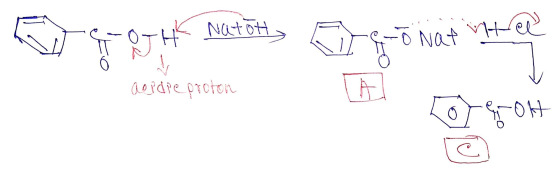
Benzoic acid has an acidic proton which can react with strong base like NaOH to form a salt.
While diethyl ether and biphenyl don't have such an equivalent proton and hence they can't react with NaOH.
After first step of extraction in organic layer B diethyl ether and biphenyl remains.
Add Answer to:
A liquid-liquid extraction is performed according to the schematic below. Which compound(s) should we expect to...
The Separation of Three Organic Compounds by Acid, Base Reactions and Liquid, Liquid Extraction. Okay, so...
The Separation of Three Organic Compounds by Acid, Base Reactions and Liquid, Liquid Extraction. Okay, so we had solid benzoic acid, ethyl 4- aminobenzoate, and 9-fluorenone all dissolved in diethyl ether. We separated the basic component by adding 3M HCl, we separated the acidic component by adding 3M NaOH. I don't understand what happens here. To isolate the acidic solution, we added 6 M NaOH and used the vacuum to recover the solid. To isolate the basic solution we added...
The Separation of Three Organic Compounds by Acid, Base Reactions and Liquid, Liquid Extraction. Okay, so...
The Separation of Three Organic Compounds by Acid, Base Reactions and Liquid, Liquid Extraction. Okay, so we had solid benzoic acid, ethyl 4- aminobenzoate, and 9-fluorenone all dissolved in methyleene chloride. We separated the basic component by adding 3M HCl, we separated the acidic component by adding 3M NaOH. I don't understand what happens here. To isolate the acidic solution, we added 6 M NaOH and used the vacuum to recover the solid. To isolate the basic solution we added...
Name: Date: Separation of Acid/Base/Neutral compounds using liquid-liquid extraction OCH CHO HN Benzocaine Molecular Weight: 165.19...
 Name: Date: Separation of Acid/Base/Neutral compounds using liquid-liquid extraction OCH CHO HN Benzocaine Molecular Weight: 165.19 Melting Point: 88-90 °C 1,1-biphenyl Molecular Weight: 154.21 Melting Point: 68-70 °C trans-cinnamic acid Molecular Weight: 148.16 Melting Point: 132-135 °C Question 1: Identify the following compounds as Acid, Base or Neutral. (2 points) a. Benzocaine: b. Biphenyl: c. Trans-cinnamic acid: (2 points) _ (2 points) Question 2: Draw the structure in the box (5 points each): NaOH OCH,CH, HCM NaOHA HC form. Ples...
Write a small introduction in words and a conclusion for this lab report Experiment 9 Acid-Base Extraction Liquid-liquid extraction utilizes the contrast solubilities of solutes in two immiscible...
 Write a small introduction in words and a conclusion for this
lab report
Experiment 9 Acid-Base Extraction Liquid-liquid extraction utilizes the contrast solubilities of solutes in two immiscible solvents the separation of a mixture. An extracting solvent can be reactive that changes the character of solute. Consider a mixture of organic acid, organic base, and neutral substance, for example, benzoic acid, aniline, biphenyl, nd phenol. They sodium benzoate. Sodium hydroxide changes phenol to sodium phenoxide. Hydrochloric acid changes aniline to...
Write a small introduction in words and a conclusion for this
lab report
Experiment 9 Acid-Base Extraction Liquid-liquid extraction utilizes the contrast solubilities of solutes in two immiscible solvents the separation of a mixture. An extracting solvent can be reactive that changes the character of solute. Consider a mixture of organic acid, organic base, and neutral substance, for example, benzoic acid, aniline, biphenyl, nd phenol. They sodium benzoate. Sodium hydroxide changes phenol to sodium phenoxide. Hydrochloric acid changes aniline to...
Draw an extraction flow chart for the Extraction experiment you completed. experiment below Separation of a...
Draw an extraction flow chart for the Extraction experiment you completed. experiment below Separation of a Benzoic Acid/Biphenyl Mixture by Acid-Base Extraction Prepare the solution to be extracted by dissolving 2.5 g of a 1:1 mixture of benzoic acid/ biphenyl in 25 mL of tert-butyl methyl ether (MTBE) . Using a 125 mL separatory funnel extract the ether solution with a mixture containing 10 mL of distilled water and 15 mL of saturated NaHCO3 . Repeat After removing the aqueous...
A mixture of compounds containing dimethylamine, phenol, ammonia, and acetic acid is separated using liquid-liquid extraction...
 A mixture of compounds containing dimethylamine, phenol, ammonia, and acetic acid is separated using liquid-liquid extraction as follows: Step 1: Concentrated HCl is added followed by draining the aqueous layer. Step 2: Dilute NaOH is added to the organic layer followed by draining the aqueous layer. Step 3: Concentrated NaOH is added to the organic layer followed by draining the aqueous layer. Which compound would you expect to be extracted into the aqueous layer after the addition of dilute NaOH,...
Draw the reaction mechanism with chemical structures in the separation of naphthalene and benzoic acid by...
Draw the reaction mechanism with chemical structures in the separation of naphthalene and benzoic acid by extraction. 1g of Naphthalene/benzoic acid mixture is dissolved in 15 mL dichloromethane, transferred to a separatory funnel where 10 mL 2.5M NaOH(aq) is added. Organic and Aqueous layers are separated, and 12M HCl(aq) is added to the aqueous layer while cooling, forming a precipitate, which is vacuum filtrated. Don't understand how to draw each chemical structure!
For the portion of the procedure shown below, create a flow chart for the acid-base extraction...
 For the portion of the procedure shown below, create a
flow chart for the acid-base extraction at the end of the Grignard
Reaction. Start your flow chart with the crude reaction (see below)
mixture before addition of HCl and continue it until the product is
recovered. Depict the desired organic product, in its correct form
at each step of the procedure.
Crude reaction mixture procedure for reference: To
the flask add Mg turnings (120 mg, 4.94 mmol) to the flask...
For the portion of the procedure shown below, create a
flow chart for the acid-base extraction at the end of the Grignard
Reaction. Start your flow chart with the crude reaction (see below)
mixture before addition of HCl and continue it until the product is
recovered. Depict the desired organic product, in its correct form
at each step of the procedure.
Crude reaction mixture procedure for reference: To
the flask add Mg turnings (120 mg, 4.94 mmol) to the flask...
can you double check the structures drawn in the boxes please. The structures from the other...
 can you double check the structures drawn in the boxes
please.
The structures from the other page will be used in Question 4
and 5
Separation of Acid/Base/Neutral compounds using liquid-liquid extraction OCH.CH Benzocaine Molecular Weight: 165.19 Melting Point: 88-90 °C 1.1-biphenyi Molecular Weight: 154.21 Melting Point: 68-70 °C trans-cinnamic acid Molecular Weight: 148.16 Melting Point 132-135°C Question 1: Identify the following compounds as Acid, Base or Neutral a. Benzocaine: _DER b. Biphenyl:_Se c. Trans-cinnamic acid:_ (2 points) (2 points)...
can you double check the structures drawn in the boxes
please.
The structures from the other page will be used in Question 4
and 5
Separation of Acid/Base/Neutral compounds using liquid-liquid extraction OCH.CH Benzocaine Molecular Weight: 165.19 Melting Point: 88-90 °C 1.1-biphenyi Molecular Weight: 154.21 Melting Point: 68-70 °C trans-cinnamic acid Molecular Weight: 148.16 Melting Point 132-135°C Question 1: Identify the following compounds as Acid, Base or Neutral a. Benzocaine: _DER b. Biphenyl:_Se c. Trans-cinnamic acid:_ (2 points) (2 points)...
In my liquid-liquid extraction experiment, I have to explain where the "rest" of my product is....
In my liquid-liquid extraction experiment, I have to explain where the "rest" of my product is. we were given 1.000 gram to start with of one acid and one neutral compound and separated using the liquid liquid extraction. First we added NaOH into the flask and shook it and observe the separation of the two layers. Then I drained them into separate beakers and added HCL to the aqueous layer containing the acidic component and I evaporated the solvent off...
 Name: Date: Separation of Acid/Base/Neutral compounds using liquid-liquid extraction OCH CHO HN Benzocaine Molecular Weight: 165.19 Melting Point: 88-90 °C 1,1-biphenyl Molecular Weight: 154.21 Melting Point: 68-70 °C trans-cinnamic acid Molecular Weight: 148.16 Melting Point: 132-135 °C Question 1: Identify the following compounds as Acid, Base or Neutral. (2 points) a. Benzocaine: b. Biphenyl: c. Trans-cinnamic acid: (2 points) _ (2 points) Question 2: Draw the structure in the box (5 points each): NaOH OCH,CH, HCM NaOHA HC form. Ples...
 Write a small introduction in words and a conclusion for this
lab report
Experiment 9 Acid-Base Extraction Liquid-liquid extraction utilizes the contrast solubilities of solutes in two immiscible solvents the separation of a mixture. An extracting solvent can be reactive that changes the character of solute. Consider a mixture of organic acid, organic base, and neutral substance, for example, benzoic acid, aniline, biphenyl, nd phenol. They sodium benzoate. Sodium hydroxide changes phenol to sodium phenoxide. Hydrochloric acid changes aniline to...
Write a small introduction in words and a conclusion for this
lab report
Experiment 9 Acid-Base Extraction Liquid-liquid extraction utilizes the contrast solubilities of solutes in two immiscible solvents the separation of a mixture. An extracting solvent can be reactive that changes the character of solute. Consider a mixture of organic acid, organic base, and neutral substance, for example, benzoic acid, aniline, biphenyl, nd phenol. They sodium benzoate. Sodium hydroxide changes phenol to sodium phenoxide. Hydrochloric acid changes aniline to...
 A mixture of compounds containing dimethylamine, phenol, ammonia, and acetic acid is separated using liquid-liquid extraction as follows: Step 1: Concentrated HCl is added followed by draining the aqueous layer. Step 2: Dilute NaOH is added to the organic layer followed by draining the aqueous layer. Step 3: Concentrated NaOH is added to the organic layer followed by draining the aqueous layer. Which compound would you expect to be extracted into the aqueous layer after the addition of dilute NaOH,...
 For the portion of the procedure shown below, create a
flow chart for the acid-base extraction at the end of the Grignard
Reaction. Start your flow chart with the crude reaction (see below)
mixture before addition of HCl and continue it until the product is
recovered. Depict the desired organic product, in its correct form
at each step of the procedure.
Crude reaction mixture procedure for reference: To
the flask add Mg turnings (120 mg, 4.94 mmol) to the flask...
For the portion of the procedure shown below, create a
flow chart for the acid-base extraction at the end of the Grignard
Reaction. Start your flow chart with the crude reaction (see below)
mixture before addition of HCl and continue it until the product is
recovered. Depict the desired organic product, in its correct form
at each step of the procedure.
Crude reaction mixture procedure for reference: To
the flask add Mg turnings (120 mg, 4.94 mmol) to the flask...
 can you double check the structures drawn in the boxes
please.
The structures from the other page will be used in Question 4
and 5
Separation of Acid/Base/Neutral compounds using liquid-liquid extraction OCH.CH Benzocaine Molecular Weight: 165.19 Melting Point: 88-90 °C 1.1-biphenyi Molecular Weight: 154.21 Melting Point: 68-70 °C trans-cinnamic acid Molecular Weight: 148.16 Melting Point 132-135°C Question 1: Identify the following compounds as Acid, Base or Neutral a. Benzocaine: _DER b. Biphenyl:_Se c. Trans-cinnamic acid:_ (2 points) (2 points)...
can you double check the structures drawn in the boxes
please.
The structures from the other page will be used in Question 4
and 5
Separation of Acid/Base/Neutral compounds using liquid-liquid extraction OCH.CH Benzocaine Molecular Weight: 165.19 Melting Point: 88-90 °C 1.1-biphenyi Molecular Weight: 154.21 Melting Point: 68-70 °C trans-cinnamic acid Molecular Weight: 148.16 Melting Point 132-135°C Question 1: Identify the following compounds as Acid, Base or Neutral a. Benzocaine: _DER b. Biphenyl:_Se c. Trans-cinnamic acid:_ (2 points) (2 points)...
Most questions answered within 3 hours.
-
Where is the error in this code sequence?
String s1 = "Hello";
String s2 = "ello";...
asked 10 months ago -
Financial data for Joel de Paris, Inc., for last year
follow:
Joel de Paris, Inc.
Balance...
asked 10 months ago -
Consider this reaction:
Al2(SO4)3 (aq)+ BaCl3
(aq) Al2Cl6 (aq)- +
3BaSO4(s) . What is the...
asked 10 months ago -
Suppose that Savneet is considering increasing her
recent random sample from 20 car rentals to 40...
asked 10 months ago -
Trucks arrive at an unloading terminal at an average rate of 120
per hour.
Trucks arrive...
asked 10 months ago -
Why are methanol and ethanol completely soluble in water while
octanol is not very little soluble....
asked 10 months ago -
A facilities manager at a university reads in a research report
that the mean amount of...
asked 10 months ago -
When the CuSO4 is rehydrated by adding water to the anhydrous
compound, is this an endothermic...
asked 10 months ago -
A ray of sunlight is passing from diamond into crown glass; the
angle of incidence is...
asked 10 months ago -
A block of mass 0.249 kg is placed on top of a light, vertical
spring of...
asked 10 months ago -
how do the kidneys compensate in the presences of acidosis
a) trigger hyperventilate
b) reserve acid...
asked 10 months ago -
Question 501 pts
The rental rate of capital to the firm increases. Which of the
following...
asked 10 months ago