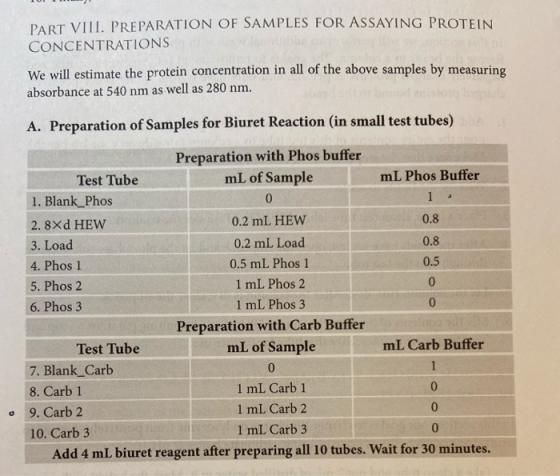
please calculate the values for dilution factor before and after adding 4ml biuret. please show work. Thank you!!

Homework Answers
Dilution Factor (D.F.) is calculated by dividing the final volume of solution to the initial volume of sample.
So, for before adding Biuret Reagent final volume is 1 and for after adding Biuret Reagent final volume is 5 while the initial volume of sample varies as they are different for some. Dilution Factor is calculated by putting these values in the formula.
And D.F. are;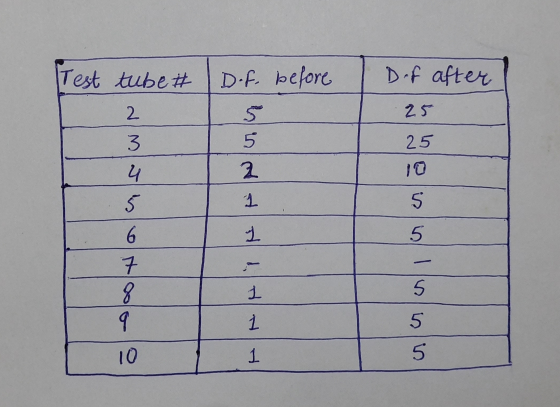
Add Answer to:
please calculate the values for dilution factor before and after
adding 4ml biuret. please show work....
Can you please calculate the lysed 1. Fill in the table of the relevant results below...
 Can you please calculate the lysed
1. Fill in the table of the relevant results below and calculate the percentage of lysed RBC assuming that 0% salt solution gives 100% lysis. (3 marks) Tube Number [NaClj (%) Absorbance at 540 nm % Erythrocytes Lysed 30 3 40 50 0.178 0.182 0.187 0.211 0.183 0.052 0.021 60 80 100 EXPERIMENTAL PROCEDURE ! 1. You are provided with two solutions: one is 10mm sodium phosphate (NaPi) buffer containing 1% NaCl and one...
Can you please calculate the lysed
1. Fill in the table of the relevant results below and calculate the percentage of lysed RBC assuming that 0% salt solution gives 100% lysis. (3 marks) Tube Number [NaClj (%) Absorbance at 540 nm % Erythrocytes Lysed 30 3 40 50 0.178 0.182 0.187 0.211 0.183 0.052 0.021 60 80 100 EXPERIMENTAL PROCEDURE ! 1. You are provided with two solutions: one is 10mm sodium phosphate (NaPi) buffer containing 1% NaCl and one...
Calculate the initial concentration of Fe3+ in test tubes 1-4. (you will need to take the...
 Calculate the initial concentration of Fe3+ in test tubes 1-4. (you will need to take the dilution in to account) Calculate the initial concentration of SCN-in each of test tubes 1-4. (you will need to take the dilution in to account) 2. Label four 20 x 150 mm test tubes 1-4. Pour about 30 mL of 0.0020 M Fe(NO3)3 into a clean, dry 100-ml beaker. Pipet 5.0 mL of this solution into each of the four labeled test tubes. Use...
I am stuck on how to find concentration for standards and unknowns. Any kind of help would be appreciated. The correct...
 I am stuck on how to find concentration for standards and
unknowns. Any kind of help would be appreciated.
The corrected absorbance is = Blank - absorbance
1. Prepare the BCA working reagent. Use a graduated cylinder and add 30 ml of the BCA reagent into a 50 ml Erlenmeyer flask. Use the appropriate micropipette to add 600 uL of the CuSO4 solution into the flask and mix by swirling the flask. Record the exact mass of albumin and the...
I am stuck on how to find concentration for standards and
unknowns. Any kind of help would be appreciated.
The corrected absorbance is = Blank - absorbance
1. Prepare the BCA working reagent. Use a graduated cylinder and add 30 ml of the BCA reagent into a 50 ml Erlenmeyer flask. Use the appropriate micropipette to add 600 uL of the CuSO4 solution into the flask and mix by swirling the flask. Record the exact mass of albumin and the...
lab question 1. What is the basis of the different purification methods? 2. What are some...
lab question 1. What is the basis of the different purification methods? 2. What are some of the factors the might have interfered with your results? 3. How might you improve the process to increase the yield and purity? lab process E. coli BL21 (DE3) cells were transformed with the pET Topo-1521 vector containing a reading frame encoding the green fluorescent protein (GFP). Cells were cultured in M9ZB media at 37°C until the absorbance at 600 nm reached 0.7, at...
Lab 7 7. In this experiment, DCPIP was used to indirectly measure photosynthetic rate. If you...
 Lab 7 7. In this experiment, DCPIP was used to indirectly measure photosynthetic rate. If you were asked to design an experiment so that photosynthesis could be measured directly, what factors might you measure? 8. Compare your results for the absorption spectrum and the action spectrum. Explain any discrepancies between the wavelengths of light that are absorbed maximally and those wavelengths that cause the greatest photosynthetic activity. (Note that the wavelengths of light transmitted by each coloured filter can be...
Laboratory goggles must be worn! A) Preparation of Solutions from Concentrated Solution In this part the...
 Laboratory goggles must be worn! A) Preparation of Solutions from Concentrated Solution In this part the experiment you will prepare several dilute solutions from the more concentrated cobalt nitrate solution 1. Read the label on the provided cobalt nitrate solution and record the molarity accurately. su-olu 563/ 316.603:48 صلاح 2. 3. 4. Molarity of Ca(NO3)2 solution 182.95 g/mol Obtain a 25-ml buret. Examine its markings, the line that spans the entire circumference occur for each milliliter. The smaller lines indicate...
7. The Absorption Spectrum of Cobalt(II) Chloride Procedure Getting Started 1. Your laboratory instructor may ask...
 7. The Absorption Spectrum of Cobalt(II) Chloride Procedure Getting Started 1. Your laboratory instructor may ask that you work in groups rather than alone. 2. Obtain directions from your laboratory instructor for discarding the solutions that you will use in'! this experiment. 3. Obtain instructions for using your spectrophotometer. 4. Obtain your unknown. Making the Measurements 1. Mark each of 7 dry 18 x 150-mm test tubes with one of a series of identification numbers running from 1 to 7....
I had clearer images. Part 1 - Making Standard solutions. 1. Into a clean, dry beaker...
 I had clearer images.
Part 1 - Making Standard solutions. 1. Into a clean, dry beaker combine the solutions from the table for each calibration solution using the appropriate pipettes. Pour the contents of the beaker into a provided cuvettes (do not fill the cuvettes to the top). Pour any excess from the sample beaker into a waste beaker, rinse the sample beaker, and continue making solutions until you have the blank and four solutions for the calibration. Calibration Solution...
I had clearer images.
Part 1 - Making Standard solutions. 1. Into a clean, dry beaker combine the solutions from the table for each calibration solution using the appropriate pipettes. Pour the contents of the beaker into a provided cuvettes (do not fill the cuvettes to the top). Pour any excess from the sample beaker into a waste beaker, rinse the sample beaker, and continue making solutions until you have the blank and four solutions for the calibration. Calibration Solution...
can you please help me with this Data and Calculations Trial 0:29 Absorbance 0.378 Je 0.086...
 can you please help me with this
Data and Calculations Trial 0:29 Absorbance 0.378 Je 0.086 Trial 2 0.47 Trial 3 0.632 Trial 4 0.729 0.686 Absorbance of standard Triw. 329 0.6 6 Temperature ke [Fe(SCN) 2+]/([Fe3+] [SCN-]) Ferrag) + SCN Cag) 2 FescN2t (ag) Absorbance of standard (Trial) Temperature 0.3 Ke expression: [Fe] 0.0010 [SCN) 10.00040 [FeSCN? Jeg [Fe [SCN ] Ke value Average of Ke values Percent error (see pg 7): (Discuss this result as part of your...
can you please help me with this
Data and Calculations Trial 0:29 Absorbance 0.378 Je 0.086 Trial 2 0.47 Trial 3 0.632 Trial 4 0.729 0.686 Absorbance of standard Triw. 329 0.6 6 Temperature ke [Fe(SCN) 2+]/([Fe3+] [SCN-]) Ferrag) + SCN Cag) 2 FescN2t (ag) Absorbance of standard (Trial) Temperature 0.3 Ke expression: [Fe] 0.0010 [SCN) 10.00040 [FeSCN? Jeg [Fe [SCN ] Ke value Average of Ke values Percent error (see pg 7): (Discuss this result as part of your...
help please? this was the only other information given REPORT SHEET Determination of the Solubility-Product Constant...
 help please?
this was the only other information given
REPORT SHEET Determination of the Solubility-Product Constant for a Sparingly Soluble Salt EXPERIMENT 8 A. Preparation of a Calibration Curve Initial (Cro121 0.0024 M Absorbance 5 mL Volume of 0.0024 M K Cro Total volume 1. I mL 100 mL 2. 100ML 3. 10 mL 100ml 4. 15 mL 100 ML Molar extinction coefficient for [CrO2) [Cro,2) 2.4x100M 12x1044 2.4810M 3.6810M 0.04) 2037.37 0.85 1.13 2. 3. Average molar extinction coefficient...
help please?
this was the only other information given
REPORT SHEET Determination of the Solubility-Product Constant for a Sparingly Soluble Salt EXPERIMENT 8 A. Preparation of a Calibration Curve Initial (Cro121 0.0024 M Absorbance 5 mL Volume of 0.0024 M K Cro Total volume 1. I mL 100 mL 2. 100ML 3. 10 mL 100ml 4. 15 mL 100 ML Molar extinction coefficient for [CrO2) [Cro,2) 2.4x100M 12x1044 2.4810M 3.6810M 0.04) 2037.37 0.85 1.13 2. 3. Average molar extinction coefficient...
 Can you please calculate the lysed
1. Fill in the table of the relevant results below and calculate the percentage of lysed RBC assuming that 0% salt solution gives 100% lysis. (3 marks) Tube Number [NaClj (%) Absorbance at 540 nm % Erythrocytes Lysed 30 3 40 50 0.178 0.182 0.187 0.211 0.183 0.052 0.021 60 80 100 EXPERIMENTAL PROCEDURE ! 1. You are provided with two solutions: one is 10mm sodium phosphate (NaPi) buffer containing 1% NaCl and one...
Can you please calculate the lysed
1. Fill in the table of the relevant results below and calculate the percentage of lysed RBC assuming that 0% salt solution gives 100% lysis. (3 marks) Tube Number [NaClj (%) Absorbance at 540 nm % Erythrocytes Lysed 30 3 40 50 0.178 0.182 0.187 0.211 0.183 0.052 0.021 60 80 100 EXPERIMENTAL PROCEDURE ! 1. You are provided with two solutions: one is 10mm sodium phosphate (NaPi) buffer containing 1% NaCl and one...
 Calculate the initial concentration of Fe3+ in test tubes 1-4. (you will need to take the dilution in to account) Calculate the initial concentration of SCN-in each of test tubes 1-4. (you will need to take the dilution in to account) 2. Label four 20 x 150 mm test tubes 1-4. Pour about 30 mL of 0.0020 M Fe(NO3)3 into a clean, dry 100-ml beaker. Pipet 5.0 mL of this solution into each of the four labeled test tubes. Use...
 I am stuck on how to find concentration for standards and
unknowns. Any kind of help would be appreciated.
The corrected absorbance is = Blank - absorbance
1. Prepare the BCA working reagent. Use a graduated cylinder and add 30 ml of the BCA reagent into a 50 ml Erlenmeyer flask. Use the appropriate micropipette to add 600 uL of the CuSO4 solution into the flask and mix by swirling the flask. Record the exact mass of albumin and the...
I am stuck on how to find concentration for standards and
unknowns. Any kind of help would be appreciated.
The corrected absorbance is = Blank - absorbance
1. Prepare the BCA working reagent. Use a graduated cylinder and add 30 ml of the BCA reagent into a 50 ml Erlenmeyer flask. Use the appropriate micropipette to add 600 uL of the CuSO4 solution into the flask and mix by swirling the flask. Record the exact mass of albumin and the...
 Lab 7 7. In this experiment, DCPIP was used to indirectly measure photosynthetic rate. If you were asked to design an experiment so that photosynthesis could be measured directly, what factors might you measure? 8. Compare your results for the absorption spectrum and the action spectrum. Explain any discrepancies between the wavelengths of light that are absorbed maximally and those wavelengths that cause the greatest photosynthetic activity. (Note that the wavelengths of light transmitted by each coloured filter can be...
 Laboratory goggles must be worn! A) Preparation of Solutions from Concentrated Solution In this part the experiment you will prepare several dilute solutions from the more concentrated cobalt nitrate solution 1. Read the label on the provided cobalt nitrate solution and record the molarity accurately. su-olu 563/ 316.603:48 صلاح 2. 3. 4. Molarity of Ca(NO3)2 solution 182.95 g/mol Obtain a 25-ml buret. Examine its markings, the line that spans the entire circumference occur for each milliliter. The smaller lines indicate...
 7. The Absorption Spectrum of Cobalt(II) Chloride Procedure Getting Started 1. Your laboratory instructor may ask that you work in groups rather than alone. 2. Obtain directions from your laboratory instructor for discarding the solutions that you will use in'! this experiment. 3. Obtain instructions for using your spectrophotometer. 4. Obtain your unknown. Making the Measurements 1. Mark each of 7 dry 18 x 150-mm test tubes with one of a series of identification numbers running from 1 to 7....
 I had clearer images.
Part 1 - Making Standard solutions. 1. Into a clean, dry beaker combine the solutions from the table for each calibration solution using the appropriate pipettes. Pour the contents of the beaker into a provided cuvettes (do not fill the cuvettes to the top). Pour any excess from the sample beaker into a waste beaker, rinse the sample beaker, and continue making solutions until you have the blank and four solutions for the calibration. Calibration Solution...
I had clearer images.
Part 1 - Making Standard solutions. 1. Into a clean, dry beaker combine the solutions from the table for each calibration solution using the appropriate pipettes. Pour the contents of the beaker into a provided cuvettes (do not fill the cuvettes to the top). Pour any excess from the sample beaker into a waste beaker, rinse the sample beaker, and continue making solutions until you have the blank and four solutions for the calibration. Calibration Solution...
 can you please help me with this
Data and Calculations Trial 0:29 Absorbance 0.378 Je 0.086 Trial 2 0.47 Trial 3 0.632 Trial 4 0.729 0.686 Absorbance of standard Triw. 329 0.6 6 Temperature ke [Fe(SCN) 2+]/([Fe3+] [SCN-]) Ferrag) + SCN Cag) 2 FescN2t (ag) Absorbance of standard (Trial) Temperature 0.3 Ke expression: [Fe] 0.0010 [SCN) 10.00040 [FeSCN? Jeg [Fe [SCN ] Ke value Average of Ke values Percent error (see pg 7): (Discuss this result as part of your...
can you please help me with this
Data and Calculations Trial 0:29 Absorbance 0.378 Je 0.086 Trial 2 0.47 Trial 3 0.632 Trial 4 0.729 0.686 Absorbance of standard Triw. 329 0.6 6 Temperature ke [Fe(SCN) 2+]/([Fe3+] [SCN-]) Ferrag) + SCN Cag) 2 FescN2t (ag) Absorbance of standard (Trial) Temperature 0.3 Ke expression: [Fe] 0.0010 [SCN) 10.00040 [FeSCN? Jeg [Fe [SCN ] Ke value Average of Ke values Percent error (see pg 7): (Discuss this result as part of your...
 help please?
this was the only other information given
REPORT SHEET Determination of the Solubility-Product Constant for a Sparingly Soluble Salt EXPERIMENT 8 A. Preparation of a Calibration Curve Initial (Cro121 0.0024 M Absorbance 5 mL Volume of 0.0024 M K Cro Total volume 1. I mL 100 mL 2. 100ML 3. 10 mL 100ml 4. 15 mL 100 ML Molar extinction coefficient for [CrO2) [Cro,2) 2.4x100M 12x1044 2.4810M 3.6810M 0.04) 2037.37 0.85 1.13 2. 3. Average molar extinction coefficient...
help please?
this was the only other information given
REPORT SHEET Determination of the Solubility-Product Constant for a Sparingly Soluble Salt EXPERIMENT 8 A. Preparation of a Calibration Curve Initial (Cro121 0.0024 M Absorbance 5 mL Volume of 0.0024 M K Cro Total volume 1. I mL 100 mL 2. 100ML 3. 10 mL 100ml 4. 15 mL 100 ML Molar extinction coefficient for [CrO2) [Cro,2) 2.4x100M 12x1044 2.4810M 3.6810M 0.04) 2037.37 0.85 1.13 2. 3. Average molar extinction coefficient...
Most questions answered within 3 hours.
-
Where is the error in this code sequence?
String s1 = "Hello";
String s2 = "ello";...
asked 10 months ago -
Financial data for Joel de Paris, Inc., for last year
follow:
Joel de Paris, Inc.
Balance...
asked 10 months ago -
Consider this reaction:
Al2(SO4)3 (aq)+ BaCl3
(aq) Al2Cl6 (aq)- +
3BaSO4(s) . What is the...
asked 10 months ago -
Suppose that Savneet is considering increasing her
recent random sample from 20 car rentals to 40...
asked 10 months ago -
Trucks arrive at an unloading terminal at an average rate of 120
per hour.
Trucks arrive...
asked 10 months ago -
Why are methanol and ethanol completely soluble in water while
octanol is not very little soluble....
asked 10 months ago -
A facilities manager at a university reads in a research report
that the mean amount of...
asked 10 months ago -
When the CuSO4 is rehydrated by adding water to the anhydrous
compound, is this an endothermic...
asked 10 months ago -
A ray of sunlight is passing from diamond into crown glass; the
angle of incidence is...
asked 10 months ago -
A block of mass 0.249 kg is placed on top of a light, vertical
spring of...
asked 10 months ago -
how do the kidneys compensate in the presences of acidosis
a) trigger hyperventilate
b) reserve acid...
asked 10 months ago -
Question 501 pts
The rental rate of capital to the firm increases. Which of the
following...
asked 10 months ago