
Homework Answers
DNA spread on plate = 100*0.08 ug/ul *10 ul/300 ul= 0.08/3
= 0.27 ug/ul
Transformation efficiency = transformed colonies / DNA spread on plate
= 136/0.27
Approximate transformation efficiency = 503
Add Answer to:
During a particular transformation protocol, you used a stock of PGLO DNA with a concentration of...
Question #1. Lab 12: Transformation GFP Results Table 1. Transformation Results Color of Color of Number...
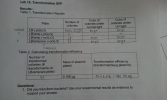 Question #1.
Lab 12: Transformation GFP Results Table 1. Transformation Results Color of Color of Number of Plate colonies under colonies under coloniesc UV light normal light co LB (-pGLO) LB/amp (-pGLO LB/amp +pGLO beige C LB/amp/ara (+pGLO) s beige Avololnose Table 2. Calculating transformation efficiency Number of transformed colonies (# transformants on LB/amp/ara plate) Transformation efficiency Mass of plasmid plated (transformants/ug plasmid) 0.156 750156 480 27 H Questions: Did you transform bacteria? Use your experimental results as evidence to...
Question #1.
Lab 12: Transformation GFP Results Table 1. Transformation Results Color of Color of Number of Plate colonies under colonies under coloniesc UV light normal light co LB (-pGLO) LB/amp (-pGLO LB/amp +pGLO beige C LB/amp/ara (+pGLO) s beige Avololnose Table 2. Calculating transformation efficiency Number of transformed colonies (# transformants on LB/amp/ara plate) Transformation efficiency Mass of plasmid plated (transformants/ug plasmid) 0.156 750156 480 27 H Questions: Did you transform bacteria? Use your experimental results as evidence to...
Results 3. (5 points) Our transformation procedure used 10 u of 0.08 ug/ul PGLO. How does...
 Results 3. (5 points) Our transformation procedure used 10 u of 0.08 ug/ul PGLO. How does the concentration of DNA affect the number of colonies and the transformation efficiency? Do you think if we used more concentrated PGLO that we could have gotten a higher transformation efficiency? The numbers of colonies shown below resulted from transformation with 10ul of PGLO at the concentrations shown. a. Calculate the transformation efficiency at each concentration. Express your answers in scientific notation. Write the...
1. Fill in the table above with what you observe on your plates. 2. Bacterial transformation...
 1. Fill in the table above with what you observe on your
plates.
2. Bacterial transformation occurred on which agar plate (s)?
What evidence do you have that the bacteria were transformed
here?
3. Which plates have glowing growth? Explain what causes
bacteria to glow.
II. Transformation of E. coli with Plasmid DNA (PGLO) 1. Three LB (Luria Broth) agar plates are obtained. The plates contain: • Plate A: LB-Agar/Ampicillin/Arabinose • Plate B: LB-Agar/Ampicillin • Plate C: LB-Agar 2. Three...
1. Fill in the table above with what you observe on your
plates.
2. Bacterial transformation occurred on which agar plate (s)?
What evidence do you have that the bacteria were transformed
here?
3. Which plates have glowing growth? Explain what causes
bacteria to glow.
II. Transformation of E. coli with Plasmid DNA (PGLO) 1. Three LB (Luria Broth) agar plates are obtained. The plates contain: • Plate A: LB-Agar/Ampicillin/Arabinose • Plate B: LB-Agar/Ampicillin • Plate C: LB-Agar 2. Three...
Number of colonies: Plate LB, no DNA LB/ amp, no DNA uncountable LB/ amp, DNA (The two plated lab...
 Number of colonies: Plate LB, no DNA LB/ amp, no DNA uncountable LB/ amp, DNA (The two plated labeled Bacteria DNA) 683 (70 ul) 291 (3011) (a) What quantity of DNA (in ng) was used in the transformation? (2 marks) (b) What fraction of the total transformation reaction was plated out? (2 marks) (c) How many transformants (colonies) were there in the total transformation reaction? (2 marks) (d) What was the transformation efficiency, expressed as transformants per ug of DNA...
Suppose that you carried out a Bacterial transformation of E. coli HA101 with pGLO plasmid experiment...
Suppose that you carried out a Bacterial transformation of E. coli HA101 with pGLO plasmid experiment in the lab. During the experiment plates with bacteria were inoculated from +GLO and -GLO microfuge tubes (LB (-) plate, LB/amp (-) plate, LB/amp (+) plate, and LB/amp/ara (+) plate). 14) Explain what kinds of bacterial growth you will find on each of 4 plates after incubation ((LB (-) plate, LB/amp (-) plate, LB/amp (+) plate, and LB/amp/ara (+) plate): under normal light and...
You add (1.04x10^0) ng of plasmid DNA in 50 µL to 100 µL of competent E....
You add (1.04x10^0) ng of plasmid DNA in 50 µL to 100 µL of competent E. coli cells and incubate the mixture on ice for 20 min. Following a heat-shock treatment, the cells are incubated at 37 C for 30 min. At the end of the incubation you spread (1.2000x10^2) µL of the transformation mix on an agar plate and incubate the plate overnight at 37 C. The next morning you observe (6.8400x10^2) colonies on the plate, each colony having...
This is what we did in the experiment .First of all,1 µl of plasmid DNA was...
 This is what we did in the experiment .First of all,1 µl of
plasmid DNA was added into the tube which contains competent cells
and the tube was tapped gently to mix DNA and the competent
bacteria. After that it was placed on ice for 30 minutes. Then, the
tube with the competent bacteria and plasmid were transferred to
heating block at 42 °C and the tube was leaved in there exactly 90
seconds. 0.25 ml of LB broth was...
This is what we did in the experiment .First of all,1 µl of
plasmid DNA was added into the tube which contains competent cells
and the tube was tapped gently to mix DNA and the competent
bacteria. After that it was placed on ice for 30 minutes. Then, the
tube with the competent bacteria and plasmid were transferred to
heating block at 42 °C and the tube was leaved in there exactly 90
seconds. 0.25 ml of LB broth was...
The starting concentration of the plasmid DNA is 100 ngul and you added 2μ1 to your...
 The starting concentration of the plasmid DNA is 100 ngul and you added 2μ1 to your cells. The cells were diluted to one ml prior to plating. First, determine how many transformants you would have if you plated the entire 1 ml of cell:s. Remember, you only plated half or your transformation reaction on plates 1 and 2. Add the number of transformants on plates 1 and 2, and then multiply by 2 for the total number transformants. Record that...
Cloning 2 Below is the restriction map of a 10 kb piece of DNA. Also shown...
 Cloning 2
Below is the restriction map of a 10 kb piece of DNA. Also shown
below is a cloning vector which has two unique restriction enzyme
recognition sites, one for EcoRI (E) and one for HindIII (H). The
location of the kanamycin (kan) and ampicillin (amp) resistance
genes is also shown. Kanamycin and ampicillin are antibiotics that
are commonly used to select transformed E. colicells (consult the
Lab Manual for more information). Note that the HindIII site is
located...
Cloning 2
Below is the restriction map of a 10 kb piece of DNA. Also shown
below is a cloning vector which has two unique restriction enzyme
recognition sites, one for EcoRI (E) and one for HindIII (H). The
location of the kanamycin (kan) and ampicillin (amp) resistance
genes is also shown. Kanamycin and ampicillin are antibiotics that
are commonly used to select transformed E. colicells (consult the
Lab Manual for more information). Note that the HindIII site is
located...
This is what we did in the experiment .First of all,1 µl of plasmid DNA was...
 This is what we did in the experiment .First of all,1 µl of
plasmid DNA was added into the tube which contains competent cells
and the tube was tapped gently to mix DNA and the competent
bacteria. After that it was placed on ice for 30 minutes. Then, the
tube with the competent bacteria and plasmid were transferred to
heating block at 42 °C and the tube was leaved in there exactly 90
seconds. 0.25 ml of LB broth was...
This is what we did in the experiment .First of all,1 µl of
plasmid DNA was added into the tube which contains competent cells
and the tube was tapped gently to mix DNA and the competent
bacteria. After that it was placed on ice for 30 minutes. Then, the
tube with the competent bacteria and plasmid were transferred to
heating block at 42 °C and the tube was leaved in there exactly 90
seconds. 0.25 ml of LB broth was...
 Question #1.
Lab 12: Transformation GFP Results Table 1. Transformation Results Color of Color of Number of Plate colonies under colonies under coloniesc UV light normal light co LB (-pGLO) LB/amp (-pGLO LB/amp +pGLO beige C LB/amp/ara (+pGLO) s beige Avololnose Table 2. Calculating transformation efficiency Number of transformed colonies (# transformants on LB/amp/ara plate) Transformation efficiency Mass of plasmid plated (transformants/ug plasmid) 0.156 750156 480 27 H Questions: Did you transform bacteria? Use your experimental results as evidence to...
Question #1.
Lab 12: Transformation GFP Results Table 1. Transformation Results Color of Color of Number of Plate colonies under colonies under coloniesc UV light normal light co LB (-pGLO) LB/amp (-pGLO LB/amp +pGLO beige C LB/amp/ara (+pGLO) s beige Avololnose Table 2. Calculating transformation efficiency Number of transformed colonies (# transformants on LB/amp/ara plate) Transformation efficiency Mass of plasmid plated (transformants/ug plasmid) 0.156 750156 480 27 H Questions: Did you transform bacteria? Use your experimental results as evidence to...
 Results 3. (5 points) Our transformation procedure used 10 u of 0.08 ug/ul PGLO. How does the concentration of DNA affect the number of colonies and the transformation efficiency? Do you think if we used more concentrated PGLO that we could have gotten a higher transformation efficiency? The numbers of colonies shown below resulted from transformation with 10ul of PGLO at the concentrations shown. a. Calculate the transformation efficiency at each concentration. Express your answers in scientific notation. Write the...
 1. Fill in the table above with what you observe on your
plates.
2. Bacterial transformation occurred on which agar plate (s)?
What evidence do you have that the bacteria were transformed
here?
3. Which plates have glowing growth? Explain what causes
bacteria to glow.
II. Transformation of E. coli with Plasmid DNA (PGLO) 1. Three LB (Luria Broth) agar plates are obtained. The plates contain: • Plate A: LB-Agar/Ampicillin/Arabinose • Plate B: LB-Agar/Ampicillin • Plate C: LB-Agar 2. Three...
1. Fill in the table above with what you observe on your
plates.
2. Bacterial transformation occurred on which agar plate (s)?
What evidence do you have that the bacteria were transformed
here?
3. Which plates have glowing growth? Explain what causes
bacteria to glow.
II. Transformation of E. coli with Plasmid DNA (PGLO) 1. Three LB (Luria Broth) agar plates are obtained. The plates contain: • Plate A: LB-Agar/Ampicillin/Arabinose • Plate B: LB-Agar/Ampicillin • Plate C: LB-Agar 2. Three...
 Number of colonies: Plate LB, no DNA LB/ amp, no DNA uncountable LB/ amp, DNA (The two plated labeled Bacteria DNA) 683 (70 ul) 291 (3011) (a) What quantity of DNA (in ng) was used in the transformation? (2 marks) (b) What fraction of the total transformation reaction was plated out? (2 marks) (c) How many transformants (colonies) were there in the total transformation reaction? (2 marks) (d) What was the transformation efficiency, expressed as transformants per ug of DNA...
 This is what we did in the experiment .First of all,1 µl of
plasmid DNA was added into the tube which contains competent cells
and the tube was tapped gently to mix DNA and the competent
bacteria. After that it was placed on ice for 30 minutes. Then, the
tube with the competent bacteria and plasmid were transferred to
heating block at 42 °C and the tube was leaved in there exactly 90
seconds. 0.25 ml of LB broth was...
This is what we did in the experiment .First of all,1 µl of
plasmid DNA was added into the tube which contains competent cells
and the tube was tapped gently to mix DNA and the competent
bacteria. After that it was placed on ice for 30 minutes. Then, the
tube with the competent bacteria and plasmid were transferred to
heating block at 42 °C and the tube was leaved in there exactly 90
seconds. 0.25 ml of LB broth was...
 The starting concentration of the plasmid DNA is 100 ngul and you added 2μ1 to your cells. The cells were diluted to one ml prior to plating. First, determine how many transformants you would have if you plated the entire 1 ml of cell:s. Remember, you only plated half or your transformation reaction on plates 1 and 2. Add the number of transformants on plates 1 and 2, and then multiply by 2 for the total number transformants. Record that...
 Cloning 2
Below is the restriction map of a 10 kb piece of DNA. Also shown
below is a cloning vector which has two unique restriction enzyme
recognition sites, one for EcoRI (E) and one for HindIII (H). The
location of the kanamycin (kan) and ampicillin (amp) resistance
genes is also shown. Kanamycin and ampicillin are antibiotics that
are commonly used to select transformed E. colicells (consult the
Lab Manual for more information). Note that the HindIII site is
located...
Cloning 2
Below is the restriction map of a 10 kb piece of DNA. Also shown
below is a cloning vector which has two unique restriction enzyme
recognition sites, one for EcoRI (E) and one for HindIII (H). The
location of the kanamycin (kan) and ampicillin (amp) resistance
genes is also shown. Kanamycin and ampicillin are antibiotics that
are commonly used to select transformed E. colicells (consult the
Lab Manual for more information). Note that the HindIII site is
located...
 This is what we did in the experiment .First of all,1 µl of
plasmid DNA was added into the tube which contains competent cells
and the tube was tapped gently to mix DNA and the competent
bacteria. After that it was placed on ice for 30 minutes. Then, the
tube with the competent bacteria and plasmid were transferred to
heating block at 42 °C and the tube was leaved in there exactly 90
seconds. 0.25 ml of LB broth was...
This is what we did in the experiment .First of all,1 µl of
plasmid DNA was added into the tube which contains competent cells
and the tube was tapped gently to mix DNA and the competent
bacteria. After that it was placed on ice for 30 minutes. Then, the
tube with the competent bacteria and plasmid were transferred to
heating block at 42 °C and the tube was leaved in there exactly 90
seconds. 0.25 ml of LB broth was...
Most questions answered within 3 hours.
-
Where is the error in this code sequence?
String s1 = "Hello";
String s2 = "ello";...
asked 10 months ago -
Financial data for Joel de Paris, Inc., for last year
follow:
Joel de Paris, Inc.
Balance...
asked 10 months ago -
Consider this reaction:
Al2(SO4)3 (aq)+ BaCl3
(aq) Al2Cl6 (aq)- +
3BaSO4(s) . What is the...
asked 10 months ago -
Suppose that Savneet is considering increasing her
recent random sample from 20 car rentals to 40...
asked 10 months ago -
Trucks arrive at an unloading terminal at an average rate of 120
per hour.
Trucks arrive...
asked 10 months ago -
Why are methanol and ethanol completely soluble in water while
octanol is not very little soluble....
asked 10 months ago -
A facilities manager at a university reads in a research report
that the mean amount of...
asked 10 months ago -
When the CuSO4 is rehydrated by adding water to the anhydrous
compound, is this an endothermic...
asked 10 months ago -
A ray of sunlight is passing from diamond into crown glass; the
angle of incidence is...
asked 10 months ago -
A block of mass 0.249 kg is placed on top of a light, vertical
spring of...
asked 10 months ago -
how do the kidneys compensate in the presences of acidosis
a) trigger hyperventilate
b) reserve acid...
asked 10 months ago -
Question 501 pts
The rental rate of capital to the firm increases. Which of the
following...
asked 10 months ago