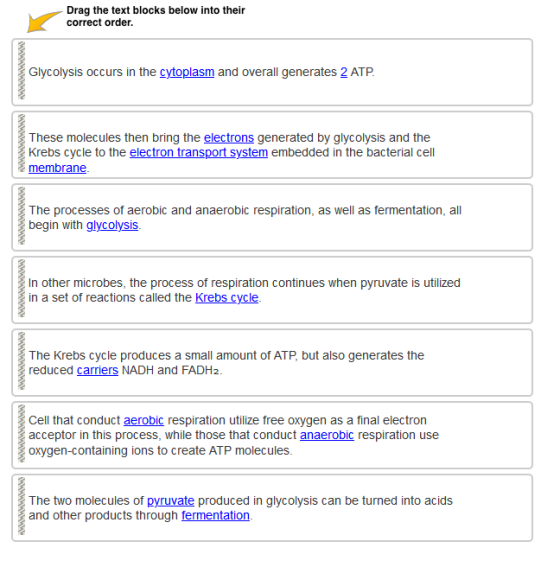
Drag the blocks below into their correct order:
Homework Answers
ANSWER :
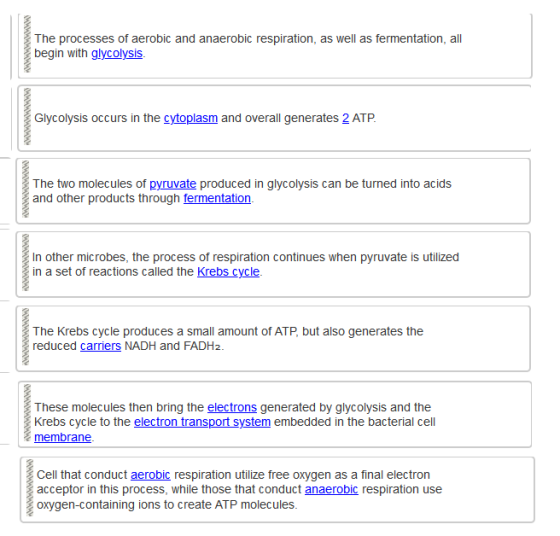
Placing the descriptions/events associated to cellular respiration, in their correct sequencial order :-
Add Answer to:
Drag the blocks below into their correct
order:
Drag the text blocks below into their correct...
The two molecules of electrons produced in glycolysis can be turned into acids and other products...
The two molecules of electrons produced in glycolysis can be turned into acids and other products through ____________ . These molecules then bring the ____________ generated by glycolysis and the Krebs cycle to the ____________ embedded in the bacterial cell ____________ . Cell that conduct ____________ respiration utilize free oxygen as a final electron acceptor in this process, while those that conduct ____________ respiration use oxygen-containing ions to create ATP molecules. The Krebs cycle produces a small amount of ATP, but also generates the reduced ____________ NADH and FADH₂. In other...
uit OT 50 Identify the following characteristics as applying to either glycolysis or the Krebs cycle....
 uit OT 50 Identify the following characteristics as applying to either glycolysis or the Krebs cycle. Characteristics (8 items) Drag and drop into the appropriate area Cellular Respiration Glycolysis Krebs Cycle Outputs: FADH2, NADH, carbon dioxide, 2 ATP Outputs 2 ATP, pyruvate, NADH Input pyruvate Input glucose Happens in cytoplasm Happens in mitochondna Is aerobic Is anaerobic
Which of the following statements is not true? Glycolysis produces most of the ATP required by...
 Which of the following statements is not true? Glycolysis produces most of the ATP required by aerobic organisms like us Glycolysis produces pyruvate, which is consumed by the Krebs cycle Glycolysis occurs in the cytosol of the cell Glycolysis is the first stage of cellular respiration • The Krebs cycle reactions Takes place in the cytoplasm Converts glucose to pyruvate Generate ATP with the help of an enzyme complex called ATP synthase Yield ATP, NADH, and FADH2 • Which of...
12. From the standpoint of the microorganism, what are the most important chemical produs the Krebs...
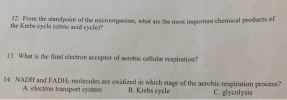 12. From the standpoint of the microorganism, what are the most important chemical produs the Krebs cycle (citric acid cycle)? 13. What is the final electron acceptor of aerobic cellular respiration? 14. NADH and FADH2 molecules are oxidized in which stage of the aerobic respiration process? A. electron transport system B. Krebs cycle C. glycolysis
What is the net yield of NADH when 26 moles of glucose are used to form...
What is the net yield of NADH when 26 moles of glucose are used to form pyruvate during glycolysis and the pyruvate is reduced during fermentation? If a bacterial cell capable of aerobic respiration and fermentation has no oxygen available, which metabolic process could be used to regenerate NAD+ so glycolysis can continue producing ATP? Aerobic Respiration Glyoxylate Pathway Pentose 5 Phosphate Pathwway Fermentation Anaerobic Respiration Which biochemical process puts electrons back on the same carbon source they came from?...
this are very difficult questions for my environmental biology class. These are examples from the practice...
 this are very difficult questions for my environmental biology
class. These are examples from the practice homework so can anyone
please help me check my answers.
-) The temperature classes of microorganisms are based on optimum temperatures of microbi A) cell wall C) cell membrane B) enzymes D) All of the above 20) Aerobic respiration, anaerobic respiration, and fermentation are all pathways of which involve the of nutrients. A) Catabolism, reduction B) Anabolism; oxidation C) Catabolism; oxidation D) Anabolism, reduction...
this are very difficult questions for my environmental biology
class. These are examples from the practice homework so can anyone
please help me check my answers.
-) The temperature classes of microorganisms are based on optimum temperatures of microbi A) cell wall C) cell membrane B) enzymes D) All of the above 20) Aerobic respiration, anaerobic respiration, and fermentation are all pathways of which involve the of nutrients. A) Catabolism, reduction B) Anabolism; oxidation C) Catabolism; oxidation D) Anabolism, reduction...
Select ALL of the statements that correctly describe the Krebs cycle. A. Pyruvic acid must be...
Select ALL of the statements that correctly describe the Krebs cycle. A. Pyruvic acid must be converted to acetyl CoA prior to entering the cycle B. The molecule oxaloacetic acid picks up the acetyl group from acetylCoA, and in the last step of the cycle, oxaloacetic acid is regenerated. C. Electrons removed during oxidation steps are picked up by NAD or FAD. D. Each turn of the cycle generates one ATP molecule for a total of two per molecule of...
tospan Student Name: Grader Name Instruction: Starting with a single glucose in a yeast cell, please...
 tospan Student Name: Grader Name Instruction: Starting with a single glucose in a yeast cell, please fill in the following table according to what happened during aerobic cellular respiration or fermentation. Make sure that you includes proper numbers of each chemical used or produced from a single glucose molecule 02 Chemicals Used or Produced FAD+/FADH2 NADP+/NADPH X х CO2 Location Cytoplasm H2O Starting Ending ADP/ATP NAD+/NADH 1 Glucose 2 Pyruvate 2ATPs->4ATP 2 NAD+->2NADH х х Pathways Glycolysis Transition Step (Connecting...
Chapter 5 (Cellular Respiration) With the aid of your notes and/or textbook, write the terms that...
 Chapter 5 (Cellular Respiration) With the aid of your notes and/or textbook, write the terms that correspond to the following definitions and descriptions Oxygen-requiring process that produces CO., H,0 and ATP. A series of enzyme catalyzed reactions that form pyruvate molecules from splitting glucose. Second stage of aerobic cellular respiration that produces CO, and electron camer molecules, and takes place in the mitochondrion. Type of cellular respiration that does not use oxygen in the production of ATP. Produces lactic acid...
7. Which of the following reactions is involved with causing the pH to rise during a...
 7. Which of the following reactions is involved with causing the pH to rise during a biochemical test? a. Protein catabolism to amino acids b. Deamination of amino acids c. NH, + H, O NHA + OH d. All of the above 8. Which of the following statements is correct regarding the biochemical tests you will be using to identify your unknown bacteria? a. Media prepared in the laboratory is not intended to duplicate an organism's natural environment. b. Media...
 uit OT 50 Identify the following characteristics as applying to either glycolysis or the Krebs cycle. Characteristics (8 items) Drag and drop into the appropriate area Cellular Respiration Glycolysis Krebs Cycle Outputs: FADH2, NADH, carbon dioxide, 2 ATP Outputs 2 ATP, pyruvate, NADH Input pyruvate Input glucose Happens in cytoplasm Happens in mitochondna Is aerobic Is anaerobic
 Which of the following statements is not true? Glycolysis produces most of the ATP required by aerobic organisms like us Glycolysis produces pyruvate, which is consumed by the Krebs cycle Glycolysis occurs in the cytosol of the cell Glycolysis is the first stage of cellular respiration • The Krebs cycle reactions Takes place in the cytoplasm Converts glucose to pyruvate Generate ATP with the help of an enzyme complex called ATP synthase Yield ATP, NADH, and FADH2 • Which of...
 12. From the standpoint of the microorganism, what are the most important chemical produs the Krebs cycle (citric acid cycle)? 13. What is the final electron acceptor of aerobic cellular respiration? 14. NADH and FADH2 molecules are oxidized in which stage of the aerobic respiration process? A. electron transport system B. Krebs cycle C. glycolysis
 this are very difficult questions for my environmental biology
class. These are examples from the practice homework so can anyone
please help me check my answers.
-) The temperature classes of microorganisms are based on optimum temperatures of microbi A) cell wall C) cell membrane B) enzymes D) All of the above 20) Aerobic respiration, anaerobic respiration, and fermentation are all pathways of which involve the of nutrients. A) Catabolism, reduction B) Anabolism; oxidation C) Catabolism; oxidation D) Anabolism, reduction...
this are very difficult questions for my environmental biology
class. These are examples from the practice homework so can anyone
please help me check my answers.
-) The temperature classes of microorganisms are based on optimum temperatures of microbi A) cell wall C) cell membrane B) enzymes D) All of the above 20) Aerobic respiration, anaerobic respiration, and fermentation are all pathways of which involve the of nutrients. A) Catabolism, reduction B) Anabolism; oxidation C) Catabolism; oxidation D) Anabolism, reduction...
 tospan Student Name: Grader Name Instruction: Starting with a single glucose in a yeast cell, please fill in the following table according to what happened during aerobic cellular respiration or fermentation. Make sure that you includes proper numbers of each chemical used or produced from a single glucose molecule 02 Chemicals Used or Produced FAD+/FADH2 NADP+/NADPH X х CO2 Location Cytoplasm H2O Starting Ending ADP/ATP NAD+/NADH 1 Glucose 2 Pyruvate 2ATPs->4ATP 2 NAD+->2NADH х х Pathways Glycolysis Transition Step (Connecting...
 Chapter 5 (Cellular Respiration) With the aid of your notes and/or textbook, write the terms that correspond to the following definitions and descriptions Oxygen-requiring process that produces CO., H,0 and ATP. A series of enzyme catalyzed reactions that form pyruvate molecules from splitting glucose. Second stage of aerobic cellular respiration that produces CO, and electron camer molecules, and takes place in the mitochondrion. Type of cellular respiration that does not use oxygen in the production of ATP. Produces lactic acid...
 7. Which of the following reactions is involved with causing the pH to rise during a biochemical test? a. Protein catabolism to amino acids b. Deamination of amino acids c. NH, + H, O NHA + OH d. All of the above 8. Which of the following statements is correct regarding the biochemical tests you will be using to identify your unknown bacteria? a. Media prepared in the laboratory is not intended to duplicate an organism's natural environment. b. Media...
Most questions answered within 3 hours.
-
Where is the error in this code sequence?
String s1 = "Hello";
String s2 = "ello";...
asked 10 months ago -
Financial data for Joel de Paris, Inc., for last year
follow:
Joel de Paris, Inc.
Balance...
asked 10 months ago -
Consider this reaction:
Al2(SO4)3 (aq)+ BaCl3
(aq) Al2Cl6 (aq)- +
3BaSO4(s) . What is the...
asked 10 months ago -
Suppose that Savneet is considering increasing her
recent random sample from 20 car rentals to 40...
asked 10 months ago -
Trucks arrive at an unloading terminal at an average rate of 120
per hour.
Trucks arrive...
asked 10 months ago -
Why are methanol and ethanol completely soluble in water while
octanol is not very little soluble....
asked 10 months ago -
A facilities manager at a university reads in a research report
that the mean amount of...
asked 10 months ago -
When the CuSO4 is rehydrated by adding water to the anhydrous
compound, is this an endothermic...
asked 10 months ago -
A ray of sunlight is passing from diamond into crown glass; the
angle of incidence is...
asked 10 months ago -
A block of mass 0.249 kg is placed on top of a light, vertical
spring of...
asked 10 months ago -
how do the kidneys compensate in the presences of acidosis
a) trigger hyperventilate
b) reserve acid...
asked 10 months ago -
Question 501 pts
The rental rate of capital to the firm increases. Which of the
following...
asked 10 months ago