Consider two non-homologous chromosomes whose normal sequence of
segments and centromere locations are shown here. What kind of
changes are these? I think it's a translocation and i cannot tell
what the second one is. 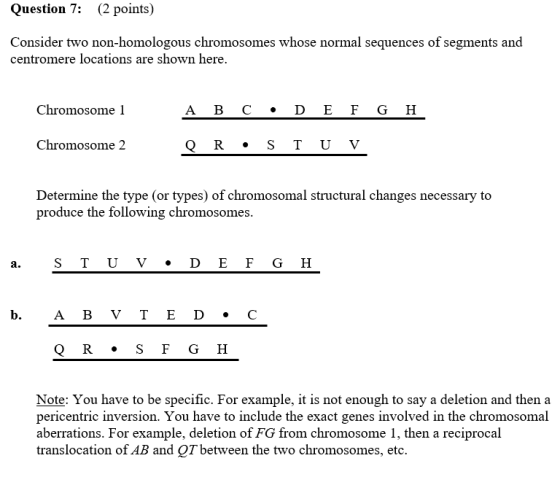
Homework Answers
A)
This involves a deletion of one arm of Chromosome 1 (deletion of the A-B-C loci) followed by a Paracentric inversion on Chromosome 2,which flipped the orientation of the S-T-U-V loci about the centromere. Finally, a non-reciprocal translocation of the inverted arm of Chromosome 2 to the deleted arm of Chromosome 1.
B)
The chromosomal changes necessary to produce the given chromosomes are:
- Deletion of U locus from Chromosome 2.
- Reciprocal translocation between the two chromosomes that exchanges the (F-G-H) segment from Chromosome 1 with the (T-V) segment from Chromosome 2.
- Pericentric Inversion of Chromosome 1, involving the segment from locus C to V. This changes the arrangement of Chromosome 1 from A-B-C-Centromere-D-E-T-V to A-B-V-T-E-D-Centromere-C.
Add Answer to:
Consider two non-homologous chromosomes whose normal sequence of
segments and centromere locations are shown here. What...
1) given the following sequence of genes on a chromosome, determine what change in chromosome structure...
1) given the following sequence of genes on a chromosome, determine what change in chromosome structure occurred. the asterisk indicates the centromere before: A B C D * E F G H after: A C D * E F G H a) inversion b) gene duplication c) terminal deletion d) interstitial deletion 2) given the following sequence of genes on a chromosome, determine what change in chromosome structure occurred. the asterisk indicates the centromere before: A B C D *...
#1 Mutation 1. A chromosomes has the following segments, where represents the centromere: MNOPQRST Give the...
 #1
Mutation 1. A chromosomes has the following segments, where represents the centromere: MNOPQRST Give the chromosome sequences that would result from the following mutations: Deletion of MN Pericentric inversion of NOP Inversion of RS, followed by tandem duplication of QRSC 2. Which type(s) of chromosomal mutations: a. Increase the amount of genetic material in a particular chromosome? b. Increase the amount of genetic material in the entire genome? c. Decrease the amount of genetic material in a particular chromosome?...
#1
Mutation 1. A chromosomes has the following segments, where represents the centromere: MNOPQRST Give the chromosome sequences that would result from the following mutations: Deletion of MN Pericentric inversion of NOP Inversion of RS, followed by tandem duplication of QRSC 2. Which type(s) of chromosomal mutations: a. Increase the amount of genetic material in a particular chromosome? b. Increase the amount of genetic material in the entire genome? c. Decrease the amount of genetic material in a particular chromosome?...
#1 Mutation 1. A chromosomes has the following segments, where represents the centromere: MNOPQRST Give the...
 #1
Mutation 1. A chromosomes has the following segments, where represents the centromere: MNOPQRST Give the chromosome sequences that would result from the following mutations: a. Deletion of MN Pericentric inversion of NOP C. Inversion of RS, followed by tandem duplication of QRST b. 2. Which type(s) of chromosomal mutations: a. Increase the amount of genetic material in a particular chromosome? b. Increase the amount of genetic material in the entire genome? c. Decrease the amount of genetic material in...
#1
Mutation 1. A chromosomes has the following segments, where represents the centromere: MNOPQRST Give the chromosome sequences that would result from the following mutations: a. Deletion of MN Pericentric inversion of NOP C. Inversion of RS, followed by tandem duplication of QRST b. 2. Which type(s) of chromosomal mutations: a. Increase the amount of genetic material in a particular chromosome? b. Increase the amount of genetic material in the entire genome? c. Decrease the amount of genetic material in...
Given two initial chromosomes ABCDEFGHI and LMNOPQRST, what chromosomal rearragements occured to produce the following chromosome?...
 Given two initial chromosomes ABCDEFGHI and LMNOPQRST, what chromosomal rearragements occured to produce the following chromosome? Check all that apply. LMNOSTEFGHI a. deletion O b. duplication O c. inversion Od translocation 1 points Given two initial chromosomes ABCDEFGHI and LMNOPQRST, what chromosomal rearragements occured to produce the following chromosome? Check all that apply. GHILONMPQPQT ♡ a translocation b. deletion c. duplication O d. inversion The diploid number of an organism is 24. How many chromosomes would be expected in H...
What are the different kinds of chromosomal duplication, and how do they differ from each other?...
 What are the different kinds of chromosomal duplication, and how do they differ from each other? What human disorder results from deletion of a region on chromosome 5 producing newborns that cry like a cat? If Dr. Obama wishes to reveal regions of the chromosomes that are rich in A-T base pairs in a karyotype preparation, she should use ___ to stain G bands on the chromosomes. A typical human karyotype has a total of ___ chromosomes and includes ___...
can help me writing a summary please Chromosomal Aberrations and Human Disorders In addition to mutations...
can help me writing a summary please Chromosomal Aberrations and Human Disorders In addition to mutations that alter the information content of a single gene, chromosomes may be subjected to more extensive alterations that occur most commonly during cell division. Pieces of a chromosome may be lost or segments may be exchanged between different chromosomes. Because these chromosomal aberrations follow chromosomal breakage, their incidence is increased by exposure to agents that damage DNA, such as viral infection, X‐rays, or reactive...
13,15 & 16 13. Deletion, Translocation, Inversion, Duplication, OR Mosaicism? Involved in 46, 5p- May result...
 13,15 & 16
13. Deletion, Translocation, Inversion, Duplication, OR Mosaicism? Involved in 46, 5p- May result in a position effect which affects gene expression May result in pseudodominance of allele normally recessive to a dominant allele Two genetically distinct populations of cells in a single individual Will result in abnormal gamete formation (more than one answer) Involved in familial Down syndrome Lethal if it occurs in the same region of two homologous chromosomes No loss or gain of genetic material...
13,15 & 16
13. Deletion, Translocation, Inversion, Duplication, OR Mosaicism? Involved in 46, 5p- May result in a position effect which affects gene expression May result in pseudodominance of allele normally recessive to a dominant allele Two genetically distinct populations of cells in a single individual Will result in abnormal gamete formation (more than one answer) Involved in familial Down syndrome Lethal if it occurs in the same region of two homologous chromosomes No loss or gain of genetic material...
I need answers for 13 to 15. Thank you 13. Deletion, Translocation, Inversion, Duplication, OR Mosaicism?...
 I need answers for 13 to 15. Thank you
13. Deletion, Translocation, Inversion, Duplication, OR Mosaicism? Involved in 46, 5p- May result in a position effect which affects gene expression May result in pseudodominance of allele normally recessive to a dominant allele Two genetically distinct populations of cells in a single individual Will result in abnormal gamete formation (more than one answer) Involved in familial Down syndrome Lethal if it occurs in the same region of two homologous chromosomes No...
I need answers for 13 to 15. Thank you
13. Deletion, Translocation, Inversion, Duplication, OR Mosaicism? Involved in 46, 5p- May result in a position effect which affects gene expression May result in pseudodominance of allele normally recessive to a dominant allele Two genetically distinct populations of cells in a single individual Will result in abnormal gamete formation (more than one answer) Involved in familial Down syndrome Lethal if it occurs in the same region of two homologous chromosomes No...
2 BIO 302 MIDTERM (CH 7-8) 1 Cause of familial Down syndrome is 2. Gain of...
 2 BIO 302 MIDTERM (CH 7-8) 1 Cause of familial Down syndrome is 2. Gain of single chromosome leads to 7 Cotton plant is an example of Triploidy B. Trisomy C.Translocation A Trisomy B. Allopolyploidy C. Amphidiploidy D. Pentaploidy A. Diploidy B.Triploidy C. Tetraploidy D. Trisomy E Monosomy What is "normal chromosome number? 18. What doesn't happen in endopolyploidy'or 3. Diploidy B. Triploidy C. Tetraploidy D. Trisomy EMonosomy 4. Multiple of same genome could be termed as A. Division of...
**Please answer ALL 10 QUESTION** 1. A species of flowering plant includes plants with blooms that...
**Please answer ALL 10 QUESTION** 1. A species of flowering plant includes plants with blooms that range from bright golden yellow to very pale yellow; no flowers carrying the yellow pigment allele appear white. The allele for yellow flower color: a. must be a suppressor of another allele. b. demonstrates incomplete penetrance. c. demonstrates variable expressivity. d. must be a modifier of another allele. e. demonstrates variable penetrance. 2. Coat color in mice is determined by two alleles acting at...
 #1
Mutation 1. A chromosomes has the following segments, where represents the centromere: MNOPQRST Give the chromosome sequences that would result from the following mutations: Deletion of MN Pericentric inversion of NOP Inversion of RS, followed by tandem duplication of QRSC 2. Which type(s) of chromosomal mutations: a. Increase the amount of genetic material in a particular chromosome? b. Increase the amount of genetic material in the entire genome? c. Decrease the amount of genetic material in a particular chromosome?...
#1
Mutation 1. A chromosomes has the following segments, where represents the centromere: MNOPQRST Give the chromosome sequences that would result from the following mutations: Deletion of MN Pericentric inversion of NOP Inversion of RS, followed by tandem duplication of QRSC 2. Which type(s) of chromosomal mutations: a. Increase the amount of genetic material in a particular chromosome? b. Increase the amount of genetic material in the entire genome? c. Decrease the amount of genetic material in a particular chromosome?...
 #1
Mutation 1. A chromosomes has the following segments, where represents the centromere: MNOPQRST Give the chromosome sequences that would result from the following mutations: a. Deletion of MN Pericentric inversion of NOP C. Inversion of RS, followed by tandem duplication of QRST b. 2. Which type(s) of chromosomal mutations: a. Increase the amount of genetic material in a particular chromosome? b. Increase the amount of genetic material in the entire genome? c. Decrease the amount of genetic material in...
#1
Mutation 1. A chromosomes has the following segments, where represents the centromere: MNOPQRST Give the chromosome sequences that would result from the following mutations: a. Deletion of MN Pericentric inversion of NOP C. Inversion of RS, followed by tandem duplication of QRST b. 2. Which type(s) of chromosomal mutations: a. Increase the amount of genetic material in a particular chromosome? b. Increase the amount of genetic material in the entire genome? c. Decrease the amount of genetic material in...
 Given two initial chromosomes ABCDEFGHI and LMNOPQRST, what chromosomal rearragements occured to produce the following chromosome? Check all that apply. LMNOSTEFGHI a. deletion O b. duplication O c. inversion Od translocation 1 points Given two initial chromosomes ABCDEFGHI and LMNOPQRST, what chromosomal rearragements occured to produce the following chromosome? Check all that apply. GHILONMPQPQT ♡ a translocation b. deletion c. duplication O d. inversion The diploid number of an organism is 24. How many chromosomes would be expected in H...
 What are the different kinds of chromosomal duplication, and how do they differ from each other? What human disorder results from deletion of a region on chromosome 5 producing newborns that cry like a cat? If Dr. Obama wishes to reveal regions of the chromosomes that are rich in A-T base pairs in a karyotype preparation, she should use ___ to stain G bands on the chromosomes. A typical human karyotype has a total of ___ chromosomes and includes ___...
 13,15 & 16
13. Deletion, Translocation, Inversion, Duplication, OR Mosaicism? Involved in 46, 5p- May result in a position effect which affects gene expression May result in pseudodominance of allele normally recessive to a dominant allele Two genetically distinct populations of cells in a single individual Will result in abnormal gamete formation (more than one answer) Involved in familial Down syndrome Lethal if it occurs in the same region of two homologous chromosomes No loss or gain of genetic material...
13,15 & 16
13. Deletion, Translocation, Inversion, Duplication, OR Mosaicism? Involved in 46, 5p- May result in a position effect which affects gene expression May result in pseudodominance of allele normally recessive to a dominant allele Two genetically distinct populations of cells in a single individual Will result in abnormal gamete formation (more than one answer) Involved in familial Down syndrome Lethal if it occurs in the same region of two homologous chromosomes No loss or gain of genetic material...
 I need answers for 13 to 15. Thank you
13. Deletion, Translocation, Inversion, Duplication, OR Mosaicism? Involved in 46, 5p- May result in a position effect which affects gene expression May result in pseudodominance of allele normally recessive to a dominant allele Two genetically distinct populations of cells in a single individual Will result in abnormal gamete formation (more than one answer) Involved in familial Down syndrome Lethal if it occurs in the same region of two homologous chromosomes No...
I need answers for 13 to 15. Thank you
13. Deletion, Translocation, Inversion, Duplication, OR Mosaicism? Involved in 46, 5p- May result in a position effect which affects gene expression May result in pseudodominance of allele normally recessive to a dominant allele Two genetically distinct populations of cells in a single individual Will result in abnormal gamete formation (more than one answer) Involved in familial Down syndrome Lethal if it occurs in the same region of two homologous chromosomes No...
 2 BIO 302 MIDTERM (CH 7-8) 1 Cause of familial Down syndrome is 2. Gain of single chromosome leads to 7 Cotton plant is an example of Triploidy B. Trisomy C.Translocation A Trisomy B. Allopolyploidy C. Amphidiploidy D. Pentaploidy A. Diploidy B.Triploidy C. Tetraploidy D. Trisomy E Monosomy What is "normal chromosome number? 18. What doesn't happen in endopolyploidy'or 3. Diploidy B. Triploidy C. Tetraploidy D. Trisomy EMonosomy 4. Multiple of same genome could be termed as A. Division of...
Most questions answered within 3 hours.
-
Where is the error in this code sequence?
String s1 = "Hello";
String s2 = "ello";...
asked 10 months ago -
Financial data for Joel de Paris, Inc., for last year
follow:
Joel de Paris, Inc.
Balance...
asked 10 months ago -
Consider this reaction:
Al2(SO4)3 (aq)+ BaCl3
(aq) Al2Cl6 (aq)- +
3BaSO4(s) . What is the...
asked 10 months ago -
Suppose that Savneet is considering increasing her
recent random sample from 20 car rentals to 40...
asked 10 months ago -
Trucks arrive at an unloading terminal at an average rate of 120
per hour.
Trucks arrive...
asked 10 months ago -
Why are methanol and ethanol completely soluble in water while
octanol is not very little soluble....
asked 10 months ago -
A facilities manager at a university reads in a research report
that the mean amount of...
asked 10 months ago -
When the CuSO4 is rehydrated by adding water to the anhydrous
compound, is this an endothermic...
asked 10 months ago -
A ray of sunlight is passing from diamond into crown glass; the
angle of incidence is...
asked 10 months ago -
A block of mass 0.249 kg is placed on top of a light, vertical
spring of...
asked 10 months ago -
how do the kidneys compensate in the presences of acidosis
a) trigger hyperventilate
b) reserve acid...
asked 10 months ago -
Question 501 pts
The rental rate of capital to the firm increases. Which of the
following...
asked 10 months ago