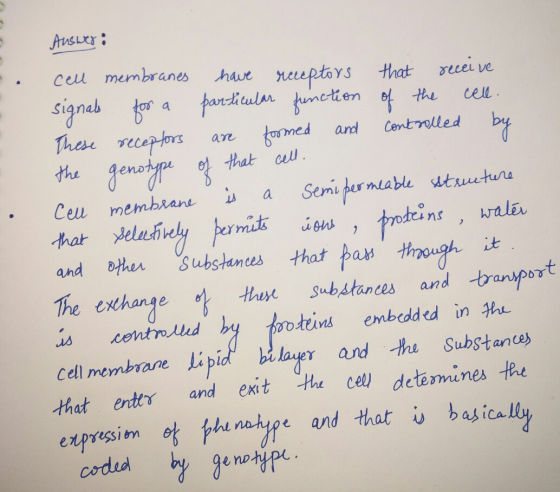
How do cell membranes allow genotypes and the phenotypes they produce to stay linked?
How do cell membranes allow genotypes and the phenotypes they produce to stay linked?
Homework Answers
Add Answer to:
How do cell membranes allow genotypes and the phenotypes they
produce to stay linked?
Cell membranes contain channels that allow ions to cross the phospholipid bilayer. A particular K+ channel...
Cell membranes contain channels that allow ions to cross the phospholipid bilayer. A particular K+ channel carries a current of 1.77 pA . How many K+ ions, ? , pass through the channel in 1.72 ms ?
ΑΙ A How many different genotypes are possible with this cross of parents? How many phenotypes...
 ΑΙ A How many different genotypes are possible with this cross of parents? How many phenotypes are possible with this cross of parents, assuming it follows a Mendelian genetics typical dominant recessive pattern?
Question 7 (1 point) Integral membrane proteins stay in membranes because of their small size, which...
 Question 7 (1 point) Integral membrane proteins stay in membranes because of their small size, which does not allow them to pass through the membrane osmotic pressure from proteins outside the cell. the locations of their polar and non-polar amino acids. diffusion of proteins from the cytoplasm to the membrane.
Cell membranes contain channels that allow Na+ ions to rush in. Consider a channel that has...
Cell membranes contain channels that allow Na+ ions to rush in. Consider a channel that has a diameter of 2.81 nm and a length of13.0 nm. If the channel has a resistance of 16.5 GΩ, what is the resistivity ? of the solution in the channel?
what is the general structure of detergents? how do these affect membranes and membranes proteins? (this...
what is the general structure of detergents? how do these affect membranes and membranes proteins? (this question is essential cell biology 4th edition chapter 11 membrane structure))
Cell membranes do all of the following EXCEPT: provide attachments between cells. provide shape and structure...
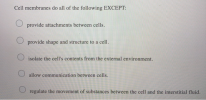 Cell membranes do all of the following EXCEPT: provide attachments between cells. provide shape and structure to a cell. isolate the cell's contents from the external environment. allow communication between cells regulate the movement of substances between the cell and the interstitial fluid.
2.In Drosophila, yellow body is due to an X-linked gene that is recessive to the gene...
2.In Drosophila, yellow body is due to an X-linked gene that is recessive to the gene for gray body. (a) A homozygous gray female is crossed with a yellow male. The F1 are intercrossed to produce F2. Give the genotypes and phenotypes, along with the expected proportions, of the F1 and F 2 progeny. (b) A yellow female is crossed with a gray male. The F1 are inter- crossed to produce the F2. Give the genotypes and phenotypes, along with...
How do viruses acquire an envelope? Viruses manufacture cell membranes because it is encoded in their...
 How do viruses acquire an envelope? Viruses manufacture cell membranes because it is encoded in their nucleic acid. Animal viruses don't make membranous envelopes; these are only produced in phage viruses. Only DNA viruses make envelopes because they have a gene for phospholipid production. When virus are released from host cell, they take the host cell membrane along with synthesized viral glycoproteins.
A cell membrane has a thickness of about 7.4 nm. How many cell membranes would it...
 A cell membrane has a thickness of about 7.4 nm. How many cell membranes would it take to make a stack 1.8 in. high? membranes
2. The history of cell membranes serves as an excellent example of how the development of...
2. The history of cell membranes serves as an excellent example of how the development of new tools in cell and molecular biology can contribute to our knowledge about a particular cell process or organelle. Explain how each of the following was significant to our current model of the cell membrane. a. Freeze-fracture b. Antibodies, Cell Fusion and Capping c. Concanavalin A and FRAP d. Cytoskeleton and Extracellular Matrix Proteins
 ΑΙ A How many different genotypes are possible with this cross of parents? How many phenotypes are possible with this cross of parents, assuming it follows a Mendelian genetics typical dominant recessive pattern?
 Question 7 (1 point) Integral membrane proteins stay in membranes because of their small size, which does not allow them to pass through the membrane osmotic pressure from proteins outside the cell. the locations of their polar and non-polar amino acids. diffusion of proteins from the cytoplasm to the membrane.
 Cell membranes do all of the following EXCEPT: provide attachments between cells. provide shape and structure to a cell. isolate the cell's contents from the external environment. allow communication between cells regulate the movement of substances between the cell and the interstitial fluid.
 How do viruses acquire an envelope? Viruses manufacture cell membranes because it is encoded in their nucleic acid. Animal viruses don't make membranous envelopes; these are only produced in phage viruses. Only DNA viruses make envelopes because they have a gene for phospholipid production. When virus are released from host cell, they take the host cell membrane along with synthesized viral glycoproteins.
 A cell membrane has a thickness of about 7.4 nm. How many cell membranes would it take to make a stack 1.8 in. high? membranes
Most questions answered within 3 hours.
-
Where is the error in this code sequence?
String s1 = "Hello";
String s2 = "ello";...
asked 10 months ago -
Financial data for Joel de Paris, Inc., for last year
follow:
Joel de Paris, Inc.
Balance...
asked 10 months ago -
Consider this reaction:
Al2(SO4)3 (aq)+ BaCl3
(aq) Al2Cl6 (aq)- +
3BaSO4(s) . What is the...
asked 10 months ago -
Suppose that Savneet is considering increasing her
recent random sample from 20 car rentals to 40...
asked 10 months ago -
Trucks arrive at an unloading terminal at an average rate of 120
per hour.
Trucks arrive...
asked 10 months ago -
Why are methanol and ethanol completely soluble in water while
octanol is not very little soluble....
asked 10 months ago -
A facilities manager at a university reads in a research report
that the mean amount of...
asked 10 months ago -
When the CuSO4 is rehydrated by adding water to the anhydrous
compound, is this an endothermic...
asked 10 months ago -
A ray of sunlight is passing from diamond into crown glass; the
angle of incidence is...
asked 10 months ago -
A block of mass 0.249 kg is placed on top of a light, vertical
spring of...
asked 10 months ago -
how do the kidneys compensate in the presences of acidosis
a) trigger hyperventilate
b) reserve acid...
asked 10 months ago -
Question 501 pts
The rental rate of capital to the firm increases. Which of the
following...
asked 10 months ago