
Homework Answers
![TMSC! H Etan O] KaC8204 Koco OHL FOTBF m OTMs TBAF OH 19,-H2O we nove to protect alcohol from oxidahon I: Pootecnion of alcoh](http://img.homeworklib.com/questions/c2b90c10-f0b1-11eb-9a97-bdba406390af.png?x-oss-process=image/resize,w_560)
Add Answer to:
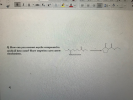
8. In more than two steps convert the aldehyde into the cyclic ester. two or more
II: ketone III: carboxylic acid IV: 2° alcohol V: cyclic ester II: carboxylate III: aldehyde IV:...
 II: ketone III: carboxylic acid IV: 2° alcohol V: cyclic ester II: carboxylate III: aldehyde IV: epoxide V: ketone II: ketone III: carboxylic acid IV: 3° alcohol V: cyclic ester II: ether III: ketone IV: 3° alcohol V. ketone II: ketone III: carboxylic acid IV: Valcohol V/ cyclic ester 2. Choose the more stable of each of the three pairs of structures drawn below. a H 5 4. 1. 3. [c]1,3&5 6. [e] 1,4&5 [a] 1,4&6 [b] 2,4&6 [d] 2,3&5
te e A 3] How can you convert acyclic compound to cyclic B keto ester? Show...
 te e A 3] How can you convert acyclic compound to cyclic B keto ester? Show stepwise curve arrow mechanism. 4]
7. When isopentyl ethanoate reacts with DIBAH it produces an aldehyde; however, if the same ester...
 7. When isopentyl ethanoate reacts with DIBAH it produces an aldehyde; however, if the same ester reacts with LAH, it produces ethanol. Why is this? Please draw reactions/intermediates/steps to explain. (5) 7. When isopentyl ethanoate reacts with DIBAH it produces an aldehyde; however, if the same ester reacts with LAH, it produces ethanol. Why is this? Please draw reactions/intermediates/steps to explain. (5) 9. 2,4-DNP is known to form imines on reaction with any aldehyde or ketone giving a characteristic yellow...
Why is acetoacetic ester more acidic than malonic ester?
Why is acetoacetic ester more acidic than malonic ester?
Write a synthetic scheme that will convert compound A to compound B. More than five steps...
 Write a synthetic scheme that will convert compound A to compound B. More than five steps maybe required for this synthesis. A-
1) [25 pts] The time it takes glyceraldehyde-3-phosphate dehydrogenase to convert aldehyde to carbolic acid follows...
1) [25 pts] The time it takes glyceraldehyde-3-phosphate dehydrogenase to convert aldehyde to carbolic acid follows a normal distribution with a mean of 19 milliseconds and standard deviation of 4.04 milliseconds. a) What is the probability that it will take glyceraldehyde-3-phosphate dehydrogenase between 15 milliseconds and 20 milliseconds to convert aldehyde to carbolic acid? b) What is the probability that it will take glyceraldehyde-3-phosphate dehydrogenase more than 20 milliseconds to convert aldehyde to carbolic acid? c) What is the probability...
1) [25 pts] The time it takes glyceraldehyde-3-phosphate dehydrogenase to convert aldehyde to carbolic acid follows...
 1) [25 pts] The time it takes glyceraldehyde-3-phosphate dehydrogenase to convert aldehyde to carbolic acid follows a normal distribution with a mean of 19 milliseconds and standard deviation of 4.04 milliseconds. a) What is the probability that it will take glyceraldehyde-3-phosphate dehydrogenase between 15 milliseconds and 20 milliseconds to convert aldehyde to carbolic acid? b) What is the probability that it will take glyceraldehyde-3-phosphate dehydrogenase more than 20 milliseconds to convert aldehyde to carbolic acid? c) What is the probability...
1) [25 pts] The time it takes glyceraldehyde-3-phosphate dehydrogenase to convert aldehyde to carbolic acid follows...
 1) [25 pts] The time it takes glyceraldehyde-3-phosphate dehydrogenase to convert aldehyde to carbolic acid follows a normal distribution with a mean of 19 milliseconds and standard deviation of 4.04 milliseconds. a) What is the probability that it will take glyceraldehyde-3-phosphate dehydrogenase between 15 milliseconds and 20 milliseconds to convert aldehyde to carbolic acid? b) What is the probability that it will take glyceraldehyde-3-phosphate dehydrogenase more than 20 milliseconds to convert aldehyde to carbolic acid? c) What is the probability...
S4. What is the cyclic hemiacetal product formed from following hydroxy aldehyde? of the 55. Identify...
 S4. What is the cyclic hemiacetal product formed from following hydroxy aldehyde? of the 55. Identify how you could synthesize an enamine A) React a ketone or an aldehyde with a React a ketone or an aldehyde with a C) React a ylide with a primary amine. D) Roact a ylide with a secondary amine with a secondary amine. a primary amine. S6. Why is an amide less reastive to mucleophilic acyl substitution than A) Nigm is a better leaving...
1. Explain why aldehyde A is more reactive to nucleophilic addition reactions than ketone B.
 1. Explain why aldehyde A is more reactive to nucleophilic addition reactions than ketone B.
 II: ketone III: carboxylic acid IV: 2° alcohol V: cyclic ester II: carboxylate III: aldehyde IV: epoxide V: ketone II: ketone III: carboxylic acid IV: 3° alcohol V: cyclic ester II: ether III: ketone IV: 3° alcohol V. ketone II: ketone III: carboxylic acid IV: Valcohol V/ cyclic ester 2. Choose the more stable of each of the three pairs of structures drawn below. a H 5 4. 1. 3. [c]1,3&5 6. [e] 1,4&5 [a] 1,4&6 [b] 2,4&6 [d] 2,3&5
 te e A 3] How can you convert acyclic compound to cyclic B keto ester? Show stepwise curve arrow mechanism. 4]
 7. When isopentyl ethanoate reacts with DIBAH it produces an aldehyde; however, if the same ester reacts with LAH, it produces ethanol. Why is this? Please draw reactions/intermediates/steps to explain. (5) 7. When isopentyl ethanoate reacts with DIBAH it produces an aldehyde; however, if the same ester reacts with LAH, it produces ethanol. Why is this? Please draw reactions/intermediates/steps to explain. (5) 9. 2,4-DNP is known to form imines on reaction with any aldehyde or ketone giving a characteristic yellow...
 Write a synthetic scheme that will convert compound A to compound B. More than five steps maybe required for this synthesis. A-
 1) [25 pts] The time it takes glyceraldehyde-3-phosphate dehydrogenase to convert aldehyde to carbolic acid follows a normal distribution with a mean of 19 milliseconds and standard deviation of 4.04 milliseconds. a) What is the probability that it will take glyceraldehyde-3-phosphate dehydrogenase between 15 milliseconds and 20 milliseconds to convert aldehyde to carbolic acid? b) What is the probability that it will take glyceraldehyde-3-phosphate dehydrogenase more than 20 milliseconds to convert aldehyde to carbolic acid? c) What is the probability...
 1) [25 pts] The time it takes glyceraldehyde-3-phosphate dehydrogenase to convert aldehyde to carbolic acid follows a normal distribution with a mean of 19 milliseconds and standard deviation of 4.04 milliseconds. a) What is the probability that it will take glyceraldehyde-3-phosphate dehydrogenase between 15 milliseconds and 20 milliseconds to convert aldehyde to carbolic acid? b) What is the probability that it will take glyceraldehyde-3-phosphate dehydrogenase more than 20 milliseconds to convert aldehyde to carbolic acid? c) What is the probability...
 S4. What is the cyclic hemiacetal product formed from following hydroxy aldehyde? of the 55. Identify how you could synthesize an enamine A) React a ketone or an aldehyde with a React a ketone or an aldehyde with a C) React a ylide with a primary amine. D) Roact a ylide with a secondary amine with a secondary amine. a primary amine. S6. Why is an amide less reastive to mucleophilic acyl substitution than A) Nigm is a better leaving...
 1. Explain why aldehyde A is more reactive to nucleophilic addition reactions than ketone B.
Most questions answered within 3 hours.
-
Where is the error in this code sequence?
String s1 = "Hello";
String s2 = "ello";...
asked 10 months ago -
Financial data for Joel de Paris, Inc., for last year
follow:
Joel de Paris, Inc.
Balance...
asked 10 months ago -
Consider this reaction:
Al2(SO4)3 (aq)+ BaCl3
(aq) Al2Cl6 (aq)- +
3BaSO4(s) . What is the...
asked 10 months ago -
Suppose that Savneet is considering increasing her
recent random sample from 20 car rentals to 40...
asked 10 months ago -
Trucks arrive at an unloading terminal at an average rate of 120
per hour.
Trucks arrive...
asked 10 months ago -
Why are methanol and ethanol completely soluble in water while
octanol is not very little soluble....
asked 10 months ago -
A facilities manager at a university reads in a research report
that the mean amount of...
asked 10 months ago -
When the CuSO4 is rehydrated by adding water to the anhydrous
compound, is this an endothermic...
asked 10 months ago -
A ray of sunlight is passing from diamond into crown glass; the
angle of incidence is...
asked 10 months ago -
A block of mass 0.249 kg is placed on top of a light, vertical
spring of...
asked 10 months ago -
how do the kidneys compensate in the presences of acidosis
a) trigger hyperventilate
b) reserve acid...
asked 10 months ago -
Question 501 pts
The rental rate of capital to the firm increases. Which of the
following...
asked 10 months ago