
Homework Answers
Hey!
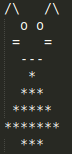
Answer for the first part is below. I am giving the code as well as a screenshot of the output.
Code for A)
// Program begins from here
#include <iostream>
using namespace std;
// user defined function to print tree
void tree(){
cout << " * " <<
endl;
cout << " *** " << endl;
cout << " ***** " << endl;
cout << "*******" << endl;
cout << " *** " << endl;
}
// user defined function to print cat
void cat(){
cout << "/\\ /\\ " <<
endl;
cout << " o o " << endl;
cout << " = = " << endl;
cout << " --- " << endl;
}
int main(){
cat();
tree();
return 0;
}
// Program ends here
Here's the screenshot of the code.
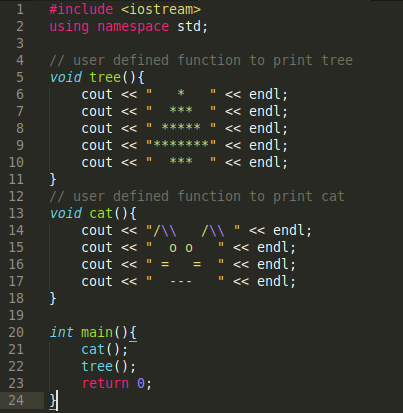
Output of above code:
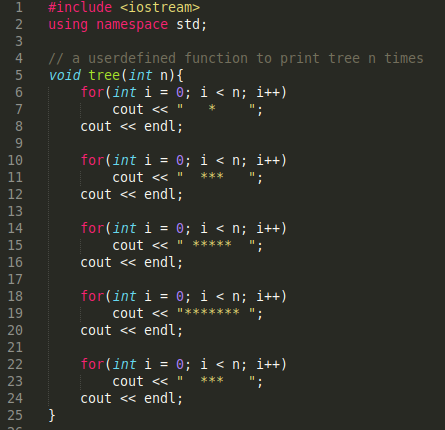
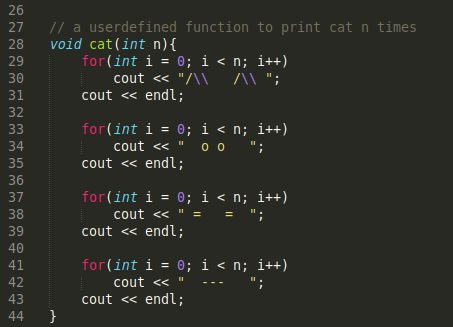
Now, the answer for the second part of the problem. I am adding the code screenshot and the code as well.
Code for B)
// Program begins from here
#include <iostream>
using namespace std;
// a userdefined function to print tree n times
void tree(int n){
for(int i = 0; i < n; i++)
cout << "
* ";
cout << endl;
for(int i = 0; i < n; i++)
cout << " ***
";
cout << endl;
for(int i = 0; i < n; i++)
cout << " ***** ";
cout << endl;
for(int i = 0; i < n; i++)
cout << "******* ";
cout << endl;
for(int i = 0; i < n; i++)
cout << " ***
";
cout << endl;
}
// a userdefined function to print cat n times
void cat(int n){
for(int i = 0; i < n; i++)
cout << "/\\ /\\
";
cout << endl;
for(int i = 0; i < n; i++)
cout << " o o
";
cout << endl;
for(int i = 0; i < n; i++)
cout << " = =
";
cout << endl;
for(int i = 0; i < n; i++)
cout << " ---
";
cout << endl;
}
int main(){
// input variable
int input;
// taking input from the user
cout << "Enter input: ";
cin >> input;
// checking if input is even or odd
if(input % 2 == 0) {
// if input is even, call tree and
cat function 10 times in same line
cat(10);
tree(10);
}
else {
// if input is odd, call tree and
cat function 20 times in the same column
for(int i = 1; i <= 20;
i++){
cat(1);
tree(1);
}
}
return 0;
}
// Program ends here
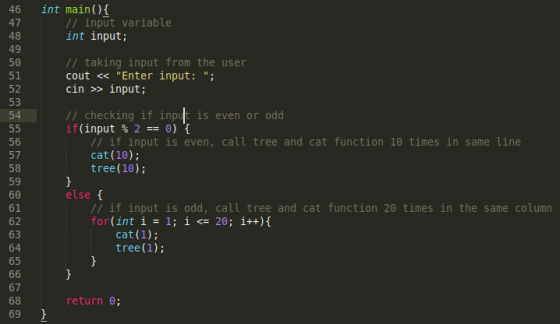
Here's the screenshot(s) of the code
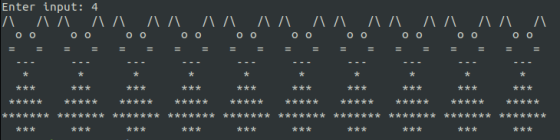
And output is here: (for even input, because for odd input, the oupt was quite large)
I hope this answers your problem.
Add Answer to:
Name: PART II: USE THE COMPUTER Problem (40 points) A A tree cat = = A)...
One example of computer-aided design (CAD) is building geometric structures inter- actively. In Chapter 4, we...
One example of computer-aided design (CAD) is building geometric structures inter- actively. In Chapter 4, we will look at ways in which we can model geometric objects comprised of polygons. Here, we want to examine the interactive part. Let’s start by writing an application that will let the user specify a series of axis- aligned rectangles interactively. Each rectangle can be defined by two mouse positions at diagonally opposite corners. Consider the event listener canvas.addEventListener("mousedown", function() { gl.bindBuffer(gl.ARRAY_BUFFER, vBuffer); if...
could you please help me with this problem, also I need a little text so I...
 could you please help me with this problem, also I
need a little text so I can understand how you solved the
problem?
import java.io.File; import java.util.Scanner; /** *
This program lists the files in a directory specified by * the
user. The user is asked to type in a directory name. * If the name
entered by the user is not a directory, a * message is printed and
the program ends. */ public class DirectoryList { public static...
could you please help me with this problem, also I
need a little text so I can understand how you solved the
problem?
import java.io.File; import java.util.Scanner; /** *
This program lists the files in a directory specified by * the
user. The user is asked to type in a directory name. * If the name
entered by the user is not a directory, a * message is printed and
the program ends. */ public class DirectoryList { public static...
Mountain Paths (Part 1) Objectives 2d arrays Store Use Nested Loops Parallel data structures (i.e...
Mountain Paths (Part 1) in C++ Objectives 2d arrays Store Use Nested Loops Parallel data structures (i.e. parallel arrays … called multiple arrays in the zyBook) Transform data Read from files Write to files structs Code Requirements Start with this code: mtnpathstart.zip Do not modify the function signatures provided. Do not #include or #include Program Flow Read the data into a 2D array Find min and max elevation to correspond to darkest and brightest color, respectively Compute the shade of...
Mountain Paths (Part 1) in C++ Objectives 2d arrays Store Use Nested Loops Parallel data structures...
Mountain Paths (Part 1) in C++ Objectives 2d arrays Store Use Nested Loops Parallel data structures (i.e. parallel arrays … called multiple arrays in the zyBook) Transform data Read from files Write to files structs Code Requirements Start with this code: mtnpathstart.zip Do not modify the function signatures provided. Do not #include or #include Program Flow Read the data into a 2D array Find min and max elevation to correspond to darkest and brightest color, respectively Compute the shade of...
This C++ Program consists of: operator overloading, as well as experience with managing dynamic memory allocation...
This C++ Program consists of: operator overloading, as well as experience with managing dynamic memory allocation inside a class. Task One common limitation of programming languages is that the built-in types are limited to smaller finite ranges of storage. For instance, the built-in int type in C++ is 4 bytes in most systems today, allowing for about 4 billion different numbers. The regular int splits this range between positive and negative numbers, but even an unsigned int (assuming 4 bytes)...
How can we assess whether a project is a success or a failure? This case presents...
 How can we assess whether a project is a success or a
failure?
This case presents two phases of a large business transformation project involving the implementation of an ERP system with the aim of creating an integrated company. The case illustrates some of the challenges associated with integration. It also presents the obstacles facing companies that undertake projects involving large information technology projects. Bombardier and Its Environment Joseph-Armand Bombardier was 15 years old when he built his first snowmobile...
How can we assess whether a project is a success or a
failure?
This case presents two phases of a large business transformation project involving the implementation of an ERP system with the aim of creating an integrated company. The case illustrates some of the challenges associated with integration. It also presents the obstacles facing companies that undertake projects involving large information technology projects. Bombardier and Its Environment Joseph-Armand Bombardier was 15 years old when he built his first snowmobile...
 could you please help me with this problem, also I
need a little text so I can understand how you solved the
problem?
import java.io.File; import java.util.Scanner; /** *
This program lists the files in a directory specified by * the
user. The user is asked to type in a directory name. * If the name
entered by the user is not a directory, a * message is printed and
the program ends. */ public class DirectoryList { public static...
could you please help me with this problem, also I
need a little text so I can understand how you solved the
problem?
import java.io.File; import java.util.Scanner; /** *
This program lists the files in a directory specified by * the
user. The user is asked to type in a directory name. * If the name
entered by the user is not a directory, a * message is printed and
the program ends. */ public class DirectoryList { public static...
 How can we assess whether a project is a success or a
failure?
This case presents two phases of a large business transformation project involving the implementation of an ERP system with the aim of creating an integrated company. The case illustrates some of the challenges associated with integration. It also presents the obstacles facing companies that undertake projects involving large information technology projects. Bombardier and Its Environment Joseph-Armand Bombardier was 15 years old when he built his first snowmobile...
How can we assess whether a project is a success or a
failure?
This case presents two phases of a large business transformation project involving the implementation of an ERP system with the aim of creating an integrated company. The case illustrates some of the challenges associated with integration. It also presents the obstacles facing companies that undertake projects involving large information technology projects. Bombardier and Its Environment Joseph-Armand Bombardier was 15 years old when he built his first snowmobile...
Most questions answered within 3 hours.
-
Where is the error in this code sequence?
String s1 = "Hello";
String s2 = "ello";...
asked 10 months ago -
Financial data for Joel de Paris, Inc., for last year
follow:
Joel de Paris, Inc.
Balance...
asked 10 months ago -
Consider this reaction:
Al2(SO4)3 (aq)+ BaCl3
(aq) Al2Cl6 (aq)- +
3BaSO4(s) . What is the...
asked 10 months ago -
Suppose that Savneet is considering increasing her
recent random sample from 20 car rentals to 40...
asked 10 months ago -
Trucks arrive at an unloading terminal at an average rate of 120
per hour.
Trucks arrive...
asked 10 months ago -
Why are methanol and ethanol completely soluble in water while
octanol is not very little soluble....
asked 10 months ago -
A facilities manager at a university reads in a research report
that the mean amount of...
asked 10 months ago -
When the CuSO4 is rehydrated by adding water to the anhydrous
compound, is this an endothermic...
asked 10 months ago -
A ray of sunlight is passing from diamond into crown glass; the
angle of incidence is...
asked 10 months ago -
A block of mass 0.249 kg is placed on top of a light, vertical
spring of...
asked 10 months ago -
how do the kidneys compensate in the presences of acidosis
a) trigger hyperventilate
b) reserve acid...
asked 10 months ago -
Question 501 pts
The rental rate of capital to the firm increases. Which of the
following...
asked 10 months ago