It's a simple circuit analysis with actually a few questions. But i'm confused of some basic circuit principals and concepts. I hope you can explian it in detail... Thx a million!
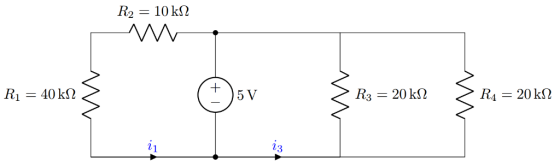
(1) why i3 is going this way? i usually see in this kind of graph i3 usually go to the negative side of the battery. Is this graph's direction prescribed?
So in this graph, the battery is supplying power (left circuit) and absorbing power (right circuit) at the same time? Do all kinds of battery have ability to do this?
(2) could you please label all the current and voltage in this graph? (do we need to choose a ground to analyze?)
(3)Find the power supplied by the battery pack. (Make sure your sign convention is correct.
(what's the "power" mean in this question. P=IV or V^2/R when consider resistors, but battery has (nearly )no resistance. As for batteries..."power" means "voltage"?)
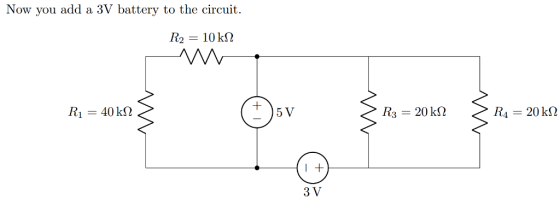
(4) Does the 3V battery supply or absorb power? Explain using calculations and noting sign conventions.
(are there any, somehow common solutions for this kind of problem?(determine a newly added/unknown device is supplying/absorbing power)
or what's the most important thing/ the correct sequence when considering this kind of problem)
Thank you again!
Homework Answers
Request Answer!
We need at least 10 more requests to produce the answer.
0 / 10 have requested this problem solution
The more requests, the faster the answer.
Add Answer to:
It's a simple circuit analysis with actually a few questions.
But i'm confused of some basic...
please help with problems 7 and 8, I am extremely confused! Part 2: Kirchhoff's Rules For...
 please help with problems 7 and 8, I am extremely
confused!
Part 2: Kirchhoff's Rules For the circuit shown below, the directions of the currents through the circuit elements has been chosen arbitrarily. Using Kirchhoff's rules, you will determine the actual currents through the circuit elements. (Yes, this circuit could be analyzed using equivalent resistance, but don't do it that way.) R1: 752 Kirchhoff's Junction Rule 4) Start by choosing a junction. Write Kirchhoft's Junction rule for that junction below...
please help with problems 7 and 8, I am extremely
confused!
Part 2: Kirchhoff's Rules For the circuit shown below, the directions of the currents through the circuit elements has been chosen arbitrarily. Using Kirchhoff's rules, you will determine the actual currents through the circuit elements. (Yes, this circuit could be analyzed using equivalent resistance, but don't do it that way.) R1: 752 Kirchhoff's Junction Rule 4) Start by choosing a junction. Write Kirchhoft's Junction rule for that junction below...
Hi I need help with answers 11-15. thank you The next three questions are about this...
 Hi I need help with answers 11-15. thank you
The next three questions are about this circuit. The voltage of
the battery is 12 V, and the values of the resistances are:
R1 = 5 ohms, R2 = 10 ohms, R3 = 15
ohms, and R4 = 20 ohms.
The next three questions pertain to the following situation.
11) R1 and R4
are in:
parallel
series
neither
12) Compare the magnitude of the
voltage across R2 and R4
V2 > V4
V2...
Hi I need help with answers 11-15. thank you
The next three questions are about this circuit. The voltage of
the battery is 12 V, and the values of the resistances are:
R1 = 5 ohms, R2 = 10 ohms, R3 = 15
ohms, and R4 = 20 ohms.
The next three questions pertain to the following situation.
11) R1 and R4
are in:
parallel
series
neither
12) Compare the magnitude of the
voltage across R2 and R4
V2 > V4
V2...
8. A simple circuit is composed of an ideal 100 v battery in series with three resistors (R1 = 10Ω, R2 = 20Ω, R3 = 30Ω). Which of the following statements is true? Statement A: Each resistor carries t...
 8. A simple circuit is composed of an ideal 100 v battery
in series with three resistors (R1 = 10Ω, R2 = 20Ω, R3 = 30Ω).
Which of the following statements is true?
Statement A: Each resistor carries the same current.
Statement B: Each resistor has the same voltage.
Statement C: Each resistor dissipates the same amount energy per
second.
Statement D: The battery power output is greater than the power
output of Resistor 1.
a. Only A is true....
8. A simple circuit is composed of an ideal 100 v battery
in series with three resistors (R1 = 10Ω, R2 = 20Ω, R3 = 30Ω).
Which of the following statements is true?
Statement A: Each resistor carries the same current.
Statement B: Each resistor has the same voltage.
Statement C: Each resistor dissipates the same amount energy per
second.
Statement D: The battery power output is greater than the power
output of Resistor 1.
a. Only A is true....
1. Consider this circuit with resistors and capacitors. The R2 battery V1 has a voltage of...
 1. Consider this circuit with resistors and capacitors. The R2 battery V1 has a voltage of 9 V, the resistors R1 and R2 have values of 100 Ω and 50 Ω, and the capacitor C1 has a value of 100 nF. Initially, the switches S1 and S2 are open. S2 (10 points) Once we close S1, what will the voltage across Rl and Cl be? How much current initially flows around the closed loop? (10 points) The current in part...
11) For the circuit shown, R1= R3 = R9 = R11= 102.0 Ohms, the rest of...
 11)
For the circuit shown, R1= R3 =
R9 = R11= 102.0 Ohms, the rest of the
resistors are 204.0 Ohms.
a) Without doing any simplification (or combination) identify
the number of pairs of resistors (that is 2 resistors) that are in
series.
b) Without doing any simplification (or combination) identify
the number of pairs of resistors (that is 2 resistors) that are in
parallel.
c) Find R12 the equivalent resistance of resistors
R1, and R2.
d) Find R123 the...
11)
For the circuit shown, R1= R3 =
R9 = R11= 102.0 Ohms, the rest of the
resistors are 204.0 Ohms.
a) Without doing any simplification (or combination) identify
the number of pairs of resistors (that is 2 resistors) that are in
series.
b) Without doing any simplification (or combination) identify
the number of pairs of resistors (that is 2 resistors) that are in
parallel.
c) Find R12 the equivalent resistance of resistors
R1, and R2.
d) Find R123 the...
ANALYSIS Use your experimental results to analyze the circuit in terms of Kirchhoff net current fow...
 ANALYSIS Use your experimental results to analyze the circuit in terms of Kirchhoff net current fow into and out of each of the four nodes, and determine whetheC s Rules. Consider supported by your data. Determine the net voltage drop around at leaston Sign determine whether or not your data supports the loop rule. (Pay close attosed loops convention.) In adition, verify ir Ohm's law is satisfied for at least three resistors and for the total reji >Q12: Why do...
Engineering circuit analysis by Hayt 8th edition question 27 and figure 9.43 I think 10u(1-t) means 10 (for t<1)...
 Engineering circuit analysis by Hayt
8th edition
question 27 and figure 9.43
I think 10u(1-t) means 10 (for t<1) and 0
(for t>1)
then, I can't remove this current source because it
continuously make 10micro A
(at t=500ms, t=1.002ms)
I don't know what's wrong now..
366 26. For the circuit of Fig. 9,43, 1 30-) mA. (a) Select R, so th O)6 V (b) Compute e2 ms). (c) Determine the settling, time of t capacitor voltage. (d) Is the inductor...
Engineering circuit analysis by Hayt
8th edition
question 27 and figure 9.43
I think 10u(1-t) means 10 (for t<1) and 0
(for t>1)
then, I can't remove this current source because it
continuously make 10micro A
(at t=500ms, t=1.002ms)
I don't know what's wrong now..
366 26. For the circuit of Fig. 9,43, 1 30-) mA. (a) Select R, so th O)6 V (b) Compute e2 ms). (c) Determine the settling, time of t capacitor voltage. (d) Is the inductor...
PLEASE SHOW ALL WORK AND TO USE PSPICE AND FOLLOW ALL DIRECTIONS. STUDENT ID=378564 Assignment: 1....
 PLEASE SHOW ALL WORK AND TO USE PSPICE AND FOLLOW ALL
DIRECTIONS.
STUDENT ID=378564
Assignment: 1. For the Circuit 1 shown below: A. Analyze the circuit by hand as described in the textbook. B. Analyze the circuit using PSPICE as follows: Use a Bias Point analysis to find the quantities found in part A above. Be sure to add text to the schematic as indicated in the Sample Report. Adjust the placement of each value on the schematic so that...
PLEASE SHOW ALL WORK AND TO USE PSPICE AND FOLLOW ALL
DIRECTIONS.
STUDENT ID=378564
Assignment: 1. For the Circuit 1 shown below: A. Analyze the circuit by hand as described in the textbook. B. Analyze the circuit using PSPICE as follows: Use a Bias Point analysis to find the quantities found in part A above. Be sure to add text to the schematic as indicated in the Sample Report. Adjust the placement of each value on the schematic so that...
answer questions #2 & #3 . Central State University Wilberforce, Ohio 45384 MFE 3510, Circuit Analysis...
 answer questions #2 & #3 .
Central State University Wilberforce, Ohio 45384 MFE 3510, Circuit Analysis Experiment 4 Obiectives After performing this experiment, you will be able to: 1. Apply the superposi 2. Construct a circult with two voltage sources, circuit, and verify your computation by measurement. tion theorem to linear circuits with more than one voltage source. solve for the currents and voltages throughout the Materials Needed: Resistors: One 4.7 kQ, one 6.8 kn, one 10.0 kQ Summary of...
answer questions #2 & #3 .
Central State University Wilberforce, Ohio 45384 MFE 3510, Circuit Analysis Experiment 4 Obiectives After performing this experiment, you will be able to: 1. Apply the superposi 2. Construct a circult with two voltage sources, circuit, and verify your computation by measurement. tion theorem to linear circuits with more than one voltage source. solve for the currents and voltages throughout the Materials Needed: Resistors: One 4.7 kQ, one 6.8 kn, one 10.0 kQ Summary of...
I only need help with the discussion there are many info that you do not need put I put just in ...
 I only need help with the discussion
there are many info that you do not need put I put just in
case as well as my data table.
please do it as soon as u can
Meauements ODeit1 Check2 Meaurements Checi3 Ced Check5 Check6 Measurements Check7 heck8 4058 33 536 1502 1035 979 119478 041 1.0319|0.554972| 64261| 153|15542033681 995781 5266566 1578807 298h 1631 119 1209430016 079096812 0.418135246 0,00032665 011890:004668155728441 0293237 1.291809502 1.22833 1.28 1952 -1116 4281 140616885511984206317 3346 8162 0.78...
I only need help with the discussion
there are many info that you do not need put I put just in
case as well as my data table.
please do it as soon as u can
Meauements ODeit1 Check2 Meaurements Checi3 Ced Check5 Check6 Measurements Check7 heck8 4058 33 536 1502 1035 979 119478 041 1.0319|0.554972| 64261| 153|15542033681 995781 5266566 1578807 298h 1631 119 1209430016 079096812 0.418135246 0,00032665 011890:004668155728441 0293237 1.291809502 1.22833 1.28 1952 -1116 4281 140616885511984206317 3346 8162 0.78...
 please help with problems 7 and 8, I am extremely
confused!
Part 2: Kirchhoff's Rules For the circuit shown below, the directions of the currents through the circuit elements has been chosen arbitrarily. Using Kirchhoff's rules, you will determine the actual currents through the circuit elements. (Yes, this circuit could be analyzed using equivalent resistance, but don't do it that way.) R1: 752 Kirchhoff's Junction Rule 4) Start by choosing a junction. Write Kirchhoft's Junction rule for that junction below...
please help with problems 7 and 8, I am extremely
confused!
Part 2: Kirchhoff's Rules For the circuit shown below, the directions of the currents through the circuit elements has been chosen arbitrarily. Using Kirchhoff's rules, you will determine the actual currents through the circuit elements. (Yes, this circuit could be analyzed using equivalent resistance, but don't do it that way.) R1: 752 Kirchhoff's Junction Rule 4) Start by choosing a junction. Write Kirchhoft's Junction rule for that junction below...
 Hi I need help with answers 11-15. thank you
The next three questions are about this circuit. The voltage of
the battery is 12 V, and the values of the resistances are:
R1 = 5 ohms, R2 = 10 ohms, R3 = 15
ohms, and R4 = 20 ohms.
The next three questions pertain to the following situation.
11) R1 and R4
are in:
parallel
series
neither
12) Compare the magnitude of the
voltage across R2 and R4
V2 > V4
V2...
Hi I need help with answers 11-15. thank you
The next three questions are about this circuit. The voltage of
the battery is 12 V, and the values of the resistances are:
R1 = 5 ohms, R2 = 10 ohms, R3 = 15
ohms, and R4 = 20 ohms.
The next three questions pertain to the following situation.
11) R1 and R4
are in:
parallel
series
neither
12) Compare the magnitude of the
voltage across R2 and R4
V2 > V4
V2...
 8. A simple circuit is composed of an ideal 100 v battery
in series with three resistors (R1 = 10Ω, R2 = 20Ω, R3 = 30Ω).
Which of the following statements is true?
Statement A: Each resistor carries the same current.
Statement B: Each resistor has the same voltage.
Statement C: Each resistor dissipates the same amount energy per
second.
Statement D: The battery power output is greater than the power
output of Resistor 1.
a. Only A is true....
8. A simple circuit is composed of an ideal 100 v battery
in series with three resistors (R1 = 10Ω, R2 = 20Ω, R3 = 30Ω).
Which of the following statements is true?
Statement A: Each resistor carries the same current.
Statement B: Each resistor has the same voltage.
Statement C: Each resistor dissipates the same amount energy per
second.
Statement D: The battery power output is greater than the power
output of Resistor 1.
a. Only A is true....
 1. Consider this circuit with resistors and capacitors. The R2 battery V1 has a voltage of 9 V, the resistors R1 and R2 have values of 100 Ω and 50 Ω, and the capacitor C1 has a value of 100 nF. Initially, the switches S1 and S2 are open. S2 (10 points) Once we close S1, what will the voltage across Rl and Cl be? How much current initially flows around the closed loop? (10 points) The current in part...
 ANALYSIS Use your experimental results to analyze the circuit in terms of Kirchhoff net current fow into and out of each of the four nodes, and determine whetheC s Rules. Consider supported by your data. Determine the net voltage drop around at leaston Sign determine whether or not your data supports the loop rule. (Pay close attosed loops convention.) In adition, verify ir Ohm's law is satisfied for at least three resistors and for the total reji >Q12: Why do...
 Engineering circuit analysis by Hayt
8th edition
question 27 and figure 9.43
I think 10u(1-t) means 10 (for t<1) and 0
(for t>1)
then, I can't remove this current source because it
continuously make 10micro A
(at t=500ms, t=1.002ms)
I don't know what's wrong now..
366 26. For the circuit of Fig. 9,43, 1 30-) mA. (a) Select R, so th O)6 V (b) Compute e2 ms). (c) Determine the settling, time of t capacitor voltage. (d) Is the inductor...
Engineering circuit analysis by Hayt
8th edition
question 27 and figure 9.43
I think 10u(1-t) means 10 (for t<1) and 0
(for t>1)
then, I can't remove this current source because it
continuously make 10micro A
(at t=500ms, t=1.002ms)
I don't know what's wrong now..
366 26. For the circuit of Fig. 9,43, 1 30-) mA. (a) Select R, so th O)6 V (b) Compute e2 ms). (c) Determine the settling, time of t capacitor voltage. (d) Is the inductor...
 PLEASE SHOW ALL WORK AND TO USE PSPICE AND FOLLOW ALL
DIRECTIONS.
STUDENT ID=378564
Assignment: 1. For the Circuit 1 shown below: A. Analyze the circuit by hand as described in the textbook. B. Analyze the circuit using PSPICE as follows: Use a Bias Point analysis to find the quantities found in part A above. Be sure to add text to the schematic as indicated in the Sample Report. Adjust the placement of each value on the schematic so that...
PLEASE SHOW ALL WORK AND TO USE PSPICE AND FOLLOW ALL
DIRECTIONS.
STUDENT ID=378564
Assignment: 1. For the Circuit 1 shown below: A. Analyze the circuit by hand as described in the textbook. B. Analyze the circuit using PSPICE as follows: Use a Bias Point analysis to find the quantities found in part A above. Be sure to add text to the schematic as indicated in the Sample Report. Adjust the placement of each value on the schematic so that...
 answer questions #2 & #3 .
Central State University Wilberforce, Ohio 45384 MFE 3510, Circuit Analysis Experiment 4 Obiectives After performing this experiment, you will be able to: 1. Apply the superposi 2. Construct a circult with two voltage sources, circuit, and verify your computation by measurement. tion theorem to linear circuits with more than one voltage source. solve for the currents and voltages throughout the Materials Needed: Resistors: One 4.7 kQ, one 6.8 kn, one 10.0 kQ Summary of...
answer questions #2 & #3 .
Central State University Wilberforce, Ohio 45384 MFE 3510, Circuit Analysis Experiment 4 Obiectives After performing this experiment, you will be able to: 1. Apply the superposi 2. Construct a circult with two voltage sources, circuit, and verify your computation by measurement. tion theorem to linear circuits with more than one voltage source. solve for the currents and voltages throughout the Materials Needed: Resistors: One 4.7 kQ, one 6.8 kn, one 10.0 kQ Summary of...
 I only need help with the discussion
there are many info that you do not need put I put just in
case as well as my data table.
please do it as soon as u can
Meauements ODeit1 Check2 Meaurements Checi3 Ced Check5 Check6 Measurements Check7 heck8 4058 33 536 1502 1035 979 119478 041 1.0319|0.554972| 64261| 153|15542033681 995781 5266566 1578807 298h 1631 119 1209430016 079096812 0.418135246 0,00032665 011890:004668155728441 0293237 1.291809502 1.22833 1.28 1952 -1116 4281 140616885511984206317 3346 8162 0.78...
I only need help with the discussion
there are many info that you do not need put I put just in
case as well as my data table.
please do it as soon as u can
Meauements ODeit1 Check2 Meaurements Checi3 Ced Check5 Check6 Measurements Check7 heck8 4058 33 536 1502 1035 979 119478 041 1.0319|0.554972| 64261| 153|15542033681 995781 5266566 1578807 298h 1631 119 1209430016 079096812 0.418135246 0,00032665 011890:004668155728441 0293237 1.291809502 1.22833 1.28 1952 -1116 4281 140616885511984206317 3346 8162 0.78...
Most questions answered within 3 hours.
-
Where is the error in this code sequence?
String s1 = "Hello";
String s2 = "ello";...
asked 10 months ago -
Financial data for Joel de Paris, Inc., for last year
follow:
Joel de Paris, Inc.
Balance...
asked 10 months ago -
Consider this reaction:
Al2(SO4)3 (aq)+ BaCl3
(aq) Al2Cl6 (aq)- +
3BaSO4(s) . What is the...
asked 10 months ago -
Suppose that Savneet is considering increasing her
recent random sample from 20 car rentals to 40...
asked 10 months ago -
Trucks arrive at an unloading terminal at an average rate of 120
per hour.
Trucks arrive...
asked 10 months ago -
Why are methanol and ethanol completely soluble in water while
octanol is not very little soluble....
asked 10 months ago -
A facilities manager at a university reads in a research report
that the mean amount of...
asked 10 months ago -
When the CuSO4 is rehydrated by adding water to the anhydrous
compound, is this an endothermic...
asked 10 months ago -
A ray of sunlight is passing from diamond into crown glass; the
angle of incidence is...
asked 10 months ago -
A block of mass 0.249 kg is placed on top of a light, vertical
spring of...
asked 10 months ago -
how do the kidneys compensate in the presences of acidosis
a) trigger hyperventilate
b) reserve acid...
asked 10 months ago -
Question 501 pts
The rental rate of capital to the firm increases. Which of the
following...
asked 10 months ago