
Homework Answers
Add Answer to:
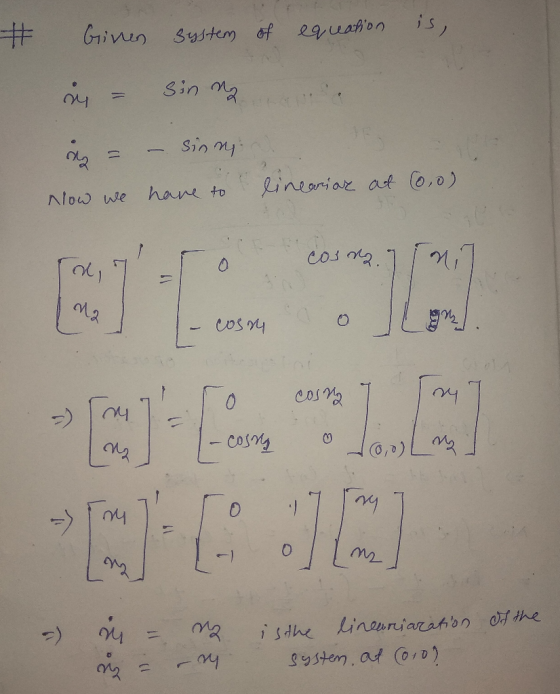
Problem 4. Conduct linearization of the system near the point P(0,0) sinx sin
Problem 3. Linearization of a nonlinear system at a non-hyperbolic fixed point] Consider the nonlinear system...
 Problem 3. Linearization of a nonlinear system at a non-hyperbolic fixed point] Consider the nonlinear system t' =-y+px(x² + y) (4) y = 1+ y(x² + y2), where is a parameter. Obviously, the origin x* = (0,0) is a fixed point of (4). (e) The solution of the ODE for o(t) is obvious - the angle o increases at a constant rate. Without solving the ODE for r(t), explain how r(t) behaves when t o in the cases H<0,1 =...
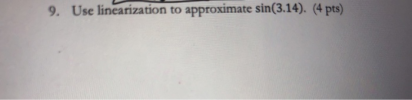
9. Use linearization to approximate sin(3.14). (4 pts)
 9. Use linearization to approximate sin(3.14). (4 pts)
Evaluate I=∫C(sinx+9y)dx+(8x+y)dy for the nonclosed path ABCD in the figure. A=(0,0),B=(4,4),C=(4,8),D=(0,12) (1 point) Evaluate I figure....
 Evaluate
I=∫C(sinx+9y)dx+(8x+y)dy for the nonclosed path ABCD in the figure.
A=(0,0),B=(4,4),C=(4,8),D=(0,12)
(1 point) Evaluate I figure. Je(sin x +9y) dx + (8x + y) dy for the nonclosed path ABCD in the A (0,0), B (4,4, C (4,8), D (0,12)
Evaluate
I=∫C(sinx+9y)dx+(8x+y)dy for the nonclosed path ABCD in the figure.
A=(0,0),B=(4,4),C=(4,8),D=(0,12)
(1 point) Evaluate I figure. Je(sin x +9y) dx + (8x + y) dy for the nonclosed path ABCD in the A (0,0), B (4,4, C (4,8), D (0,12)
Previous Problem Problem List Next Problem (1 point) Find the local linearization of f(x) = x2...
 Previous Problem Problem List Next Problem (1 point) Find the local linearization of f(x) = x2 at -6. 1_6(x) = Preview My Answers Submit Answers
dx/dt = 4x -x^2 -2xy dy/dt = -y+0.5 xy a) find equilibrium points b) find Jacobian matrix for above system c) find Jacobian matrix at eq. point (0,0) d) draw phase portrait near (0,0) from © e) show...
dx/dt = 4x -x^2 -2xy dy/dt = -y+0.5 xy a) find equilibrium points b) find Jacobian matrix for above system c) find Jacobian matrix at eq. point (0,0) d) draw phase portrait near (0,0) from © e) show at eq. point (4,0) the Jacobian matrix is -4 -8 0 1 f) draw phase portrait near (4,0) from (d) g) at eq. point (2,1) the Jacobian matrix is -2 -4 0.5 0 h) draw phase portrait near (2,1) from (f) i)...
2 This system has an equilibrium point at the origin (you do not have to show this) For parts (d)-(e), consider the system This system also has an equilibrium point at the origin (you do not have to...
 2 This system has an equilibrium point at the origin (you do not have to show this) For parts (d)-(e), consider the system This system also has an equilibrium point at the origin (you do not have to show this). (d) (4 pts) Compute the linearization of this system, and conclude that the Jacobian yields no relevant infor- mation regarding the equilibrium at (0,0). (e) (3 pts) Sketch the nullcline diagram for this system. Conclude from the diagram that the...
x (0,0)=(3+4 sin cos e, +(3+4 sin º) sin 0 e2+ 4 cos 0 e3 The...
 x (0,0)=(3+4 sin cos e, +(3+4 sin º) sin 0 e2+ 4 cos 0 e3 The value of Jxoxxo/ at 9 = 1 is: 21 28 O 49
4 direction 7 = 21 +1 4. Find the linearization of f(c,y) = x2 + y2...
 4
direction 7 = 21 +1 4. Find the linearization of f(c,y) = x2 + y2 at the point P(3, 4) and use it to approximate f(3.05, 3.95). 5. Find the local minimum and maximum values and saddle points of 10
4
direction 7 = 21 +1 4. Find the linearization of f(c,y) = x2 + y2 at the point P(3, 4) and use it to approximate f(3.05, 3.95). 5. Find the local minimum and maximum values and saddle points of 10
please answer all the following parts neatly. thank you Let's consider the problem that has given rise t...
 please answer all the following parts neatly. thank you
Let's consider the problem that has given rise to the branch of calculus called differential calculus: the tangent problem. This problem relates to finding the slope of the tangent line to a curve at a given point. To understand how this is done we are going to consider the point (0,0) on the graph of f)-sinx (5) . On graph paper, sketch the graph of -sinx and draw a tangent line...
please answer all the following parts neatly. thank you
Let's consider the problem that has given rise to the branch of calculus called differential calculus: the tangent problem. This problem relates to finding the slope of the tangent line to a curve at a given point. To understand how this is done we are going to consider the point (0,0) on the graph of f)-sinx (5) . On graph paper, sketch the graph of -sinx and draw a tangent line...
(1 point) Solve the nonhomogeneous heat problem 24 = 1,+ sin(2.0), 0<I<T, u(0,t) = 0, u1,t)...
 (1 point) Solve the nonhomogeneous heat problem 24 = 1,+ sin(2.0), 0<I<T, u(0,t) = 0, u1,t) = 0 u(3,0) = 3 sin(4x) uz,t) = sinx, sint Steady State Solution limuz,t) =
 Problem 3. Linearization of a nonlinear system at a non-hyperbolic fixed point] Consider the nonlinear system t' =-y+px(x² + y) (4) y = 1+ y(x² + y2), where is a parameter. Obviously, the origin x* = (0,0) is a fixed point of (4). (e) The solution of the ODE for o(t) is obvious - the angle o increases at a constant rate. Without solving the ODE for r(t), explain how r(t) behaves when t o in the cases H<0,1 =...
 9. Use linearization to approximate sin(3.14). (4 pts)
 Evaluate
I=∫C(sinx+9y)dx+(8x+y)dy for the nonclosed path ABCD in the figure.
A=(0,0),B=(4,4),C=(4,8),D=(0,12)
(1 point) Evaluate I figure. Je(sin x +9y) dx + (8x + y) dy for the nonclosed path ABCD in the A (0,0), B (4,4, C (4,8), D (0,12)
Evaluate
I=∫C(sinx+9y)dx+(8x+y)dy for the nonclosed path ABCD in the figure.
A=(0,0),B=(4,4),C=(4,8),D=(0,12)
(1 point) Evaluate I figure. Je(sin x +9y) dx + (8x + y) dy for the nonclosed path ABCD in the A (0,0), B (4,4, C (4,8), D (0,12)
 Previous Problem Problem List Next Problem (1 point) Find the local linearization of f(x) = x2 at -6. 1_6(x) = Preview My Answers Submit Answers
 2 This system has an equilibrium point at the origin (you do not have to show this) For parts (d)-(e), consider the system This system also has an equilibrium point at the origin (you do not have to show this). (d) (4 pts) Compute the linearization of this system, and conclude that the Jacobian yields no relevant infor- mation regarding the equilibrium at (0,0). (e) (3 pts) Sketch the nullcline diagram for this system. Conclude from the diagram that the...
 x (0,0)=(3+4 sin cos e, +(3+4 sin º) sin 0 e2+ 4 cos 0 e3 The value of Jxoxxo/ at 9 = 1 is: 21 28 O 49
 4
direction 7 = 21 +1 4. Find the linearization of f(c,y) = x2 + y2 at the point P(3, 4) and use it to approximate f(3.05, 3.95). 5. Find the local minimum and maximum values and saddle points of 10
4
direction 7 = 21 +1 4. Find the linearization of f(c,y) = x2 + y2 at the point P(3, 4) and use it to approximate f(3.05, 3.95). 5. Find the local minimum and maximum values and saddle points of 10
 please answer all the following parts neatly. thank you
Let's consider the problem that has given rise to the branch of calculus called differential calculus: the tangent problem. This problem relates to finding the slope of the tangent line to a curve at a given point. To understand how this is done we are going to consider the point (0,0) on the graph of f)-sinx (5) . On graph paper, sketch the graph of -sinx and draw a tangent line...
please answer all the following parts neatly. thank you
Let's consider the problem that has given rise to the branch of calculus called differential calculus: the tangent problem. This problem relates to finding the slope of the tangent line to a curve at a given point. To understand how this is done we are going to consider the point (0,0) on the graph of f)-sinx (5) . On graph paper, sketch the graph of -sinx and draw a tangent line...
 (1 point) Solve the nonhomogeneous heat problem 24 = 1,+ sin(2.0), 0<I<T, u(0,t) = 0, u1,t) = 0 u(3,0) = 3 sin(4x) uz,t) = sinx, sint Steady State Solution limuz,t) =
Most questions answered within 3 hours.
-
Where is the error in this code sequence?
String s1 = "Hello";
String s2 = "ello";...
asked 10 months ago -
Financial data for Joel de Paris, Inc., for last year
follow:
Joel de Paris, Inc.
Balance...
asked 10 months ago -
Consider this reaction:
Al2(SO4)3 (aq)+ BaCl3
(aq) Al2Cl6 (aq)- +
3BaSO4(s) . What is the...
asked 10 months ago -
Suppose that Savneet is considering increasing her
recent random sample from 20 car rentals to 40...
asked 10 months ago -
Trucks arrive at an unloading terminal at an average rate of 120
per hour.
Trucks arrive...
asked 10 months ago -
Why are methanol and ethanol completely soluble in water while
octanol is not very little soluble....
asked 10 months ago -
A facilities manager at a university reads in a research report
that the mean amount of...
asked 10 months ago -
When the CuSO4 is rehydrated by adding water to the anhydrous
compound, is this an endothermic...
asked 10 months ago -
A ray of sunlight is passing from diamond into crown glass; the
angle of incidence is...
asked 10 months ago -
A block of mass 0.249 kg is placed on top of a light, vertical
spring of...
asked 10 months ago -
how do the kidneys compensate in the presences of acidosis
a) trigger hyperventilate
b) reserve acid...
asked 10 months ago -
Question 501 pts
The rental rate of capital to the firm increases. Which of the
following...
asked 10 months ago