
Homework Answers
Add Answer to:
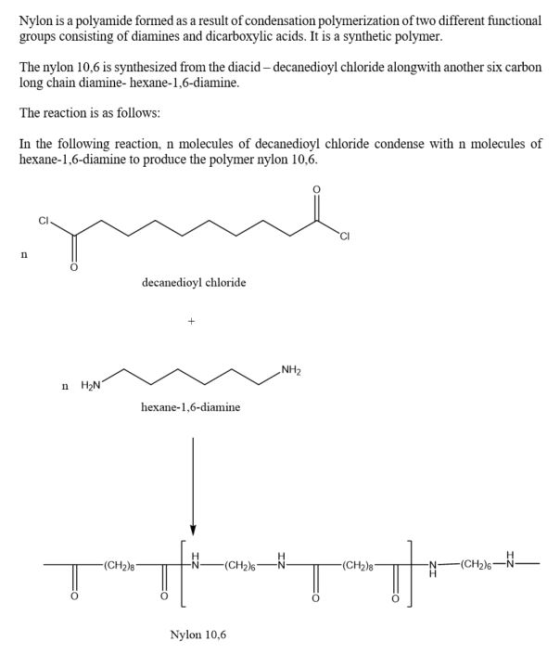
You synthesized Nylon-10,6, using interfacial polymerization. Draw a representation of what your experiment looked like. Clearly...
a. If you hadn’t used blocking solution what might the staining have looked like on your...
a. If you hadn’t used blocking solution what might the staining have looked like on your nitrocellulose membranes? b. If you had boiled the protein extracts prior to the experiment what effect might this have had on your results? The expression pattern for the final three cyclins is shown above. The aim of this week’s experiment is to verify how M-cyclin is varying within the synchronised tobacco BY2 cell culture. Protein levels will be assays using a dot blot immunoassay...
what is the theoretical yield for this experiment? ORGANIC POLYMERS: THE SYNTHESIS OF NYLON Nylon's outstanding...
 what is the theoretical yield for this experiment?
ORGANIC POLYMERS: THE SYNTHESIS OF NYLON Nylon's outstanding characteristic in the textile industry is its versatility. It can be made strong enough to stand up under the punishment tire cords must endure, fine enough for sheer, high fashion hosiery, and light enough for parachute cloth and backpacker's tents. Nylon is used both alone and in blends with other fibers, where its chief contributions are strength and abrasion resistance. Nylon washes easily, dries...
what is the theoretical yield for this experiment?
ORGANIC POLYMERS: THE SYNTHESIS OF NYLON Nylon's outstanding characteristic in the textile industry is its versatility. It can be made strong enough to stand up under the punishment tire cords must endure, fine enough for sheer, high fashion hosiery, and light enough for parachute cloth and backpacker's tents. Nylon is used both alone and in blends with other fibers, where its chief contributions are strength and abrasion resistance. Nylon washes easily, dries...
Physics of the Human Arm If you have ever done bicep curls at the gym and looked at your arm in the mirror while you were doing it, you might have seen something like Figure 1 (plus or minus tan...
 Physics of the Human Arm If you have ever done bicep curls at the gym and looked at your arm in the mirror while you were doing it, you might have seen something like Figure 1 (plus or minus tanned skin and/or hair! Figure 1: Outside of arm lifting a weight using mostly the contracted bicep muscles We know what's going on under your skin from anatomy. The bicep muscles are attached via tendons to the top of your shoulder...
Draw the following sketches. “Sketch” means a drawing that clearly illustrates the concept(s) related to the question, b...
Draw the following sketches. “Sketch” means a drawing that clearly illustrates the concept(s) related to the question, but does not require you to use a computer or to do any calculations to draw. Be sure you clearly label the axes. (a) Sketch a production function (with one input) that implies economies of scale at low levels of output and diseconomies of scale at high levels of output. (b) What does the corresponding cost curve look like? Provide a separate sketch...
Extraction of solids: Experiment outlined below Draw a “roadmap” of the experiment, containing chemical structures and...
 Extraction of solids: Experiment outlined below
Draw a “roadmap” of the experiment, containing chemical
structures and “layers” (organic and aqueous). This should contain
the individual reactions occurring in each step, and show which
layer the various components are present. Make sure you think about
whether the acetaminophen, caffeine and aspirin are neutral,
protonated or deprotonated.
Preliminary separation obtain a sample (1.0g) of the mixture. weigh the sample and record it. this sample should consist of a 2:1:1 mixture (by mass)...
Extraction of solids: Experiment outlined below
Draw a “roadmap” of the experiment, containing chemical
structures and “layers” (organic and aqueous). This should contain
the individual reactions occurring in each step, and show which
layer the various components are present. Make sure you think about
whether the acetaminophen, caffeine and aspirin are neutral,
protonated or deprotonated.
Preliminary separation obtain a sample (1.0g) of the mixture. weigh the sample and record it. this sample should consist of a 2:1:1 mixture (by mass)...
Draw the condensed structure of 2,2-dimethylbutane. b.) Estimate what the 1H NMR spectrum of 2,2-dimethylbutane is expected to look like. c.) Clearly label each proton environments and match each to its signal. d.) Be sure to include appropriate splitting
 Draw the condensed structure of 2,2-dimethylbutane. b.) Estimate what the 1H NMR spectrum of 2,2-dimethylbutane is expected to look like. c.) Clearly label each proton environments and match each to its signal. d.) Be sure to include appropriate splitting. e.) Above each signal, include the appropriate integration.I need problem 1, part C answered.4-1.jpg
Experiment 7 In your Pre-Lab, you should draw the chemical reactions for the carbonyl tests using...
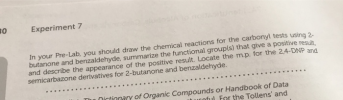 Experiment 7 In your Pre-Lab, you should draw the chemical reactions for the carbonyl tests using 2 butanone and benzaldehyde, summarize the functional group(s) that give a positive result and describe the appearance of the positive result. Locate the m.p. for the 2,4-DNP and semicarbazone derivatives for 2-butanone and benzaldehyde Dictionary of Organic Compounds or Handbook of Data ful For the Tollens' and
Seard 2. Evaluate without using a calculator. Draw a picture. Show and label where your answer...
 Seard 2. Evaluate without using a calculator. Draw a picture. Show and label where your answer lies. What is the reference angle? Write your answer as an exact value. You must show your work. Do not skip steps. v2 2 a. sin b. tan (13) 3. Find the length of the arc s intercepted by a central angle 0 = 330 in a circle of radius r =6 in. Round your answer to the nearest tenth. 1 4. If cos...
Draw your very own Galvanic cell. The process you will be using is that solid chromium...
Draw your very own Galvanic cell. The process you will be using is that solid chromium releases two electrons, becoming chromium (II) ions. At the same time, iron (II) ions acquire there electrons, forming solid iron metal. Make sure you label each part of your Galvanic cell. Do not forget site of oxidation, site of reduction, porous plug, wire, salt bridge, anode, cathode. Indicate the metal at each site and the resulting movement of ions.
EXPERIMENT W12: ORGANIC STRUCTURES AND MOLECULAR MODELS 7. Build models of all possible isomers of CHCl,...
 EXPERIMENT W12: ORGANIC STRUCTURES AND MOLECULAR MODELS 7. Build models of all possible isomers of CHCl, and then draw and name the Lewis Structure for each Isomers that differ in their relative geometry (or orientation) across a rigid double bond are called geometrie isomers. Circle your geometric isomers. Label each molecule as polar or non-polar. Certain physical properties of molecules, such as boiling point, are dependent on the degree of polanty of a molecule. What hybrid orbital is used by...
 what is the theoretical yield for this experiment?
ORGANIC POLYMERS: THE SYNTHESIS OF NYLON Nylon's outstanding characteristic in the textile industry is its versatility. It can be made strong enough to stand up under the punishment tire cords must endure, fine enough for sheer, high fashion hosiery, and light enough for parachute cloth and backpacker's tents. Nylon is used both alone and in blends with other fibers, where its chief contributions are strength and abrasion resistance. Nylon washes easily, dries...
what is the theoretical yield for this experiment?
ORGANIC POLYMERS: THE SYNTHESIS OF NYLON Nylon's outstanding characteristic in the textile industry is its versatility. It can be made strong enough to stand up under the punishment tire cords must endure, fine enough for sheer, high fashion hosiery, and light enough for parachute cloth and backpacker's tents. Nylon is used both alone and in blends with other fibers, where its chief contributions are strength and abrasion resistance. Nylon washes easily, dries...
 Physics of the Human Arm If you have ever done bicep curls at the gym and looked at your arm in the mirror while you were doing it, you might have seen something like Figure 1 (plus or minus tanned skin and/or hair! Figure 1: Outside of arm lifting a weight using mostly the contracted bicep muscles We know what's going on under your skin from anatomy. The bicep muscles are attached via tendons to the top of your shoulder...
 Extraction of solids: Experiment outlined below
Draw a “roadmap” of the experiment, containing chemical
structures and “layers” (organic and aqueous). This should contain
the individual reactions occurring in each step, and show which
layer the various components are present. Make sure you think about
whether the acetaminophen, caffeine and aspirin are neutral,
protonated or deprotonated.
Preliminary separation obtain a sample (1.0g) of the mixture. weigh the sample and record it. this sample should consist of a 2:1:1 mixture (by mass)...
Extraction of solids: Experiment outlined below
Draw a “roadmap” of the experiment, containing chemical
structures and “layers” (organic and aqueous). This should contain
the individual reactions occurring in each step, and show which
layer the various components are present. Make sure you think about
whether the acetaminophen, caffeine and aspirin are neutral,
protonated or deprotonated.
Preliminary separation obtain a sample (1.0g) of the mixture. weigh the sample and record it. this sample should consist of a 2:1:1 mixture (by mass)...
 Experiment 7 In your Pre-Lab, you should draw the chemical reactions for the carbonyl tests using 2 butanone and benzaldehyde, summarize the functional group(s) that give a positive result and describe the appearance of the positive result. Locate the m.p. for the 2,4-DNP and semicarbazone derivatives for 2-butanone and benzaldehyde Dictionary of Organic Compounds or Handbook of Data ful For the Tollens' and
 Seard 2. Evaluate without using a calculator. Draw a picture. Show and label where your answer lies. What is the reference angle? Write your answer as an exact value. You must show your work. Do not skip steps. v2 2 a. sin b. tan (13) 3. Find the length of the arc s intercepted by a central angle 0 = 330 in a circle of radius r =6 in. Round your answer to the nearest tenth. 1 4. If cos...
 EXPERIMENT W12: ORGANIC STRUCTURES AND MOLECULAR MODELS 7. Build models of all possible isomers of CHCl, and then draw and name the Lewis Structure for each Isomers that differ in their relative geometry (or orientation) across a rigid double bond are called geometrie isomers. Circle your geometric isomers. Label each molecule as polar or non-polar. Certain physical properties of molecules, such as boiling point, are dependent on the degree of polanty of a molecule. What hybrid orbital is used by...
Most questions answered within 3 hours.
-
Where is the error in this code sequence?
String s1 = "Hello";
String s2 = "ello";...
asked 10 months ago -
Financial data for Joel de Paris, Inc., for last year
follow:
Joel de Paris, Inc.
Balance...
asked 10 months ago -
Consider this reaction:
Al2(SO4)3 (aq)+ BaCl3
(aq) Al2Cl6 (aq)- +
3BaSO4(s) . What is the...
asked 10 months ago -
Suppose that Savneet is considering increasing her
recent random sample from 20 car rentals to 40...
asked 10 months ago -
Trucks arrive at an unloading terminal at an average rate of 120
per hour.
Trucks arrive...
asked 10 months ago -
Why are methanol and ethanol completely soluble in water while
octanol is not very little soluble....
asked 10 months ago -
A facilities manager at a university reads in a research report
that the mean amount of...
asked 10 months ago -
When the CuSO4 is rehydrated by adding water to the anhydrous
compound, is this an endothermic...
asked 10 months ago -
A ray of sunlight is passing from diamond into crown glass; the
angle of incidence is...
asked 10 months ago -
A block of mass 0.249 kg is placed on top of a light, vertical
spring of...
asked 10 months ago -
how do the kidneys compensate in the presences of acidosis
a) trigger hyperventilate
b) reserve acid...
asked 10 months ago -
Question 501 pts
The rental rate of capital to the firm increases. Which of the
following...
asked 10 months ago