
Homework Answers
Add Answer to:
An arbitrary quantum mechanical system may be in its ground state. At timet0 a perturbation of...
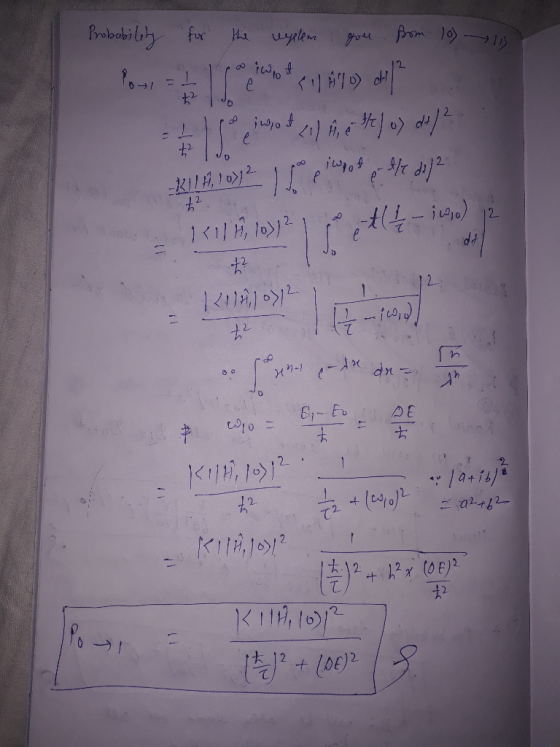
Please solve the problem as soon as possible. Problem 1: Consider a two level system with Hamiltonian: Using the first order time-dependent perturbation theory, obtain the probability coefficients cn...
 Please solve the problem as soon as possible.
Problem 1: Consider a two level system with Hamiltonian: Using the first order time-dependent perturbation theory, obtain the probability coefficients cn (t) if the perturbation is applied at t >0 and the system is originally in the ground state. Hint: When solving the problem, first you may need to find the energies and wave functions of the unperturbed Hamiltonian A0.
Problem 1: Consider a two level system with Hamiltonian: Using the first...
Please solve the problem as soon as possible.
Problem 1: Consider a two level system with Hamiltonian: Using the first order time-dependent perturbation theory, obtain the probability coefficients cn (t) if the perturbation is applied at t >0 and the system is originally in the ground state. Hint: When solving the problem, first you may need to find the energies and wave functions of the unperturbed Hamiltonian A0.
Problem 1: Consider a two level system with Hamiltonian: Using the first...
Quantum Mechanics Problem 1. (25) Consider an infinite potential well with the following shape: 0 a/4...
 Quantum Mechanics Problem
1. (25) Consider an infinite potential well with the following shape: 0 a/4 3al4 a h2 where 4 Using the ground state wavefunction of the original infinite potential well as a trial function, 2πχ trial = 1-sin- find the approximation of the ground state energy for this system with the variational method. (Note, this question is simplified by considering the two components of the Hamiltonian, and V, on their own) b) If we had used the 1st...
Quantum Mechanics Problem
1. (25) Consider an infinite potential well with the following shape: 0 a/4 3al4 a h2 where 4 Using the ground state wavefunction of the original infinite potential well as a trial function, 2πχ trial = 1-sin- find the approximation of the ground state energy for this system with the variational method. (Note, this question is simplified by considering the two components of the Hamiltonian, and V, on their own) b) If we had used the 1st...
Consider a quantum mechanical system with 4 states and an unperturbed Hamiltonian given by 1 0 0 0 Ho E0 0 2 0 a small perturbation is added to this Hamiltonian 0 0 1 0 where e is much smaller than E...
 Consider a quantum mechanical system with 4 states and an unperturbed Hamiltonian given by 1 0 0 0 Ho E0 0 2 0 a small perturbation is added to this Hamiltonian 0 0 1 0 where e is much smaller than E a) [10pts] What are the energy eigenvalues of the unperturbed system of the following states? 1 o 2o 0 and which energy levels are degenerate? b) [10pts Find a good basis for degenerate perturbation theory instead of c)...
Quantum Mechanics. Find the energies, degenerations and wave functions for the first three energy levels (ground state...
Quantum Mechanics. Find the energies, degenerations and wave functions for the first three energy levels (ground state and first two excited states) of a system of two identical particles with spin , which move in a one- dimensional infinite well of size . Find corrections of energies to first order in if an attracting potential of contact is added. Show that in the case of "spinless" fermions, the previous perturbation has no effect. Step by step process with good handwriting,...
1. Consider a spin-0 particle of mass m and charge q moving in a symmetric three-dimensional harm...
 1. Consider a spin-0 particle of mass m and charge q moving in a symmetric three-dimensional harmonic oscillator potential with natural frequency W.Att-0 an external magnetic field is turned on which is uniform in space but oscillates with temporal frequency W as follows. E(t)-Bo sin(at) At time t>0, the perturbation is turned off. Assuming that the system starts off at t-0 in the ground state, apply time-dependent perturbation theory to estimate the probability that the system ends up in an...
(10 points) A spin-1/2 particle is originally in the ground state of the Hamiltonian Ho woS...
 (10 points) A spin-1/2 particle is originally in the ground state of the Hamiltonian Ho woS At time t - 0 the system is perturbed by Here and above s, are the spin matrices. Consider H, as a small perturbation of Ho i.e., ao > wi, Find the probability for the particle to flip its spin under the perturbation at t n oo.
3. (a) Consider a 1-dim harmonic oscillator in its ground state (0) of the unperturbed Hamiltonian at t--0o. Let a pert...
 3. (a) Consider a 1-dim harmonic oscillator in its ground state (0) of the unperturbed Hamiltonian at t--0o. Let a perturbation Hi(t)--eEXe t2 (e, E and rare constants) be applied between - and too. What is the probability that the oscillator will be in the state n) (of the unperturbed oscillator) as t-> oo?(15%) (b) The bottom of an infinite well is changed to have the shape V(x)-ε sin® for 0Sxa. Calculate the energy shifts for all the excited states...
Quantum Mechanics. Find the energies, degenerations and wave functions for the first three energy levels (ground...
 Quantum Mechanics.
Find the energies, degenerations and wave functions for the first
three energy levels (ground state
and first two excited states) of a system of two identical
particles with spin , which move in a
one-
dimensional infinite well of size .
Find corrections of energies to first order in if an
attracting potential of contact
is added.
Show that in the case of "spinless" fermions, the previous
perturbation has no effect.
Step by step process with good handwriting,...
Quantum Mechanics.
Find the energies, degenerations and wave functions for the first
three energy levels (ground state
and first two excited states) of a system of two identical
particles with spin , which move in a
one-
dimensional infinite well of size .
Find corrections of energies to first order in if an
attracting potential of contact
is added.
Show that in the case of "spinless" fermions, the previous
perturbation has no effect.
Step by step process with good handwriting,...
3 Angular Momentum and Spherical Harmonics For a quantum mechanical system that is able to rotate...
 3 Angular Momentum and Spherical Harmonics For a quantum mechanical system that is able to rotate in 3D, one can always define a set of angular momentum operators J. Jy, J., often collectively written as a vector J. They must satisfy the commutation relations (, ] = ihſ, , Îu] = ihſ, J., ſu] = ihỈy. (1) In a more condensed notation, we may write [1,1]] = Žiheikh, i, j= 1,2,3 k=1 Here we've used the Levi-Civita symbol, defined as...
The energy levels of a quantum mechanical system are given by the equation: En = -hfo/√n^2+9....
The energy levels of a quantum mechanical system are given by the equation: En = -hfo/√n^2+9. given: fo = 10^15 Hz, n = 0,1,2... a) Determine the frequency and wavelength of photon emitted in a transition form level 2 to the ground state (n=0) b) In the transition in a), how many photons are emitted per second in order to produce a radiation power of .002W? I did part a using the equation Eph = hf, then E2 - E0...
 Please solve the problem as soon as possible.
Problem 1: Consider a two level system with Hamiltonian: Using the first order time-dependent perturbation theory, obtain the probability coefficients cn (t) if the perturbation is applied at t >0 and the system is originally in the ground state. Hint: When solving the problem, first you may need to find the energies and wave functions of the unperturbed Hamiltonian A0.
Problem 1: Consider a two level system with Hamiltonian: Using the first...
Please solve the problem as soon as possible.
Problem 1: Consider a two level system with Hamiltonian: Using the first order time-dependent perturbation theory, obtain the probability coefficients cn (t) if the perturbation is applied at t >0 and the system is originally in the ground state. Hint: When solving the problem, first you may need to find the energies and wave functions of the unperturbed Hamiltonian A0.
Problem 1: Consider a two level system with Hamiltonian: Using the first...
 Quantum Mechanics Problem
1. (25) Consider an infinite potential well with the following shape: 0 a/4 3al4 a h2 where 4 Using the ground state wavefunction of the original infinite potential well as a trial function, 2πχ trial = 1-sin- find the approximation of the ground state energy for this system with the variational method. (Note, this question is simplified by considering the two components of the Hamiltonian, and V, on their own) b) If we had used the 1st...
Quantum Mechanics Problem
1. (25) Consider an infinite potential well with the following shape: 0 a/4 3al4 a h2 where 4 Using the ground state wavefunction of the original infinite potential well as a trial function, 2πχ trial = 1-sin- find the approximation of the ground state energy for this system with the variational method. (Note, this question is simplified by considering the two components of the Hamiltonian, and V, on their own) b) If we had used the 1st...
 Consider a quantum mechanical system with 4 states and an unperturbed Hamiltonian given by 1 0 0 0 Ho E0 0 2 0 a small perturbation is added to this Hamiltonian 0 0 1 0 where e is much smaller than E a) [10pts] What are the energy eigenvalues of the unperturbed system of the following states? 1 o 2o 0 and which energy levels are degenerate? b) [10pts Find a good basis for degenerate perturbation theory instead of c)...
 1. Consider a spin-0 particle of mass m and charge q moving in a symmetric three-dimensional harmonic oscillator potential with natural frequency W.Att-0 an external magnetic field is turned on which is uniform in space but oscillates with temporal frequency W as follows. E(t)-Bo sin(at) At time t>0, the perturbation is turned off. Assuming that the system starts off at t-0 in the ground state, apply time-dependent perturbation theory to estimate the probability that the system ends up in an...
 (10 points) A spin-1/2 particle is originally in the ground state of the Hamiltonian Ho woS At time t - 0 the system is perturbed by Here and above s, are the spin matrices. Consider H, as a small perturbation of Ho i.e., ao > wi, Find the probability for the particle to flip its spin under the perturbation at t n oo.
 3. (a) Consider a 1-dim harmonic oscillator in its ground state (0) of the unperturbed Hamiltonian at t--0o. Let a perturbation Hi(t)--eEXe t2 (e, E and rare constants) be applied between - and too. What is the probability that the oscillator will be in the state n) (of the unperturbed oscillator) as t-> oo?(15%) (b) The bottom of an infinite well is changed to have the shape V(x)-ε sin® for 0Sxa. Calculate the energy shifts for all the excited states...
 Quantum Mechanics.
Find the energies, degenerations and wave functions for the first
three energy levels (ground state
and first two excited states) of a system of two identical
particles with spin , which move in a
one-
dimensional infinite well of size .
Find corrections of energies to first order in if an
attracting potential of contact
is added.
Show that in the case of "spinless" fermions, the previous
perturbation has no effect.
Step by step process with good handwriting,...
Quantum Mechanics.
Find the energies, degenerations and wave functions for the first
three energy levels (ground state
and first two excited states) of a system of two identical
particles with spin , which move in a
one-
dimensional infinite well of size .
Find corrections of energies to first order in if an
attracting potential of contact
is added.
Show that in the case of "spinless" fermions, the previous
perturbation has no effect.
Step by step process with good handwriting,...
 3 Angular Momentum and Spherical Harmonics For a quantum mechanical system that is able to rotate in 3D, one can always define a set of angular momentum operators J. Jy, J., often collectively written as a vector J. They must satisfy the commutation relations (, ] = ihſ, , Îu] = ihſ, J., ſu] = ihỈy. (1) In a more condensed notation, we may write [1,1]] = Žiheikh, i, j= 1,2,3 k=1 Here we've used the Levi-Civita symbol, defined as...
Most questions answered within 3 hours.
-
Where is the error in this code sequence?
String s1 = "Hello";
String s2 = "ello";...
asked 10 months ago -
Financial data for Joel de Paris, Inc., for last year
follow:
Joel de Paris, Inc.
Balance...
asked 10 months ago -
Consider this reaction:
Al2(SO4)3 (aq)+ BaCl3
(aq) Al2Cl6 (aq)- +
3BaSO4(s) . What is the...
asked 10 months ago -
Suppose that Savneet is considering increasing her
recent random sample from 20 car rentals to 40...
asked 10 months ago -
Trucks arrive at an unloading terminal at an average rate of 120
per hour.
Trucks arrive...
asked 10 months ago -
Why are methanol and ethanol completely soluble in water while
octanol is not very little soluble....
asked 10 months ago -
A facilities manager at a university reads in a research report
that the mean amount of...
asked 10 months ago -
When the CuSO4 is rehydrated by adding water to the anhydrous
compound, is this an endothermic...
asked 10 months ago -
A ray of sunlight is passing from diamond into crown glass; the
angle of incidence is...
asked 10 months ago -
A block of mass 0.249 kg is placed on top of a light, vertical
spring of...
asked 10 months ago -
how do the kidneys compensate in the presences of acidosis
a) trigger hyperventilate
b) reserve acid...
asked 10 months ago -
Question 501 pts
The rental rate of capital to the firm increases. Which of the
following...
asked 10 months ago