

Homework Answers
 we know that,
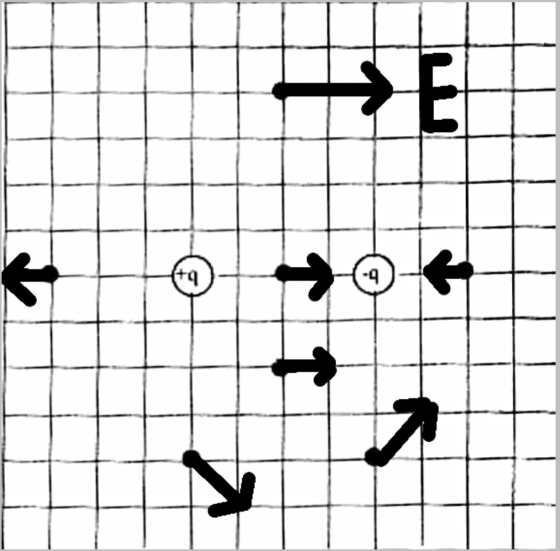
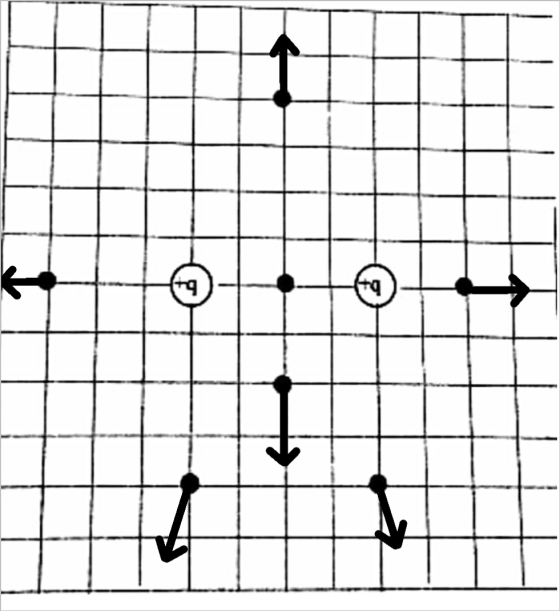
Due to a positive charged, the direction of electric field points away from the charge and due to a negative charge, the direction of the electric field points towards the charge hence the net electric field due to these two charges are as follows-
Add Answer to:
Electrical Charge Distribution - 9 (a) Suppose a metal plate was charged positively. What would the...
Suppose you place a charge q near a large metal plate. If q is attracted to...
 Suppose you place a charge q near a large metal plate. If q is attracted to the plate, is the plate necessarily charged? Yes, since only unlike charges can attract each other Yes, since only like charges can attract each other No, since a polarization charge could be induced in the plate No, since q can be attracted to an uncharged metal plate Question 8 (12.5 points) What would the electric field look like in a system with two parallel...
There is an infinitely large positively charged metal plate. On the right of the plate, two...
There is an infinitely large positively charged metal plate. On the right of the plate, two point-charges Q1 = -6.7 μC and Q2 = 1.8 μC are placed. The line connecting Q1 and Q2 is perpendicular to the charged plate. The distance between the plate and Q1 is D = 0.20 m, and the distance between Q1 and Q2 is d = 0.34 m. If the charge density in the plate σ is 1.3 μC/m2 , find the electric force...
2. The electric field outside a positively charged metal, but very near the surface, is σ/ε0....
2. The electric field outside a positively charged metal, but very near the surface, is σ/ε0. The electric field outside a single positively charged parallel (as in capacitor) plate is σ/2ε0. How can thinking about the problem of two positively charged parallel plates help to understand this problem?
2. The electric field outside a positively charged metal, but very near the surface, is o/Eo....
 2. The electric field outside a positively charged metal, but very near the surface, is o/Eo. The electric field outside a single positively charged parallel (as in capacitor) plate is 0/2€0. How can thinking about the problem of two positively charged parallel plates help to understand this problem?
just 5-7 Ground your electroscope. Touch a negatively charged rod to the metal plate of the...
 just 5-7
Ground your electroscope. Touch a negatively charged rod to the metal plate of the electroscope. Draw in the schematic how the charges are distributed, and indicate the new deflection of the rotating pointer once it has come to equilibrium + Perform this experiment with the charge remaining from step 3. Recharge your negatively charged object and bring it into close proximity to the metal plate without touching. We are charging by induction in this case. How does the...
just 5-7
Ground your electroscope. Touch a negatively charged rod to the metal plate of the electroscope. Draw in the schematic how the charges are distributed, and indicate the new deflection of the rotating pointer once it has come to equilibrium + Perform this experiment with the charge remaining from step 3. Recharge your negatively charged object and bring it into close proximity to the metal plate without touching. We are charging by induction in this case. How does the...
Electric Fields and Potentials What do you think the electrie field lines look like in the...
 Electric Fields and Potentials What do you think the electrie field lines look like in the region of space between a single positive charge and a single negative ch 6. arge? What do you think the equipotential lines look like in the region of space between a single positive charge and a single negative charge? 7. What is the shape of the electric field if there are two positive charges near each other? 8. 850 0 q What is the...
8) A proton is placed at rest near a positively charged plate. The proton is released...
 8) A proton is placed at rest near a positively charged plate. The proton is released and travels in the positive x direction. The proton reaches a velocity of 85000 m/s at the point when the potential is zero. (mproton = 1.67 x 10⁻²⁷ kg, et = 1.6 x 10⁻¹⁹ C) a) What is the electric potential at the positively charged plate? A X b) The proton then enters a 9 T magnetic field directed into the page. Choose the...
A conducting plate of metal is charged uniformly so the surface charge per unit area, A...
 A conducting plate of metal is charged uniformly so the surface
charge per unit area,
A conducting, plate of metal is charged uniformly so the surface charge per unit area, σ = 6.35 C/m2, (only on the surface!) as in the figure below. Charge on surface of conductor Find the electric field at a distance of 8.26 cm from the plate. N/C.
A conducting plate of metal is charged uniformly so the surface
charge per unit area,
A conducting, plate of metal is charged uniformly so the surface charge per unit area, σ = 6.35 C/m2, (only on the surface!) as in the figure below. Charge on surface of conductor Find the electric field at a distance of 8.26 cm from the plate. N/C.
Suppose we had a large, positively charged plate in an upright (vertical) position and a point...
 Suppose we had a large, positively charged plate in an upright (vertical) position and a point charge with positive charge +Q. In lecture, you saw that a large charged plate gives rise to an electric field which is constant in space: we will call this electric field Eplate. Let us suppose also that we had a s bl with positive charge +q and mass m. The situation is depicted in Figure 1. +q,m +Q Figure 1 The objective of this...
Q4. The figure below shows two negatively charged objects (with the same charge) and one positively...
 Q4. The figure below shows two negatively charged objects (with the same charge) and one positively charged object. What is the direction of the net electric force on the positively charged object? A. Horizontal to the Left B. Horizontal to the Right C. Force is zero D. None of the above
 Suppose you place a charge q near a large metal plate. If q is attracted to the plate, is the plate necessarily charged? Yes, since only unlike charges can attract each other Yes, since only like charges can attract each other No, since a polarization charge could be induced in the plate No, since q can be attracted to an uncharged metal plate Question 8 (12.5 points) What would the electric field look like in a system with two parallel...
 2. The electric field outside a positively charged metal, but very near the surface, is o/Eo. The electric field outside a single positively charged parallel (as in capacitor) plate is 0/2€0. How can thinking about the problem of two positively charged parallel plates help to understand this problem?
 just 5-7
Ground your electroscope. Touch a negatively charged rod to the metal plate of the electroscope. Draw in the schematic how the charges are distributed, and indicate the new deflection of the rotating pointer once it has come to equilibrium + Perform this experiment with the charge remaining from step 3. Recharge your negatively charged object and bring it into close proximity to the metal plate without touching. We are charging by induction in this case. How does the...
just 5-7
Ground your electroscope. Touch a negatively charged rod to the metal plate of the electroscope. Draw in the schematic how the charges are distributed, and indicate the new deflection of the rotating pointer once it has come to equilibrium + Perform this experiment with the charge remaining from step 3. Recharge your negatively charged object and bring it into close proximity to the metal plate without touching. We are charging by induction in this case. How does the...
 Electric Fields and Potentials What do you think the electrie field lines look like in the region of space between a single positive charge and a single negative ch 6. arge? What do you think the equipotential lines look like in the region of space between a single positive charge and a single negative charge? 7. What is the shape of the electric field if there are two positive charges near each other? 8. 850 0 q What is the...
 8) A proton is placed at rest near a positively charged plate. The proton is released and travels in the positive x direction. The proton reaches a velocity of 85000 m/s at the point when the potential is zero. (mproton = 1.67 x 10⁻²⁷ kg, et = 1.6 x 10⁻¹⁹ C) a) What is the electric potential at the positively charged plate? A X b) The proton then enters a 9 T magnetic field directed into the page. Choose the...
 A conducting plate of metal is charged uniformly so the surface
charge per unit area,
A conducting, plate of metal is charged uniformly so the surface charge per unit area, σ = 6.35 C/m2, (only on the surface!) as in the figure below. Charge on surface of conductor Find the electric field at a distance of 8.26 cm from the plate. N/C.
A conducting plate of metal is charged uniformly so the surface
charge per unit area,
A conducting, plate of metal is charged uniformly so the surface charge per unit area, σ = 6.35 C/m2, (only on the surface!) as in the figure below. Charge on surface of conductor Find the electric field at a distance of 8.26 cm from the plate. N/C.
 Suppose we had a large, positively charged plate in an upright (vertical) position and a point charge with positive charge +Q. In lecture, you saw that a large charged plate gives rise to an electric field which is constant in space: we will call this electric field Eplate. Let us suppose also that we had a s bl with positive charge +q and mass m. The situation is depicted in Figure 1. +q,m +Q Figure 1 The objective of this...
 Q4. The figure below shows two negatively charged objects (with the same charge) and one positively charged object. What is the direction of the net electric force on the positively charged object? A. Horizontal to the Left B. Horizontal to the Right C. Force is zero D. None of the above
Most questions answered within 3 hours.
-
Where is the error in this code sequence?
String s1 = "Hello";
String s2 = "ello";...
asked 10 months ago -
Financial data for Joel de Paris, Inc., for last year
follow:
Joel de Paris, Inc.
Balance...
asked 10 months ago -
Consider this reaction:
Al2(SO4)3 (aq)+ BaCl3
(aq) Al2Cl6 (aq)- +
3BaSO4(s) . What is the...
asked 10 months ago -
Suppose that Savneet is considering increasing her
recent random sample from 20 car rentals to 40...
asked 10 months ago -
Trucks arrive at an unloading terminal at an average rate of 120
per hour.
Trucks arrive...
asked 10 months ago -
Why are methanol and ethanol completely soluble in water while
octanol is not very little soluble....
asked 10 months ago -
A facilities manager at a university reads in a research report
that the mean amount of...
asked 10 months ago -
When the CuSO4 is rehydrated by adding water to the anhydrous
compound, is this an endothermic...
asked 10 months ago -
A ray of sunlight is passing from diamond into crown glass; the
angle of incidence is...
asked 10 months ago -
A block of mass 0.249 kg is placed on top of a light, vertical
spring of...
asked 10 months ago -
how do the kidneys compensate in the presences of acidosis
a) trigger hyperventilate
b) reserve acid...
asked 10 months ago -
Question 501 pts
The rental rate of capital to the firm increases. Which of the
following...
asked 10 months ago