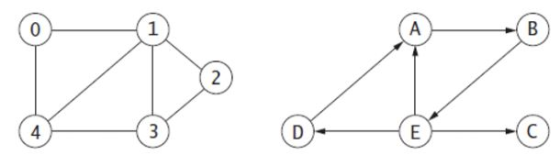
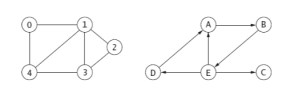
Show the breadth-first trace and then the depth-first trace of these graphs in java.
Homework Answers
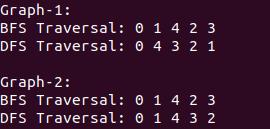
Graph-1:
BFS Traversal: 0 1 4 2 3
DFS Traversal: 0 4 3 2 1
Graph-2:
BFS Traversal: A B E C D
DFS Traversal: A B E D C
Java code for above problem
import java.util.*;
class Main
{
// testing main method
public static void main(String args[])
{
graph_1();
graph_2();
}
// method for graph_1
public static void graph_1()
{
List<List<Integer>>
graph=new ArrayList<List<Integer>>();
for(int i=0;i<5;i++)
{
graph.add(new
ArrayList<Integer>());
}
graph.get(0).add(1);
graph.get(0).add(4);
graph.get(1).add(0);
graph.get(1).add(2);
graph.get(1).add(3);
graph.get(1).add(4);
graph.get(2).add(1);
graph.get(2).add(3);
graph.get(3).add(1);
graph.get(3).add(2);
graph.get(3).add(4);
graph.get(4).add(0);
graph.get(4).add(1);
graph.get(4).add(3);
System.out.println("Graph-1:
");
bfs(graph);
dfs(graph);
System.out.println();
}
// method for graph_2
public static void graph_2()
{
List<List<Integer>>
graph=new ArrayList<List<Integer>>();
for(int i=0;i<5;i++)
{
graph.add(new
ArrayList<Integer>());
}
graph.get(0).add(1);
graph.get(1).add(4);
graph.get(3).add(0);
graph.get(4).add(0);
graph.get(4).add(2);
graph.get(4).add(3);
System.out.println("Graph-2:
");
bfs(graph);
dfs(graph);
System.out.println();
}
// method that prints the bfs traversal of given
graph
public static void bfs(List<List<Integer>>
graph)
{
System.out.print("BFS Traversal:
");
int V=graph.size();
boolean [] visited=new
boolean[V];
Queue<Integer> queue=new
LinkedList<Integer>();
queue.add(0);
visited[0]=true;
while(!queue.isEmpty())
{
Integer
node=queue.poll();
System.out.print(node+" ");
List<Integer> list=graph.get(node);
for(int value:
list)
{
if(!visited[value])
{
visited[value]=true;
queue.add(value);
}
}
}
System.out.println();
}
// method that prints the dfs traversal of given
graph
public static void dfs(List<List<Integer>>
graph)
{
System.out.print("DFS Traversal:
");
int V=graph.size();
boolean [] visited=new
boolean[V];
Stack<Integer> stack=new
Stack<Integer>();
stack.add(0);
visited[0]=true;
while(!stack.isEmpty())
{
Integer
node=stack.pop();
System.out.print(node+" ");
List<Integer> list=graph.get(node);
for(int value:
list)
{
if(!visited[value])
{
visited[value]=true;
stack.add(value);
}
}
}
System.out.println();
}
}
Sample output
Note: Assume 0 as A, 1 as B, 2 as C, 3 as D and 4 as E for graph-2
Mention in comments if any mistakes or errors are found. Thank you.
Add Answer to:
Show the breadth-first trace and then the depth-first trace of
these graphs in java.
0 B....
Implement Depth-First Search (DFS) and Breadth-First Search (BFS) algorithms for a graph in Java....
Implement Depth-First Search (DFS) and Breadth-First Search (BFS) algorithms for a graph in Java.(Can be any graph, just an example of DFS and BFS is sufficient) If it cannot be done for a graph, then just an example of DFS and BFS are enough.
Resource: Ch. 10, "Graphs", of Data Structures: Abstraction and Design Using Java, Exercises for Section 10.4;...
 Resource: Ch. 10, "Graphs", of Data
Structures: Abstraction and Design Using Java, Exercises for
Section 10.4; Self-Check #1
Complete the Self-Check Question #1 within
"Exercises for Sections 10.4" subsection in Section 10.4,
"Traversals of Graphs" of Ch. 10, "Graphs" in Data Structures:
Abstraction and Design Using Java.
Document the breadth-first search trees in the
Self-Check question.
Submit the assignment to the Assignment Files
tab.
4. Show the breadth-first search trees for the following
graphs.
2 1 3 0 4
Resource: Ch. 10, "Graphs", of Data
Structures: Abstraction and Design Using Java, Exercises for
Section 10.4; Self-Check #1
Complete the Self-Check Question #1 within
"Exercises for Sections 10.4" subsection in Section 10.4,
"Traversals of Graphs" of Ch. 10, "Graphs" in Data Structures:
Abstraction and Design Using Java.
Document the breadth-first search trees in the
Self-Check question.
Submit the assignment to the Assignment Files
tab.
4. Show the breadth-first search trees for the following
graphs.
2 1 3 0 4
From the given graph discover the structure of the graph using 1. breadth first search(BFS) a. depth first search(DFS) b. Show the steps and techniques used for each method (20 points) From the...
 From the given graph discover the structure of the graph using 1. breadth first search(BFS) a. depth first search(DFS) b. Show the steps and techniques used for each method (20 points)
From the given graph discover the structure of the graph using 1. breadth first search(BFS) a. depth first search(DFS) b. Show the steps and techniques used for each method (20 points)
From the given graph discover the structure of the graph using 1. breadth first search(BFS) a. depth first search(DFS) b. Show the steps and techniques used for each method (20 points)
Depth-first Search vs Breadth-first Search Please explain the difference!
Depth-first Search vs Breadth-first Search Please explain the difference!
(a) Compute the Breadth-First Search tree for the following graph, using node a as the root....
 (a) Compute the Breadth-First Search tree for the following
graph, using node a as the root. Please use alphabetic order to
make choice when you have multiple choices. You only need to show
the tree without showing the steps. (b) What is the height of the
tree?
Currently I have a tree of depth 3, a as the root, (b,g,h,k) as
depth 1, (c,j) under b (f) under g (e) under k for depth 2, and (d)
under c for...
(a) Compute the Breadth-First Search tree for the following
graph, using node a as the root. Please use alphabetic order to
make choice when you have multiple choices. You only need to show
the tree without showing the steps. (b) What is the height of the
tree?
Currently I have a tree of depth 3, a as the root, (b,g,h,k) as
depth 1, (c,j) under b (f) under g (e) under k for depth 2, and (d)
under c for...
Minimum Spanning Trees Networks & Graphs 1. Create a spanning tree using the breadth-first search algorithm....
 Minimum Spanning Trees Networks & Graphs 1. Create a spanning tree using the breadth-first search algorithm. Start at A (i..0) and label cach vertex with the correct number after A and show your path. How many edges were used to create a spanning tree? 2. Create a spanning tree using the breadth-first search algorithm. Start at G (ie. O) and label each vertex with the correct number after A and show your path How many edges were used to create...
*** NOTE to EXPERT: Please use both breadth and depth-first searching strategy to find a route...
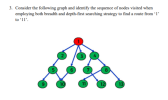 *** NOTE to EXPERT: Please use both breadth and
depth-first searching strategy to find a route from 1-11
***
3. Consider the following graph and identify the sequence of nodes visited when employing both breadth and depth-first searching strategy to find a route from ‘l' to '11'. 3 5 6 8 10 11 12 13
*** NOTE to EXPERT: Please use both breadth and
depth-first searching strategy to find a route from 1-11
***
3. Consider the following graph and identify the sequence of nodes visited when employing both breadth and depth-first searching strategy to find a route from ‘l' to '11'. 3 5 6 8 10 11 12 13
Using Depth-First search for Undirected Graphs, complete the table starting at 0.
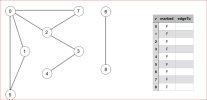 Using Depth-First search for Undirected Graphs, complete the
table starting at 0.
Using Depth-First search for Undirected Graphs, complete the
table starting at 0.
1. Code a breadth First traversal. 2. Code a depth First traversal. Using Python, please include...
1. Code a breadth First traversal. 2. Code a depth First traversal. Using Python, please include test cases.
Hi I need help with a breadth first and depth first search in C++. If you...
Hi I need help with a breadth first and depth first search in C++. If you could please help me with the code for dfs, bfs, and dfsRecursiv functions.
 Resource: Ch. 10, "Graphs", of Data
Structures: Abstraction and Design Using Java, Exercises for
Section 10.4; Self-Check #1
Complete the Self-Check Question #1 within
"Exercises for Sections 10.4" subsection in Section 10.4,
"Traversals of Graphs" of Ch. 10, "Graphs" in Data Structures:
Abstraction and Design Using Java.
Document the breadth-first search trees in the
Self-Check question.
Submit the assignment to the Assignment Files
tab.
4. Show the breadth-first search trees for the following
graphs.
2 1 3 0 4
Resource: Ch. 10, "Graphs", of Data
Structures: Abstraction and Design Using Java, Exercises for
Section 10.4; Self-Check #1
Complete the Self-Check Question #1 within
"Exercises for Sections 10.4" subsection in Section 10.4,
"Traversals of Graphs" of Ch. 10, "Graphs" in Data Structures:
Abstraction and Design Using Java.
Document the breadth-first search trees in the
Self-Check question.
Submit the assignment to the Assignment Files
tab.
4. Show the breadth-first search trees for the following
graphs.
2 1 3 0 4
 From the given graph discover the structure of the graph using 1. breadth first search(BFS) a. depth first search(DFS) b. Show the steps and techniques used for each method (20 points)
From the given graph discover the structure of the graph using 1. breadth first search(BFS) a. depth first search(DFS) b. Show the steps and techniques used for each method (20 points)
From the given graph discover the structure of the graph using 1. breadth first search(BFS) a. depth first search(DFS) b. Show the steps and techniques used for each method (20 points)
 (a) Compute the Breadth-First Search tree for the following
graph, using node a as the root. Please use alphabetic order to
make choice when you have multiple choices. You only need to show
the tree without showing the steps. (b) What is the height of the
tree?
Currently I have a tree of depth 3, a as the root, (b,g,h,k) as
depth 1, (c,j) under b (f) under g (e) under k for depth 2, and (d)
under c for...
(a) Compute the Breadth-First Search tree for the following
graph, using node a as the root. Please use alphabetic order to
make choice when you have multiple choices. You only need to show
the tree without showing the steps. (b) What is the height of the
tree?
Currently I have a tree of depth 3, a as the root, (b,g,h,k) as
depth 1, (c,j) under b (f) under g (e) under k for depth 2, and (d)
under c for...
 Minimum Spanning Trees Networks & Graphs 1. Create a spanning tree using the breadth-first search algorithm. Start at A (i..0) and label cach vertex with the correct number after A and show your path. How many edges were used to create a spanning tree? 2. Create a spanning tree using the breadth-first search algorithm. Start at G (ie. O) and label each vertex with the correct number after A and show your path How many edges were used to create...
 *** NOTE to EXPERT: Please use both breadth and
depth-first searching strategy to find a route from 1-11
***
3. Consider the following graph and identify the sequence of nodes visited when employing both breadth and depth-first searching strategy to find a route from ‘l' to '11'. 3 5 6 8 10 11 12 13
*** NOTE to EXPERT: Please use both breadth and
depth-first searching strategy to find a route from 1-11
***
3. Consider the following graph and identify the sequence of nodes visited when employing both breadth and depth-first searching strategy to find a route from ‘l' to '11'. 3 5 6 8 10 11 12 13
 Using Depth-First search for Undirected Graphs, complete the
table starting at 0.
Using Depth-First search for Undirected Graphs, complete the
table starting at 0.
Most questions answered within 3 hours.
-
Where is the error in this code sequence?
String s1 = "Hello";
String s2 = "ello";...
asked 10 months ago -
Financial data for Joel de Paris, Inc., for last year
follow:
Joel de Paris, Inc.
Balance...
asked 10 months ago -
Consider this reaction:
Al2(SO4)3 (aq)+ BaCl3
(aq) Al2Cl6 (aq)- +
3BaSO4(s) . What is the...
asked 10 months ago -
Suppose that Savneet is considering increasing her
recent random sample from 20 car rentals to 40...
asked 10 months ago -
Trucks arrive at an unloading terminal at an average rate of 120
per hour.
Trucks arrive...
asked 10 months ago -
Why are methanol and ethanol completely soluble in water while
octanol is not very little soluble....
asked 10 months ago -
A facilities manager at a university reads in a research report
that the mean amount of...
asked 10 months ago -
When the CuSO4 is rehydrated by adding water to the anhydrous
compound, is this an endothermic...
asked 10 months ago -
A ray of sunlight is passing from diamond into crown glass; the
angle of incidence is...
asked 10 months ago -
A block of mass 0.249 kg is placed on top of a light, vertical
spring of...
asked 10 months ago -
how do the kidneys compensate in the presences of acidosis
a) trigger hyperventilate
b) reserve acid...
asked 10 months ago -
Question 501 pts
The rental rate of capital to the firm increases. Which of the
following...
asked 10 months ago