
 PLEASE GIVE
ANNOTATIONS EXPLAINING THE CONCEPTS BEHIND EACH STEP.
PLEASE GIVE
ANNOTATIONS EXPLAINING THE CONCEPTS BEHIND EACH STEP.Homework Answers
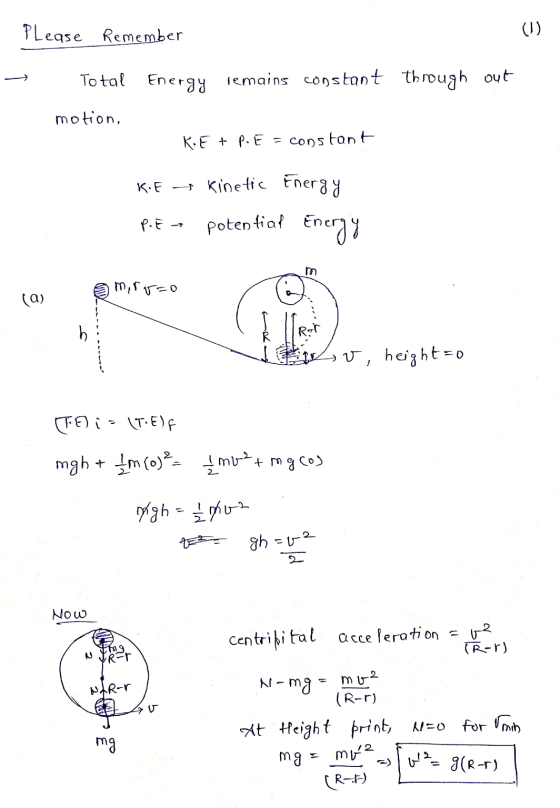
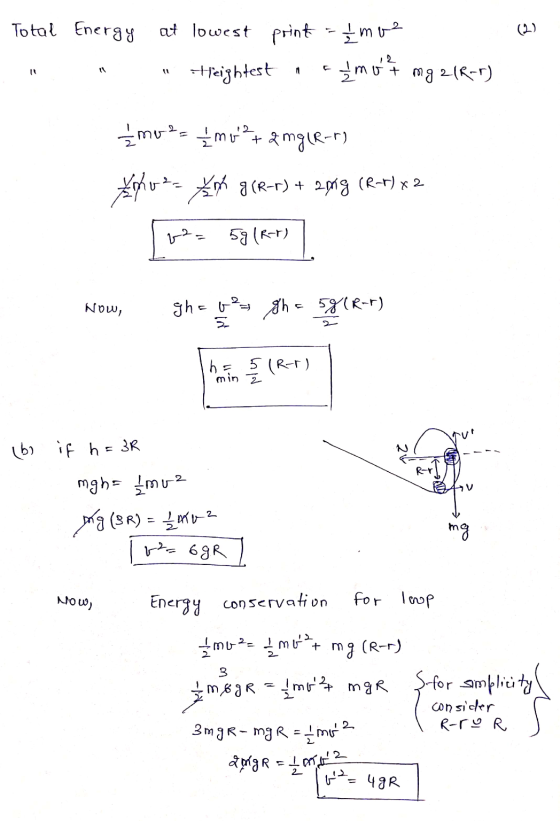
![imig u = mx 4g R N = mx HQ R = 4mg = 4mg Nek force Net For Net Force = Jimgjet (ings 2 = mgJ1+16 If net = JF mg]](http://img.homeworklib.com/questions/94889100-f950-11eb-845b-13fe789743e1.png?x-oss-process=image/resize,w_560)
Add Answer to:
PLEASE GIVE
ANNOTATIONS EXPLAINING THE CONCEPTS BEHIND EACH STEP.
7. (100 points) In Figure 1, we...
A roller-coaster car shown in the figure on the right is released from rest from a...
A roller-coaster car shown in the figure on the right is released from rest from a height h and then moves freely with negligible friction. The roller-coaster track includes a circular loop of radius R in a vertical plane. a. First suppose the car barely makes it around the loop; at the top of the loop, the riders are upside down and feel weightless. Find the required height h of the release point above the bottom of the loop in...
I need a step by step on 1 and 2 so I can teach myself. 1....
 I need a step by step on 1 and 2 so I can teach myself.
1. A solid, uniform sphere with a mass of 2.0 kg is rolling from rest down an incline plane from the top of the plane. The incline plane makes an angle of 20° with the horizontal and has a height of 2.0 m. At the bottom of the incline plane, the surface levels out to a frictionless horizontal surface. A spring with a spring constant...
I need a step by step on 1 and 2 so I can teach myself.
1. A solid, uniform sphere with a mass of 2.0 kg is rolling from rest down an incline plane from the top of the plane. The incline plane makes an angle of 20° with the horizontal and has a height of 2.0 m. At the bottom of the incline plane, the surface levels out to a frictionless horizontal surface. A spring with a spring constant...
AP Physics C FRQ 3. A sphere of mass m and radius r is released from...
 AP Physics C FRQ
3. A sphere of mass m and radius r is released from rest at the top of a curved track of height H. The sphere travels down the curved track and around a loop of radius R. The sphere rolls without slipping during the entire motion. Point A on the loop is at height R, and point B is at the top of the loop. The rotational inertia of the sphere is 2mr2/s. Express all of...
AP Physics C FRQ
3. A sphere of mass m and radius r is released from rest at the top of a curved track of height H. The sphere travels down the curved track and around a loop of radius R. The sphere rolls without slipping during the entire motion. Point A on the loop is at height R, and point B is at the top of the loop. The rotational inertia of the sphere is 2mr2/s. Express all of...
I just need help with part c) please/thank you A solid brass ball of mass 20.9 g and radius 8.37 ...
I just need help with part c) please/thank you A solid brass ball of mass 20.9 g and radius 8.37 mm rolls smoothly along a loop-the-loop track when released from rest from a tall ramp leading to the loop-the-loop. The circular loop has a 12 cm radius. (a) What is the minimum height from which you can release the ball so that it will go around the loop-the-loop without falling off? 32.4 cm Correct: Your answer is correct. For part...
Can you please work each part of this question and show complete work? Trying to understand...
 Can you please work each part of this question and show complete
work? Trying to understand each step and all concepts for exam.
4. Seefigures below. A mass m = 15 kg is released from rest at the top of a frictionless inclined plane a height h above a frictionless horizontal surface (left figure). It slides down the incline onto the surface, where it has a velocity v = 7 m/s (middle figure) The incline angle is 25° with respect...
Can you please work each part of this question and show complete
work? Trying to understand each step and all concepts for exam.
4. Seefigures below. A mass m = 15 kg is released from rest at the top of a frictionless inclined plane a height h above a frictionless horizontal surface (left figure). It slides down the incline onto the surface, where it has a velocity v = 7 m/s (middle figure) The incline angle is 25° with respect...
1a. 1b. 1c. Block A slides down the incline In the figure, two blocks are connected...
 1a.
1b.
1c.
Block A slides down the incline In the figure, two blocks are connected over a pulley. The mass of block A is me and the coeffcient of kinetic friction between A and the incline is in Angle of the incline is 6 at constant speed. What is the mass of block B? Express your answer in terms of the variables given. Frictionless, massless pulley B In the figure, a small block of mass m = 0.021 kg...
1a.
1b.
1c.
Block A slides down the incline In the figure, two blocks are connected over a pulley. The mass of block A is me and the coeffcient of kinetic friction between A and the incline is in Angle of the incline is 6 at constant speed. What is the mass of block B? Express your answer in terms of the variables given. Frictionless, massless pulley B In the figure, a small block of mass m = 0.021 kg...
I don't understand how to find 6b and all of 7. 6. A hollow sphere with...
 I don't understand how to find 6b and all of 7.
6. A hollow sphere with mass = 0.65 kg and radius = 0.13 m is initially at rest on a 20° incline and rolls down the incline without slipping. The initial height of the disk (H) a. At the top of the incline, just before the disk begins to roll, what is the total mechanical energy of the disk? Emech=PEtop=6.37) b. Determine the velocity of the disk at H=...
I don't understand how to find 6b and all of 7.
6. A hollow sphere with mass = 0.65 kg and radius = 0.13 m is initially at rest on a 20° incline and rolls down the incline without slipping. The initial height of the disk (H) a. At the top of the incline, just before the disk begins to roll, what is the total mechanical energy of the disk? Emech=PEtop=6.37) b. Determine the velocity of the disk at H=...
Need help with Q2 ASAP! thanks in advance. Describe briefly the law of conservation of momentum....
 Need help with Q2 ASAP! thanks in advance.
Describe briefly the law of conservation of momentum. In an F vs. r (force vs. position) figure, what does the area under the curve stands for? Problems The "Elysium" is a space station located at an orbit with an altitude 6000 km. It is shaped like a ring and rotates to simulate Earth's gravity. If the radius of the space station is 20 km, what are (a) its rotating (spinning) period (b)...
Need help with Q2 ASAP! thanks in advance.
Describe briefly the law of conservation of momentum. In an F vs. r (force vs. position) figure, what does the area under the curve stands for? Problems The "Elysium" is a space station located at an orbit with an altitude 6000 km. It is shaped like a ring and rotates to simulate Earth's gravity. If the radius of the space station is 20 km, what are (a) its rotating (spinning) period (b)...
Need help with Q1 ASAP! thanks in advance. Describe briefly the law of conservation of momentum....
 Need help with Q1 ASAP! thanks in
advance.
Describe briefly the law of conservation of momentum. In an F vs. r (force vs. position) figure, what does the area under the curve stands for? Problems The "Elysium" is a space station located at an orbit with an altitude 6000 km. It is shaped like a ring and rotates to simulate Earth's gravity. If the radius of the space station is 20 km, what are (a) its rotating (spinning) period (b)...
Need help with Q1 ASAP! thanks in
advance.
Describe briefly the law of conservation of momentum. In an F vs. r (force vs. position) figure, what does the area under the curve stands for? Problems The "Elysium" is a space station located at an orbit with an altitude 6000 km. It is shaped like a ring and rotates to simulate Earth's gravity. If the radius of the space station is 20 km, what are (a) its rotating (spinning) period (b)...
1. John (who is 95 kg) drives his car over an absurdly large half-circle speedbump with...
1. John (who is 95 kg) drives his car over an absurdly large half-circle speedbump with a radius of 5 meters. Given that his normal weight is 930 N and his apparent weight at the top of the speed-bump was 246 N, how fast did he drive over the speed bump? 2. When working in circular motion problems, what do we define as always being the positive direction? 3. When in circular motion, the net force points in what direction?...
 I need a step by step on 1 and 2 so I can teach myself.
1. A solid, uniform sphere with a mass of 2.0 kg is rolling from rest down an incline plane from the top of the plane. The incline plane makes an angle of 20° with the horizontal and has a height of 2.0 m. At the bottom of the incline plane, the surface levels out to a frictionless horizontal surface. A spring with a spring constant...
I need a step by step on 1 and 2 so I can teach myself.
1. A solid, uniform sphere with a mass of 2.0 kg is rolling from rest down an incline plane from the top of the plane. The incline plane makes an angle of 20° with the horizontal and has a height of 2.0 m. At the bottom of the incline plane, the surface levels out to a frictionless horizontal surface. A spring with a spring constant...
 AP Physics C FRQ
3. A sphere of mass m and radius r is released from rest at the top of a curved track of height H. The sphere travels down the curved track and around a loop of radius R. The sphere rolls without slipping during the entire motion. Point A on the loop is at height R, and point B is at the top of the loop. The rotational inertia of the sphere is 2mr2/s. Express all of...
AP Physics C FRQ
3. A sphere of mass m and radius r is released from rest at the top of a curved track of height H. The sphere travels down the curved track and around a loop of radius R. The sphere rolls without slipping during the entire motion. Point A on the loop is at height R, and point B is at the top of the loop. The rotational inertia of the sphere is 2mr2/s. Express all of...
 Can you please work each part of this question and show complete
work? Trying to understand each step and all concepts for exam.
4. Seefigures below. A mass m = 15 kg is released from rest at the top of a frictionless inclined plane a height h above a frictionless horizontal surface (left figure). It slides down the incline onto the surface, where it has a velocity v = 7 m/s (middle figure) The incline angle is 25° with respect...
Can you please work each part of this question and show complete
work? Trying to understand each step and all concepts for exam.
4. Seefigures below. A mass m = 15 kg is released from rest at the top of a frictionless inclined plane a height h above a frictionless horizontal surface (left figure). It slides down the incline onto the surface, where it has a velocity v = 7 m/s (middle figure) The incline angle is 25° with respect...
 1a.
1b.
1c.
Block A slides down the incline In the figure, two blocks are connected over a pulley. The mass of block A is me and the coeffcient of kinetic friction between A and the incline is in Angle of the incline is 6 at constant speed. What is the mass of block B? Express your answer in terms of the variables given. Frictionless, massless pulley B In the figure, a small block of mass m = 0.021 kg...
1a.
1b.
1c.
Block A slides down the incline In the figure, two blocks are connected over a pulley. The mass of block A is me and the coeffcient of kinetic friction between A and the incline is in Angle of the incline is 6 at constant speed. What is the mass of block B? Express your answer in terms of the variables given. Frictionless, massless pulley B In the figure, a small block of mass m = 0.021 kg...
 I don't understand how to find 6b and all of 7.
6. A hollow sphere with mass = 0.65 kg and radius = 0.13 m is initially at rest on a 20° incline and rolls down the incline without slipping. The initial height of the disk (H) a. At the top of the incline, just before the disk begins to roll, what is the total mechanical energy of the disk? Emech=PEtop=6.37) b. Determine the velocity of the disk at H=...
I don't understand how to find 6b and all of 7.
6. A hollow sphere with mass = 0.65 kg and radius = 0.13 m is initially at rest on a 20° incline and rolls down the incline without slipping. The initial height of the disk (H) a. At the top of the incline, just before the disk begins to roll, what is the total mechanical energy of the disk? Emech=PEtop=6.37) b. Determine the velocity of the disk at H=...
 Need help with Q2 ASAP! thanks in advance.
Describe briefly the law of conservation of momentum. In an F vs. r (force vs. position) figure, what does the area under the curve stands for? Problems The "Elysium" is a space station located at an orbit with an altitude 6000 km. It is shaped like a ring and rotates to simulate Earth's gravity. If the radius of the space station is 20 km, what are (a) its rotating (spinning) period (b)...
Need help with Q2 ASAP! thanks in advance.
Describe briefly the law of conservation of momentum. In an F vs. r (force vs. position) figure, what does the area under the curve stands for? Problems The "Elysium" is a space station located at an orbit with an altitude 6000 km. It is shaped like a ring and rotates to simulate Earth's gravity. If the radius of the space station is 20 km, what are (a) its rotating (spinning) period (b)...
 Need help with Q1 ASAP! thanks in
advance.
Describe briefly the law of conservation of momentum. In an F vs. r (force vs. position) figure, what does the area under the curve stands for? Problems The "Elysium" is a space station located at an orbit with an altitude 6000 km. It is shaped like a ring and rotates to simulate Earth's gravity. If the radius of the space station is 20 km, what are (a) its rotating (spinning) period (b)...
Need help with Q1 ASAP! thanks in
advance.
Describe briefly the law of conservation of momentum. In an F vs. r (force vs. position) figure, what does the area under the curve stands for? Problems The "Elysium" is a space station located at an orbit with an altitude 6000 km. It is shaped like a ring and rotates to simulate Earth's gravity. If the radius of the space station is 20 km, what are (a) its rotating (spinning) period (b)...
Most questions answered within 3 hours.
-
Where is the error in this code sequence?
String s1 = "Hello";
String s2 = "ello";...
asked 10 months ago -
Financial data for Joel de Paris, Inc., for last year
follow:
Joel de Paris, Inc.
Balance...
asked 10 months ago -
Consider this reaction:
Al2(SO4)3 (aq)+ BaCl3
(aq) Al2Cl6 (aq)- +
3BaSO4(s) . What is the...
asked 10 months ago -
Suppose that Savneet is considering increasing her
recent random sample from 20 car rentals to 40...
asked 10 months ago -
Trucks arrive at an unloading terminal at an average rate of 120
per hour.
Trucks arrive...
asked 10 months ago -
Why are methanol and ethanol completely soluble in water while
octanol is not very little soluble....
asked 10 months ago -
A facilities manager at a university reads in a research report
that the mean amount of...
asked 10 months ago -
When the CuSO4 is rehydrated by adding water to the anhydrous
compound, is this an endothermic...
asked 10 months ago -
A ray of sunlight is passing from diamond into crown glass; the
angle of incidence is...
asked 10 months ago -
A block of mass 0.249 kg is placed on top of a light, vertical
spring of...
asked 10 months ago -
how do the kidneys compensate in the presences of acidosis
a) trigger hyperventilate
b) reserve acid...
asked 10 months ago -
Question 501 pts
The rental rate of capital to the firm increases. Which of the
following...
asked 10 months ago