You are preparing the breakfast table with coffee and a plate of toast. While setting the...
You are preparing the breakfast table with coffee and a plate of
toast. While setting the plate down, you accidently tilt it
slightly so that the toast slides off and falls to the floor. It
always seems to land jelly-side down. Newton's laws and the laws of
rotational dynamics are partly to blame. The toast leaves the plate
with a small rotational velocity and continues to rotate as it
falls. From the height of a typical table, this small rotation
almost always causes the toast to make a one-half rotation and land
jelly-side down. If it started at a higher initial position, like
your elbow when standing, it might have a greater number of
rotations and land jelly-side up; but if slightly tilted when
landing it might bounce and flip over with jelly-side down. If it
first lands jelly-side down, it does not bounce but remains stuck
to the floor. Another interesting observation is that the toast
lands jelly-side down only if it slides slowly off the plate. If it
is shoved from the table with high velocity, it can land either
way.
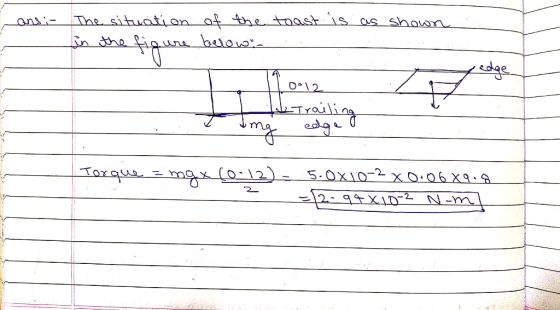
The length of the toast is about 0.12 m and the mass is about
5.0×10⁻² kg . Determine the torque about the trailing
edge of the toast due to the force that Earth exerts on the toast
when its trailing edge is just barely on the plate and the rest is
off the plate.
Homework Answers
Add Answer to:
You are preparing the breakfast table with coffee and a plate of
toast. While setting the...
Most questions answered within 3 hours.
-
Where is the error in this code sequence?
String s1 = "Hello";
String s2 = "ello";...
asked 10 months ago -
Financial data for Joel de Paris, Inc., for last year
follow:
Joel de Paris, Inc.
Balance...
asked 10 months ago -
Consider this reaction:
Al2(SO4)3 (aq)+ BaCl3
(aq) Al2Cl6 (aq)- +
3BaSO4(s) . What is the...
asked 10 months ago -
Suppose that Savneet is considering increasing her
recent random sample from 20 car rentals to 40...
asked 10 months ago -
Trucks arrive at an unloading terminal at an average rate of 120
per hour.
Trucks arrive...
asked 10 months ago -
Why are methanol and ethanol completely soluble in water while
octanol is not very little soluble....
asked 10 months ago -
A facilities manager at a university reads in a research report
that the mean amount of...
asked 10 months ago -
When the CuSO4 is rehydrated by adding water to the anhydrous
compound, is this an endothermic...
asked 10 months ago -
A ray of sunlight is passing from diamond into crown glass; the
angle of incidence is...
asked 10 months ago -
A block of mass 0.249 kg is placed on top of a light, vertical
spring of...
asked 10 months ago -
how do the kidneys compensate in the presences of acidosis
a) trigger hyperventilate
b) reserve acid...
asked 10 months ago -
Question 501 pts
The rental rate of capital to the firm increases. Which of the
following...
asked 10 months ago