
Homework Answers
Add Answer to:
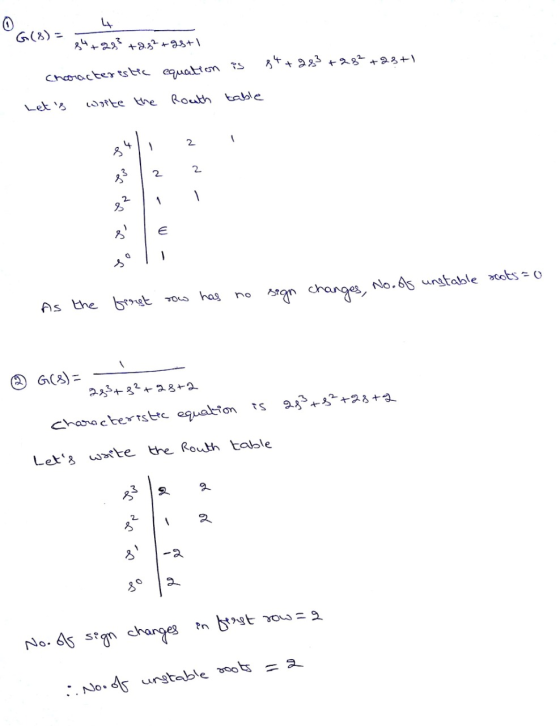
Problem 2 (50 points): Apply Routh's criterion to assess the number of unstable poles on the...
Problem #6: Applying Routh's Criterion, assume you have a gain K that you can tune for...
 Problem #6: Applying Routh's Criterion, assume you have a gain K that you can tune for your system that gives the following characteristic polynomial 1+G(s) = 55+ 5s4 + 1053 + 10s2 + 5s +K a) Find the range of K that makes the system stable? b) Can use MATLAB to plot the roots onto a pole-zero map for several values of the ranges you determined in a), to show the system is in fact stable? Problem #7: Applying Routh's...
solve completely Routh Stability Criterion, Steady State Tracking Performance, Feedforward Control, Simulation of DC Motors Problem...
 solve completely
Routh Stability Criterion, Steady State Tracking Performance, Feedforward Control, Simulation of DC Motors Problem 1: Consider the following control system: RIS) Y G() cs) Con traller Process The process transfer function is G(s) = Y(s) _ s* +3s' +30s2 + 30s + 200 s+6s s6s +200 U(s) 1.1. Are there any zeros of G(s) in RHP? How many? Use Routh table 1.2. Are there any poles of G(s) in RHP? How many? Use Routh table. Is G(s) stable?...
solve completely
Routh Stability Criterion, Steady State Tracking Performance, Feedforward Control, Simulation of DC Motors Problem 1: Consider the following control system: RIS) Y G() cs) Con traller Process The process transfer function is G(s) = Y(s) _ s* +3s' +30s2 + 30s + 200 s+6s s6s +200 U(s) 1.1. Are there any zeros of G(s) in RHP? How many? Use Routh table 1.2. Are there any poles of G(s) in RHP? How many? Use Routh table. Is G(s) stable?...
A2. (a) Explain how the open-loop polar plot can be used to assess closed-loop stability by...
 A2. (a) Explain how the open-loop polar plot can be used to assess closed-loop stability by applying Nyquist's stability criterion. Apply Nyquist's stability criterion to determine the stability condition for a closed-loop system that is unstable in the open-loop. [30%] = K (b) An unstable system has transfer function given by G(S) in which the gain K is S(S-2) positive. A derivative compensator H(s) = 0.5s + 1 is inserted in the negative feedback path to form a control loop....
Please sketch the Root Loci of the system below and show intermediate steps. Thanks! Problem 2....
 Please sketch the Root Loci of the system below and show
intermediate steps. Thanks!
Problem 2. [5 points] Utilizing the Routh's stability criterion, determine the range of K for stability for the given characteristic equation s+2s3 (4+K)s2 +9s25 0, and verify the analysis by selecting K values for stable and unstable regions, respectively, and by observing time responses with Simulink simulations. Note that the associated open-loop transfer function can be derived such that s +2s3 +4s+925+Ks2-0+K G() 0 where G(5...
Please sketch the Root Loci of the system below and show
intermediate steps. Thanks!
Problem 2. [5 points] Utilizing the Routh's stability criterion, determine the range of K for stability for the given characteristic equation s+2s3 (4+K)s2 +9s25 0, and verify the analysis by selecting K values for stable and unstable regions, respectively, and by observing time responses with Simulink simulations. Note that the associated open-loop transfer function can be derived such that s +2s3 +4s+925+Ks2-0+K G() 0 where G(5...
QUESTION 2: Again, for the feedback control system from Question 1, Let G(S) 3 +27 s2 +218 s+504 ...
 QUESTION 2: Again, for the feedback control system from Question 1, Let G(S) 3 +27 s2 +218 s+504 s2 +6s+34 Part a) What are the poles and zeroes of G(s)? Part b) Plot the root-locus using RLOCUS.M - Refer to the MATLAB notes in the back of this handout. - Be sure to indicate the direction of "increasing K" on each branch Part c) Comment on this root-locus plot How it pertains to poles and zeros of G(s), etc. Are...
Exercise 1 (Transfer Function Analysis) MATLAB provides numerous commands for working with polyno...
 Please do part C only, thank you.
Exercise 1 (Transfer Function Analysis) MATLAB provides numerous commands for working with polynomials, ratios of polynomials, partial fraction expansions and transfer functions: see, for example, the commands roots, poly, conv, residue, zpk and tf (a) Use MATLAB to gener ate the continuous-time transfer function H5+15)( +26(s+72) s(s +56)2(s2 +5s +30) H(s) displaying the result in two forms: as (i) the given ratio of factors and (ii) a ratio of two polynomials. (b) Use...
Please do part C only, thank you.
Exercise 1 (Transfer Function Analysis) MATLAB provides numerous commands for working with polynomials, ratios of polynomials, partial fraction expansions and transfer functions: see, for example, the commands roots, poly, conv, residue, zpk and tf (a) Use MATLAB to gener ate the continuous-time transfer function H5+15)( +26(s+72) s(s +56)2(s2 +5s +30) H(s) displaying the result in two forms: as (i) the given ratio of factors and (ii) a ratio of two polynomials. (b) Use...
2. Given a unity feedback system with open-loop transfer function s+40s-I) a) For K-1, derive the...
 2. Given a unity feedback system with open-loop transfer function s+40s-I) a) For K-1, derive the expressions for the real and imaginary parts of G(jo). b) What happen to the real and imaginary parts of G(jo) for ω 0 and for Are there values of ω that either the real or imaginary part goes to zero? If not, compute Gijo) for some ovalue, say,, or 2, to help you sketch the Polar plot of Gja). c) d) Use Matlab to...
PROBLEM 1 Consider the transfer function T(S) =s5 +2s4 + 2s3 + 4s2 + s + 2 a) Using the Routh-Hurwitz method, determine whether the system is stable. If it is not stable, how many poles are in the...
 PROBLEM 1 Consider the transfer function T(S) =s5 +2s4 + 2s3 + 4s2 + s + 2 a) Using the Routh-Hurwitz method, determine whether the system is stable. If it is not stable, how many poles are in the right-half plane? b) Using MATLAB, compute the poles of T(s) and verify the result in part a) c) Plot the unit step response and discuss the results. (Report should include: Code, Figure 1.Unit step response, answers and conclusion)
PROBLEM 1 Consider...
PROBLEM 1 Consider the transfer function T(S) =s5 +2s4 + 2s3 + 4s2 + s + 2 a) Using the Routh-Hurwitz method, determine whether the system is stable. If it is not stable, how many poles are in the right-half plane? b) Using MATLAB, compute the poles of T(s) and verify the result in part a) c) Plot the unit step response and discuss the results. (Report should include: Code, Figure 1.Unit step response, answers and conclusion)
PROBLEM 1 Consider...
Plot the root locus for the following systems where the given transfer function is located in...
 Plot the root locus for the following systems where the given transfer function is located in a unit negative feedback system, i.e., the characteristic equation is 1+KG(s)-0. Where applic- able, the plot should indicate the large gain asymptotes, the angle of departure from complex poles, the angle of arrival at complex zeros, and breakaway points. Verify your answer using MAT- LAB (rlocus" command) and show the results obtained from MATLAB. (s +4) a) Ge)(s+2(s+1+ j4)s+1-4) b) G(s)= s(s+2(s2 2s +2)...
please solve problems 1 and problems 2. PROBLEM 1: Derive state-space equations for the following circuit in the form of L1 where χ = :L2 L3 L1 and (a) y 7 V L3 R1 L1 L3 R3 Vt R2 Vc し2 (c) For Part (...
 please solve problems 1 and
problems 2.
PROBLEM 1: Derive state-space equations for the following circuit in the form of L1 where χ = :L2 L3 L1 and (a) y 7 V L3 R1 L1 L3 R3 Vt R2 Vc し2 (c) For Part (a), use the file CircuitStateSpace.slx (define the four matrices in Matlab) to verify your derivation using the following numerical values: R1-1; R3-1 R2-10; L1-1e-3 L3-1e-3 L2-10e-2 ; C1-10e-6 PROBLEM 2: (a) What are eigenvalues of the...
please solve problems 1 and
problems 2.
PROBLEM 1: Derive state-space equations for the following circuit in the form of L1 where χ = :L2 L3 L1 and (a) y 7 V L3 R1 L1 L3 R3 Vt R2 Vc し2 (c) For Part (a), use the file CircuitStateSpace.slx (define the four matrices in Matlab) to verify your derivation using the following numerical values: R1-1; R3-1 R2-10; L1-1e-3 L3-1e-3 L2-10e-2 ; C1-10e-6 PROBLEM 2: (a) What are eigenvalues of the...
 Problem #6: Applying Routh's Criterion, assume you have a gain K that you can tune for your system that gives the following characteristic polynomial 1+G(s) = 55+ 5s4 + 1053 + 10s2 + 5s +K a) Find the range of K that makes the system stable? b) Can use MATLAB to plot the roots onto a pole-zero map for several values of the ranges you determined in a), to show the system is in fact stable? Problem #7: Applying Routh's...
 solve completely
Routh Stability Criterion, Steady State Tracking Performance, Feedforward Control, Simulation of DC Motors Problem 1: Consider the following control system: RIS) Y G() cs) Con traller Process The process transfer function is G(s) = Y(s) _ s* +3s' +30s2 + 30s + 200 s+6s s6s +200 U(s) 1.1. Are there any zeros of G(s) in RHP? How many? Use Routh table 1.2. Are there any poles of G(s) in RHP? How many? Use Routh table. Is G(s) stable?...
solve completely
Routh Stability Criterion, Steady State Tracking Performance, Feedforward Control, Simulation of DC Motors Problem 1: Consider the following control system: RIS) Y G() cs) Con traller Process The process transfer function is G(s) = Y(s) _ s* +3s' +30s2 + 30s + 200 s+6s s6s +200 U(s) 1.1. Are there any zeros of G(s) in RHP? How many? Use Routh table 1.2. Are there any poles of G(s) in RHP? How many? Use Routh table. Is G(s) stable?...
 A2. (a) Explain how the open-loop polar plot can be used to assess closed-loop stability by applying Nyquist's stability criterion. Apply Nyquist's stability criterion to determine the stability condition for a closed-loop system that is unstable in the open-loop. [30%] = K (b) An unstable system has transfer function given by G(S) in which the gain K is S(S-2) positive. A derivative compensator H(s) = 0.5s + 1 is inserted in the negative feedback path to form a control loop....
 Please sketch the Root Loci of the system below and show
intermediate steps. Thanks!
Problem 2. [5 points] Utilizing the Routh's stability criterion, determine the range of K for stability for the given characteristic equation s+2s3 (4+K)s2 +9s25 0, and verify the analysis by selecting K values for stable and unstable regions, respectively, and by observing time responses with Simulink simulations. Note that the associated open-loop transfer function can be derived such that s +2s3 +4s+925+Ks2-0+K G() 0 where G(5...
Please sketch the Root Loci of the system below and show
intermediate steps. Thanks!
Problem 2. [5 points] Utilizing the Routh's stability criterion, determine the range of K for stability for the given characteristic equation s+2s3 (4+K)s2 +9s25 0, and verify the analysis by selecting K values for stable and unstable regions, respectively, and by observing time responses with Simulink simulations. Note that the associated open-loop transfer function can be derived such that s +2s3 +4s+925+Ks2-0+K G() 0 where G(5...
 QUESTION 2: Again, for the feedback control system from Question 1, Let G(S) 3 +27 s2 +218 s+504 s2 +6s+34 Part a) What are the poles and zeroes of G(s)? Part b) Plot the root-locus using RLOCUS.M - Refer to the MATLAB notes in the back of this handout. - Be sure to indicate the direction of "increasing K" on each branch Part c) Comment on this root-locus plot How it pertains to poles and zeros of G(s), etc. Are...
 Please do part C only, thank you.
Exercise 1 (Transfer Function Analysis) MATLAB provides numerous commands for working with polynomials, ratios of polynomials, partial fraction expansions and transfer functions: see, for example, the commands roots, poly, conv, residue, zpk and tf (a) Use MATLAB to gener ate the continuous-time transfer function H5+15)( +26(s+72) s(s +56)2(s2 +5s +30) H(s) displaying the result in two forms: as (i) the given ratio of factors and (ii) a ratio of two polynomials. (b) Use...
Please do part C only, thank you.
Exercise 1 (Transfer Function Analysis) MATLAB provides numerous commands for working with polynomials, ratios of polynomials, partial fraction expansions and transfer functions: see, for example, the commands roots, poly, conv, residue, zpk and tf (a) Use MATLAB to gener ate the continuous-time transfer function H5+15)( +26(s+72) s(s +56)2(s2 +5s +30) H(s) displaying the result in two forms: as (i) the given ratio of factors and (ii) a ratio of two polynomials. (b) Use...
 2. Given a unity feedback system with open-loop transfer function s+40s-I) a) For K-1, derive the expressions for the real and imaginary parts of G(jo). b) What happen to the real and imaginary parts of G(jo) for ω 0 and for Are there values of ω that either the real or imaginary part goes to zero? If not, compute Gijo) for some ovalue, say,, or 2, to help you sketch the Polar plot of Gja). c) d) Use Matlab to...
 PROBLEM 1 Consider the transfer function T(S) =s5 +2s4 + 2s3 + 4s2 + s + 2 a) Using the Routh-Hurwitz method, determine whether the system is stable. If it is not stable, how many poles are in the right-half plane? b) Using MATLAB, compute the poles of T(s) and verify the result in part a) c) Plot the unit step response and discuss the results. (Report should include: Code, Figure 1.Unit step response, answers and conclusion)
PROBLEM 1 Consider...
PROBLEM 1 Consider the transfer function T(S) =s5 +2s4 + 2s3 + 4s2 + s + 2 a) Using the Routh-Hurwitz method, determine whether the system is stable. If it is not stable, how many poles are in the right-half plane? b) Using MATLAB, compute the poles of T(s) and verify the result in part a) c) Plot the unit step response and discuss the results. (Report should include: Code, Figure 1.Unit step response, answers and conclusion)
PROBLEM 1 Consider...
 Plot the root locus for the following systems where the given transfer function is located in a unit negative feedback system, i.e., the characteristic equation is 1+KG(s)-0. Where applic- able, the plot should indicate the large gain asymptotes, the angle of departure from complex poles, the angle of arrival at complex zeros, and breakaway points. Verify your answer using MAT- LAB (rlocus" command) and show the results obtained from MATLAB. (s +4) a) Ge)(s+2(s+1+ j4)s+1-4) b) G(s)= s(s+2(s2 2s +2)...
 please solve problems 1 and
problems 2.
PROBLEM 1: Derive state-space equations for the following circuit in the form of L1 where χ = :L2 L3 L1 and (a) y 7 V L3 R1 L1 L3 R3 Vt R2 Vc し2 (c) For Part (a), use the file CircuitStateSpace.slx (define the four matrices in Matlab) to verify your derivation using the following numerical values: R1-1; R3-1 R2-10; L1-1e-3 L3-1e-3 L2-10e-2 ; C1-10e-6 PROBLEM 2: (a) What are eigenvalues of the...
please solve problems 1 and
problems 2.
PROBLEM 1: Derive state-space equations for the following circuit in the form of L1 where χ = :L2 L3 L1 and (a) y 7 V L3 R1 L1 L3 R3 Vt R2 Vc し2 (c) For Part (a), use the file CircuitStateSpace.slx (define the four matrices in Matlab) to verify your derivation using the following numerical values: R1-1; R3-1 R2-10; L1-1e-3 L3-1e-3 L2-10e-2 ; C1-10e-6 PROBLEM 2: (a) What are eigenvalues of the...
Most questions answered within 3 hours.
-
Where is the error in this code sequence?
String s1 = "Hello";
String s2 = "ello";...
asked 10 months ago -
Financial data for Joel de Paris, Inc., for last year
follow:
Joel de Paris, Inc.
Balance...
asked 10 months ago -
Consider this reaction:
Al2(SO4)3 (aq)+ BaCl3
(aq) Al2Cl6 (aq)- +
3BaSO4(s) . What is the...
asked 10 months ago -
Suppose that Savneet is considering increasing her
recent random sample from 20 car rentals to 40...
asked 10 months ago -
Trucks arrive at an unloading terminal at an average rate of 120
per hour.
Trucks arrive...
asked 10 months ago -
Why are methanol and ethanol completely soluble in water while
octanol is not very little soluble....
asked 10 months ago -
A facilities manager at a university reads in a research report
that the mean amount of...
asked 10 months ago -
When the CuSO4 is rehydrated by adding water to the anhydrous
compound, is this an endothermic...
asked 10 months ago -
A ray of sunlight is passing from diamond into crown glass; the
angle of incidence is...
asked 10 months ago -
A block of mass 0.249 kg is placed on top of a light, vertical
spring of...
asked 10 months ago -
how do the kidneys compensate in the presences of acidosis
a) trigger hyperventilate
b) reserve acid...
asked 10 months ago -
Question 501 pts
The rental rate of capital to the firm increases. Which of the
following...
asked 10 months ago