What are the equations for motion regarding distance, velocity, acceleration. Also, please mention that the equations...
Homework Answers
From equation of motion
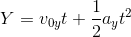
distane 
from equation of motion
v = u + at
velocity v = g t
incase of acceleration
a = g
Add Answer to:
What are the equations for motion regarding distance, velocity,
acceleration. Also, please mention that the equations...
with reason please. Velocity and Acceleration Vectors An object is moving with an initial velocity along...
 with reason please.
Velocity and Acceleration Vectors An object is moving with an initial velocity along the x-axis and a constant acceleration in the second quadrant of the x-y plane as shown. Which one of the following statements about the subsequent motion of the object is true? (a) The velocity of the object never changes magnitude. (b) The velocity of the object never changes direction. (c) The direction of the velocity of the object is never the same as that...
with reason please.
Velocity and Acceleration Vectors An object is moving with an initial velocity along the x-axis and a constant acceleration in the second quadrant of the x-y plane as shown. Which one of the following statements about the subsequent motion of the object is true? (a) The velocity of the object never changes magnitude. (b) The velocity of the object never changes direction. (c) The direction of the velocity of the object is never the same as that...
Motion can be derived from the slope of the graph? 8 . Wild equation Show how...
 Motion can be derived from the slope of the graph? 8 . Wild equation Show how position vs time and velocity vs time graphs are connected. Include the following information in your summary: • What are the 5 variables you need for accelerated motion problems? How do you determine the equation you will need to use to solve the problem? What are the accelerated motion kinematics equations? What do +/- mean for kinematics? What combinations of (+/-) velocity and acceleration...
Physics 2010 Spring 2019 Rotational motion 2. When talking about rotational motion, instead of linear distance...
 Physics 2010 Spring 2019 Rotational motion 2. When talking about rotational motion, instead of linear distance we talk about angular distance (also oros eros called angular displacement) Angular displacement is marked by either 0 or ф and is measured in radians. (a) How many radians is one trip around a circle? (b) Angular velocity is represented by the symbol o (omega, NOT w), How would you find angular velocity o(t) from the angular displacement 00? Hint: Find parallels to linear...
Physics 2010 Spring 2019 Rotational motion 2. When talking about rotational motion, instead of linear distance...
 Physics 2010 Spring 2019 Rotational motion 2. When talking about rotational motion, instead of linear distance we talk about angular distance (also oros eros called angular displacement) Angular displacement is marked by either 0 or ф and is measured in radians. (a) How many radians is one trip around a circle? (b) Angular velocity is represented by the symbol o (omega, NOT w), How would you find angular velocity o(t) from the angular displacement 00? Hint: Find parallels to linear...
A. Write equations for the position, velocity, and acceleration of the mass as a function of...
 A. Write equations for the position, velocity, and acceleration of the mass as a function of time. These equations express what physicists call simple harmonic motion (SHM): B. In our equations above, we have assumed there is no damping (i.e. friction, air drag etc.) to decrease the amplitude of the motion. If you watch the motion of the mass for even a short amount of time, you do see the effects of damping. What should we include in our equations...
a) What is hang time? b) What happens to your i) speed ii) velocity iii) acceleration...
a) What is hang time? b) What happens to your i) speed ii) velocity iii) acceleration iv) force as you go up during hang time (increase/decrease/stay the same)? as you come down in hang time(increase/decrease/stay the same)? c) How do each vary compared to something moving horizontally and speeding up after a stop light in a car? d) Reflecting back to Chapter 2, what happens with the net force and is an object in equilibrium when it is in free...
Does gravitational acceleration remain constant even if there is initial velocity? (We conducted an experiment to...
Does gravitational acceleration remain constant even if there is initial velocity? (We conducted an experiment to get the acceleration of an object by dropping it. The first trial was in free fall condition while second trial was with initial velocity on the object. Our data showed that both trials had an acceleration near 9.8 m/s2)
Write an essay that explains the importance of motion to the study of physics. First, describe...
Write an essay that explains the importance of motion to the study of physics. First, describe and define the properties of a moving particle, including position, velocity, and acceleration. Describe how these properties can be measured. Then provide detailed examples of how specific motion affects the world around you. Describe what is moving, and provide detail about the velocity and acceleration of the object. Where applicable, mention any force involved in the motion. Make sure to discuss at least one...
Show that each of the following equations are dimensionally correct or in correct: x=distance, v=velocity, a=acceleration,...
Show that each of the following equations are dimensionally correct or in correct: x=distance, v=velocity, a=acceleration, t=time A) x= v^2/4a b) v=1/3πR^3h where V=volume of conical shape, π=contant, R=radius, and h=height
An object's motion is represented by the x vs. t graph shown below Hint: Velocity is...
 An object's motion is represented by the x vs. t graph shown below Hint: Velocity is the slope of x vs. t graph, and acceleration is slope of v vs. t graph. 130 points: 5 points each r (s) t (a) a. Draw the corresponding v vs. t graph on the axes provided. b. Draw the corresponding a vs. t graph on the axes provided. c. At what times is the position a maximum (most positive)? At those times, is...
 with reason please.
Velocity and Acceleration Vectors An object is moving with an initial velocity along the x-axis and a constant acceleration in the second quadrant of the x-y plane as shown. Which one of the following statements about the subsequent motion of the object is true? (a) The velocity of the object never changes magnitude. (b) The velocity of the object never changes direction. (c) The direction of the velocity of the object is never the same as that...
with reason please.
Velocity and Acceleration Vectors An object is moving with an initial velocity along the x-axis and a constant acceleration in the second quadrant of the x-y plane as shown. Which one of the following statements about the subsequent motion of the object is true? (a) The velocity of the object never changes magnitude. (b) The velocity of the object never changes direction. (c) The direction of the velocity of the object is never the same as that...
 Motion can be derived from the slope of the graph? 8 . Wild equation Show how position vs time and velocity vs time graphs are connected. Include the following information in your summary: • What are the 5 variables you need for accelerated motion problems? How do you determine the equation you will need to use to solve the problem? What are the accelerated motion kinematics equations? What do +/- mean for kinematics? What combinations of (+/-) velocity and acceleration...
 Physics 2010 Spring 2019 Rotational motion 2. When talking about rotational motion, instead of linear distance we talk about angular distance (also oros eros called angular displacement) Angular displacement is marked by either 0 or ф and is measured in radians. (a) How many radians is one trip around a circle? (b) Angular velocity is represented by the symbol o (omega, NOT w), How would you find angular velocity o(t) from the angular displacement 00? Hint: Find parallels to linear...
 Physics 2010 Spring 2019 Rotational motion 2. When talking about rotational motion, instead of linear distance we talk about angular distance (also oros eros called angular displacement) Angular displacement is marked by either 0 or ф and is measured in radians. (a) How many radians is one trip around a circle? (b) Angular velocity is represented by the symbol o (omega, NOT w), How would you find angular velocity o(t) from the angular displacement 00? Hint: Find parallels to linear...
 A. Write equations for the position, velocity, and acceleration of the mass as a function of time. These equations express what physicists call simple harmonic motion (SHM): B. In our equations above, we have assumed there is no damping (i.e. friction, air drag etc.) to decrease the amplitude of the motion. If you watch the motion of the mass for even a short amount of time, you do see the effects of damping. What should we include in our equations...
 An object's motion is represented by the x vs. t graph shown below Hint: Velocity is the slope of x vs. t graph, and acceleration is slope of v vs. t graph. 130 points: 5 points each r (s) t (a) a. Draw the corresponding v vs. t graph on the axes provided. b. Draw the corresponding a vs. t graph on the axes provided. c. At what times is the position a maximum (most positive)? At those times, is...
Most questions answered within 3 hours.
-
Where is the error in this code sequence?
String s1 = "Hello";
String s2 = "ello";...
asked 10 months ago -
Financial data for Joel de Paris, Inc., for last year
follow:
Joel de Paris, Inc.
Balance...
asked 10 months ago -
Consider this reaction:
Al2(SO4)3 (aq)+ BaCl3
(aq) Al2Cl6 (aq)- +
3BaSO4(s) . What is the...
asked 10 months ago -
Suppose that Savneet is considering increasing her
recent random sample from 20 car rentals to 40...
asked 10 months ago -
Trucks arrive at an unloading terminal at an average rate of 120
per hour.
Trucks arrive...
asked 10 months ago -
Why are methanol and ethanol completely soluble in water while
octanol is not very little soluble....
asked 10 months ago -
A facilities manager at a university reads in a research report
that the mean amount of...
asked 10 months ago -
When the CuSO4 is rehydrated by adding water to the anhydrous
compound, is this an endothermic...
asked 10 months ago -
A ray of sunlight is passing from diamond into crown glass; the
angle of incidence is...
asked 10 months ago -
A block of mass 0.249 kg is placed on top of a light, vertical
spring of...
asked 10 months ago -
how do the kidneys compensate in the presences of acidosis
a) trigger hyperventilate
b) reserve acid...
asked 10 months ago -
Question 501 pts
The rental rate of capital to the firm increases. Which of the
following...
asked 10 months ago