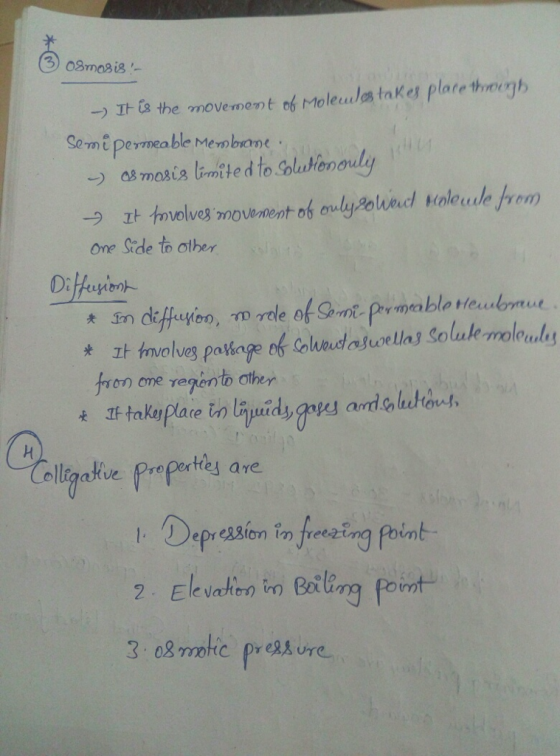
3. What is the difference between osmosis and diffusion? 4. What are three colligative properties?
3. What is the difference between osmosis and diffusion?
4. What are three colligative properties?
Homework Answers
Add Answer to:
3. What is the difference between osmosis and
diffusion?
4. What are three colligative properties?
QUESTIONS 1. What is the difference between diffusion and osmosis? om one Slace to an to...
 QUESTIONS 1. What is the difference between diffusion and osmosis? om one Slace to an to we movement OP water aaross ca membiane is the solute and the 2. In a salt water solution, the is the solvent. Part A: The Effect of Concentration on Rate of Diffusion 3. Based on your results, how does the concentration of a solute affect its rate of diffusion? Part B: The Effect of Molecular Weight on Rate of Diffusion 4. Based on your...
Air flow into and out of the lungs is an example of what? Diffusion Osmosis Bulk...
Air flow into and out of the lungs is an example of what? Diffusion Osmosis Bulk flow Active Transport Facilitated Diffusion
Bio 109-Osmosis and Diffusion b. What does it mean when the cell membrane is described as...
 Bio 109-Osmosis and Diffusion b. What does it mean when the cell membrane is described as being selectively permeable? c. Distinguish between osmosis and diffusion. 5. Define the following terms: a. solute A Gubstance tnat is dissolvedina soluhon b. solvent The dissoluing ao a solu hoyn c. solution eneous mixture hun on d. organic molecule Revised 06/2011
What would be the purpose of this lab based on the following information? Colligative Properties II...
What would be the purpose of this lab based on the following information? Colligative Properties II Colligative Property is a property of a solution that depends only on the number of solute molecule present. Osmotic pressure, freezing point depression, boiling point elevation, and vapor pressure lowering are all colligative properties. In today’s lab we will look at three of these properties. Electrolytes are substances that forms ions in solution that conduct electricity. Electrolytes can either be an acid, base or...
What is the difference between steady-state and equilibrium? Be sure to include three properties of each...
What is the difference between steady-state and equilibrium? Be sure to include three properties of each and state which is found in cells.
Osmosis differs from diffusion in that a specific molecule is moving across a membrane layer. What...
Osmosis differs from diffusion in that a specific molecule is moving across a membrane layer. What is this molecule?
4. Colligative Properties: Consider the following solutions: 1) pure water, and 2) a 0.100 M solution...
 4. Colligative Properties: Consider the following solutions: 1) pure water, and 2) a 0.100 M solution of NaCl. Answer the following questions by circling the correct answer, and then explaining your choice (with words or pictures). 0.100 M NaCl soln pure water [A] Which has the lower freezing point? 0.100 M NaCl soln [B] Which has the lower boiling point? pure water (C) Which has the higher vapour pressure? pure water 0.100 M NaCl soln 5. Osmosis: Draw a picture...
Assignment Four Colligative properties refer to properties of the solvent that are affected by the presence/absence...
 Assignment Four Colligative properties refer to properties of the solvent that are affected by the presence/absence of solute particles. As such, they are dependent on the physical reaction of the solute and the solvent—there are no chemical reactions involved. All responses to the following questions should use language and terms that a high school senior that hasn't taken AP chemistry. 1) Why does the addition of solute decrease the melting point, and increase the boiling point of the solvent? 2)...
Which of the following are colligative properties? (select all that apply) 1. Boiling Point Elevation 2....
Which of the following are colligative properties? (select all that apply) 1. Boiling Point Elevation 2. Osmotic Pressure 3. Temperature Change 4. Density 5. Enthalpy of Formation
9:08 LTE Question 19 of 23 Submit What is the difference between effusion and diffusion? A)...
 9:08 LTE Question 19 of 23 Submit What is the difference between effusion and diffusion? A) Diffusion separates gases, and effusion collects them. B) Diffusion is through a pinhole, and effusion is through open space. C) Effusion separates gases, and diffusion collects them. D) Effusion is through a pinhole, and diffusion is through open space. E) Diffusion is for real gases, and effusion for ideal gases. Tap here or pull up for additional resources
 QUESTIONS 1. What is the difference between diffusion and osmosis? om one Slace to an to we movement OP water aaross ca membiane is the solute and the 2. In a salt water solution, the is the solvent. Part A: The Effect of Concentration on Rate of Diffusion 3. Based on your results, how does the concentration of a solute affect its rate of diffusion? Part B: The Effect of Molecular Weight on Rate of Diffusion 4. Based on your...
 Bio 109-Osmosis and Diffusion b. What does it mean when the cell membrane is described as being selectively permeable? c. Distinguish between osmosis and diffusion. 5. Define the following terms: a. solute A Gubstance tnat is dissolvedina soluhon b. solvent The dissoluing ao a solu hoyn c. solution eneous mixture hun on d. organic molecule Revised 06/2011
 4. Colligative Properties: Consider the following solutions: 1) pure water, and 2) a 0.100 M solution of NaCl. Answer the following questions by circling the correct answer, and then explaining your choice (with words or pictures). 0.100 M NaCl soln pure water [A] Which has the lower freezing point? 0.100 M NaCl soln [B] Which has the lower boiling point? pure water (C) Which has the higher vapour pressure? pure water 0.100 M NaCl soln 5. Osmosis: Draw a picture...
 Assignment Four Colligative properties refer to properties of the solvent that are affected by the presence/absence of solute particles. As such, they are dependent on the physical reaction of the solute and the solvent—there are no chemical reactions involved. All responses to the following questions should use language and terms that a high school senior that hasn't taken AP chemistry. 1) Why does the addition of solute decrease the melting point, and increase the boiling point of the solvent? 2)...
 9:08 LTE Question 19 of 23 Submit What is the difference between effusion and diffusion? A) Diffusion separates gases, and effusion collects them. B) Diffusion is through a pinhole, and effusion is through open space. C) Effusion separates gases, and diffusion collects them. D) Effusion is through a pinhole, and diffusion is through open space. E) Diffusion is for real gases, and effusion for ideal gases. Tap here or pull up for additional resources
Most questions answered within 3 hours.
-
Where is the error in this code sequence?
String s1 = "Hello";
String s2 = "ello";...
asked 10 months ago -
Financial data for Joel de Paris, Inc., for last year
follow:
Joel de Paris, Inc.
Balance...
asked 10 months ago -
Consider this reaction:
Al2(SO4)3 (aq)+ BaCl3
(aq) Al2Cl6 (aq)- +
3BaSO4(s) . What is the...
asked 10 months ago -
Suppose that Savneet is considering increasing her
recent random sample from 20 car rentals to 40...
asked 10 months ago -
Trucks arrive at an unloading terminal at an average rate of 120
per hour.
Trucks arrive...
asked 10 months ago -
Why are methanol and ethanol completely soluble in water while
octanol is not very little soluble....
asked 10 months ago -
A facilities manager at a university reads in a research report
that the mean amount of...
asked 10 months ago -
When the CuSO4 is rehydrated by adding water to the anhydrous
compound, is this an endothermic...
asked 10 months ago -
A ray of sunlight is passing from diamond into crown glass; the
angle of incidence is...
asked 10 months ago -
A block of mass 0.249 kg is placed on top of a light, vertical
spring of...
asked 10 months ago -
how do the kidneys compensate in the presences of acidosis
a) trigger hyperventilate
b) reserve acid...
asked 10 months ago -
Question 501 pts
The rental rate of capital to the firm increases. Which of the
following...
asked 10 months ago