![Determine the Time Domain Representation, alt)of the Frequency Domain signal, X[k], with the following Magnitude and Phase Sp](http://img.homeworklib.com/questions/27f1eb10-a741-11ec-bf68-b37adf0c88a8.png?x-oss-process=image/resize,w_560)
Homework Answers


Add Answer to:
please solve it fast
Determine the Time Domain Representation, alt)of the Frequency Domain signal, X[k], with...
1. Find and graph the frequency domain representation of the periodic signal given below: X(+) =...
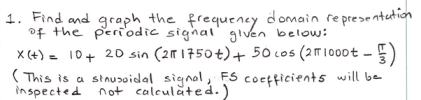 1. Find and graph the frequency domain representation of the periodic signal given below: X(+) = 10+ 20 sin (211750 t) + 5010S (2171000 (This is a sinusoidal signal, FS coefficients will be inspected not calculated. )
a) Derive the frequency domain representation X() of a band-limited signal r(t) that has been uniformly sampled in time to become r(n). b) Derive the expression of the reconstructed signal r(t) from...
 a) Derive the frequency domain representation X() of a band-limited signal r(t) that has been uniformly sampled in time to become r(n). b) Derive the expression of the reconstructed signal r(t) from the discrete time signal (n). Show all steps in detail: the sampling/reconstruction functions and processes both in the time and the frequency domain
a) Derive the frequency domain representation X() of a band-limited signal r(t) that has been uniformly sampled in time to become r(n). b) Derive the...
a) Derive the frequency domain representation X() of a band-limited signal r(t) that has been uniformly sampled in time to become r(n). b) Derive the expression of the reconstructed signal r(t) from the discrete time signal (n). Show all steps in detail: the sampling/reconstruction functions and processes both in the time and the frequency domain
a) Derive the frequency domain representation X() of a band-limited signal r(t) that has been uniformly sampled in time to become r(n). b) Derive the...
Problem 3:(3.7) Using the defining equation for the FT, evaluate the frequency-domain representation (frequency spectrum) for...
 Problem 3:(3.7) Using the defining equation for the FT, evaluate the frequency-domain representation (frequency spectrum) for the following signals. Simplify into the form X(ja)-Kga) ejLXja) Sketch the magnitude (|X(juo)) and phase (ZX(j)) spectra for each. -3t (a) x1(t) etut-1) (b) X2(t) e-Itl (c) x3(t) te2u(t)
I dont understand how to figure out if a signal is in the frequency and time...
 I
dont understand how to figure out if a signal is in the frequency
and time domain
7. Consider f[n] = ejwon and g[n] = ej(wo+21)n, with wo to be a constant. (a) Please decide whether f[n] is periodic or not in the frequency domain, and specify the period if yes. You don't need the Fourier series to solve this, just arguments are fine. (b) Decide whether f [n] is periodic in time domain, and specify the period if yes....
I
dont understand how to figure out if a signal is in the frequency
and time domain
7. Consider f[n] = ejwon and g[n] = ej(wo+21)n, with wo to be a constant. (a) Please decide whether f[n] is periodic or not in the frequency domain, and specify the period if yes. You don't need the Fourier series to solve this, just arguments are fine. (b) Decide whether f [n] is periodic in time domain, and specify the period if yes....
how to do laplace transform on a signal that is in frequency domain. I have a...
how to do laplace transform on a signal that is in frequency domain. I have a signal that is in time domain and i used fft to plot it in the frequency domain, is there a way i could plot it in s domain. I know that i could do laplace transform directly from time domain to s domain, but I need to find out are these two results match each other. Fs = 4; % samples per second dt...
QUESTION 1 Consider the time domain signal shown below. Determine the magnitude of the Fourier Tr...
 QUESTION 1 Consider the time domain signal shown below. Determine the magnitude of the Fourier Transform, X(w), at a frequency of ω : 22 rad/sec, for a-3, b = 2, and c=2 be" for te[0,c] x(t)-| 0 forte(0,c]
QUESTION 1 Consider the time domain signal shown below. Determine the magnitude of the Fourier Transform, X(w), at a frequency of ω : 22 rad/sec, for a-3, b = 2, and c=2 be" for te[0,c] x(t)-| 0 forte(0,c]
QUESTION 1 Consider the time domain signal shown below. Determine the magnitude of the Fourier Transform, X(w), at a frequency of ω : 22 rad/sec, for a-3, b = 2, and c=2 be" for te[0,c] x(t)-| 0 forte(0,c]
Clear steps, please. Question # 4(a) a. Time period of x(t) Cos(10Tmt) issec b. Time period...
 Clear steps, please.
Question # 4(a) a. Time period of x(t) Cos(10Tmt) issec b. Time period of x(t) Cos(10Tt) +Cos (50Tt) issec c. Frequency of x(t) Cos(10mt) isHz d. Frequency ofx(t) Cos(10mt) + Cos(50πt) is- --Hz e. Phase spectrum is anfunction of frequency. f. Magnitude spectrum is an g To check stability in time domain, a system H(s) is stable if and only if function of frequency. h. To check stability in time domain, a system ht) is stable if...
Clear steps, please.
Question # 4(a) a. Time period of x(t) Cos(10Tmt) issec b. Time period of x(t) Cos(10Tt) +Cos (50Tt) issec c. Frequency of x(t) Cos(10mt) isHz d. Frequency ofx(t) Cos(10mt) + Cos(50πt) is- --Hz e. Phase spectrum is anfunction of frequency. f. Magnitude spectrum is an g To check stability in time domain, a system H(s) is stable if and only if function of frequency. h. To check stability in time domain, a system ht) is stable if...
A periodic signal x(t) is shown below. We want to find the Fourier Series representation for...
 A periodic signal x(t) is shown below. We want to find the Fourier Series representation for this signal. x(t) AA -4 -2 1 2 4 6 8 (a) Find the period (T.) and radian frequency (wo) of (t). (b) Find the Trigonometric Series representation of X(t). These include: (a) Fourier coefficients ao, an, and bn ; (b) complete mathematical Fourier series expression for X(t); and (c) first five terms of the series.
Please answer in MATLAB, thank you! 2. Calculate the energy of time domain signal x (t) and z (t) for the range of 0SIS...
 Please answer in MATLAB, thank you!
2. Calculate the energy of time domain signal x (t) and z (t) for the range of 0SIS2.5 Also calculate the energy of these signals in frequency domain using Parseval's theorem. Plot Energy (X) and Energy (Z) as a function of frequency f in a 2xl subplot (Energy vs frequency plot is know as energy spectrum of a signal).
2. Calculate the energy of time domain signal x (t) and z (t) for the...
Please answer in MATLAB, thank you!
2. Calculate the energy of time domain signal x (t) and z (t) for the range of 0SIS2.5 Also calculate the energy of these signals in frequency domain using Parseval's theorem. Plot Energy (X) and Energy (Z) as a function of frequency f in a 2xl subplot (Energy vs frequency plot is know as energy spectrum of a signal).
2. Calculate the energy of time domain signal x (t) and z (t) for the...
(a) Determine the period, amplitude, and frequency of a signal given by, v(t) (120nt). Plot this ...
 (a) Determine the period, amplitude, and frequency of a signal given by, v(t) (120nt). Plot this signal both in the time-domain and frequency domain. (b) For the following square wave v(t), determine if it is a periodic signal, and if yes, what 10 V sin 4. [61 are its amplitude, period T and fundamental frequency f? Why do we need to convert this signal into sine/cosine wave for transmission? 2 o-oims (c) () According to Fourier Theorem, the above signal...
 1. Find and graph the frequency domain representation of the periodic signal given below: X(+) = 10+ 20 sin (211750 t) + 5010S (2171000 (This is a sinusoidal signal, FS coefficients will be inspected not calculated. )
 a) Derive the frequency domain representation X() of a band-limited signal r(t) that has been uniformly sampled in time to become r(n). b) Derive the expression of the reconstructed signal r(t) from the discrete time signal (n). Show all steps in detail: the sampling/reconstruction functions and processes both in the time and the frequency domain
a) Derive the frequency domain representation X() of a band-limited signal r(t) that has been uniformly sampled in time to become r(n). b) Derive the...
a) Derive the frequency domain representation X() of a band-limited signal r(t) that has been uniformly sampled in time to become r(n). b) Derive the expression of the reconstructed signal r(t) from the discrete time signal (n). Show all steps in detail: the sampling/reconstruction functions and processes both in the time and the frequency domain
a) Derive the frequency domain representation X() of a band-limited signal r(t) that has been uniformly sampled in time to become r(n). b) Derive the...
 Problem 3:(3.7) Using the defining equation for the FT, evaluate the frequency-domain representation (frequency spectrum) for the following signals. Simplify into the form X(ja)-Kga) ejLXja) Sketch the magnitude (|X(juo)) and phase (ZX(j)) spectra for each. -3t (a) x1(t) etut-1) (b) X2(t) e-Itl (c) x3(t) te2u(t)
 I
dont understand how to figure out if a signal is in the frequency
and time domain
7. Consider f[n] = ejwon and g[n] = ej(wo+21)n, with wo to be a constant. (a) Please decide whether f[n] is periodic or not in the frequency domain, and specify the period if yes. You don't need the Fourier series to solve this, just arguments are fine. (b) Decide whether f [n] is periodic in time domain, and specify the period if yes....
I
dont understand how to figure out if a signal is in the frequency
and time domain
7. Consider f[n] = ejwon and g[n] = ej(wo+21)n, with wo to be a constant. (a) Please decide whether f[n] is periodic or not in the frequency domain, and specify the period if yes. You don't need the Fourier series to solve this, just arguments are fine. (b) Decide whether f [n] is periodic in time domain, and specify the period if yes....
 QUESTION 1 Consider the time domain signal shown below. Determine the magnitude of the Fourier Transform, X(w), at a frequency of ω : 22 rad/sec, for a-3, b = 2, and c=2 be" for te[0,c] x(t)-| 0 forte(0,c]
QUESTION 1 Consider the time domain signal shown below. Determine the magnitude of the Fourier Transform, X(w), at a frequency of ω : 22 rad/sec, for a-3, b = 2, and c=2 be" for te[0,c] x(t)-| 0 forte(0,c]
QUESTION 1 Consider the time domain signal shown below. Determine the magnitude of the Fourier Transform, X(w), at a frequency of ω : 22 rad/sec, for a-3, b = 2, and c=2 be" for te[0,c] x(t)-| 0 forte(0,c]
 Clear steps, please.
Question # 4(a) a. Time period of x(t) Cos(10Tmt) issec b. Time period of x(t) Cos(10Tt) +Cos (50Tt) issec c. Frequency of x(t) Cos(10mt) isHz d. Frequency ofx(t) Cos(10mt) + Cos(50πt) is- --Hz e. Phase spectrum is anfunction of frequency. f. Magnitude spectrum is an g To check stability in time domain, a system H(s) is stable if and only if function of frequency. h. To check stability in time domain, a system ht) is stable if...
Clear steps, please.
Question # 4(a) a. Time period of x(t) Cos(10Tmt) issec b. Time period of x(t) Cos(10Tt) +Cos (50Tt) issec c. Frequency of x(t) Cos(10mt) isHz d. Frequency ofx(t) Cos(10mt) + Cos(50πt) is- --Hz e. Phase spectrum is anfunction of frequency. f. Magnitude spectrum is an g To check stability in time domain, a system H(s) is stable if and only if function of frequency. h. To check stability in time domain, a system ht) is stable if...
 A periodic signal x(t) is shown below. We want to find the Fourier Series representation for this signal. x(t) AA -4 -2 1 2 4 6 8 (a) Find the period (T.) and radian frequency (wo) of (t). (b) Find the Trigonometric Series representation of X(t). These include: (a) Fourier coefficients ao, an, and bn ; (b) complete mathematical Fourier series expression for X(t); and (c) first five terms of the series.
 Please answer in MATLAB, thank you!
2. Calculate the energy of time domain signal x (t) and z (t) for the range of 0SIS2.5 Also calculate the energy of these signals in frequency domain using Parseval's theorem. Plot Energy (X) and Energy (Z) as a function of frequency f in a 2xl subplot (Energy vs frequency plot is know as energy spectrum of a signal).
2. Calculate the energy of time domain signal x (t) and z (t) for the...
Please answer in MATLAB, thank you!
2. Calculate the energy of time domain signal x (t) and z (t) for the range of 0SIS2.5 Also calculate the energy of these signals in frequency domain using Parseval's theorem. Plot Energy (X) and Energy (Z) as a function of frequency f in a 2xl subplot (Energy vs frequency plot is know as energy spectrum of a signal).
2. Calculate the energy of time domain signal x (t) and z (t) for the...
 (a) Determine the period, amplitude, and frequency of a signal given by, v(t) (120nt). Plot this signal both in the time-domain and frequency domain. (b) For the following square wave v(t), determine if it is a periodic signal, and if yes, what 10 V sin 4. [61 are its amplitude, period T and fundamental frequency f? Why do we need to convert this signal into sine/cosine wave for transmission? 2 o-oims (c) () According to Fourier Theorem, the above signal...
Most questions answered within 3 hours.
-
Where is the error in this code sequence?
String s1 = "Hello";
String s2 = "ello";...
asked 10 months ago -
Financial data for Joel de Paris, Inc., for last year
follow:
Joel de Paris, Inc.
Balance...
asked 10 months ago -
Consider this reaction:
Al2(SO4)3 (aq)+ BaCl3
(aq) Al2Cl6 (aq)- +
3BaSO4(s) . What is the...
asked 10 months ago -
Suppose that Savneet is considering increasing her
recent random sample from 20 car rentals to 40...
asked 10 months ago -
Trucks arrive at an unloading terminal at an average rate of 120
per hour.
Trucks arrive...
asked 10 months ago -
Why are methanol and ethanol completely soluble in water while
octanol is not very little soluble....
asked 10 months ago -
A facilities manager at a university reads in a research report
that the mean amount of...
asked 10 months ago -
When the CuSO4 is rehydrated by adding water to the anhydrous
compound, is this an endothermic...
asked 10 months ago -
A ray of sunlight is passing from diamond into crown glass; the
angle of incidence is...
asked 10 months ago -
A block of mass 0.249 kg is placed on top of a light, vertical
spring of...
asked 10 months ago -
how do the kidneys compensate in the presences of acidosis
a) trigger hyperventilate
b) reserve acid...
asked 10 months ago -
Question 501 pts
The rental rate of capital to the firm increases. Which of the
following...
asked 10 months ago