Solve using Matlab. Please no handwritten .

Homework Answers
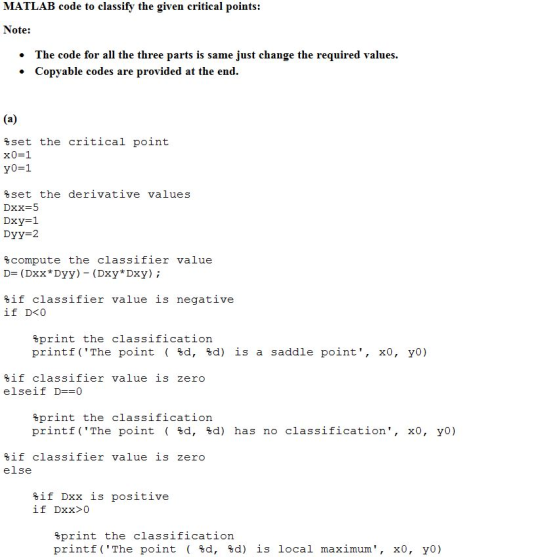

Raw Copyable MATLAB scripts:
%(a)
%set the critical point
x0=1
y0=1
%set the derivative values
Dxx=5
Dxy=1
Dyy=2
%compute the classifier value
D=(Dxx*Dyy)-(Dxy*Dxy);
%if classifier value is negative
if D<0
%print the classification
printf('The point ( %d, %d) is a saddle point', x0, y0)
%if classifier value is zero
elseif D==0
%print the classification
printf('The point ( %d, %d) has no classification', x0, y0)
%if classifier value is zero
else
%if Dxx is positive
if Dxx>0
%print the classification
printf('The point ( %d, %d) is local maximum', x0, y0)
%else
else
%print the classification
printf('The point ( %d, %d) is local minimum', x0, y0)
end
end
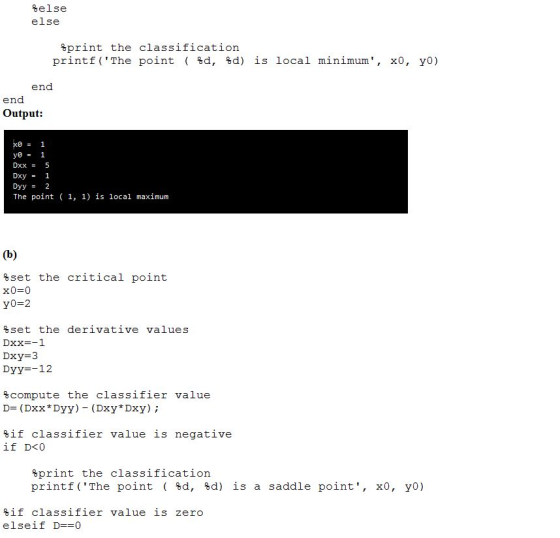
%(b)
%set the critical point
x0=0
y0=2
%set the derivative values
Dxx=-1
Dxy=3
Dyy=-12
%compute the classifier value
D=(Dxx*Dyy)-(Dxy*Dxy);
%if classifier value is negative
if D<0
%print the classification
printf('The point ( %d, %d) is a saddle point', x0, y0)
%if classifier value is zero
elseif D==0
%print the classification
printf('The point ( %d, %d) has no classification', x0, y0)
%if classifier value is zero
else
%if Dxx is positive
if Dxx>0
%print the classification
printf('The point ( %d, %d) is local maximum', x0, y0)
%else
else
%print the classification
printf('The point ( %d, %d) is local minimum', x0, y0)
end
end
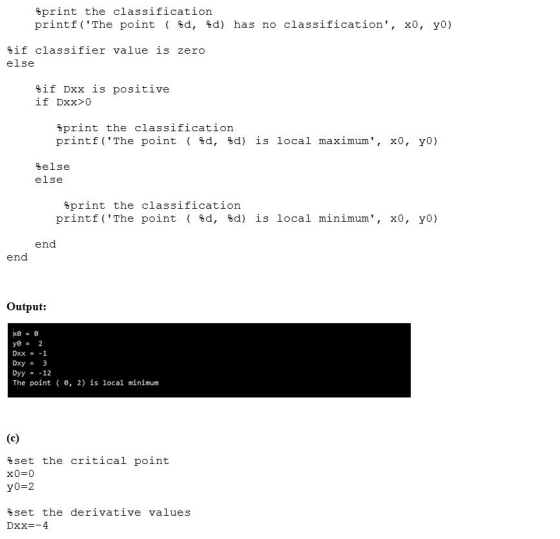
%(c)
%set the critical point
x0=0
y0=2
%set the derivative values
Dxx=-4
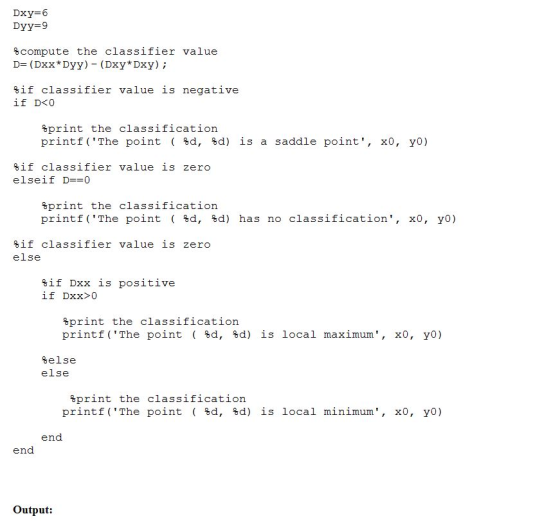
Dxy=6
Dyy=9
%compute the classifier value
D=(Dxx*Dyy)-(Dxy*Dxy);
%if classifier value is negative
if D<0
%print the classification
printf('The point ( %d, %d) is a saddle point', x0, y0)
%if classifier value is zero
elseif D==0
%print the classification
printf('The point ( %d, %d) has no classification', x0, y0)
%if classifier value is zero
else
%if Dxx is positive
if Dxx>0
%print the classification
printf('The point ( %d, %d) is local maximum', x0, y0)
%else
else
%print the classification
printf('The point ( %d, %d) is local minimum', x0, y0)
end
end
Add Answer to:
Solve using Matlab. Please no handwritten .
1. Suppose (xo. yo) is a critical point of...
Suppose (1,1) is a critical point of a function f with continuous second derivatives. In each...
Suppose (1,1) is a critical point of a function f with continuous second derivatives. In each case, what can you say about f? (6 Pts) (a) fxx(1,1) = −3, fxy(1,1) = 1, fyy(1,1) = 2 (b) fxx(1,1) = −4, fxy(1,1) = 2, fyy(1,1) = −1 (c) fxx(1,1) = −4, fxy(1,1) = −2, fyy(1,1) = −2 (d) fxx(1,1) = 4, fxy(1,1) = 3, fyy(1,1) = 3
Given a two-variable function f(x, y), if P(x0,yo) is a critical point, then the behavior of...
 Given a two-variable function f(x, y), if P(x0,yo) is a critical point, then the behavior of f around P can be approximated by its second order terms according to Taylor series, that is, f(x,y) = f(P) + F(x – xo)?H (x, y) , where H(x, y) = fyy(P)(=%)2 + 2 fxy(P) (?=%) + fxx(P). (a). If H(x, y) > 0 for all x,y, is P a local max, local min or saddle point? (b). Let s = (4=90). Then, H(x,...
1. What are the four basic shapes/combinations of first and second deriva tives? One common probl...
 1. What are the four basic shapes/combinations of first and second deriva tives? One common problem is forgetting to check where the first or second deriva tive does not exist. These are also critical/inflection points. Consider the x = t-sin(t y 1-cos(t) parametric function where-2π < t < 2T. 2. What are the first and second derivatives? 3. Where are the first and second derivatives equal to 0? 4. Where are the first and second derivatives undefined? 5. Where is...
I cannot figure out the first set of critical points and classifications. (1 point) The following...
 I cannot figure out the first
set of critical points and classifications.
(1 point) The following table gives values of the differentiable function y = f(x). X 0 1 2 3 4 5 6 7 8 9 10 y 1 -1 -3 -2 1-1 -2 123 5 Estimate the x-values of critical points of f(x) on the interval 0<x< 10. Classify each critical point as a local maximum, local minimum, or neither. (Enter your critical points as comma-separated xvalue,classification pairs....
I cannot figure out the first
set of critical points and classifications.
(1 point) The following table gives values of the differentiable function y = f(x). X 0 1 2 3 4 5 6 7 8 9 10 y 1 -1 -3 -2 1-1 -2 123 5 Estimate the x-values of critical points of f(x) on the interval 0<x< 10. Classify each critical point as a local maximum, local minimum, or neither. (Enter your critical points as comma-separated xvalue,classification pairs....
please solve all parts. For the function f(x,y)=x3+y3 – 6y2-3x+5, do the following: (a) Determine its...
 please solve all parts.
For the function f(x,y)=x3+y3 – 6y2-3x+5, do the following: (a) Determine its critical point(s) if exists. Express your answer as coordinate pairs with parentheses and commas. Separate your answers with commas and list in ascending order of x if the function has more than one critical point. Use **DNE" if the function has no critical point. Answer: (b) Use the D-Test to classify at each critical point whether the function has a relative maximum or minimum,...
please solve all parts.
For the function f(x,y)=x3+y3 – 6y2-3x+5, do the following: (a) Determine its critical point(s) if exists. Express your answer as coordinate pairs with parentheses and commas. Separate your answers with commas and list in ascending order of x if the function has more than one critical point. Use **DNE" if the function has no critical point. Answer: (b) Use the D-Test to classify at each critical point whether the function has a relative maximum or minimum,...
SOLVE USING MATLAB PLEASE THANKS! The governing differential equation for the deflection of a cantilever beam...
 SOLVE USING MATLAB PLEASE THANKS!
The governing differential equation for the deflection of a cantilever beam subjected to a point load at its free end (Fig. 1) is given by: 2 dx2 where E is elastic modulus, Izz is beam moment of inertia, y 1s beam deflection, P is the point load, and x is the distance along the beam measured from the free end. The boundary conditions are the deflection y(L) is zero and the slope (dy/dx) at x-L...
SOLVE USING MATLAB PLEASE THANKS!
The governing differential equation for the deflection of a cantilever beam subjected to a point load at its free end (Fig. 1) is given by: 2 dx2 where E is elastic modulus, Izz is beam moment of inertia, y 1s beam deflection, P is the point load, and x is the distance along the beam measured from the free end. The boundary conditions are the deflection y(L) is zero and the slope (dy/dx) at x-L...
solve with matlab Given the function: f(x) x2 + 4x + et and the point f(1)...
 solve with matlab
Given the function: f(x) x2 + 4x + et and the point f(1) = 7.7183 use Taylor series to compute the second order approximation to find the value off (1.5). Input your answer up to 4 decimal places.
solve with matlab
Given the function: f(x) x2 + 4x + et and the point f(1) = 7.7183 use Taylor series to compute the second order approximation to find the value off (1.5). Input your answer up to 4 decimal places.
Solve using Matlab Use the forward Euler method, Vi+,-Vi+(4+1-tinti ,Vi) for i= 0,1,2, , taking yo y(to) to be the initial condition, to approximate the solution at t-2 of the IVP y'=y-t2 + 1, 0-...
 Solve using Matlab
Use the forward Euler method, Vi+,-Vi+(4+1-tinti ,Vi) for i= 0,1,2, , taking yo y(to) to be the initial condition, to approximate the solution at t-2 of the IVP y'=y-t2 + 1, 0-t-2, y(0) = 0.5. Use N = 2k, k = 1, 2, , 20 equispaced time steps (so to = 0 and tN-1 = 2). Make a convergence plot, computing the error by comparing with the exact solution, y: t1)2 -exp(t)/2, and plotting the error as...
Solve using Matlab
Use the forward Euler method, Vi+,-Vi+(4+1-tinti ,Vi) for i= 0,1,2, , taking yo y(to) to be the initial condition, to approximate the solution at t-2 of the IVP y'=y-t2 + 1, 0-t-2, y(0) = 0.5. Use N = 2k, k = 1, 2, , 20 equispaced time steps (so to = 0 and tN-1 = 2). Make a convergence plot, computing the error by comparing with the exact solution, y: t1)2 -exp(t)/2, and plotting the error as...
please solve in matlab 1[35p) Write a user-defined MATLAB function that determines the unit vector in...
 please solve in matlab
1[35p) Write a user-defined MATLAB function that determines the unit vector in the direction of the line that connects two points (A and B) in space. For the func- tion name and arguments, use n = unitvec (A,B). The input to the function are two vectors A and B, each with the Cartesian coordinates of the corre- sponding point. The output is a vector with the components of the unit vector Join the direction from A...
please solve in matlab
1[35p) Write a user-defined MATLAB function that determines the unit vector in the direction of the line that connects two points (A and B) in space. For the func- tion name and arguments, use n = unitvec (A,B). The input to the function are two vectors A and B, each with the Cartesian coordinates of the corre- sponding point. The output is a vector with the components of the unit vector Join the direction from A...
Use the attached Matlab code as a basis to solve the following ordinary differential equation usi...
 Question 1
QUESTION 2
Use the attached Matlab code as a basis to solve the following ordinary differential equation using Euler's method, with timestep of 0.1, from t-0to t-100. d)0) -0 - sin (5vt cos(у Plot y versus t from t=0 to t=100. How many local maxima are on this interval(do not include end points). Be careful to count them all! Answer should be an integer 1 w% Matlab code for the solution of Module 2 3 dt-9.1; %dt is...
Question 1
QUESTION 2
Use the attached Matlab code as a basis to solve the following ordinary differential equation using Euler's method, with timestep of 0.1, from t-0to t-100. d)0) -0 - sin (5vt cos(у Plot y versus t from t=0 to t=100. How many local maxima are on this interval(do not include end points). Be careful to count them all! Answer should be an integer 1 w% Matlab code for the solution of Module 2 3 dt-9.1; %dt is...
 Given a two-variable function f(x, y), if P(x0,yo) is a critical point, then the behavior of f around P can be approximated by its second order terms according to Taylor series, that is, f(x,y) = f(P) + F(x – xo)?H (x, y) , where H(x, y) = fyy(P)(=%)2 + 2 fxy(P) (?=%) + fxx(P). (a). If H(x, y) > 0 for all x,y, is P a local max, local min or saddle point? (b). Let s = (4=90). Then, H(x,...
 1. What are the four basic shapes/combinations of first and second deriva tives? One common problem is forgetting to check where the first or second deriva tive does not exist. These are also critical/inflection points. Consider the x = t-sin(t y 1-cos(t) parametric function where-2π < t < 2T. 2. What are the first and second derivatives? 3. Where are the first and second derivatives equal to 0? 4. Where are the first and second derivatives undefined? 5. Where is...
 I cannot figure out the first
set of critical points and classifications.
(1 point) The following table gives values of the differentiable function y = f(x). X 0 1 2 3 4 5 6 7 8 9 10 y 1 -1 -3 -2 1-1 -2 123 5 Estimate the x-values of critical points of f(x) on the interval 0<x< 10. Classify each critical point as a local maximum, local minimum, or neither. (Enter your critical points as comma-separated xvalue,classification pairs....
I cannot figure out the first
set of critical points and classifications.
(1 point) The following table gives values of the differentiable function y = f(x). X 0 1 2 3 4 5 6 7 8 9 10 y 1 -1 -3 -2 1-1 -2 123 5 Estimate the x-values of critical points of f(x) on the interval 0<x< 10. Classify each critical point as a local maximum, local minimum, or neither. (Enter your critical points as comma-separated xvalue,classification pairs....
 please solve all parts.
For the function f(x,y)=x3+y3 – 6y2-3x+5, do the following: (a) Determine its critical point(s) if exists. Express your answer as coordinate pairs with parentheses and commas. Separate your answers with commas and list in ascending order of x if the function has more than one critical point. Use **DNE" if the function has no critical point. Answer: (b) Use the D-Test to classify at each critical point whether the function has a relative maximum or minimum,...
please solve all parts.
For the function f(x,y)=x3+y3 – 6y2-3x+5, do the following: (a) Determine its critical point(s) if exists. Express your answer as coordinate pairs with parentheses and commas. Separate your answers with commas and list in ascending order of x if the function has more than one critical point. Use **DNE" if the function has no critical point. Answer: (b) Use the D-Test to classify at each critical point whether the function has a relative maximum or minimum,...
 SOLVE USING MATLAB PLEASE THANKS!
The governing differential equation for the deflection of a cantilever beam subjected to a point load at its free end (Fig. 1) is given by: 2 dx2 where E is elastic modulus, Izz is beam moment of inertia, y 1s beam deflection, P is the point load, and x is the distance along the beam measured from the free end. The boundary conditions are the deflection y(L) is zero and the slope (dy/dx) at x-L...
SOLVE USING MATLAB PLEASE THANKS!
The governing differential equation for the deflection of a cantilever beam subjected to a point load at its free end (Fig. 1) is given by: 2 dx2 where E is elastic modulus, Izz is beam moment of inertia, y 1s beam deflection, P is the point load, and x is the distance along the beam measured from the free end. The boundary conditions are the deflection y(L) is zero and the slope (dy/dx) at x-L...
 solve with matlab
Given the function: f(x) x2 + 4x + et and the point f(1) = 7.7183 use Taylor series to compute the second order approximation to find the value off (1.5). Input your answer up to 4 decimal places.
solve with matlab
Given the function: f(x) x2 + 4x + et and the point f(1) = 7.7183 use Taylor series to compute the second order approximation to find the value off (1.5). Input your answer up to 4 decimal places.
 Solve using Matlab
Use the forward Euler method, Vi+,-Vi+(4+1-tinti ,Vi) for i= 0,1,2, , taking yo y(to) to be the initial condition, to approximate the solution at t-2 of the IVP y'=y-t2 + 1, 0-t-2, y(0) = 0.5. Use N = 2k, k = 1, 2, , 20 equispaced time steps (so to = 0 and tN-1 = 2). Make a convergence plot, computing the error by comparing with the exact solution, y: t1)2 -exp(t)/2, and plotting the error as...
Solve using Matlab
Use the forward Euler method, Vi+,-Vi+(4+1-tinti ,Vi) for i= 0,1,2, , taking yo y(to) to be the initial condition, to approximate the solution at t-2 of the IVP y'=y-t2 + 1, 0-t-2, y(0) = 0.5. Use N = 2k, k = 1, 2, , 20 equispaced time steps (so to = 0 and tN-1 = 2). Make a convergence plot, computing the error by comparing with the exact solution, y: t1)2 -exp(t)/2, and plotting the error as...
 please solve in matlab
1[35p) Write a user-defined MATLAB function that determines the unit vector in the direction of the line that connects two points (A and B) in space. For the func- tion name and arguments, use n = unitvec (A,B). The input to the function are two vectors A and B, each with the Cartesian coordinates of the corre- sponding point. The output is a vector with the components of the unit vector Join the direction from A...
please solve in matlab
1[35p) Write a user-defined MATLAB function that determines the unit vector in the direction of the line that connects two points (A and B) in space. For the func- tion name and arguments, use n = unitvec (A,B). The input to the function are two vectors A and B, each with the Cartesian coordinates of the corre- sponding point. The output is a vector with the components of the unit vector Join the direction from A...
 Question 1
QUESTION 2
Use the attached Matlab code as a basis to solve the following ordinary differential equation using Euler's method, with timestep of 0.1, from t-0to t-100. d)0) -0 - sin (5vt cos(у Plot y versus t from t=0 to t=100. How many local maxima are on this interval(do not include end points). Be careful to count them all! Answer should be an integer 1 w% Matlab code for the solution of Module 2 3 dt-9.1; %dt is...
Question 1
QUESTION 2
Use the attached Matlab code as a basis to solve the following ordinary differential equation using Euler's method, with timestep of 0.1, from t-0to t-100. d)0) -0 - sin (5vt cos(у Plot y versus t from t=0 to t=100. How many local maxima are on this interval(do not include end points). Be careful to count them all! Answer should be an integer 1 w% Matlab code for the solution of Module 2 3 dt-9.1; %dt is...
Most questions answered within 3 hours.
-
Where is the error in this code sequence?
String s1 = "Hello";
String s2 = "ello";...
asked 10 months ago -
Financial data for Joel de Paris, Inc., for last year
follow:
Joel de Paris, Inc.
Balance...
asked 10 months ago -
Consider this reaction:
Al2(SO4)3 (aq)+ BaCl3
(aq) Al2Cl6 (aq)- +
3BaSO4(s) . What is the...
asked 10 months ago -
Suppose that Savneet is considering increasing her
recent random sample from 20 car rentals to 40...
asked 10 months ago -
Trucks arrive at an unloading terminal at an average rate of 120
per hour.
Trucks arrive...
asked 10 months ago -
Why are methanol and ethanol completely soluble in water while
octanol is not very little soluble....
asked 10 months ago -
A facilities manager at a university reads in a research report
that the mean amount of...
asked 10 months ago -
When the CuSO4 is rehydrated by adding water to the anhydrous
compound, is this an endothermic...
asked 10 months ago -
A ray of sunlight is passing from diamond into crown glass; the
angle of incidence is...
asked 10 months ago -
A block of mass 0.249 kg is placed on top of a light, vertical
spring of...
asked 10 months ago -
how do the kidneys compensate in the presences of acidosis
a) trigger hyperventilate
b) reserve acid...
asked 10 months ago -
Question 501 pts
The rental rate of capital to the firm increases. Which of the
following...
asked 10 months ago