pls answer part "d" specifically. Thanks! Q2. This question uses the general monetary model, where L...
pls answer part "d" specifically. Thanks!
Q2. This question uses the general monetary model,
where L is no longer assumed constant, and money demand is
inversely related to the nominal interest rate. Consider two
countries: Japan and South Korea. In 1996 Japan experienced
relatively slow output growth (1%), while Korea had relatively
robust output growth (6%). Suppose the Bank of Japan allowed the
money supply to grow by 2% each year, while the Bank of Korea chose
to maintain relatively high money growth of 15% per year. In
addition, the bank deposits in Japan pay a 3% interest rate, i¥ =
3%.
a. Compute the interest rate paid on South Korean deposits. (1
mark)
b. Using the definition of the real interest rate (nominal interest
rate adjusted for inflation), show that the real interest rate in
South Korea is equal to the real interest rate in Japan. (Note that
the inflation rates you computed in the previous question will be
the same in this question.) (1 mark)
c. Suppose the Bank of Korea decreases the money growth rate from
15% to 12% and the inflation rate falls proportionately (one for
one) with this decrease. If the nominal interest rate in Japan
remains unchanged, what happens to the interest rate paid on South
Korean deposits? (1 mark)
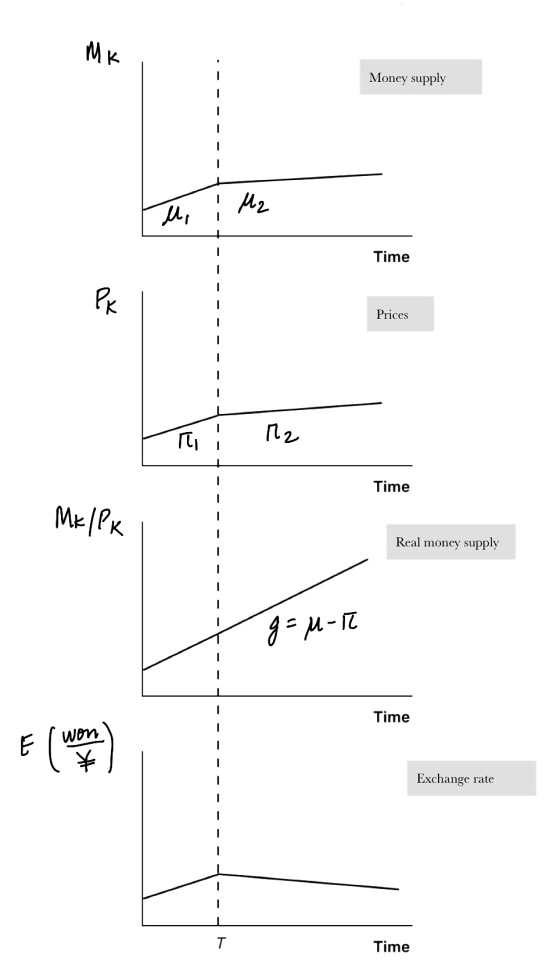
d. Using time series diagrams, illustrate how this decrease in the
money growth rate affects the money supply MK; South Korea’s
interest rate; prices PK; real money supply; and Ewon/¥ over time.
(Plot each variable on the vertical axis and time on the horizontal
axis.) (1 mark)
Homework Answers
Answer :-
2.(d) :- As per simple monetary model, inflation rate is equivalent to money supply growth short the real output growth rate. On the off chance that money growth rate decreases, at that point inflation rate falls (given that real output Growth stays same).
In this way, money supply falls. alongside that, inflation rate falls. Leave T alone the timeframe when the money supply is decreased.
Money supply is indicated by  and inflation rate is indicated by
  . Addendum 1 means the timespan before the money supply growth
fall and 2 shows the timeframe when money growth rate is
diminished.
. Addendum 1 means the timespan before the money supply growth
fall and 2 shows the timeframe when money growth rate is
diminished.
Since both
and
falls, the distinction between them continues as before.
Henceforth the growth of real money supply continues as before as
it was previously.
All the factors are plotted in figure 1.
Add Answer to:
pls answer part "d" specifically. Thanks!
Q2. This question uses the general monetary model,
where L...
4.* NOT To BE SUBMITTED (BUT GOOD PRACTICE FOR MIDTERM 1) Slightly modified version of Feenstra...
 4.* NOT To BE SUBMITTED (BUT GOOD PRACTICE FOR MIDTERM 1) Slightly modified version of Feenstra and Taylor (2018), International Macroeconomics, Ch.3, question 8. This question uses the general (long-run) monetary model, where money demand is inversely related to the nominal interest rate Consider two countries, Japan (J) and Korea (K), where the currencies used are the Japanese yen (JPY) and the Korean won (KRW). In 1996, Japan experienced relatively slow output growth (1%), while Korea had relatively robust output...
3. Consider two countries, Japan and Korea. In 1996, Japan experienced relatively slow output growth (1%),...
 3. Consider two countries, Japan and Korea. In 1996, Japan experienced relatively slow output growth (1%), whereas Korea had relatively robust output growth (6%). Suppose the Bank of Japan allowed the money supply to grow by 2% each year, whereas the Bank of Korea chose to maintain relatively high money growth of 12% per year. For the following questions, you will find it easiest to treat Korea as the home country and Japan as the foreign country A. What is...
9. A problem using the general monetary model Suppose we use the general model, in which...
 9. A problem using the general monetary model Suppose we use the general model, in which real money demand is L(i)rand we assume that both relative PPP (RPPP) and uncovered interest parity (UIP) hold. Consider two countries, Australia (A) and New Zealand (NZ). Imagine in a particular year that Australia had slower real income growth (2%) and NZ had higher real income growth (5%). Suppose the central bank of A permitted the nominal money supply to grow by 4% per...
Answer Q2 and Q3 please Question 5: A monetary policy response to an increase in the...
 Answer Q2 and Q3 please
Question 5: A monetary policy response to an increase in the risk premium say that, initially, the real interest rate (r) is 2%, and the risk premium (x) is 1%. Suddenly, there is an increase in the default risk of borrowers, and the risk premium increases by 4%. a. Show the effect of this increase in the risk premium on the level of output using the IS b. Say that the central bank wants to...
Answer Q2 and Q3 please
Question 5: A monetary policy response to an increase in the risk premium say that, initially, the real interest rate (r) is 2%, and the risk premium (x) is 1%. Suddenly, there is an increase in the default risk of borrowers, and the risk premium increases by 4%. a. Show the effect of this increase in the risk premium on the level of output using the IS b. Say that the central bank wants to...
please answer Question 7: Inflation targeting and the Taylor rule in the IS-LM model Consider a...
 please answer Question 7:
Inflation targeting and the Taylor rule in the IS-LM model Consider a closed economy in which the central bank follows an interest rate rule. The IS relation is given by Y C(Y- T) I(Y,r) G Where r is the real interest rate. The central bank sets the nominal interest rate according to the rule i = i* + a(n° =- T*) + b(Y- Y1) Where T is expected inflation, T* is the target rate of inflation,...
please answer Question 7:
Inflation targeting and the Taylor rule in the IS-LM model Consider a closed economy in which the central bank follows an interest rate rule. The IS relation is given by Y C(Y- T) I(Y,r) G Where r is the real interest rate. The central bank sets the nominal interest rate according to the rule i = i* + a(n° =- T*) + b(Y- Y1) Where T is expected inflation, T* is the target rate of inflation,...
Question 3: The Quantity Theory and the Fisher Effect [16 Points) Suppose that in El Salvador...
 Question 3: The Quantity Theory and the Fisher Effect [16 Points) Suppose that in El Salvador the velocity of money is constant, real GDP falls by 1.4% per year, the stock on money grows by 8.9% per year, and the nominal interest rate is 4.5%. (a) According to the quantity theory, what must the inflation rate be in El Salvador? [4 Points] (b) Calculate the real interest rate in El Salvador [2 Points] (e) Suppose that the central bank decides...
Question 29 (1 point) According to the classical dichotomy, what is influenced by monetary factors? real...
 Question 29 (1 point) According to the classical dichotomy, what is influenced by monetary factors? real GDP ОО investment nominal interest rates the real wage rate Question 30 (1 point) Which statement best defines the velocity of money? It is the average number of times per year a dollar is spent. ООО It is the money supply divided by nominal GDP. It is the rate at which the central bank puts money into the economy. It is the long-term growth...
080302 Monetary neutrality implies that an increase in the quantity of money will increase employment increase...
 080302 Monetary neutrality implies that an increase in the quantity of money will increase employment increase the price level increase the incentive to save. not increase any of the above. QUESTION 5 080304 The classical dichotomy argues that changes in the money supply affect both nominal and real variables. affect neither nominal nor real variables. affect nominal variables, but not real variables. do not affect nominal variables, but do affect real variables. QUESTION 6 080305 According to the principle of...
Which of the following statements is not true? -An increase in real domestic income while the...
Which of the following statements is not true? -An increase in real domestic income while the price level and the real money supply are constant. -An increase in the price4 level while real domestic income and the nominal money supply are rising -A decrease in the real money supply while the price3 level and real domestic income are constant -An increase in the price level while real domestic income and the nominal money supply are constant Which of the following...
Question 1 (a) The rates of growth of money supply is 10%, of velocity of money...
Question 1 (a) The rates of growth of money supply is 10%, of velocity of money circulation 1%, of real GDP 3%, what is the inflation rate? (b) The nominal interest rate is 7%, the inflation rate is 5%, what is the real interest rate?
 4.* NOT To BE SUBMITTED (BUT GOOD PRACTICE FOR MIDTERM 1) Slightly modified version of Feenstra and Taylor (2018), International Macroeconomics, Ch.3, question 8. This question uses the general (long-run) monetary model, where money demand is inversely related to the nominal interest rate Consider two countries, Japan (J) and Korea (K), where the currencies used are the Japanese yen (JPY) and the Korean won (KRW). In 1996, Japan experienced relatively slow output growth (1%), while Korea had relatively robust output...
 3. Consider two countries, Japan and Korea. In 1996, Japan experienced relatively slow output growth (1%), whereas Korea had relatively robust output growth (6%). Suppose the Bank of Japan allowed the money supply to grow by 2% each year, whereas the Bank of Korea chose to maintain relatively high money growth of 12% per year. For the following questions, you will find it easiest to treat Korea as the home country and Japan as the foreign country A. What is...
 9. A problem using the general monetary model Suppose we use the general model, in which real money demand is L(i)rand we assume that both relative PPP (RPPP) and uncovered interest parity (UIP) hold. Consider two countries, Australia (A) and New Zealand (NZ). Imagine in a particular year that Australia had slower real income growth (2%) and NZ had higher real income growth (5%). Suppose the central bank of A permitted the nominal money supply to grow by 4% per...
 Answer Q2 and Q3 please
Question 5: A monetary policy response to an increase in the risk premium say that, initially, the real interest rate (r) is 2%, and the risk premium (x) is 1%. Suddenly, there is an increase in the default risk of borrowers, and the risk premium increases by 4%. a. Show the effect of this increase in the risk premium on the level of output using the IS b. Say that the central bank wants to...
Answer Q2 and Q3 please
Question 5: A monetary policy response to an increase in the risk premium say that, initially, the real interest rate (r) is 2%, and the risk premium (x) is 1%. Suddenly, there is an increase in the default risk of borrowers, and the risk premium increases by 4%. a. Show the effect of this increase in the risk premium on the level of output using the IS b. Say that the central bank wants to...
 please answer Question 7:
Inflation targeting and the Taylor rule in the IS-LM model Consider a closed economy in which the central bank follows an interest rate rule. The IS relation is given by Y C(Y- T) I(Y,r) G Where r is the real interest rate. The central bank sets the nominal interest rate according to the rule i = i* + a(n° =- T*) + b(Y- Y1) Where T is expected inflation, T* is the target rate of inflation,...
please answer Question 7:
Inflation targeting and the Taylor rule in the IS-LM model Consider a closed economy in which the central bank follows an interest rate rule. The IS relation is given by Y C(Y- T) I(Y,r) G Where r is the real interest rate. The central bank sets the nominal interest rate according to the rule i = i* + a(n° =- T*) + b(Y- Y1) Where T is expected inflation, T* is the target rate of inflation,...
 Question 3: The Quantity Theory and the Fisher Effect [16 Points) Suppose that in El Salvador the velocity of money is constant, real GDP falls by 1.4% per year, the stock on money grows by 8.9% per year, and the nominal interest rate is 4.5%. (a) According to the quantity theory, what must the inflation rate be in El Salvador? [4 Points] (b) Calculate the real interest rate in El Salvador [2 Points] (e) Suppose that the central bank decides...
 Question 29 (1 point) According to the classical dichotomy, what is influenced by monetary factors? real GDP ОО investment nominal interest rates the real wage rate Question 30 (1 point) Which statement best defines the velocity of money? It is the average number of times per year a dollar is spent. ООО It is the money supply divided by nominal GDP. It is the rate at which the central bank puts money into the economy. It is the long-term growth...
 080302 Monetary neutrality implies that an increase in the quantity of money will increase employment increase the price level increase the incentive to save. not increase any of the above. QUESTION 5 080304 The classical dichotomy argues that changes in the money supply affect both nominal and real variables. affect neither nominal nor real variables. affect nominal variables, but not real variables. do not affect nominal variables, but do affect real variables. QUESTION 6 080305 According to the principle of...
Most questions answered within 3 hours.
-
Where is the error in this code sequence?
String s1 = "Hello";
String s2 = "ello";...
asked 10 months ago -
Financial data for Joel de Paris, Inc., for last year
follow:
Joel de Paris, Inc.
Balance...
asked 10 months ago -
Consider this reaction:
Al2(SO4)3 (aq)+ BaCl3
(aq) Al2Cl6 (aq)- +
3BaSO4(s) . What is the...
asked 10 months ago -
Suppose that Savneet is considering increasing her
recent random sample from 20 car rentals to 40...
asked 10 months ago -
Trucks arrive at an unloading terminal at an average rate of 120
per hour.
Trucks arrive...
asked 10 months ago -
Why are methanol and ethanol completely soluble in water while
octanol is not very little soluble....
asked 10 months ago -
A facilities manager at a university reads in a research report
that the mean amount of...
asked 10 months ago -
When the CuSO4 is rehydrated by adding water to the anhydrous
compound, is this an endothermic...
asked 10 months ago -
A ray of sunlight is passing from diamond into crown glass; the
angle of incidence is...
asked 10 months ago -
A block of mass 0.249 kg is placed on top of a light, vertical
spring of...
asked 10 months ago -
how do the kidneys compensate in the presences of acidosis
a) trigger hyperventilate
b) reserve acid...
asked 10 months ago -
Question 501 pts
The rental rate of capital to the firm increases. Which of the
following...
asked 10 months ago