Please check my answers for time complexity
![function CalculateAverageFromTable (values, total_rows, total_columns): sum0 n=0 for y from to total_rows: for x from 0 to total_columns: sum values[y][x] n +1 return sum/ Which of the below answers describes the time complexity of the above code most accurately? Pick one of the choices O(n!) O(n2) O(n) O(nlogn)](http://img.homeworklib.com/questions/10056e00-b82d-11ec-baec-33ef354e2c04.png?x-oss-process=image/resize,w_560)
Homework Answers
 .
.Add Answer to:
Please check my answers for time complexity
function CalculateAverageFromTable (values, total_rows, total_columns): sum0 n=0 for y...
#9 What is time complexity of fun()? int fun(int n) { int count = 0; for...
#9 What is time complexity of fun()? int fun(int n) { int count = 0; for (int i = n; i > 0; i /= 2) for (int j = 0; j < i; j++) count += 1; return count; } Group of answer choices O(n^2) O(nLogn) O(n) O(nLognLogn)
What is the time complexity of the following code segment? for (int i = 0; i<n;...
 What is the time complexity of the following code segment? for (int i = 0; i<n; i--) if (a[i] != 0) sum = a[i]; What is the time complexity of the following code segment? for (int i = 0; i<10; i++) if (a[i] != 0) sum += a[i]; What is the time complexity of the following code segment? for (int i = 0; i<n/2; i++) if (a[i] != 0) sum += a[i]; What is the time complexity of the following...
The task was to find the recurrence relation for this function and then find the complexity...
The task was to find the recurrence relation for this function and then find the complexity class for it as well. Provided is my work and the function. My question is, I feel like I'm missing some step in the recurrence relation and complexity class. Is this correct? The following code is in JavaScript. function divideAndConquerSum(x){ if(x.length<1){ return 0; } if(x.length == 1){ return x[0]; } var third = Math.floor((x.length-1)/3); var next = (third *2)+1; var y = x.slice(0, third+1);...
Please answer the following questions. Thank you, will rate! Q03. The order of time complexity of...
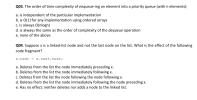 Please answer the following questions. Thank you, will rate!
Q03. The order of time complexity of enqueue-ing an element into a priority queue (with n elements): a. is independent of the particular implementation b. is O(1) for any implementation using ordered arrays c. is always O(nlogn) d. is always the same as the order of complexity of the dequeue operation e. none of the above Q04. Suppose x is a linked-list node and not the last node on the list....
Please answer the following questions. Thank you, will rate!
Q03. The order of time complexity of enqueue-ing an element into a priority queue (with n elements): a. is independent of the particular implementation b. is O(1) for any implementation using ordered arrays c. is always O(nlogn) d. is always the same as the order of complexity of the dequeue operation e. none of the above Q04. Suppose x is a linked-list node and not the last node on the list....
What is the time-complexity of the algorithm abc? Procedure abc(n: integer) s := 0 i :=1...
What is the time-complexity of the algorithm abc? Procedure abc(n: integer) s := 0 i :=1 while i ≤ n s := s+1 i := 2*i return s consider the following algorithm: Procedure foo(n: integer) m := 1 for i := 1 to n for j :=1 to i2m:=m*1 return m c.) Find a formula that describes the number of operations the algorithm foo takes for every input n? d.)Express the running time complexity of foo using big-O/big-
What is the worst case running time of the following pseudo-code. void doSomething(int n, int m)...
What is the worst case running time of the following pseudo-code. void doSomething(int n, int m) { if(m> n) return; System.out.println("m=" + m); doSomething(n, m+2); } A o(n) B O(nlogn) C O(n2) D O(n+m) E None of the above
Which big-O expression best characterizes the worst case time complexity of the following code? public static...
 Which big-O expression best characterizes the worst case time complexity of the following code? public static int foo(int N) ( int count = 0; int i1; while (i <N) C for (int j = 1; j < N; j=j+2) { count++ i=i+2; return count; A. O(log log N) B. O(log N2) C. O(N log N) D. O(N2)
Using C++ please explain What is the Big-O time complexity of the following code: for (int...
 Using C++ please explain
What is the Big-O time complexity of the following code: for (int i=0; i<N; i+=2) { ... constant time operations... Select one: o a. O(n^2) O b. O(log n) c. O(n) O d. 0(1) What is the Big-O time complexity of the following code: for(int i=1; i<N; i*=2) { ... constant time operations... Select one: O O a. O(n^2) b. 0(1) c. O(n) d. O(log n) O What is the Big-O time complexity of the following...
Using C++ please explain
What is the Big-O time complexity of the following code: for (int i=0; i<N; i+=2) { ... constant time operations... Select one: o a. O(n^2) O b. O(log n) c. O(n) O d. 0(1) What is the Big-O time complexity of the following code: for(int i=1; i<N; i*=2) { ... constant time operations... Select one: O O a. O(n^2) b. 0(1) c. O(n) d. O(log n) O What is the Big-O time complexity of the following...
For each code write the time complexity. For each of the following pieces of code, write...
 For each code write the time complexity.
For each of the following pieces of code, write down the time complexity that the code will run in, choosing from O(1), O(log n), O(n), O(n log n), O(n^2): def something (n) for i in range (n) return n Big-O:_____ for i in range (n) for j in range (5) print (i*j) Big-O:______ for i in range (n) for j in range (n n/3, 9): print (i*j) Big-O:_____ for i in range (521313*2213*11);...
For each code write the time complexity.
For each of the following pieces of code, write down the time complexity that the code will run in, choosing from O(1), O(log n), O(n), O(n log n), O(n^2): def something (n) for i in range (n) return n Big-O:_____ for i in range (n) for j in range (5) print (i*j) Big-O:______ for i in range (n) for j in range (n n/3, 9): print (i*j) Big-O:_____ for i in range (521313*2213*11);...
. Big O Notation.Thanks to Reges, Building Java Programs, 2nd edition. Estimate the big-O complexity for...
. Big O Notation.Thanks to Reges, Building Java Programs, 2nd edition. Estimate the big-O complexity for each of these algorithms, and justify your answer. To confirm your calculations, answers are provided at the end of the rubric. Your justification can be mathematical or written, formal or informal. Rubric: Correct Big-O classification of four problems Justification of four problems Big-O categories: 3.1. O(log n). 3.2. O(n). 3.3. O(n2). 3.4. O(1) Problem Code fragment 3.1 int sum = 0; int j =...
 What is the time complexity of the following code segment? for (int i = 0; i<n; i--) if (a[i] != 0) sum = a[i]; What is the time complexity of the following code segment? for (int i = 0; i<10; i++) if (a[i] != 0) sum += a[i]; What is the time complexity of the following code segment? for (int i = 0; i<n/2; i++) if (a[i] != 0) sum += a[i]; What is the time complexity of the following...
 Please answer the following questions. Thank you, will rate!
Q03. The order of time complexity of enqueue-ing an element into a priority queue (with n elements): a. is independent of the particular implementation b. is O(1) for any implementation using ordered arrays c. is always O(nlogn) d. is always the same as the order of complexity of the dequeue operation e. none of the above Q04. Suppose x is a linked-list node and not the last node on the list....
Please answer the following questions. Thank you, will rate!
Q03. The order of time complexity of enqueue-ing an element into a priority queue (with n elements): a. is independent of the particular implementation b. is O(1) for any implementation using ordered arrays c. is always O(nlogn) d. is always the same as the order of complexity of the dequeue operation e. none of the above Q04. Suppose x is a linked-list node and not the last node on the list....
 Which big-O expression best characterizes the worst case time complexity of the following code? public static int foo(int N) ( int count = 0; int i1; while (i <N) C for (int j = 1; j < N; j=j+2) { count++ i=i+2; return count; A. O(log log N) B. O(log N2) C. O(N log N) D. O(N2)
 Using C++ please explain
What is the Big-O time complexity of the following code: for (int i=0; i<N; i+=2) { ... constant time operations... Select one: o a. O(n^2) O b. O(log n) c. O(n) O d. 0(1) What is the Big-O time complexity of the following code: for(int i=1; i<N; i*=2) { ... constant time operations... Select one: O O a. O(n^2) b. 0(1) c. O(n) d. O(log n) O What is the Big-O time complexity of the following...
Using C++ please explain
What is the Big-O time complexity of the following code: for (int i=0; i<N; i+=2) { ... constant time operations... Select one: o a. O(n^2) O b. O(log n) c. O(n) O d. 0(1) What is the Big-O time complexity of the following code: for(int i=1; i<N; i*=2) { ... constant time operations... Select one: O O a. O(n^2) b. 0(1) c. O(n) d. O(log n) O What is the Big-O time complexity of the following...
 For each code write the time complexity.
For each of the following pieces of code, write down the time complexity that the code will run in, choosing from O(1), O(log n), O(n), O(n log n), O(n^2): def something (n) for i in range (n) return n Big-O:_____ for i in range (n) for j in range (5) print (i*j) Big-O:______ for i in range (n) for j in range (n n/3, 9): print (i*j) Big-O:_____ for i in range (521313*2213*11);...
For each code write the time complexity.
For each of the following pieces of code, write down the time complexity that the code will run in, choosing from O(1), O(log n), O(n), O(n log n), O(n^2): def something (n) for i in range (n) return n Big-O:_____ for i in range (n) for j in range (5) print (i*j) Big-O:______ for i in range (n) for j in range (n n/3, 9): print (i*j) Big-O:_____ for i in range (521313*2213*11);...
Most questions answered within 3 hours.
-
Where is the error in this code sequence?
String s1 = "Hello";
String s2 = "ello";...
asked 10 months ago -
Financial data for Joel de Paris, Inc., for last year
follow:
Joel de Paris, Inc.
Balance...
asked 10 months ago -
Consider this reaction:
Al2(SO4)3 (aq)+ BaCl3
(aq) Al2Cl6 (aq)- +
3BaSO4(s) . What is the...
asked 10 months ago -
Suppose that Savneet is considering increasing her
recent random sample from 20 car rentals to 40...
asked 10 months ago -
Trucks arrive at an unloading terminal at an average rate of 120
per hour.
Trucks arrive...
asked 10 months ago -
Why are methanol and ethanol completely soluble in water while
octanol is not very little soluble....
asked 10 months ago -
A facilities manager at a university reads in a research report
that the mean amount of...
asked 10 months ago -
When the CuSO4 is rehydrated by adding water to the anhydrous
compound, is this an endothermic...
asked 10 months ago -
A ray of sunlight is passing from diamond into crown glass; the
angle of incidence is...
asked 10 months ago -
A block of mass 0.249 kg is placed on top of a light, vertical
spring of...
asked 10 months ago -
how do the kidneys compensate in the presences of acidosis
a) trigger hyperventilate
b) reserve acid...
asked 10 months ago -
Question 501 pts
The rental rate of capital to the firm increases. Which of the
following...
asked 10 months ago