In Powerpoint, create a working animated version of the Fei-Ranis model. Lewis model and Fei-Ranis model,...
In Powerpoint, create a working animated version of the Fei-Ranis model. Lewis model and Fei-Ranis model, were presented separately. But as noted, they are compatible, and can fit together. One part of the latter is a simplified version of the former. Therefore, change version of the Fei-Ranis model so that it includes the details shown in the Lewis model. Use this adjusted model to show the progress of the Meiji economy to the Turning Point.
Homework Answers
Fei-Ranis (FR) Model of Double Economy:
The two financial analysts John Fei and Gustav Ranis displayed their double economy model. There was a defect in Lewis model that it didn't give enough consideration to the significance of agri. area in advancing modern development. Be that as it may, Fei-Ranis (FR) model of double economy clarifies how the expanded efficiency in agri. segment would end up supportive in advancing mechanical division. In this regard, it presents three phases whereby a UDC moves from stagnation to self-supported monetary development. Subsequently, this model is treated as an improvement over Lewis model of boundless inventory of work.
Fundamental Theory of the Model:
This hypothesis is worried about a poor economy which has following properties:
(I) There is a bounty of work in such UDC and deficiency of normal assets.
(ii) The populace development rate is extremely high which results in mass joblessness in the economy.
(iii) The significant portion of populace is occupied with agribusiness. Yet, agribusiness area is dormant. Henceforth, the minor efficiency of work is zero and negative in horticulture part.
(iv) There are sure non-agrarian segments in the economy where there is diminished utilization of capital.
(v) There is a powerful modern part in the economy.
Along these lines the model proposes that:
"Monetary improvement would happen if rural workers are moved to modern segment where their profitability will increment".
As we told before that it is a double economy where there is a dormant agri. division and dynamic mechanical part. The circumstance where MPL - 0, work can be moved to mechanical area with no misfortune in horticultural yield. The genuine wages in mechanical division stays fixed and it is equivalent to the underlying degree of genuine pay in agri. area. Such wages are given the name of institutional wages.
Phases of Fei-Ranis Model:
Fei and Ranis build up their double economy model with the assistance of three phases of monetary development. They are displayed as:
Graph/Figure:
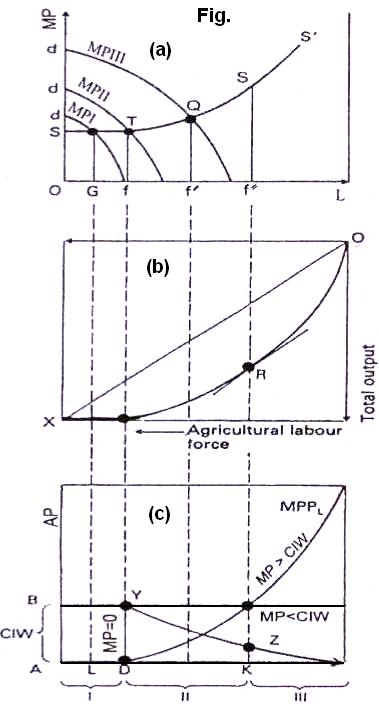
the (a) some portion of the Fig., the work supply bend is consummately versatile, as among S and T. In stage (I) as appeared in (c) some portion of Fig., the MPL = 0. At the end of the day AL = MPL = 0. Be that as it may, here APL = Abdominal muscle. Following Lewis the FR model
contends that Advertisement units of work are the surplus measure of work in agri. area which is prey to camouflaged joblessness. In this manner, they can be pulled back from agri. segment without evolving agri. yield. In stage (II) APL > MPL, yet after Advertisement, MPL starts to rise (c part of Fig). The development of work power in mechanical segment increments from zero to OG (a piece of Fig). The APL in agri. division is appeared by BYZ bend (c part of Fig).
After Advertisement as relocation happens from agri. division to modern area MP, > 0, yet AP[_ falls. This demonstrates an ascent in genuine wages for mechanical works in view of deficiency of nourishment supply. An expansion in genuine wages will diminish benefits and the size of 'excess' which could have reploughed for further industrialization.
The interest in mechanical area (with the surplus earned) will move the MP bend outward right as from aa to bb and afterward to cc. Along these lines agri. division will have the option to dispose of work until the MPL = genuine wages = Abdominal muscle =
consistent institutional pay (CIW) which is acquired by separating the all out agri. yield ORX (b part of Fig) by Promotion measure of work. At the end of the day, the slant of ORX bend speaks to genuine pay rate. In this way the MPL = CIW where the digression to the complete yield line ORX at X is parallel to Bull. In the second stage DK measure of work were utilized. Yet at the same time MPL < CIW or CIW > MPL. It implies that in this stage still a specific measure of work is surplus or they are prey to camouflaged joblessness.
The primary phase of FR model is fundamentally the same as Lewis. Camouflaged joblessness appears on the grounds that the inventory of work is superbly versatile and MPL = 0. Consequently, such masked jobless are to be moved to modern division at the steady institutional pay.
In the second phase of FR model (stage) agri. laborers add to agri. yield yet they produce not exactly institutional pay they get. As such, in the second stage the work surplus exists where APL > MPL, however it isn't equivalent to subsistence (institutional) compensation. Appropriately, such masked jobless additionally must be moved to mechanical area. In the event that the relocation to mechanical area proceeds with a circumstance is in the long run arrived at where the homestead laborers produce yield equivalent to institutional wages. This would imply that efficiency in agri. segment has gone up. With this the third stage (arrange) begins.
In the third phase of FR model the take-off circumstance arrives at an end and there starts the period of self-continued development where the homestead laborers produce more than the institutional pay they get. In this phase of financial development the surplus work reaches an end and the agri. area ends up marketed part. All such is clarified with the Fig.
In like manner, they must be moved to modern segment. As work are moved to mechanical area a deficiency of work will create in agri. segment. At the end of the day, it will be hard for the mechanical part to get the work at same winning steady wages. Accordingly, the wages in the mechanical area will ascend as from T to Q in (a) some portion of Fig.
After point T the turn which happens in the SZ bend is known as "Lewis Defining moment". In the third stage the agri. workers produce more than CIW. (As here MPL > CIW appeared in (c) some portion of Fig). In this stage the take off reaches an end and self-continued development begins. This is otherwise called purpose of commercialization (of agri.) in FR model. Here the economy is completely marketed without camouflaged joblessness. Such commercialization occurred at the expense of retention of camouflaged joblessness in mechanical part.
The sum and time to re-distribute work will rely on:
(I) The pace of development of modern capital which relies on the development of benefits in mechanical part and development of surplus created inside the agri. part.
(ii) The nature and inclination of specialized advancement in industry.
(iii) The pace of development of populace. It implies that the pace of work move must be in overabundance of the pace of development of populace.
The three periods of work move are outlined as:
In stage I: MPL = 0 and there exists the surplus work equivalent to Promotion.
n pnase II: CIW > MPL > 0 and there exists the open and masked joblessness equivalent to AK.
In stage III: MPL > CIW and the economy is completely popularized and masked joblessness is depleted. The inventory of work bend winds up more extreme and both agri. furthermore, modern segment rival each other to get work.
Hence we find that while Lewis had neglected to offer an acceptable clarification of this subsistence division and overlooked the genuine effect of populace development on the decision of capital power on the procedure of surplus work retention. In addition, FR model accentuated upon the concurrent development of agri. what's more, mechanical areas. Subsequently FR model has faith in 'Adjusted Development' in the take-off stage. It implies that there ought to be a concurrent interest in both agri, part and mechanical segment. As indicated by FR model initially the surplus ascents; such surplus will bo accessible as a capital in the take-offstage. Some piece of this surplus will be utilized in agri. advancement, while some part will be reploughed in mechanical improvement. Thus, both agri. what's more, mechanical divisions will develop under 'Adjusted Development' design.
Along these lines, three significant focuses are featured in the FR mode:
(I) Development of agri. is as significant as the development of industry.
(ii) There ought to be a fair development of agri and modern parts.
(iii) The pace of work ingestion must be higher than the pace of populace development to escape the "Malthusian Bad dream".
FR model contended that surplus can be created by the venture exercises of the land rulers and by the monetary proportions of the govt. Be that as it may, spillages could exist in view of the expense of moving the work from agri. part to modern segment as transport cost and working of schools and emergency clinics, and so on. Also, the transference may prompt expanded per capita utilization of agri. yield, and a hole may likewise rise if there should be an occurrence of provincial wages and urban wages. Once more, if the inventory bend of-the work is in reverse bowing, the laborers may lessen their work exertion as their earnings rise.
Analysis:
The FR model is viewed as an improvement over Lewis. This model introduces a reasonable development of both the segments of the economy, the most remarkable thing for the development of UDCs. In spite of this reality, this model has following deficiencies:
(I) Minor Efficiency of Work in Stage I: The FR model is of the view that MFL = 0 in the main period of development, and the exchange of work from agri. would not lessen yield in the agri. part in stage I. However, the business analysts like Berry and Soligo are of the view that agri. yield in stage I of FR model won't stay steady and may fell under various frameworks of land residency, i.e., the worker ownership and offer editing and so on.
(ii) Minimal Profitability of Work isn't Zero: Prof. Jorgenson who has likewise introduced a model of 'double economy' has object FR model's conflict of zero MP in stage I. He says whether MPL will be zero is an observational issue. During the periods of planting and reaping the MPL > 0. Jorgenson finished up based on Japanese information in any event, for the pre I world war period the stockpile of work was not boundless. At that point how MPL can be zero.
(iii) Disregarding The Job of Capital: The FR model concentrated upon land and work as the determinants of yield, overlooking the job of capital. However, Profs. Dark colored, Byres, Frankel, Griffen, Ghatak and Ingersent are of the view that in the UDCs there has happened what is known as 'Green Upset' in agri. which has advanced the more noteworthy utilization of capital and innovation on lands. Thusly, there has been a more prominent increment in the agri. profitability and agri. livelihoods.
(iv) Open Economy: FR model disregarded the job of outside exchange as it accepted a shut economy model. In the second stage when agri. item diminishes the TOT conflicts with modern area. This would happen within the sight of shut economy. Be that as it may, if the model is made open such would not occur as the merchandise could be imported within the sight of then-shortage. This was particularly seen if there should arise an occurrence of Japan which imported modest homestead items to improve her TOT (terms of exchange).
(v) Supply of Land in Since quite a while ago Run: FR model accepted that during the time spent monetary advancement the inventory of land stayed fixed. In any case, it isn't valid. The stockpile of land can be expanded if there should arise an occurrence of since a long time ago run.
(vi) Commercialization Of Agri. Also, Swelling: As per FR model when third stage begins the agri. part ends up marketed. Yet, it is scrutinized by saying that this stage doesn't begin so effectively The moving of work to mechanical division will make work lack in agri. part. This will make lack of nourishment stuff prompting increment their costs. Thusly, the swelling will produce which may block the procedure of advancement.
(vii) Low Profitability in Agri Division: As indicated by Jorgenson it has been seen that there has been an extremely moderate ascent in the efficiency of agri. division. Thusly, the surplus will scarcely be made in agri. segment. As needs be, agri. division won't add to advancement In this way the development necessitates that the surplus must be produced and it should persevere.
The Lewis Model of Monetary Improvement
the Lewis model of monetary improvement.
Various market analysts endeavored to dissect improvement with regards to a 'work surplus economy'. These hypotheses owe their beginning to the praised work of Nobel Laureate Sir W. Arthur Lewis in 1954. An intricate discourse of the work surplus economy is given by G. Ranis and John Fei in 1961.
In 1954 Sir Arthur Lewis distributed a paper, 'Monetary Improvement with boundless supplies of work' (The Manchester School), which has since turned out to be one of the most oftentimes refered to productions by any cutting edge market analyst: its center was a 'double financial matters' — little, urban, industrialized parts of monetary movement encompassed by an enormous, country, conventional segment, similar to moment is to a great extent in an immense sea.
A focal topic of that article was that, work in double economies is accessible to the urban, industrialized division at a steady compensation dictated by least degrees of presence in customary family cultivating as a result of 'masked joblessness in agribusiness, there is basically boundless supply of work and accessible of industrialisation, in any event in the beginning periods of improvement. At some later point throughout the entire existence of double financial aspects, the stockpile of work is depleted then just a rising compensation rate will draw more work out of agribusiness.
With their intense material destitution, it is troublesome from the outset sight to envision how the overpopulated nations can expand their reserve funds without incredible hardships. Despite what might be expected, their surplus populace on the land appears to offer a significant unused potential for development, standing by just for the 'missing part' of outside money to help them all the while.
In addition, their fast paces of populace development loan themselves to figurings of total capital necessities which must be made accessible if their per capita livelihoods are to be kept up or raised.
Says Myint, "With everything taken into account, the dramatization of the poor nations battling at the base subsistence level and the requirement for a gigantic portion of outside cash-flow to break the interlocking horrendous circles which hold them down to that level doesn't achieve its full grievous greatness except if saw against the foundation of overpopulation."
A LDC is imagined to work in two parts:
(1) A conventional agricultural part, and
(2) An a lot littler and furthermore progressively current modern division.
"Surplus work" (or camouflaged joblessness) implies the presence of such a tremendous populace in the farming area that the negligible result of work is zero. Along these lines, if a couple of laborers are expelled from land, the all out item stays unaltered.
The quintessence of the advancement procedure in such an economy is "the exchange of work assets from the agrarian part, where they don't add anything to generation, to the more present day modern area, where they make a surplus that might be utilized for further development and improvement."
In Lewis model the change procedure or the procedure of basic change begins by a self-sufficient development sought after in industry because of changes in household purchaser tastes, in government buys, or in universal markets.
The main issue is that work (here thought about homogeneous and incompetent) shifts from agribusiness into industry. The stockpile of work from agribusiness to industry is "boundless" (i.e., totally flexible) at the given urban compensation (around 30 to half higher than the provincial pay), attributable to the general sire of the horticultural work powers at the edge.
The marvel is every now and again named "masked joblessness in farming". Repetitive supplies of untalented work to industry at existing wages hold down modern work costs. Be that as it may, more appeal and more significant expenses in industry bring about higher benefits.
At the point when these benefits are furrowed once again into mechanical capital arrangement, interest for modern yield (both for utilization merchandise by recently utilized specialists and speculation by entrepreneurs) rises, bringing on additional movements of work out of horticulture into industry.
The procedure stops when agrarian efficiency ascends to a point where the stock cost of work to industry increments, i.e., a time when rural options of yield and pay are adequately attractive to the future mechanical laborers to keep them in cultivating. Without rustic urban contrasts in the typical cost for basic items, this happens when the peripheral result of work in the two parts are equivalent.
Lewis hypothesizes the presence of a subsistence segment with surplus work and he finds in this the seed for the subsistence area. One significant characteristic of the industrialist division is that it utilizes reproducible capital and that it produces benefit.
Since there is surplus work from the subsistence division, the industrialist area draws its work from the subsistence part and it is expected that because of fast increments in populace in as of now thickly populated nations the inventory of untalented work is boundless.
So capitalists can get in any event, expanding supplies of such work at the current compensation rate, i.e., they won't need to raise wages to draw in more work. In this way, the industrialist area can extend uncertainly at a steady compensation rate for the untalented work.
The genuine (advertise) wage rate will be controlled by profit in the subsistence division. Be that as it may, 'profit' here means the normal item and not the negligible one, in subsistence segment gets an equivalent portion of what is delivered.
Lewis has accepted and pointed out that business people should pay an edge of about 30% better than expected subsistence pay, in light of the fact that the surplus laborers need some motivation to move and regardless piece of the thing that matters is expected to remunerate them for the greater expense of living in urban territories.
Another point to note is that in the subsistence division work is utilized up to the point where its minor item is zero. Conversely, in the entrepreneur area work might be utilized up to the point where its minor item rises to the compensation rate—the well-known relationship got from the negligible efficiency hypothesis. On the off chance that wages surpass minimal productivity an industrialist business would diminish his surplus since he paid work more than he got for what was created.
This surplus is the way in to the Lewis model of advancement. In Fig. 14 operating system is the normal result of the subsistence division—the sum a man would get there. Here, OW is the industrialist wage.
We start with a fixed amount of capital, and in this circumstance the interest for work is spoken to by the minimal profitability timetable of work NQ. Under benefit boosting conditions, work will be applied to the point where the compensation, W, rises to minor profitability, i.e., Q1, corresponding to Oa number of laborers. Laborers in abundance of Oa will win whatever they can in the subsistence part.
Improvement happens since some portion of what is created collects to the entrepreneur as an overflow (WN, Q1 in Fig.14). This sum is reinvested. This reinvestment delivers an expansion in the measure of fixed capital and causes a move in the peripheral result of work bend structure N1Q1 to N2Q2 in the following time frame.
The Lewis Model
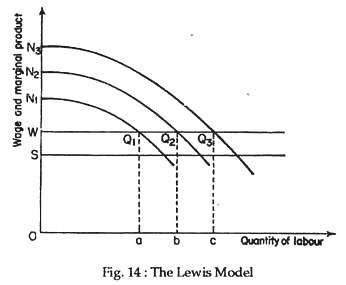
More work will presently be utilized and the surplus builds, prompting a further move of the bend to N3Q3, making more work be attracted from the subsistence area has been drawn into the entrepreneur sector. At the point when that happens pay in the subsistence area will begin to rise, making compensation in the industrialist segment rise, and afterward the main period of advancement will have stopped as the inventory bend of work has stopped to be horizontal, yet has turned up wards.
Reactions:
The Lewis model is near the Ricardian one. It ignores the focal worry of Ricardo: how the cost of nourishment is to be held down. On the off chance that it he accepted, notwithstanding, that the inventory of work to industry is interminably flexible at a relentless compensation on account of surplus work in farming, this can help clarify beginning advancement which arrives at an end when wages begin to ascend with expanded capital development.
Generally, the model misses one significant point:
"A departure of work from farming raising wages there applies weight for legitimization of horticultural innovation for the presentation of apparatus and other capital-concentrated techniques, for example, manure. Efficiency increments in industry cooperate with profitability increments in agribusiness after the stockpile of work has been drawn down."
The Lewis model starts with the old style of Marx, yet finishes with an a lot more joyful neo-traditional outcome. Introductory development in the double economy is to a great extent as expanded benefits made accessible from underpayment of wages. Rather than the unavoidable emergencies of Marx, in any case, the double economy of Lewis in the end runs easily as a solitary economy under neo-old style rules.
The contrasts between the entrepreneur and non-industrialist divisions are eliminated by their mutual work lack. Lewis' central matter is that inevitable more extensive spread monetary development and improvement can be fuelled by introductory huge supplies of modest work that outcome from the underlying state of financial duality.
The Lewis model was deciphered all through the third world as justifying an import finishing, industrialisation development procedure and must therefore be given a portion of the fault, through no shortcoming of the creator, for the disregard of rustic improvement in the organizations of Africa, Asia and Latin America which has been singled out as the extraordinary embarrassment of advancement during the 1970s. D. W. Jorgenson has given a neo-traditional clarification of the improvement of 'dualism' in LDCs, dismissing Lewis' persuasive hypothesis of 'monetary advancement with boundless supplies of work'.
It is to be noticed that in spite of the fact that the Lewis model of advancement is both straightforward and generally in congruity with the chronicled understanding of monetary development in the West, it has three key suspicions which are pointedly conversely with the substances of underdevelopment in most Third World countries.
In the first place, the model certainly accept that the pace of work move and business creation is relative to the pace of capital aggregation. In this way, if there happens work sparing capital gathering, the business implications of the model will be adjusted.
Second, the model expect that 'excess' work exists in provincial zones while there is full work in the urban regions. Actually, precisely the switch is valid in LDCs: there is generous open joblessness in urban zones however no broad surplus work in provincial areas.
The third key suspicion at difference with the truth is the thought of the proceeded with presence of consistent genuine urban wages until the inventory of little surplus work is depleted. Says M.P. Todaro, "One of the most striking highlights of the urban pay circumstance in practically all creating nations, notwithstanding, has been the propensity for these wages to rise considerably, both in outright terms and comparative with normal provincial salaries, even within the sight of rising degrees of open joblessness."
The work sparing predisposition of present day mechanical exchange upheld by the across the board non-presence of provincial surplus work, the predominance of 'urban surplus' work, and the propensity for urban open joblessness exists, propose that the Lewis model offers minimal logical and strategy direction for taking care of business issues in labor-surplus LDCs.
"By and by", finishes up M. P. Todaro, "the model has some diagnostic incentive in that it underlines two significant components of the business issue: the auxiliary and monetary contrasts between the rustic and the urban divisions, and the focal significance of the procedure of work move between them."
Monetary Advancement under Sovereign Meiji
From the get-go in the rule of Head Meiji, Japan's legislature was resolved to modernize the nation's economy. The economy was fundamentally agrarian, with just 20 percent of its property reasonable for development and tea and silk as significant fares. In 1871, the administration liberated ranchers from confinements ashore use, enabling them to develop anything they desired, and in 1872 it conceded individuals the privilege to purchase and sell land. The administration put resources into agribusiness, setting up horticultural schools, building up a test ranch and furnishing ranchers with specialized exhortation. Improvement in seed strains was made and in planting methods. There was an expansion being used of composts, improved bug control and an augmentation of water system frameworks.
The development of the horticultural area of the economy helped make conceivable the development in Japan's assembling, with ranchers making good on the regulatory expenses that made incomes that the administration utilized for putting resources into modern advancement. Japan's legislature and its industrialists, the zaibatsu, guided the country monetarily. Japan was building up its ventures at a quick pace, to a great extent in light of the fact that the administration needed to make Japan a noteworthy military influence, with its motto "rich nation, solid armed force." Shipbuilding initiated. Japan's administration energized the structure of railways crosswise over a significant part of the country and empowered the making of a transmit system and delivery lines. An advanced financial framework was created. The material and silk ventures extended quickly.
In all out populace, Japan was only somewhat in front of England, Japan's populace ascending from 35 million out of 1873 to 43.8 million of every 1900 – 58 percent of the U.S. populace, at 75.9 million out of 1900. Be that as it may, just 8.6 percent of Japan's populace was urbanized in 1900, contrasted with 32.8 percent for England, 18.7 percent for the US, 15.5 percent for Germany and 13.3 percent for France.
Workers endured during Japan's quick industrialization, as workers had in Europe and the US during their mechanical transformations. Excavators lived in military enclosure and worked 12 hours every day for little pay and within the sight of gatekeepers who didn't enable them to loosen their pace of work – at temperatures that may reach as high as 130 degrees Fahrenheit. For mechanical development the Meiji government upheld the industrialists and was against strikes. In any case, strikes happened, for example, that of 100 female laborers at a cotton plant. Also, strikes kept on developing as far as possible of the century, while the administration made strike arranging a wrongdoing.
During the Meiji time frame (1868-1912), riches focus happened in rural zones. Sixty-seven percent of all laborer families were crashed into tenure.
the ranch profitability stagnated. As inhabitants had to pay over a large portion of their yield as lease, they were regularly compelled to send spouses and girls to material plants or to offer little girls into prostitution to make good on for government expenses.
ndustrialization and the administration giving free rule to business interests were restricted by certain Buddhists from their situation of reduced impact. Such Buddhists saw aspiration for material things and cash as something that individuals ought to deny themselves. Also, a few Confucianists were upset about the independence and utilitarianism that went with Japan's transformation.
The Meiji time frame that pursued the Rebuilding was a time of major political, monetary, and social change in Japan. The changes ordered during the Meiji sovereign's standard achieved the modernization and Westernization of the nation and prepared for Japan to turn into a significant global power. Among different achievements, during the Meiji time frame Japan embraced a constitution and a parliamentary framework, organized all inclusive training, constructed railways and introduced transmit lines, and set up solid armed force and naval force powers.
Obstruction and Resistance Crushed
In spite of the fact that these progressions were made for the sake of the sovereign and national protection, the loss of benefits brought some hatred and resistance. At the point when the top administration left to go in Europe and the US to think about Western routes in 1872, traditionalist gatherings contended that Japan should answer to Korean's refusal to amend a centuries old settlement with an intrusion. This would assist energetic samurai with regaining their significance. In any case, the new pioneers immediately came back from Europe and restored their control, contending that Japan should focus without anyone else modernization and not participate in such outside undertakings.
For the following twenty years, during the 1870s and 1880s, the top need stayed household change planned for changing Japan's social and monetary foundations along the lines of the model gave by the incredible Western countries. The last hit to moderate samurai came in the 1877 Satsuma disobedience, when the administration's recently drafted armed force, prepared in European infantry systems and furnished with present day Western weapons, vanquished the last opposition of the customary samurai warriors. Except for these couple of samurai flare-ups, Japan's household change continued with noteworthy speed, vitality, and the collaboration of the individuals. This marvel is one of the significant attributes of Japan's cutting edge history.
Belief system
With an end goal to join the Japanese country because of the Western test, the Meiji pioneers made a community belief system revolved around the sovereign. In spite of the fact that the sovereign employed no political power, he had for quite some time been seen as an image of Japanese culture and recorded congruity. He was the leader of the Shintô religion, Japan's local religion. Among different convictions, Shintô holds that the ruler is slipped from the sun goddess and the divine beings who made Japan and in this way is semidivine. Westerners of that time knew him basically as a stately figure. The Meiji reformers brought the head and Shintô to national unmistakable quality, supplanting Buddhism as the national religion, for political and ideological reasons. By partner Shintô with the magnificent line, which ventured once more into amazing occasions, Japan had not just the most established managing house on the planet, however a ground-breaking image of age-old national solidarity.
The individuals only from time to time observed the sovereign, yet they were to do his requests beyond a shadow of a doubt, in respect to him and to the solidarity of the Japanese individuals, which he spoke to. Truth be told, the ruler didn't run the show. It was his "counselors," the little gathering of men who practiced political control, that contrived and completed the change program for the sake of the ruler.
Social and Monetary Changes
The abrogation of feudalism made conceivable colossal social and political changes. A large number of individuals were all of a sudden allowed to pick their occupation and move about without limitations. By giving another condition of political and money related security, the administration made conceivable interest in new businesses and innovations.
The administration drove the path in this, building railroad and delivering lines, broadcast and phone frameworks, three shipyards, ten mines, five weapons works, and fifty-three shopper ventures (making sugar, glass, materials, concrete, synthetic concoctions, and other significant items). This was pricey, be that as it may, and stressed government funds, so in 1880 the administration chose to offer the greater part of these ventures to private speculators, from there on empowering such movement through appropriations and different motivating forces. A portion of the samurai and traders who constructed these businesses set up major corporate aggregates called zaibatsu, which controlled a lot of Japan's cutting edge mechanical division.
The administration additionally presented a national instructive framework and a constitution, making a chosen parliament called the Eating routine. They did this to give a decent situation to national development, win the regard of the Westerners, and construct support for the advanced state. In the Tokugawa time frame, prominent training had spread quickly, and in 1872 the administration built up a national framework to instruct the whole populace. Before the finish of the Meiji time frame, nearly everybody went to the free government funded schools for at any rate six years. The administration firmly controlled the schools, ensuring that notwithstanding abilities like arithmetic and perusing, all understudies considered "moral preparing," which focused on the significance of their obligation to the head, the nation and their families.
The 1889 constitution was "given" to the individuals by the sovereign, and just he (or his guides) could transform it. A parliament was chosen starting in 1890, yet just the wealthiest one percent of the populace could cast a ballot in races. In 1925 this was changed to permit all men (yet not yet ladies) to cast a ballot.
To win the acknowledgment of the Western powers and persuade them to change the inconsistent bargains the Japanese had been compelled to sign during the 1850s, Japan changed its whole legitimate framework, receiving another lawbreaker and common code demonstrated after those of France and Germany. The Western countries at last consented to amend the settlements in 1894, recognizing Japan as an equivalent on a basic level, in spite of the fact that not in worldwide power.
The Worldwide Atmosphere: Imperialism and Extension
In 1894 Japan battled a war against China over its enthusiasm for Korea, which China asserted as a vassal state. The Korean landmass is the nearest some portion of Asia to Japan, under 100 miles via ocean, and the Japanese were stressed that the Russians may oversee that frail country. Japan won the war and dealt with Korea and picked up Taiwan as a settlement. Japan's abrupt, conclusive triumph over China shocked the world and stressed some European forces.
As of now the European countries were starting to guarantee extraordinary rights in China — the French, with their province in Indochina (the present Vietnam, Laos, and Cambodia), were engaged with South China; the English additionally asserted exceptional rights in South China, close Hong Kong, and later the entire Yangtze valley; and the Russians, who were building
How was the Meiji Reclamation a defining moment?
Meiji Reclamation seen as defining moment for industrialisation. ... The Meiji Reclamation of 1868 was a rebellion by a band of disillusioned youthful samurai warriors and nobles to topple the Tokugawa shogunate, a military government, and to reestablish the Sovereign as the country's head of state
How did the Meiji Reclamation change Japan quizlet?
The settlement finished Japan's disconnection. Besides, ports were open and the ruler's capacity was reestablished. ... It occured prior on the grounds that the Meiji changes were resolved to reinforce Japan against the West. Individuals from the administration voyaged and received Western government, financial aspects, innovation, and traditions.
Was the Meiji Reclamation effective?
The most significant factor that prompted the accomplishment of the Meiji Rebuilding was the adaptable political structure the Meiji Theocracy received to satisfy various objectives of modernization at the same time. ... The Meiji Reclamation will be set from 1868 to 1912, under the Meiji sovereign...
Add Answer to:
In Powerpoint, create a working animated version of the
Fei-Ranis model. Lewis model and Fei-Ranis model,...
I need Summary of this Paper i dont need long summary i need What methodology they used , what is the purpose of this...
 I need Summary of this Paper i dont need long summary i need
What methodology they used , what is the purpose of this paper and
some conclusions and contributes of this paper. I need this for my
Finishing Project so i need this ASAP please ( IN 1-2-3 HOURS
PLEASE !!!)
SPECIAL ARTICLES tole of Monetary Policy C Rangarajan What should be the objectives of monetary policy? Does the objective of price stability conflict with the goal of achieving...
I need Summary of this Paper i dont need long summary i need
What methodology they used , what is the purpose of this paper and
some conclusions and contributes of this paper. I need this for my
Finishing Project so i need this ASAP please ( IN 1-2-3 HOURS
PLEASE !!!)
SPECIAL ARTICLES tole of Monetary Policy C Rangarajan What should be the objectives of monetary policy? Does the objective of price stability conflict with the goal of achieving...
Discussion questions 1. What is the link between internal marketing and service quality in the ai...
 Discussion questions
1. What is the link between internal marketing and service
quality in the airline industry?
2. What internal marketing programmes could British Airways
put into place to avoid further internal unrest? What potential is
there to extend auch programmes to external partners?
3. What challenges may BA face in implementing an internal
marketing programme to deliver value to its customers?
(1981)ǐn the context ofbank marketing ths theme has bon pururd by other, nashri oriented towards the identification of...
Discussion questions
1. What is the link between internal marketing and service
quality in the airline industry?
2. What internal marketing programmes could British Airways
put into place to avoid further internal unrest? What potential is
there to extend auch programmes to external partners?
3. What challenges may BA face in implementing an internal
marketing programme to deliver value to its customers?
(1981)ǐn the context ofbank marketing ths theme has bon pururd by other, nashri oriented towards the identification of...
I need Summary of this Paper i dont need long summary i need What methodology they used , what is the purpose of this p...
 I need Summary of this Paper i dont need long summary i need
What methodology they used , what is the purpose of this paper and
some conclusions and contributes of this paper. I need this for my
Finishing Project so i need this ASAP please ( IN 1-2-3 HOURS
PLEASE !!!)
Budgetary Policy and Economic Growth Errol D'Souza The share of capital expenditures in government expenditures has been slipping and the tax reforms have not yet improved the income...
I need Summary of this Paper i dont need long summary i need
What methodology they used , what is the purpose of this paper and
some conclusions and contributes of this paper. I need this for my
Finishing Project so i need this ASAP please ( IN 1-2-3 HOURS
PLEASE !!!)
Budgetary Policy and Economic Growth Errol D'Souza The share of capital expenditures in government expenditures has been slipping and the tax reforms have not yet improved the income...
How can we assess whether a project is a success or a failure? This case presents...
 How can we assess whether a project is a success or a
failure?
This case presents two phases of a large business transformation project involving the implementation of an ERP system with the aim of creating an integrated company. The case illustrates some of the challenges associated with integration. It also presents the obstacles facing companies that undertake projects involving large information technology projects. Bombardier and Its Environment Joseph-Armand Bombardier was 15 years old when he built his first snowmobile...
How can we assess whether a project is a success or a
failure?
This case presents two phases of a large business transformation project involving the implementation of an ERP system with the aim of creating an integrated company. The case illustrates some of the challenges associated with integration. It also presents the obstacles facing companies that undertake projects involving large information technology projects. Bombardier and Its Environment Joseph-Armand Bombardier was 15 years old when he built his first snowmobile...
4. Perform a SWOT analysis for Fitbit. Based on your assessment of these, what are some strategic options for Fitbit go...
 4. Perform a SWOT analysis for Fitbit. Based on your
assessment of these, what are some strategic options for Fitbit
going forward?
5. Analyze the company’s financial performance. Do trends
suggest that Fitbit’s strategy is working?
6.What recommendations would you make to Fitbit management to
address the most important strategic issues facing the
company?
Fitbit, Inc., in 2017: Can Revive Its Strategy and It Reverse Mounting Losses? connect ROCHELLE R. BRUNSON Baylor University MARLENE M. REED Baylor University in the...
4. Perform a SWOT analysis for Fitbit. Based on your
assessment of these, what are some strategic options for Fitbit
going forward?
5. Analyze the company’s financial performance. Do trends
suggest that Fitbit’s strategy is working?
6.What recommendations would you make to Fitbit management to
address the most important strategic issues facing the
company?
Fitbit, Inc., in 2017: Can Revive Its Strategy and It Reverse Mounting Losses? connect ROCHELLE R. BRUNSON Baylor University MARLENE M. REED Baylor University in the...
 I need Summary of this Paper i dont need long summary i need
What methodology they used , what is the purpose of this paper and
some conclusions and contributes of this paper. I need this for my
Finishing Project so i need this ASAP please ( IN 1-2-3 HOURS
PLEASE !!!)
SPECIAL ARTICLES tole of Monetary Policy C Rangarajan What should be the objectives of monetary policy? Does the objective of price stability conflict with the goal of achieving...
I need Summary of this Paper i dont need long summary i need
What methodology they used , what is the purpose of this paper and
some conclusions and contributes of this paper. I need this for my
Finishing Project so i need this ASAP please ( IN 1-2-3 HOURS
PLEASE !!!)
SPECIAL ARTICLES tole of Monetary Policy C Rangarajan What should be the objectives of monetary policy? Does the objective of price stability conflict with the goal of achieving...
 Discussion questions
1. What is the link between internal marketing and service
quality in the airline industry?
2. What internal marketing programmes could British Airways
put into place to avoid further internal unrest? What potential is
there to extend auch programmes to external partners?
3. What challenges may BA face in implementing an internal
marketing programme to deliver value to its customers?
(1981)ǐn the context ofbank marketing ths theme has bon pururd by other, nashri oriented towards the identification of...
Discussion questions
1. What is the link between internal marketing and service
quality in the airline industry?
2. What internal marketing programmes could British Airways
put into place to avoid further internal unrest? What potential is
there to extend auch programmes to external partners?
3. What challenges may BA face in implementing an internal
marketing programme to deliver value to its customers?
(1981)ǐn the context ofbank marketing ths theme has bon pururd by other, nashri oriented towards the identification of...
 I need Summary of this Paper i dont need long summary i need
What methodology they used , what is the purpose of this paper and
some conclusions and contributes of this paper. I need this for my
Finishing Project so i need this ASAP please ( IN 1-2-3 HOURS
PLEASE !!!)
Budgetary Policy and Economic Growth Errol D'Souza The share of capital expenditures in government expenditures has been slipping and the tax reforms have not yet improved the income...
I need Summary of this Paper i dont need long summary i need
What methodology they used , what is the purpose of this paper and
some conclusions and contributes of this paper. I need this for my
Finishing Project so i need this ASAP please ( IN 1-2-3 HOURS
PLEASE !!!)
Budgetary Policy and Economic Growth Errol D'Souza The share of capital expenditures in government expenditures has been slipping and the tax reforms have not yet improved the income...
 How can we assess whether a project is a success or a
failure?
This case presents two phases of a large business transformation project involving the implementation of an ERP system with the aim of creating an integrated company. The case illustrates some of the challenges associated with integration. It also presents the obstacles facing companies that undertake projects involving large information technology projects. Bombardier and Its Environment Joseph-Armand Bombardier was 15 years old when he built his first snowmobile...
How can we assess whether a project is a success or a
failure?
This case presents two phases of a large business transformation project involving the implementation of an ERP system with the aim of creating an integrated company. The case illustrates some of the challenges associated with integration. It also presents the obstacles facing companies that undertake projects involving large information technology projects. Bombardier and Its Environment Joseph-Armand Bombardier was 15 years old when he built his first snowmobile...
 4. Perform a SWOT analysis for Fitbit. Based on your
assessment of these, what are some strategic options for Fitbit
going forward?
5. Analyze the company’s financial performance. Do trends
suggest that Fitbit’s strategy is working?
6.What recommendations would you make to Fitbit management to
address the most important strategic issues facing the
company?
Fitbit, Inc., in 2017: Can Revive Its Strategy and It Reverse Mounting Losses? connect ROCHELLE R. BRUNSON Baylor University MARLENE M. REED Baylor University in the...
4. Perform a SWOT analysis for Fitbit. Based on your
assessment of these, what are some strategic options for Fitbit
going forward?
5. Analyze the company’s financial performance. Do trends
suggest that Fitbit’s strategy is working?
6.What recommendations would you make to Fitbit management to
address the most important strategic issues facing the
company?
Fitbit, Inc., in 2017: Can Revive Its Strategy and It Reverse Mounting Losses? connect ROCHELLE R. BRUNSON Baylor University MARLENE M. REED Baylor University in the...
Most questions answered within 3 hours.
-
Where is the error in this code sequence?
String s1 = "Hello";
String s2 = "ello";...
asked 10 months ago -
Financial data for Joel de Paris, Inc., for last year
follow:
Joel de Paris, Inc.
Balance...
asked 10 months ago -
Consider this reaction:
Al2(SO4)3 (aq)+ BaCl3
(aq) Al2Cl6 (aq)- +
3BaSO4(s) . What is the...
asked 10 months ago -
Suppose that Savneet is considering increasing her
recent random sample from 20 car rentals to 40...
asked 10 months ago -
Trucks arrive at an unloading terminal at an average rate of 120
per hour.
Trucks arrive...
asked 10 months ago -
Why are methanol and ethanol completely soluble in water while
octanol is not very little soluble....
asked 10 months ago -
A facilities manager at a university reads in a research report
that the mean amount of...
asked 10 months ago -
When the CuSO4 is rehydrated by adding water to the anhydrous
compound, is this an endothermic...
asked 10 months ago -
A ray of sunlight is passing from diamond into crown glass; the
angle of incidence is...
asked 10 months ago -
A block of mass 0.249 kg is placed on top of a light, vertical
spring of...
asked 10 months ago -
how do the kidneys compensate in the presences of acidosis
a) trigger hyperventilate
b) reserve acid...
asked 10 months ago -
Question 501 pts
The rental rate of capital to the firm increases. Which of the
following...
asked 10 months ago