Two identical objects are in thermal contact. One is at a high temperature (T-hot) and the...
Two identical objects are in thermal contact. One is at a high temperature (T-hot) and the other is at a cool temperature (T-cool). Assume that this system is isolated, i.e. there is no interaction with the surroundings. Using the thermodynamic definition of entropy, explain why heat always flows from T-hot to T-cool, and never the other way around.
Homework Answers


Add Answer to:
Two identical objects are in thermal contact. One is at a high
temperature (T-hot) and the...
When two objects are in thermal contact heat energy is transferred from the hot to the...
When two objects are in thermal contact heat energy is transferred from the hot to the cold object until the temperature of both becomes equal (i.e., the objects are in thermal equilibrium). Suppose you pour 20-gram milk at 200C into a cup of 80-gram tea at 920C. Assume the specific heat of tea is 4.2 J/gram.0K and that of milk is 3.9 J/gram.0K Assuming no heat is lost into the surrounding air what is the temperature of the tea and...
Objects A and B of equal mass are brought into close thermal contact with each other,...
Objects A and B of equal mass are brought into close thermal contact with each other, but they are well isolated from their surroundings. Initially TA = 0°C and TB = 100°C. The specific heat of A is the same as the specific heat of B. The two objects will soon reach a common final temperature Tf. The final temperature is: a. Tf > 50°C. b. Tf < 50°C. c. Tf = 50°C.
An isolated system consists of two very large thermal reservoirs, one hot and one cold, with...
An isolated system consists of two very large thermal reservoirs, one hot and one cold, with constant temperatures of 373 K and 273 K, respectively. If 1000 J of heat were to flow from the cold reservoir to the hot reservoir spontaneously, (a) what would be the change in entropy of the hot reservoir? (b) of the cold reservoir? (c) What would be the total change in entropy of the isolated system? (d) could the process take place naturally?
Two objects are maintained at constant temperatures, one hot and one cold. Two identical bars can...
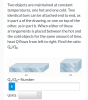 Two objects are maintained at constant temperatures, one hot and one cold. Two identical bars can be attached end to end, as in part a of the drawing, or one on top of the other, as in part b. When either of these arrangements is placed between the hot and the cold objects for the same amount of time, heat Q flows from left to right. Find the ratio Qa/Qb. (b) Qa/Qb= Number i Units
2. Consider a macroscopic system of two blocks that are in thermal contact. The two-block system ...
 2. Consider a macroscopic system of two blocks that are in thermal contact. The two-block system is isolated from the rest of the universe. Initially, a hotter block is at a temperature TH and a colder block is at a temperature Tc. In the final state of the system, the two blocks are at the same intermediate temperature T. Compare the following quantities for the matal state and final state: Entropy for the block that starts at TH Sf> Si...
Two initially separated objects, make thermal contact, m_1, c_1 and T_1 are respectively the mass, specific...
Two initially separated objects, make thermal contact, m_1, c_1 and T_1 are respectively the mass, specific heat and temperature of the first object and m_2, c_2 and T_2 are respectively the corresponding of the second object. The initial temperatures are T_20 <T_10. While body 1 slowly cools, 2 heats up slowly. a) Calculate T_2 (T_1) b) Find the change in deltropy entropy as a function of T_1 c) show that deltaS is a maximum when both bodies reach thermal equilibrium
Problem 8: Two amounts of salt water at different temperatures are brought into thermal contact with...
 Problem 8: Two amounts of salt water at different temperatures are brought into thermal contact with each other and mixed thoroughly. The first amount of water has mass m, = 0.302 kg and its initial temperature is T, = 7.61 °C. The second has a mass of m2 = 0.873 kg and an initial temperature of T2 = 34.5 °C. Assume that the system is isolated. Let the specific heat of the water at this salinity to be Cw=0.84 kcal...
Two containers, one at 305 K and the other at 295 K, are placed in contact...
Two containers, one at 305 K and the other at 295 K, are placed in contact with each other. a. 1 J of heat flows from the hot container to the cold container. Find the change in entropy of the hot container and the cold container, and of the whole system (hot + cold container together). Does this process violate the second law of thermodynamics? b. 1 J of heat flows from the cold container to the hot container. Find...
Two identical cylindrical rods except one has a thermal conductivity k1 and the other k2. The...
Two identical cylindrical rods except one has a thermal conductivity k1 and the other k2. The rods are placed end to end between the two walls that are 1m apart and maintained at different temperatures, Tw and Tc. T3 the interface temperature, is halfway between the walls. If k2 = 0.5k1 and the heat flows only along the lengths of the rod determine the temperature T3. (Please calculate to final).
1. Hot air rises - this causes upward heat transfer and is one of the most...
1. Hot air rises - this causes upward heat transfer and is one of the most familiar forms of convection. Why does air cool as it rises this way? 2. (H16.17) Since all objects emit energy to their surroundings, why don’t the temperatures of all objects continuously decrease? 3. (H16.25) Does Newton’s law of cooling apply to warming a well as to cooling? 4. (H17.4) Why is evaporation a cooling process? 5. (H17.19) When will water boil at a temperature...
 Two objects are maintained at constant temperatures, one hot and one cold. Two identical bars can be attached end to end, as in part a of the drawing, or one on top of the other, as in part b. When either of these arrangements is placed between the hot and the cold objects for the same amount of time, heat Q flows from left to right. Find the ratio Qa/Qb. (b) Qa/Qb= Number i Units
 2. Consider a macroscopic system of two blocks that are in thermal contact. The two-block system is isolated from the rest of the universe. Initially, a hotter block is at a temperature TH and a colder block is at a temperature Tc. In the final state of the system, the two blocks are at the same intermediate temperature T. Compare the following quantities for the matal state and final state: Entropy for the block that starts at TH Sf> Si...
 Problem 8: Two amounts of salt water at different temperatures are brought into thermal contact with each other and mixed thoroughly. The first amount of water has mass m, = 0.302 kg and its initial temperature is T, = 7.61 °C. The second has a mass of m2 = 0.873 kg and an initial temperature of T2 = 34.5 °C. Assume that the system is isolated. Let the specific heat of the water at this salinity to be Cw=0.84 kcal...
Most questions answered within 3 hours.
-
Where is the error in this code sequence?
String s1 = "Hello";
String s2 = "ello";...
asked 10 months ago -
Financial data for Joel de Paris, Inc., for last year
follow:
Joel de Paris, Inc.
Balance...
asked 10 months ago -
Consider this reaction:
Al2(SO4)3 (aq)+ BaCl3
(aq) Al2Cl6 (aq)- +
3BaSO4(s) . What is the...
asked 10 months ago -
Suppose that Savneet is considering increasing her
recent random sample from 20 car rentals to 40...
asked 10 months ago -
Trucks arrive at an unloading terminal at an average rate of 120
per hour.
Trucks arrive...
asked 10 months ago -
Why are methanol and ethanol completely soluble in water while
octanol is not very little soluble....
asked 10 months ago -
A facilities manager at a university reads in a research report
that the mean amount of...
asked 10 months ago -
When the CuSO4 is rehydrated by adding water to the anhydrous
compound, is this an endothermic...
asked 10 months ago -
A ray of sunlight is passing from diamond into crown glass; the
angle of incidence is...
asked 10 months ago -
A block of mass 0.249 kg is placed on top of a light, vertical
spring of...
asked 10 months ago -
how do the kidneys compensate in the presences of acidosis
a) trigger hyperventilate
b) reserve acid...
asked 10 months ago -
Question 501 pts
The rental rate of capital to the firm increases. Which of the
following...
asked 10 months ago