Explain addresses in C++ and pointers. What is the difference between the pointer (*) symbol, the...
Explain addresses in C++ and pointers.
What is the difference between the pointer (*) symbol, the deference operator (&) ?
Include 30 words
Homework Answers
An address of a variable defines the location where the variable is stored.
For example :
int a =20;
This means a is a variable which is stored in memory with a value of 20.
To get the address of the variable, we use & operator.
Consider the following segment :
#include <iostream>
using namespace std;
int main() {
int a = 20;
cout << &a;
}
The value which is printed is the address of the variable a. This address which is displayed in the console is a logical address and not physical address. Thus, the logical address is transformed into physical address by operating system using memory management unit ( M.M.U.) and then this physical address in the memory stores the variable a with value 20.
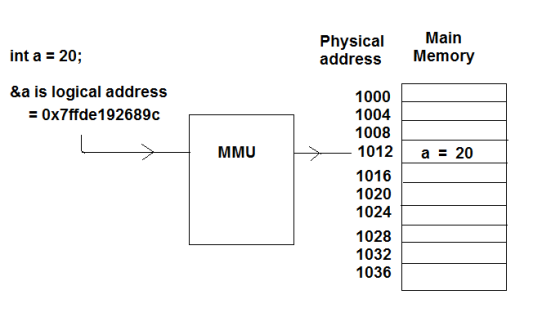
In the above figure, the logical address 0x7ffde192689c is mapped to physical address 1012 of the main memory using MMU.
Difference between (*) symbol and ( & ) operator :
The (*) is called the dereference operator. This is used to return value stored in a particular memory location. In other words, it returns the value that the pointer pointing to a variable is holding.
For example :
int a = 20;
int *p;
p = &a;
cout << *p
This (*) operator will return the value of the variable whose address is stored in pointer p. Thus, *p will give the output 20.
(&) operator is called an address of operator as it stores the address of a variable with a particular value.
In the following segment :
int a = 20;
cout << &a;
&a will give the address of the variable a and it actually tells where in memory the variable a is located with value 20.
Add Answer to:
Explain addresses in C++ and pointers.
What is the difference between the pointer (*)
symbol, the...
I have some questions about pointers/pointer arithmetic in C++ 1) Pointers and Pointer Arithmetic a.) What...
I have some questions about pointers/pointer arithmetic in C++ 1) Pointers and Pointer Arithmetic a.) What is the difference between statically allocated arrays and dynamically allocated arrays (be brief) b.) Which of the following pointers can be used for a dynamically allocated array? (Circle) char ptr; char * ptr; char ptr *; char ptr[]; char [] ptr; c.) Show now, using that pointer, how to dynamically allocate array of characters of size 10: (don't use malloc) d.) Which of the...
Lab 8 CS102 Lab 8 Hands on programming with Pointers The goal of this lab exercise...
 Lab 8 CS102 Lab 8 Hands on programming with Pointers The goal of this lab exercise is to apply the knowledge of pointers and File input output operations. Program 1 Short description: Declare, initialize and use pointers for different data types. Detailed Description: Declare 4 variables of type's int, float, double and char respectively and initialize them to some logically correct values. Declare pointers to all these variables. Initialize the pointers to point to these variables respectively Print the values...
In C programming, what is the difference between passing a struct by pointer vs. by value?
In C programming, what is the difference between passing a struct by pointer vs. by value?
In C89 programming: (a) What is the difference between a pointer to an array of ints...
In C89 programming: (a) What is the difference between a pointer to an array of ints (“x”) and a pointer to the first element of the same array (“y”)? (b) What is the only character that cannot appear in a string, and why?
Question 16 (4 points) Write a complete C program that declares four variables of type integer...
 Question 16 (4 points) Write a complete C program that declares four variables of type integer (i.e integer variables) and four variables of type pointer to integer (i.e. integer pointers). Assign the addresses into the pointers. Using the indirection operator with a pointer, assign the values 1, 2, 3, and 4 into the four integers. (Use the indirection operator with the pointers to write the integer values.) Your program should write the addresses and values of all eight variables to...
C. When using NAT, Define and explain what are; outside local addresses, outside global addresses, inside...
C. When using NAT, Define and explain what are; outside local addresses, outside global addresses, inside global addresses and inside local addresses. What’s the difference? (Draw a diagram explaining this, as well).
Pointer tasks: ( In C++ ) 1. Write a program to store the address of a...
Pointer tasks: ( In C++ ) 1. Write a program to store the address of a character variable and a float variable. • Print the address of both variables. • Print the values of variable using dereference operator. • Add 2 in float value using pointer. • Print address of character variable using reference operator. 2. Write a program that takes 5 elements in an array and print them in reverse order using pointers. 3. Write to program that takes...
Function with Pointer (C++) 1. The function should be named "myFunction" which takes two pointers to...
Function with Pointer (C++) 1. The function should be named "myFunction" which takes two pointers to chars and returns void (nothing). 2. The value pointed in the first argument should be copied into the value of the second pointer (and the second to the first). 3. The pointer itself is not copied, just the char it points to. Thanks in advance!
What are the difference(s) between C/C++ arrays and Java arrays?. What are the differences(s) between C/C++...
What are the difference(s) between C/C++ arrays and Java arrays?. What are the differences(s) between C/C++ and Java’s dynamic memory allocation? What is the difference between pointer and reference in C++?
IN C PROGRAMMING, NOT C++ Rewrite the program you submitted for A8 to use pointers, pointer...
IN C PROGRAMMING, NOT C++ Rewrite the program you submitted for A8 to use pointers, pointer notation and arithmetic, etc. as follows: If you did not complete A8, you will need to start with those instructions, and then, change your code based on the instructions here The main() function should: Create a fixed or dynamic array, e.g., double grade[SIZE] or double *grade = malloc(...) or calloc(...) Concerning the function call for getData(), pass the address of the array and its...
 Lab 8 CS102 Lab 8 Hands on programming with Pointers The goal of this lab exercise is to apply the knowledge of pointers and File input output operations. Program 1 Short description: Declare, initialize and use pointers for different data types. Detailed Description: Declare 4 variables of type's int, float, double and char respectively and initialize them to some logically correct values. Declare pointers to all these variables. Initialize the pointers to point to these variables respectively Print the values...
 Question 16 (4 points) Write a complete C program that declares four variables of type integer (i.e integer variables) and four variables of type pointer to integer (i.e. integer pointers). Assign the addresses into the pointers. Using the indirection operator with a pointer, assign the values 1, 2, 3, and 4 into the four integers. (Use the indirection operator with the pointers to write the integer values.) Your program should write the addresses and values of all eight variables to...
Most questions answered within 3 hours.
-
Where is the error in this code sequence?
String s1 = "Hello";
String s2 = "ello";...
asked 10 months ago -
Financial data for Joel de Paris, Inc., for last year
follow:
Joel de Paris, Inc.
Balance...
asked 10 months ago -
Consider this reaction:
Al2(SO4)3 (aq)+ BaCl3
(aq) Al2Cl6 (aq)- +
3BaSO4(s) . What is the...
asked 10 months ago -
Suppose that Savneet is considering increasing her
recent random sample from 20 car rentals to 40...
asked 10 months ago -
Trucks arrive at an unloading terminal at an average rate of 120
per hour.
Trucks arrive...
asked 10 months ago -
Why are methanol and ethanol completely soluble in water while
octanol is not very little soluble....
asked 10 months ago -
A facilities manager at a university reads in a research report
that the mean amount of...
asked 10 months ago -
When the CuSO4 is rehydrated by adding water to the anhydrous
compound, is this an endothermic...
asked 10 months ago -
A ray of sunlight is passing from diamond into crown glass; the
angle of incidence is...
asked 10 months ago -
A block of mass 0.249 kg is placed on top of a light, vertical
spring of...
asked 10 months ago -
how do the kidneys compensate in the presences of acidosis
a) trigger hyperventilate
b) reserve acid...
asked 10 months ago -
Question 501 pts
The rental rate of capital to the firm increases. Which of the
following...
asked 10 months ago