In Go-Back-N protocol, only one timeout timer (for the oldest unACKed packet) is maintained at the...
In Go-Back-N protocol, only one timeout timer (for the oldest unACKed packet) is maintained at the sender. Can you explain why this is sufficient?
Homework Answers
Whenever we sent a packet we need to get acknowledgement . If every packet get acknowledgement then it is called independent acknowledgement and if n number of packets get single acknowledgement then it is called Cumulative acknowledgement.
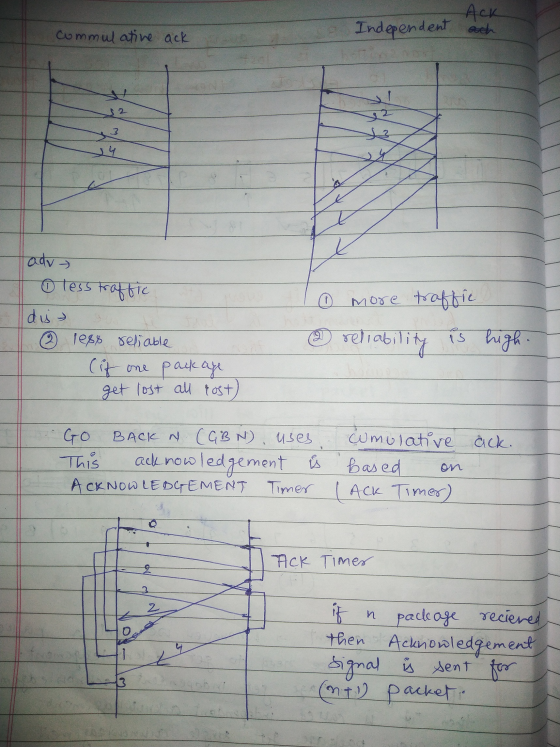
IN GOBACK -N we consider the window size of reciever as 1. Due to this suppose we sent packets 0,1,2,3,4,5 and 0,1 is recieved but 2 is lost. Now if 2 is lost and since the window size of reciever is 1 it will discard packets 3,4,5 because it need packet 2 first. So due to this on sender side we have only one time out timer for oldest packet whose acknowledgement has not yet recieved. Because if time out timer of packet is 2 exceeds and no ack came then sender will send 2 along with 3 ,4 and 5 thinking that reciever might have discarded these packets .
Add Answer to:
In Go-Back-N protocol, only one timeout timer (for the oldest
unACKed packet) is maintained at the...
1. After transmiting a batch of packets, when a timer expires (timeout event happens), a TCP...
 1. After transmiting a batch of packets, when a timer expires (timeout event happens), a TCP sender retransmits Optional Answers: 1. all packets for which It had not yet received an acknowlegement 2. a single packet: the oldest unacked packet 3. the acknowledgement it has just received 4. The last packet that it had transmitted 2. With TCP's cumulative acknowledgements, the loss of a packet carrying ACK# N can be "mitigated" by a higher order ACK being received. No retransmissions...
Consider a Go-Back-N protocol with a sender window size of 5 and a sequence number range...
Consider a Go-Back-N protocol with a sender window size of 5 and a sequence number range of 1,024, and assume the receiver sends ACKs with the number of the next sequence number expected. Suppose that at time t, the next in-order packet that the receiver is expecting is a packet with the sequence number 8. Assume that the channel does not reorder packets. (a) What are the possible sets of sequence numbers inside the sender’s window at time t? Justify...
Consider a simplified actual TCP senderreceiver, described as follows: .Upon a loss (timeout or t...
 Consider a simplified actual TCP senderreceiver, described as follows: .Upon a loss (timeout or triple-duplicate ACKs), the sender o transmits the oldest unACKed packet (whose sequence number Base) o restarts the timer Upon receiving an ACK with a Sequence #y > Base. o it considers all packets with sequence numbers s y as ACKed (cumulative ACK) o Sets Base to the sequence number of the packet immediately after the packet whose sequence number is y o Restarts the timer ....
For the Go-Back-N pipelined protocol, how many out of sequence packets will the receiver buffer?
For the Go-Back-N pipelined protocol, how many out of sequence packets will the receiver buffer?
For the Go-Back-N pipelined protocol, how many out of 10 sequence packets will the receiver buffer?
For the Go-Back-N pipelined protocol, how many out of 10 sequence packets will the receiver buffer?
(a) In a sliding window protocol with RWS=SWS=5, a very large set of possible sequence numbers...
(a) In a sliding window protocol with RWS=SWS=5, a very large set of possible sequence numbers (assume no wrapping), and in-order packet arrivals, why can the receiver be assured -3- that it will never again receive the frame with sequence number 10 if it is currently expecting frame 17? (b) For the sliding window protocol, if the sender’s window size (SWS) equals the receiver’s window size (RWS), what is the minimum number of sequence numbers that are required? How many...
(a) A data link with a 1 Gigabits/sec capacity is used to transmit packets made up of 1400 bytes of data and 100 bytes of protocol control information. Each packet is acknowledged by a short frame of...
 (a) A data link with a 1 Gigabits/sec capacity is used to transmit packets made up of 1400 bytes of data and 100 bytes of protocol control information. Each packet is acknowledged by a short frame of size 150 bytes. The propagation speed in the transmission medium is 200,000 km/sec. Consider the buffering and processing time in the nodes to be negligible. A node A communicates with a node B, with a distance between nodes A and B of 16...
emember that although only one question will show on each page, you can go back to...
 emember that although only one question will show on each page, you can go back to previous quest Question 20 1 pts Define FEV1 and explain how it is useful for differentiating between obstructive pulmonary disease and restrictive pulmonary disease. Do this in 4 sentences or fewer. HTML Editor BIU AA- IEE 31 *, EE - Bop 22 V D 12pt - Paragraph . W E R T Y U o po s D E G H J K L
What are the layers of the TCP/IP protocol stack, the function, protocols and PDU of each...
What are the layers of the TCP/IP protocol stack, the function, protocols and PDU of each layer What is the difference of throughput and bandwidth? Calculate throughput, transmission, propagation and queuing and error checking delays. Calculate RTT’s and total delays What are three types of transmissions? Which services would use TCP? UDP? Explain how cookies and the website backend database work, Identify parts of a http send/response messages Explain the differences between TCP and UDP. What is the difference between...
which of the following statements is not true for local DNS servers? Option: A local DNS...
which of the following statements is not true for local DNS servers? Option: A local DNS server acts like a proxy. IPS often provide default name servers. A local DNS server provides authorization hostname to IP address mappings. A local DNS servers has a local cache to speed up. Which of the following is unlikely to be one of the transport layers services? Option: Segmenting Reliable data transfer congestion control host-to-host communication What is the data unit exchanged in the...
 1. After transmiting a batch of packets, when a timer expires (timeout event happens), a TCP sender retransmits Optional Answers: 1. all packets for which It had not yet received an acknowlegement 2. a single packet: the oldest unacked packet 3. the acknowledgement it has just received 4. The last packet that it had transmitted 2. With TCP's cumulative acknowledgements, the loss of a packet carrying ACK# N can be "mitigated" by a higher order ACK being received. No retransmissions...
 Consider a simplified actual TCP senderreceiver, described as follows: .Upon a loss (timeout or triple-duplicate ACKs), the sender o transmits the oldest unACKed packet (whose sequence number Base) o restarts the timer Upon receiving an ACK with a Sequence #y > Base. o it considers all packets with sequence numbers s y as ACKed (cumulative ACK) o Sets Base to the sequence number of the packet immediately after the packet whose sequence number is y o Restarts the timer ....
 (a) A data link with a 1 Gigabits/sec capacity is used to transmit packets made up of 1400 bytes of data and 100 bytes of protocol control information. Each packet is acknowledged by a short frame of size 150 bytes. The propagation speed in the transmission medium is 200,000 km/sec. Consider the buffering and processing time in the nodes to be negligible. A node A communicates with a node B, with a distance between nodes A and B of 16...
 emember that although only one question will show on each page, you can go back to previous quest Question 20 1 pts Define FEV1 and explain how it is useful for differentiating between obstructive pulmonary disease and restrictive pulmonary disease. Do this in 4 sentences or fewer. HTML Editor BIU AA- IEE 31 *, EE - Bop 22 V D 12pt - Paragraph . W E R T Y U o po s D E G H J K L
Most questions answered within 3 hours.
-
Where is the error in this code sequence?
String s1 = "Hello";
String s2 = "ello";...
asked 10 months ago -
Financial data for Joel de Paris, Inc., for last year
follow:
Joel de Paris, Inc.
Balance...
asked 10 months ago -
Consider this reaction:
Al2(SO4)3 (aq)+ BaCl3
(aq) Al2Cl6 (aq)- +
3BaSO4(s) . What is the...
asked 10 months ago -
Suppose that Savneet is considering increasing her
recent random sample from 20 car rentals to 40...
asked 10 months ago -
Trucks arrive at an unloading terminal at an average rate of 120
per hour.
Trucks arrive...
asked 10 months ago -
Why are methanol and ethanol completely soluble in water while
octanol is not very little soluble....
asked 10 months ago -
A facilities manager at a university reads in a research report
that the mean amount of...
asked 10 months ago -
When the CuSO4 is rehydrated by adding water to the anhydrous
compound, is this an endothermic...
asked 10 months ago -
A ray of sunlight is passing from diamond into crown glass; the
angle of incidence is...
asked 10 months ago -
A block of mass 0.249 kg is placed on top of a light, vertical
spring of...
asked 10 months ago -
how do the kidneys compensate in the presences of acidosis
a) trigger hyperventilate
b) reserve acid...
asked 10 months ago -
Question 501 pts
The rental rate of capital to the firm increases. Which of the
following...
asked 10 months ago