Ceteris paribus, when ticket prices fall: Total revenue product increases. Marginal revenue product decreases. Marginal revenue...
Ceteris paribus, when ticket prices fall:
Total revenue product increases.
Marginal revenue product decreases.
Marginal revenue product increases.
Marginal revenue product is unaffected.
Homework Answers
When there is a fall in the prices, the marginal revenue of the firm also reduces with each additional unit because though the total revenue is increasing as a resukr of price decrease, it is increasing at a decreasing rate. This rate of increase is captured through MR, which as a result decreases with a decrease in prices. Thus, option b. Marginal reveune product decreases is correct.
Add Answer to:
Ceteris paribus, when ticket prices fall:
Total revenue product increases.
Marginal revenue product decreases.
Marginal revenue...
Question 2 Ceteris paribus, when the supply of beef decreases, beef prices will rise by a...
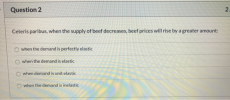 Question 2 Ceteris paribus, when the supply of beef decreases, beef prices will rise by a greater amount: when the demand is perfectly elastic when the demand is elastic when demand is unit elastic when the demand is inelastic
Given a marginal propensity to consume = .8 (Ceteris paribus) and the government increases the level...
Given a marginal propensity to consume = .8 (Ceteris paribus) and the government increases the level of transfer payments by $100, we should expect that the GDP will increase by $400. $80. $100. $500.
which of the following is true (ceteris paribus)? a. increases in the strike price lead to...
which of the following is true (ceteris paribus)? a. increases in the strike price lead to increases in call value b. decreases in interest rates lead to decreases in put value c. increases in stock price to increases in put value d.none of the above are true
If the demand for a monopolist's product increases, its A. marginal revenue decreases, making it more...
If the demand for a monopolist's product increases, its A. marginal revenue decreases, making it more profitable to hire more workers. B. marginal revenue increases, making it more profitable to hire fewer workers. C. marginal revenue increases, making it more profitable to hire more workers. D. marginal revenue decreases, making it more profitable to hire fewer workers.
50. Ceteris paribus, the total demand for money curve will increase (shift rightward): A. if interest...
 50. Ceteris paribus, the total demand for money curve will increase (shift rightward): A. if interest rates increase. B. if nominal GDP decreases. C. if the price level decreases. D. if nominal GDP increases. 51. Ceteris paribus, the total demand for money curve will decrease (shift leftward): A. if interest rates increase. B. if nominal GDP decreases. C. if the price level increases. D. if nominal GDP increases. 52. Which of the following is correct? A. The asset (speculative) demand...
Given the economy's marginal propensity to consume = .8 (Ceteris paribus) by how much will national...
Given the economy's marginal propensity to consume = .8 (Ceteris paribus) by how much will national income increase when the government raises the level of transfer payments by $100? $100. $500. $80. $400.
QUESTION 1 Total revenue decreases as output increases whenever: a. marginal revenue is negative O b.marginal...
 QUESTION 1 Total revenue decreases as output increases whenever: a. marginal revenue is negative O b.marginal revenue is less than average revenue c. average revenue is decreasing O d.marginal revenue is greater than average revenue Oe. average revenue is negative
8. In one year, a company increases its production by $20 million and increases sales by $18 million. Ceteris Paribus, w...
8. In one year, a company increases its production by $20 million and increases sales by $18 million. Ceteris Paribus, which of the following is true? A) GDP increases by $ 18 million and inventory investment decreases by $2 million B) GDP increases by $20 million and inventory investment increases by $2 million C) GDP increases by $18 million and inventory investment equals $0 D) GDP increases by $18 million and inventory investment increases by $2 million
1). Given a marginal propensity to consume = .8 (Ceteris paribus) and the government increases the...
1). Given a marginal propensity to consume = .8 (Ceteris paribus) and the government increases the level of transfer payments by $100, we should expect that the GDP will increase by a. $500. b. $80. c. $100. d. $400. 2). Suppose that actual GDP (Y) for France is 100 euros and: Consumption = 10 + .5Y Investment Spending = 5 Government Expenditure = 20 The Marginal Tax Rate (t) = .20 At these current levels, the size of the budget...
Question 49 2 pts Given a marginal propensity consume = 8 (Ceteris paribus) and the government...
 Question 49 2 pts Given a marginal propensity consume = 8 (Ceteris paribus) and the government increases the level of transfer payments by $100, we should expect that the GDP will increase by $400. O $100. O $80. O $500. Question 50 2 pts Given the following data for an economy, the value of the marginal propensity to invest is equal to: Consumption = 50+.75Y Investment = 20+.10Y Government = 60 Taxes = .20Y
 Question 2 Ceteris paribus, when the supply of beef decreases, beef prices will rise by a greater amount: when the demand is perfectly elastic when the demand is elastic when demand is unit elastic when the demand is inelastic
 50. Ceteris paribus, the total demand for money curve will increase (shift rightward): A. if interest rates increase. B. if nominal GDP decreases. C. if the price level decreases. D. if nominal GDP increases. 51. Ceteris paribus, the total demand for money curve will decrease (shift leftward): A. if interest rates increase. B. if nominal GDP decreases. C. if the price level increases. D. if nominal GDP increases. 52. Which of the following is correct? A. The asset (speculative) demand...
 QUESTION 1 Total revenue decreases as output increases whenever: a. marginal revenue is negative O b.marginal revenue is less than average revenue c. average revenue is decreasing O d.marginal revenue is greater than average revenue Oe. average revenue is negative
 Question 49 2 pts Given a marginal propensity consume = 8 (Ceteris paribus) and the government increases the level of transfer payments by $100, we should expect that the GDP will increase by $400. O $100. O $80. O $500. Question 50 2 pts Given the following data for an economy, the value of the marginal propensity to invest is equal to: Consumption = 50+.75Y Investment = 20+.10Y Government = 60 Taxes = .20Y
Most questions answered within 3 hours.
-
Where is the error in this code sequence?
String s1 = "Hello";
String s2 = "ello";...
asked 10 months ago -
Financial data for Joel de Paris, Inc., for last year
follow:
Joel de Paris, Inc.
Balance...
asked 10 months ago -
Consider this reaction:
Al2(SO4)3 (aq)+ BaCl3
(aq) Al2Cl6 (aq)- +
3BaSO4(s) . What is the...
asked 10 months ago -
Suppose that Savneet is considering increasing her
recent random sample from 20 car rentals to 40...
asked 10 months ago -
Trucks arrive at an unloading terminal at an average rate of 120
per hour.
Trucks arrive...
asked 10 months ago -
Why are methanol and ethanol completely soluble in water while
octanol is not very little soluble....
asked 10 months ago -
A facilities manager at a university reads in a research report
that the mean amount of...
asked 10 months ago -
When the CuSO4 is rehydrated by adding water to the anhydrous
compound, is this an endothermic...
asked 10 months ago -
A ray of sunlight is passing from diamond into crown glass; the
angle of incidence is...
asked 10 months ago -
A block of mass 0.249 kg is placed on top of a light, vertical
spring of...
asked 10 months ago -
how do the kidneys compensate in the presences of acidosis
a) trigger hyperventilate
b) reserve acid...
asked 10 months ago -
Question 501 pts
The rental rate of capital to the firm increases. Which of the
following...
asked 10 months ago