Does changes in either concentration or path length result in significant changes in the extinction coefficient....
Homework Answers

Add Answer to:
Does changes in either concentration or path length result in
significant changes in the extinction coefficient....
Provided that the extinction coefficient for a compound and path length were known, could an absorbance...
 Provided that the extinction coefficient for a compound and path length were known, could an absorbance measurement be used to determine concentration? Explain your reasoning.
Assuming a path length of 1-cm and a dsDNA extinction coefficient of 0.020 mL·µg-1·cm-1, what is...
Assuming a path length of 1-cm and a dsDNA extinction coefficient of 0.020 mL·µg-1·cm-1, what is the concentration of dsDNA (in nanograms) if A260 was measured to be 0.041?
A solution contains 0.00750M of a first compound with an extinction coefficient of 22.4cm−1M−1. A second...
 A solution contains 0.00750M of
a first compound with an extinction coefficient of 22.4cm−1M−1. A
second compound is added to the solution at a concentration of
0.0260M. The absorbance of the resulting solution is 0.324 with a
path length of 1.00cm. What is the extinction coefficient for the
second compound in the solution? Round the answer to three
significant figures. Give the answer to three significant
figures.
A solution contains 0.00750 M of a first compound with an extinction coefficient...
A solution contains 0.00750M of
a first compound with an extinction coefficient of 22.4cm−1M−1. A
second compound is added to the solution at a concentration of
0.0260M. The absorbance of the resulting solution is 0.324 with a
path length of 1.00cm. What is the extinction coefficient for the
second compound in the solution? Round the answer to three
significant figures. Give the answer to three significant
figures.
A solution contains 0.00750 M of a first compound with an extinction coefficient...
A solution contains 0.032M of a first compound. The absorbance through a path length of 1.00cm...
A solution contains 0.032M of a first compound. The absorbance through a path length of 1.00cm is 0.768. A second compound with an extinction coefficient of 15.2cm−1M−1 is added to the solution, and the absorbance increases to 0.940. What is the concentration of the second compound in the solution? Give the answer to three significant figures.
is there anyway to calculate the absorbance from beer-lambert law? Extinction coefficient = 82 mm-1 concentration...
is there anyway to calculate the absorbance from beer-lambert law? Extinction coefficient = 82 mm-1 concentration = 3.2 mw = 17 dA
QUESTION 8 Calculate the extinction coefficient in (mg/mL) cm from the following data. It is suggested...
 QUESTION 8 Calculate the extinction coefficient in (mg/mL) cm from the following data. It is suggested that you use Excel to do this. Give your answer in 3 significant figures. Assume the path length is 1 cm. (You may want to look at the write-up for LAB 19 -1 c (mg/mL) Abs (e 500 nm) 0.001 0.245 0.002 0.490 0.003 0.735 0.004 0.980 0.005 1.100 0.006 1.200 0.007 1.250
1. For the peptide, endothelin-3 calculate its molar extinction coefficient at 280nm (in an aqueous solution)....
1. For the peptide, endothelin-3 calculate its molar extinction coefficient at 280nm (in an aqueous solution). Endothelin-3 Cys Thr Cys Phe Thr Tyr Lys Asp Lys Glu Cys Val Tyr Tyr Cys His Leu Asp Ile Ile Trp path length is 1cm (Disulfide bridge: 1-15; 3-11) What is peptide concentration, if the solution has an Abs280nm =0.275?
100. The following equation: A = 8xlx C (where lis path length and C is concentration)...
 100. The following equation: A = 8xlx C (where lis path length and C is concentration) is known as the law. _-Lambert
Which of the following can result in deviations from Beer's law when the path length is...
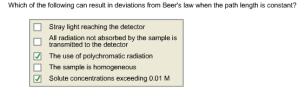 Which of the following can result in deviations from Beer's law when the path length is constant? Stray light reaching the detector Allradiationnotabsorbedby the sample is transmitted to the detector The use of polychromatic radiation The sample is homogeneous Solute concentrations exceeding 0.01 M
Please answer both 1. Often when handling proteins, we use concentration in terms of mg/ml. A...
Please answer both 1. Often when handling proteins, we use concentration in terms of mg/ml. A high concentration is greater than 1 mg/ml and low concentrations are below 0.1 mg/ml (roughly). If you obtained a sample of MDH that was 10 micromoles/L, what is the concentration in mg/ml? Assume that the molecular weight for MDH is 32 kDa. 2. Using Beer's Law, determine the concentration of your sample if the UV-vis reading at 280 nm was 1.2 absorbance units and...
 Provided that the extinction coefficient for a compound and path length were known, could an absorbance measurement be used to determine concentration? Explain your reasoning.
 A solution contains 0.00750M of
a first compound with an extinction coefficient of 22.4cm−1M−1. A
second compound is added to the solution at a concentration of
0.0260M. The absorbance of the resulting solution is 0.324 with a
path length of 1.00cm. What is the extinction coefficient for the
second compound in the solution? Round the answer to three
significant figures. Give the answer to three significant
figures.
A solution contains 0.00750 M of a first compound with an extinction coefficient...
A solution contains 0.00750M of
a first compound with an extinction coefficient of 22.4cm−1M−1. A
second compound is added to the solution at a concentration of
0.0260M. The absorbance of the resulting solution is 0.324 with a
path length of 1.00cm. What is the extinction coefficient for the
second compound in the solution? Round the answer to three
significant figures. Give the answer to three significant
figures.
A solution contains 0.00750 M of a first compound with an extinction coefficient...
 QUESTION 8 Calculate the extinction coefficient in (mg/mL) cm from the following data. It is suggested that you use Excel to do this. Give your answer in 3 significant figures. Assume the path length is 1 cm. (You may want to look at the write-up for LAB 19 -1 c (mg/mL) Abs (e 500 nm) 0.001 0.245 0.002 0.490 0.003 0.735 0.004 0.980 0.005 1.100 0.006 1.200 0.007 1.250
 100. The following equation: A = 8xlx C (where lis path length and C is concentration) is known as the law. _-Lambert
 Which of the following can result in deviations from Beer's law when the path length is constant? Stray light reaching the detector Allradiationnotabsorbedby the sample is transmitted to the detector The use of polychromatic radiation The sample is homogeneous Solute concentrations exceeding 0.01 M
Most questions answered within 3 hours.
-
Where is the error in this code sequence?
String s1 = "Hello";
String s2 = "ello";...
asked 10 months ago -
Financial data for Joel de Paris, Inc., for last year
follow:
Joel de Paris, Inc.
Balance...
asked 10 months ago -
Consider this reaction:
Al2(SO4)3 (aq)+ BaCl3
(aq) Al2Cl6 (aq)- +
3BaSO4(s) . What is the...
asked 10 months ago -
Suppose that Savneet is considering increasing her
recent random sample from 20 car rentals to 40...
asked 10 months ago -
Trucks arrive at an unloading terminal at an average rate of 120
per hour.
Trucks arrive...
asked 10 months ago -
Why are methanol and ethanol completely soluble in water while
octanol is not very little soluble....
asked 10 months ago -
A facilities manager at a university reads in a research report
that the mean amount of...
asked 10 months ago -
When the CuSO4 is rehydrated by adding water to the anhydrous
compound, is this an endothermic...
asked 10 months ago -
A ray of sunlight is passing from diamond into crown glass; the
angle of incidence is...
asked 10 months ago -
A block of mass 0.249 kg is placed on top of a light, vertical
spring of...
asked 10 months ago -
how do the kidneys compensate in the presences of acidosis
a) trigger hyperventilate
b) reserve acid...
asked 10 months ago -
Question 501 pts
The rental rate of capital to the firm increases. Which of the
following...
asked 10 months ago