In a behavior experiment you stimulate the antenna of a crayfish with water of a pH...
Homework Answers

Add Answer to:
In
a behavior experiment you stimulate the antenna of a crayfish with
water of a pH...
In a behavioral experiment, you want to inject a 60 g crayfish with a drug and...
In a behavioral experiment, you want to inject a 60 g crayfish with a drug and reach a drug concentration of 10-5 M in the hemolymph. The maximal volume to inject into a crayfish is 1 mL. How do you do this? How much of which concentration of the drug (in mM) do you inject? Please show work!
For a behavior experiment, you want to test the effect of injected GABA. How much of...
For a behavior experiment, you want to test the effect of injected GABA. How much of a 2x10⁻⁴ M GABA solution do you have to inject into a 60 g crayfish to reach a concentration of 10-5 M in the hemolymph of the crayfish?
An experiment concerning a tracking antenna needs two (2) motors and two (2) switches. The supply...
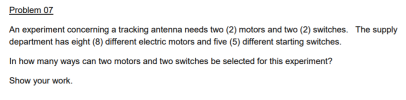 An experiment concerning a tracking antenna needs two (2) motors and two (2) switches. The supply department has eight (8) different electric motors and five (5) different starting switches In how many ways can two motors and two switches be selected for this experiment? Show your work.
please help with both thank you When sodium acetate dissolves in water the resulting pH is...
 please help with both thank
you
When sodium acetate dissolves in water the resulting pH is above 7. This is because Sodium ion reacts with water to produce hydroxide ions. O Sodium ion is the cation of a strong base and acetate is the anion of a weak acid. Acetate ion reacts with hydroxide ions to produce excess protons. none of these answers Knowing the pH of a solution will allow one to know the pOH as well. O True...
please help with both thank
you
When sodium acetate dissolves in water the resulting pH is above 7. This is because Sodium ion reacts with water to produce hydroxide ions. O Sodium ion is the cation of a strong base and acetate is the anion of a weak acid. Acetate ion reacts with hydroxide ions to produce excess protons. none of these answers Knowing the pH of a solution will allow one to know the pOH as well. O True...
Bonus Question (Extra Credit) - You have a 50.0 mL of pure water at pH =...
 Bonus Question (Extra Credit) - You have a 50.0 mL of pure water at pH = 7. Considering the equilibrium of water at 25°C, how many individual H,O* (by count) are in solution? The density of water is 0.998 g/ml.
In today’s lab, you will design an experiment to differentiate between the stimuli that trigger the...
In today’s lab, you will design an experiment to differentiate between the stimuli that trigger the physiological responses comprising the MDR. You will examine how cold, apnea, and cold + apnea stimuli influence the MDR and blood oxygen levels, as compared to baseline, and describe the magnitude of the evoked response. In order to study the effect of one stimulus (cold or apnea), you must control for (or eliminate) the other stimuli during testing. Remember, in this lab we will...
In this experiment you will be measuring pH for several different solutions. A pH probe will...
 In this experiment you will be measuring pH for several
different solutions. A pH probe will be used rather than pH paper
as it will be more accurate.
You will be testing the pH of six solutions: deionized water,
0.1 M HCl, 0.1 M HCH3COO, 0.1 M NaCH3COO, 0.1
M NaOH, and a buffer made by mixing equal parts of
HCH3COO and NaCH3COO.
You will measure the pH of each solution three times:
Neat - just the solution
After the...
In this experiment you will be measuring pH for several
different solutions. A pH probe will be used rather than pH paper
as it will be more accurate.
You will be testing the pH of six solutions: deionized water,
0.1 M HCl, 0.1 M HCH3COO, 0.1 M NaCH3COO, 0.1
M NaOH, and a buffer made by mixing equal parts of
HCH3COO and NaCH3COO.
You will measure the pH of each solution three times:
Neat - just the solution
After the...
Show your work! 1. At pH 9.0, what is the concentration of OH- in solution? ___________...
Show your work! 1. At pH 9.0, what is the concentration of OH- in solution? ___________ 2. If the monoprotic acid HAb has a pK of 4 and a solution is adjusted to pH 9: a) what is the concentration of hydrogen ions in that solution? ____________ b) what is the ratio of Ab- to HAb? ________________ PLEASE HELP! Also, show how you got the answers.
I did an experiment and these are the results of the pH for these temperatures. I used 2mL of 1.0...
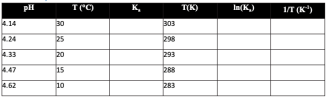 I did an experiment and these are the results of the pH for
these temperatures. I used 2mL of 1.0 M NaOH and 15mL of acetic
acid (5% Distilled White Vinegar). Could you please explain and
show me how to do the calculations for the rest of the table? Thank
you!
pH T (°C) T(K) In(K,) 1/T (K1) 4.14 4.24 4.33 4.47 4.62 303 298 293 288 283 30 20 3 10
pH T (°C) T(K) In(K,) 1/T (K1) 4.14...
I did an experiment and these are the results of the pH for
these temperatures. I used 2mL of 1.0 M NaOH and 15mL of acetic
acid (5% Distilled White Vinegar). Could you please explain and
show me how to do the calculations for the rest of the table? Thank
you!
pH T (°C) T(K) In(K,) 1/T (K1) 4.14 4.24 4.33 4.47 4.62 303 298 293 288 283 30 20 3 10
pH T (°C) T(K) In(K,) 1/T (K1) 4.14...
Titration: Acids and Bases 2. How can you determine which acid is diprotic? 3. using the...
 Titration: Acids and Bases
2. How can you determine which acid is diprotic?
3. using the answers to questions one and two, which acid is
diprotic?
4. Which base has more hydroxide ions per molecule?
Acid Volume Base Base Initial Volume (mL) Base Final Volume (mL) Volume of Base Used (mL) Acid: Base Ratio Acid 1 20 mL Base 1 50 mL 34.5 15.5 4:3 Acid 2 20 mL Base 1 Acid 1 20 mL Base 2 Acid 2 20...
Titration: Acids and Bases
2. How can you determine which acid is diprotic?
3. using the answers to questions one and two, which acid is
diprotic?
4. Which base has more hydroxide ions per molecule?
Acid Volume Base Base Initial Volume (mL) Base Final Volume (mL) Volume of Base Used (mL) Acid: Base Ratio Acid 1 20 mL Base 1 50 mL 34.5 15.5 4:3 Acid 2 20 mL Base 1 Acid 1 20 mL Base 2 Acid 2 20...
 An experiment concerning a tracking antenna needs two (2) motors and two (2) switches. The supply department has eight (8) different electric motors and five (5) different starting switches In how many ways can two motors and two switches be selected for this experiment? Show your work.
 please help with both thank
you
When sodium acetate dissolves in water the resulting pH is above 7. This is because Sodium ion reacts with water to produce hydroxide ions. O Sodium ion is the cation of a strong base and acetate is the anion of a weak acid. Acetate ion reacts with hydroxide ions to produce excess protons. none of these answers Knowing the pH of a solution will allow one to know the pOH as well. O True...
please help with both thank
you
When sodium acetate dissolves in water the resulting pH is above 7. This is because Sodium ion reacts with water to produce hydroxide ions. O Sodium ion is the cation of a strong base and acetate is the anion of a weak acid. Acetate ion reacts with hydroxide ions to produce excess protons. none of these answers Knowing the pH of a solution will allow one to know the pOH as well. O True...
 Bonus Question (Extra Credit) - You have a 50.0 mL of pure water at pH = 7. Considering the equilibrium of water at 25°C, how many individual H,O* (by count) are in solution? The density of water is 0.998 g/ml.
 In this experiment you will be measuring pH for several
different solutions. A pH probe will be used rather than pH paper
as it will be more accurate.
You will be testing the pH of six solutions: deionized water,
0.1 M HCl, 0.1 M HCH3COO, 0.1 M NaCH3COO, 0.1
M NaOH, and a buffer made by mixing equal parts of
HCH3COO and NaCH3COO.
You will measure the pH of each solution three times:
Neat - just the solution
After the...
In this experiment you will be measuring pH for several
different solutions. A pH probe will be used rather than pH paper
as it will be more accurate.
You will be testing the pH of six solutions: deionized water,
0.1 M HCl, 0.1 M HCH3COO, 0.1 M NaCH3COO, 0.1
M NaOH, and a buffer made by mixing equal parts of
HCH3COO and NaCH3COO.
You will measure the pH of each solution three times:
Neat - just the solution
After the...
 I did an experiment and these are the results of the pH for
these temperatures. I used 2mL of 1.0 M NaOH and 15mL of acetic
acid (5% Distilled White Vinegar). Could you please explain and
show me how to do the calculations for the rest of the table? Thank
you!
pH T (°C) T(K) In(K,) 1/T (K1) 4.14 4.24 4.33 4.47 4.62 303 298 293 288 283 30 20 3 10
pH T (°C) T(K) In(K,) 1/T (K1) 4.14...
I did an experiment and these are the results of the pH for
these temperatures. I used 2mL of 1.0 M NaOH and 15mL of acetic
acid (5% Distilled White Vinegar). Could you please explain and
show me how to do the calculations for the rest of the table? Thank
you!
pH T (°C) T(K) In(K,) 1/T (K1) 4.14 4.24 4.33 4.47 4.62 303 298 293 288 283 30 20 3 10
pH T (°C) T(K) In(K,) 1/T (K1) 4.14...
 Titration: Acids and Bases
2. How can you determine which acid is diprotic?
3. using the answers to questions one and two, which acid is
diprotic?
4. Which base has more hydroxide ions per molecule?
Acid Volume Base Base Initial Volume (mL) Base Final Volume (mL) Volume of Base Used (mL) Acid: Base Ratio Acid 1 20 mL Base 1 50 mL 34.5 15.5 4:3 Acid 2 20 mL Base 1 Acid 1 20 mL Base 2 Acid 2 20...
Titration: Acids and Bases
2. How can you determine which acid is diprotic?
3. using the answers to questions one and two, which acid is
diprotic?
4. Which base has more hydroxide ions per molecule?
Acid Volume Base Base Initial Volume (mL) Base Final Volume (mL) Volume of Base Used (mL) Acid: Base Ratio Acid 1 20 mL Base 1 50 mL 34.5 15.5 4:3 Acid 2 20 mL Base 1 Acid 1 20 mL Base 2 Acid 2 20...
Most questions answered within 3 hours.
-
Where is the error in this code sequence?
String s1 = "Hello";
String s2 = "ello";...
asked 10 months ago -
Financial data for Joel de Paris, Inc., for last year
follow:
Joel de Paris, Inc.
Balance...
asked 10 months ago -
Consider this reaction:
Al2(SO4)3 (aq)+ BaCl3
(aq) Al2Cl6 (aq)- +
3BaSO4(s) . What is the...
asked 10 months ago -
Suppose that Savneet is considering increasing her
recent random sample from 20 car rentals to 40...
asked 10 months ago -
Trucks arrive at an unloading terminal at an average rate of 120
per hour.
Trucks arrive...
asked 10 months ago -
Why are methanol and ethanol completely soluble in water while
octanol is not very little soluble....
asked 10 months ago -
A facilities manager at a university reads in a research report
that the mean amount of...
asked 10 months ago -
When the CuSO4 is rehydrated by adding water to the anhydrous
compound, is this an endothermic...
asked 10 months ago -
A ray of sunlight is passing from diamond into crown glass; the
angle of incidence is...
asked 10 months ago -
A block of mass 0.249 kg is placed on top of a light, vertical
spring of...
asked 10 months ago -
how do the kidneys compensate in the presences of acidosis
a) trigger hyperventilate
b) reserve acid...
asked 10 months ago -
Question 501 pts
The rental rate of capital to the firm increases. Which of the
following...
asked 10 months ago